Table of Contents >> Show >> Hide
- Reality check: “black belts” and “beat up cops” don’t match the history
- The real story: the “Suffrajitsu” moment and the women who trained
- So… did women’s rights activists actually fight the police?
- How American women’s rights history connects to the self-defense story
- Why the press loved the “jujitsu suffragette” trope
- What this history teaches us about protest, safety, and power
- Experiences: what it feels like to train for safety in a world that doubts you (about )
- Conclusion
That headline sounds like a modern clickbait fever dreamexcept the “clickbait” part existed a full century before anyone could click anything.
Here’s the real story behind the sensational claim: in the early 1900s, some women’s rights activists did train in martial artsespecially jujutsu and later judobecause public protest came with very real physical risk. But “blackbelts to beat up cops” is an exaggerated, historically messy summary that skips context, compresses timelines, and turns self-defense into a punchline.
This article breaks down what actually happened, why it happened, and what it teaches us about the relationship between women’s rights, public protest, and the politics of physical safetywithout glorifying violence or turning history into a how-to manual.
Reality check: “black belts” and “beat up cops” don’t match the history
1) The training was realbut the belt language is mostly anachronistic
When people say “black belt,” they’re usually thinking of a modern ranking system. Early 20th-century jujutsu instruction in Britain often looked different from today’s belt-based martial arts culture. Some Japanese arts had rank systems, but the public image of “black belt equals certified human tornado” is a later pop-culture shortcut.
2) The goal wasn’t “go fight police,” even if clashes happened
The best-supported interpretation is that training was primarily about protection: resisting rough handling, avoiding assaults from hostile crowds, and shielding leaders from being seized during arrests. That still produced confrontationsbecause when authorities treat political protest like a criminal threat, bodies end up in the middle. But it’s not the same thing as “they trained to beat up cops.”
In other words: the history is more interesting than the headline. It’s less “martial arts revenge arc,” more “women organized for safety in a world that didn’t think their safety mattered.”
The real story: the “Suffrajitsu” moment and the women who trained
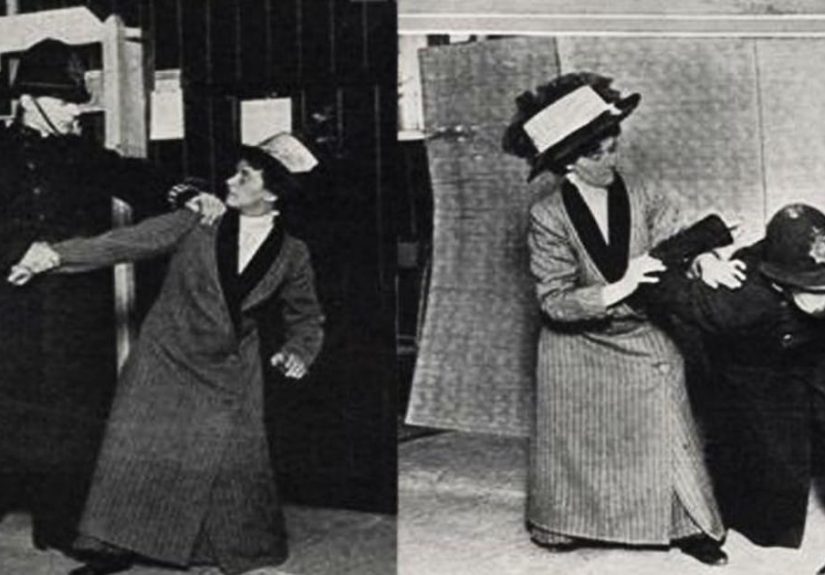
If one chapter keeps resurfacing online, it’s the tale of British suffrage activists connected to the Women’s Social and Political Union (WSPU) and their self-defense training, later nicknamed “Suffrajitsu” (a mash-up of “suffragette” and “jiu-jitsu”).
Edith Garrud: the instructor at the center of the legend
One of the most frequently cited figures is Edith Garrud, a British martial arts instructor who taught women jujutsu at a time when many people still thought women shouldn’t even ride a bicycle too enthusiastically. Garrud’s significance isn’t just that she could teach; it’s that she helped frame physical training as part of women’s autonomystrength as a civic skill, not a scandal.
Public demonstrations and press coverage helped spread the idea that women could learn practical self-defenseespecially by using leverage and technique rather than size. That mattered because the everyday threats weren’t imaginary. Women faced harassment, intimidation, and sometimes physical force for speaking, marching, and refusing to “stay in their place.”
Why a “bodyguard” unit existed at all
Protest movements often produce a grim pattern: the more effective they become, the more energy authorities and opponents invest in disrupting them. In Britain, suffrage leaders were surveilled and targeted for re-arrest. Supporters responded by organizing protectionsometimes described as a women’s bodyguard unit tasked with helping leaders avoid being grabbed and removed from public appearances.
That protection wasn’t just about brawling. It was also about coordination, disciplined movement, and the practical reality that a protester surrounded by police doesn’t need a dramatic movie fightshe needs to keep breathing, keep her dignity, and keep her fellow organizers from being isolated.
What “training” meant (and what it didn’t)
The training most commonly described in historical discussions is not “learn the secret combo to knock out a constable.” It’s closer to: build confidence, improve balance and awareness, and practice getting out of aggressive grabs. It’s the kind of training that helps someone stay calm when adrenaline spikesespecially when public space becomes hostile.
Importantly, even sympathetic historical accounts tend to emphasize that activists weren’t trying to militarize the movement into street combat. They were trying to keep women safe in environments where women were routinely treated as physically vulnerable and politically disposable.
So… did women’s rights activists actually fight the police?
Sometimes, yesclashes happened. That’s part of the story. But the “why” matters more than the “wow.”
The difference between aggression and resistance
When a movement is being repeatedly broken up, people get injured, and leaders are dragged away, resistance becomes a survival tactic. In that context, self-defense training can serve multiple roles:
- Personal safety: reducing the chance of being harmed during arrests or crowd violence.
- Movement continuity: keeping leaders available to speak, organize, and raise funds.
- Symbolic power: proving that women were not fragile ornaments, but full political actors.
That last point is sneaky-important. Political opponents often argued women were too emotional, too delicate, too “unsuited” for public life. Self-defense training didn’t just protect bodies; it challenged the story society told about women’s bodies.
Why the “beat up cops” framing is misleading
The “beat up cops” headline makes it sound like the activists’ central mission was violence. Historically, the central mission was political equalityvotes, rights, representation, and dignity. Training was a response to the conditions around them.
It’s also worth remembering that most successful women’s rights campaigns included a broad spectrum of tactics, from nonviolent persuasion to civil disobedience. Movements aren’t monoliths; they’re coalitions. A sensational headline flattens that complexity into a single mood: “fight.” The real mood was closer to: “We’re not going away.”
How American women’s rights history connects to the self-defense story
The “Suffrajitsu” story is largely British, but the United States has its own deeply documented record of women facing arrest and hostility for demanding the voteespecially in the era of public picketing and mass demonstrations.
Protest, arrests, and the politics of public space
American suffrage activists organized marches, picketed government buildings, and endured arrests for actions that would look, to modern eyes, like textbook peaceful protest. The public nature of these demonstrations mattered: it forced the question of women’s citizenship into the street, where it could not be politely ignored.
And when women were arrested, the message to everyone watching was clear: political participation had a physical price tag. Even without copying the British approach, American organizers understood the same truth: if you want rights in public, you often have to risk your body in public.
America’s early self-defense boom: jiu-jitsu, judo, boxing, and “don’t panic” energy
In the U.S., women’s self-defense training rose alongside broader conversations about women’s independence. Articles and cultural commentary discussed “modern” women learning jiu-jitsu or boxingnot because they were looking for a fight, but because they wanted control over their own safety.
That matters for SEO-history reasons (yes, that’s a thing): the story isn’t just about suffrage organizations. It’s also about ordinary women responding to everyday harassment with skills, confidence, and the radical idea that their bodies were not public property.
Why the press loved the “jujitsu suffragette” trope
Imagine the early 1900s newsroom pitch: “Ladies demanding votes” is already spicy. “Ladies demanding votes while flipping men in demonstration photos” is basically irresistible.
Shock value sellsand gender norms made it extra clickable
Stories about women learning martial arts punched two cultural buttons at once:
- It challenged femininity norms: Women weren’t supposed to be physically assertive.
- It mocked political ambition: The narrative could be framed as “hysterical women playing at war.”
Even when coverage wasn’t openly hostile, it often treated women’s self-defense as novelty. That novelty angle is how you end up with headlines that sound like modern memes: bold, simple, and just inaccurate enough to travel fast.
But the “trope” had an unintended effect: it made women’s strength imaginable
Here’s the twist: even mocking coverage can spread a powerful image. Once people saw women trainingonce they heard about women taking their safety seriously“women are naturally helpless” became harder to sell with a straight face.
What this history teaches us about protest, safety, and power
The deeper lesson isn’t “activists should learn to fight.” The lesson is that movements grow in environments shaped by power, and power often responds with pressure. In those environments, safety becomes political.
1) Self-defense can be about dignity, not dominance
For many women, self-defense training is less about winning fights and more about reclaiming spacewalking without fear, setting boundaries, recognizing danger early, and refusing to shrink.
2) Physical confidence changes how people speak
There’s a practical, psychological shift that happens when someone believes they can protect themselves. They stand differently. They use their voice differently. That shift is hard to quantifybut anyone who’s watched a nervous first-time speaker become a confident organizer understands it immediately.
3) The “violent activist” label is an old political trick
Throughout history, marginalized groups pushing for rights have been portrayed as dangerousespecially when they refuse to be quietly grateful. A sensational label can be used to justify crackdowns, dismiss legitimate demands, or scare the public into “law and order” thinking.
That’s why it’s important to tell this story carefully: acknowledging real conflict without romanticizing it, and honoring the broader struggle for rights that made the conflict possible in the first place.
Experiences: what it feels like to train for safety in a world that doubts you (about )
Ask people why they start self-defense trainingespecially women and girlsand you’ll rarely get an answer that sounds like revenge. The most common stories are quieter: someone was followed on the way home, someone got tired of being grabbed at a party, someone realized they tense up every time a stranger stands too close. The “experience” is often less cinematic than the internet expects. It’s about stress, boundaries, and the exhausting math of risk that many women do automatically.
One of the first things people notice in a good class is that confidence is a skill, not a personality trait. Beginners arrive apologizing for taking up spaceliterally saying “sorry” when they bump a pad, when they raise their hand, when they exist at full volume. Over time, those apologies fade. Not because someone becomes mean, but because they become certain: “My safety is not an inconvenience.” That mindset shift is a small revolution you can carry in your posture.
Another common experience is realizing how much self-defense is actually self-management. Your heart rate spikes, your hands get shaky, and your brain wants to either freeze or overreact. Training (at its best) teaches people to slow down, breathe, and make decisions under pressureskills that help far beyond physical situations. People describe using that calm in job interviews, public speaking, and even family conflicts. It’s not about becoming aggressive. It’s about becoming hard to intimidate.
For activists and organizers, the experience often becomes about community. Safety planning isn’t glamorous, but it’s real: buddy systems, checking in after events, knowing where exits are, having a plan if someone gets separated. When a movement is targetedby hecklers, by harassment, by systems that treat protest as a nuisancepeople learn that courage is easier when it’s shared. You don’t have to be fearless. You just have to be supported.
There’s also a surprising emotional moment many trainees describe: grief. Not the dramatic kindmore like a quiet sadness that they had to learn these skills at all. That feeling can turn into motivation, though. It’s the same energy you see in historic women’s rights movements: “I shouldn’t have to fight for basic dignity, but since I do, I’m going to be prepared.”
And finally, many people who train for safety end up with a clearer sense of ethics. They learn that responsible self-defense is about prevention, escape, and de-escalation whenever possible. They learn the value of restraint. They learn that strength without judgment is just chaosbut strength with judgment is freedom. That’s the most useful way to connect modern experiences to those old “Suffrajitsu” headlines: not by copying conflict, but by understanding why self-protection became part of the fight for equal rights.
Conclusion
The women’s rights activists linked to “Suffrajitsu” weren’t cartoon superheroes training for street fights, and they weren’t a punchline either. Their martial arts trainingreal as it wasmade sense in a time when demanding rights could mean being shoved, grabbed, or arrested. The sensational headline survives because it’s vivid. But the truth survives because it’s meaningful: when society treats women as politically powerless and physically vulnerable, learning to protect yourself becomes a form of protest.
So yes: some activists trained. Some confrontations happened. But the heart of the story isn’t “beat up cops.” It’s “women refused to be powerless”and they backed that refusal with discipline, community, and the radical belief that their bodies belonged to them.