Table of Contents >> Show >> Hide
- Why These Tattoos Are So Fascinating
- How Arm-Extension Tattoos Actually Work
- Popular Design Ideas for Tattoos That Reveal on Extension
- Why These Tattoos Are Harder Than They Look
- Placement Matters More Than Usual
- Before You Get One, Ask Smarter Questions
- The Safety Part That Should Not Be Boring, But Usually Is
- What Makes a Great Reveal Tattoo Last
- Why the Trend Feels Bigger Than a Trend
- Experiences People Often Have With These Tattoos
- Final Thoughts
Some tattoos sit there politely and look nice. Others wait for a dramatic cue, like a theater kid hiding behind the curtain until the spotlight hits. Tattoos that reveal themselves only when you extend your arms belong firmly in the second category. They are clever, dynamic, and just a little show-offy in the best possible way. One moment the design looks abstract, partial, or mysterious. Then you stretch your arms, rotate your elbows, or open your posture, and suddenly the full image appears like it was hiding in plain sight the whole time.
That is the magic of movement-based tattoo design. These pieces are not just drawn on the body. They are designed with the body. The elbow crease, inner arm, forearm curve, and natural tension of the skin all become part of the artwork. In other words, this is not your average “pick a Pinterest photo and hope for the best” tattoo. This is body architecture with ink.
And yes, it is very cool. It is also more technically demanding than it looks.
Why These Tattoos Are So Fascinating
The appeal is easy to understand. Most tattoos are static, but the human body is not. Arms bend, muscles flex, skin stretches, and posture changes the way a design is seen. Reveal tattoos use that motion as part of the concept. Instead of fighting the body’s movement, they lean into it.
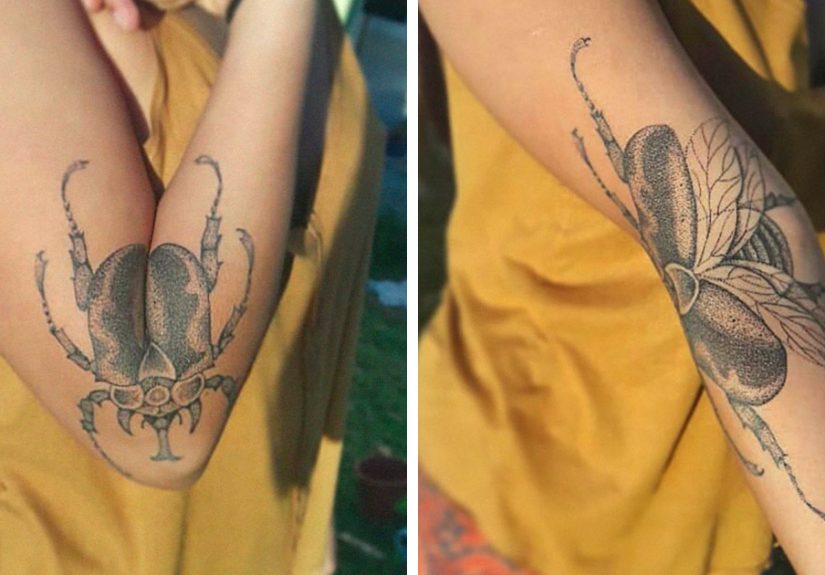
That gives the tattoo two lives. In one position, the piece may look fragmented, hidden, folded, or symbolic. In another, it becomes complete. Some designs appear to open like wings. Others lengthen into a creature, line up into a face, or transform from one visual idea into another. It is part tattoo, part illusion, part engineering project, and part “wait, hold still, I need to see that again.”
That sense of surprise is what makes these tattoos so memorable. They invite interaction. People do not just glance at them; they experience them. The wearer becomes part of the reveal, which makes the tattoo feel less like decoration and more like performance art that lives on skin.
How Arm-Extension Tattoos Actually Work
The body becomes part of the composition
Artists who create strong arm-reveal tattoos think beyond flat paper. They consider the natural flow of the arm, the shape of the forearm muscles, the bend at the elbow, and the way skin compresses and stretches. A tattoo that looks perfect on a stencil can fall apart if it ignores anatomy. A tattoo that respects anatomy can look almost animated.
Folds, negative space, and alignment do the heavy lifting
Many of these tattoos rely on carefully placed negative space, mirrored forms, or image fragments that only connect when the arm opens. The crease of the elbow can hide a detail. The inside of the forearm can act like a secret panel. The outer arm can carry the “visible” version of the art, while the extended pose reveals the full story. It is a bit like origami, except the paper has opinions and occasionally gets goosebumps.
Symmetry helps, but it is not the only trick
Symmetrical motifs often work beautifully because the eye loves balance. Wings, insects, masks, moons, eyes, gates, serpents, and ornamental designs all lend themselves to reveal-based layouts. But asymmetrical designs can work too, especially when the goal is transformation instead of mirror perfection. A bent arm might show one mood, while an extended arm shows another. That makes the tattoo feel cinematic, not merely decorative.
Popular Design Ideas for Tattoos That Reveal on Extension
The most effective concepts tend to be the ones that already suggest motion, unfolding, or dual identity. Here are some of the most naturally suited styles:
Wings and insects
Butterflies, moths, beetles, and birds are almost made for this technique. A folded arm can hide the “closed” version of the image, and an extended arm can create the feeling of flight. It is dramatic, readable, and deeply satisfying when done well.
Eyes, faces, and masks
These designs play especially well with illusion. A partial portrait can seem abstract until the arms are opened or aligned. Then suddenly the face appears. Done right, it feels eerie, artistic, and a little bit like the tattoo is smarter than everyone in the room.
Snakes, tentacles, vines, and flowing lines
Anything organic that can twist, stretch, or travel across the arm is a strong candidate. These tattoos work because they follow the body’s natural curves instead of forcing a rigid image onto a moving surface.
Geometric and ornamental pieces
Geometric tattoos and ornamental blackwork are also strong choices, especially for people who want a reveal effect without a literal image. When the arms extend, lines align, shapes complete themselves, and the overall piece suddenly snaps into visual focus.
Why These Tattoos Are Harder Than They Look
This style is not hard because the idea is unusual. It is hard because the body is unpredictable. Skin is not a flat canvas. It shifts during the appointment. It changes as you sit, stand, flex, and heal. A piece that depends on alignment has less room for error than a standard design on a broad, steady area.
That means the tattoo artist has to think in motion. Placement matters more. Flow matters more. Stencil adjustments matter more. In some cases, freehand design matters a lot more because the artist may need to build the piece directly around the client’s anatomy instead of forcing anatomy to obey the sketch.
It also means not every tattoo artist is the right artist for this job. A great traditional artist is not automatically a great movement-based illusion artist. A talented fine-line artist is not automatically the best person to build a two-position reveal piece. The portfolio matters. If the artist has not shown work that follows body contours, uses symmetry well, or demonstrates thoughtful placement, that is not necessarily a red flag for all tattoos. For this tattoo, though, it should make you pause.
Placement Matters More Than Usual
The arm is a favorite canvas for a reason. It offers visibility, length, and enough natural structure to support storytelling. It is also more manageable than many other body areas for larger designs. But even within the arm, not all zones behave the same way.
Forearm
The forearm is often one of the friendlier places to start, especially for people who want a tattoo that can be shown off or covered more easily. It gives artists a long visual field and usually enough room to create flow without a ton of distortion.
Inner arm and elbow crease
This is where things get interesting and more intense. The inner arm can make a tattoo feel intimate and hidden, which is ideal for reveal-based art. But the area around the inner elbow tends to be more sensitive, less forgiving, and more prone to movement-related distortion. Beautiful? Yes. Casual? Not exactly.
Full bilateral concepts
Some of the most striking reveal tattoos use both arms together, so the full image appears only when the wearer extends, lifts, or aligns them. These are ambitious and incredibly memorable, but they demand serious planning. The body is no longer a canvas. It is a puzzle with joints.
Before You Get One, Ask Smarter Questions
A tattoo like this deserves better than “I found a cool idea online.” Before you book, ask questions that match the complexity of the piece.
Can the artist show healed work?
Fresh tattoos are glamorous. Healed tattoos tell the truth. Because reveal tattoos depend so much on crisp flow and readability, healed examples matter. Fine lines can soften. Tiny alignment choices can read differently over time. Ask to see work after healing, not just on day one when the skin is freshly moisturized and everyone is feeling photogenic.
Will the design be custom for your anatomy?
It should be. The whole point of this style is interaction with your specific body. A copied design might look decent on a screen and awkward on an actual person. A custom design has a much better chance of moving well and aging gracefully.
What about pain and healing?
Be realistic. Areas with thinner skin, more nerve endings, or more movement can be rougher during the session and fussier during healing. Also, because arm-extension tattoos often sit near joints or flexible skin, aftercare discipline matters. Stretching, friction, picking, and sun exposure are not helpful. They are the villains of this story.
The Safety Part That Should Not Be Boring, But Usually Is
Here is the unglamorous truth: a tattoo is still a wound while it heals. No amount of artistic genius changes that. Federal health guidance and dermatology advice have repeatedly emphasized that contaminated inks, poor sterilization, allergic reactions, and skin infections are real risks. So while your future tattoo may look like visual poetry, the shop still needs to behave like a professional environment, not a vibes-only basement operation.
Choose a licensed, reputable artist. Pay attention to sanitation. Ask about aftercare. Wash the tattoo gently as directed. Moisturize appropriately. Avoid soaking it too early. Keep it out of direct sun while it heals. Do not scratch it like you are trying to win an argument with your skin. And if redness, swelling, pain, heat, or drainage worsen instead of improving, get it checked.
This is especially important for detail-heavy tattoos. A reveal tattoo depends on precision, and precision does not love infection, scarring, or neglected healing.
What Makes a Great Reveal Tattoo Last
The best version of this trend is not just clever on day one. It still reads well later. That depends on three big things: design clarity, artist skill, and long-term care.
Clarity matters because overly complicated concepts can lose their magic if the reveal is too subtle or visually muddy. Artist skill matters because placement is everything. Long-term care matters because sun exposure, poor healing habits, and disregard for maintenance can make even a strong design fade faster than it should.
If you want a piece like this to age well, simplicity is not the enemy. A tattoo can be imaginative without becoming overcrowded. In fact, some of the most effective reveal tattoos use just enough detail to create wonder without turning the arm into a Where’s Waldo puzzle.
Why the Trend Feels Bigger Than a Trend
These tattoos tap into something modern and timeless at once. Modern, because people increasingly want body art that feels personal, interactive, and visually smart. Timeless, because tattoos have always been about identity, symbolism, and the relationship between body and story.
An arm-extension tattoo simply makes that relationship more literal. The meaning is not only in the image. It is in the action. The wearer participates in the reveal. The body becomes an active collaborator. That is probably why these tattoos feel so memorable: they do not just sit on the skin. They respond to life.
Experiences People Often Have With These Tattoos
One of the most interesting things about these tattoos is that the experience starts long before the tattoo is finished. People often describe the design consultation as part art meeting, part anatomy lesson, and part “wow, I never realized my elbow had this much personality.” Because the tattoo depends on movement, the artist may ask the client to bend, straighten, rotate, and relax the arm repeatedly. It can feel less like posing for a tattoo and more like auditioning for a very niche dance performance.
During the session itself, the emotional arc is often different from a regular tattoo. With a standard design, people usually know what they are getting and where it goes. With a reveal tattoo, there is often an extra layer of suspense. The wearer sees fragments first. Lines. Shadows. Shapes that do not make total sense yet. Then, at some point, the artist asks them to extend the arm, and the image clicks together. That moment can be surprisingly emotional. People laugh, stare, go quiet, or immediately say, “Okay, that is sick.” Not exactly poetic, but deeply sincere.
Afterward, daily life changes the way the tattoo is perceived. In a mirror, it may look different from how it looks in a photo. In a relaxed posture, it might seem subtle or mysterious. Mid-gesture, it comes alive. That gives the tattoo a social life that many static designs do not have. Friends ask to see “the trick.” Strangers do a double take. Someone at a coffee shop inevitably says, “Wait, move your arm again.” Suddenly your body art has a demo mode.
There is also a more personal side. Many people like that the tattoo is not fully available at a glance. You control when it appears. That can make the piece feel intimate even if it is visible. It is not hidden in the traditional sense, but it is not always fully revealed either. For some wearers, that feels symbolic. They like the idea that meaning unfolds with motion, intention, or openness.
Healing can be a little more annoying than the glamorous tattoo reveal videos suggest. When a design sits near a bend or high-movement area, you become very aware of how often you use your arms. Spoiler: constantly. Reaching for a seat belt, carrying groceries, typing, sleeping, pulling on a sweatshirt, and dramatically pointing at something for emphasis all become events. None of this means the tattoo is a bad idea. It just means the aftercare phase is less “I am effortlessly cool” and more “I would like to moisturize in peace.”
Long term, though, people who choose these tattoos often seem especially attached to them. Maybe it is because the piece feels custom in a deeper way. Maybe it is because it surprises people. Maybe it is because it transforms a normal gesture into a reveal. Whatever the reason, these tattoos tend to become conversation pieces, memory markers, and confidence boosters all at once. They are not passive. They participate. And that is exactly why they stay interesting.
Final Thoughts
These tattoos reveal themselves only if you extend your arms, but that is exactly why they stay with you. They turn movement into meaning, posture into drama, and anatomy into part of the art. When done well, they are not gimmicks. They are brilliantly planned pieces that respect the body’s structure and use it as a living frame.
If you are considering one, choose the artist carefully, keep the concept clear, and take aftercare seriously. The reward is a tattoo that does more than look good in a still image. It changes with you, appears on cue, and proves that some of the best body art is not just seen. It is revealed.