Table of Contents >> Show >> Hide
- What the Nokia G20 Brings to the Table
- A Budget Phone That Knows Its Job
- Display and Design: Functional, Not Fancy
- Camera Setup: More Versatile Than You Might Expect
- Software and Updates: A Strong Point for the Price
- Performance: Manage Expectations and You Will Be Happier
- Why the Nokia G20 Makes Sense in the U.S. Market
- Who Should Buy the Nokia G20?
- The Bigger Picture: Nokia’s Budget Strategy
- Final Thoughts
- Everyday Experience With the Nokia G20 in the U.S.
If smartphones had a bargain-bin royal family, Nokia would absolutely show up wearing a sensible jacket, carrying a giant battery, and reminding everyone that not every phone needs to cost half a paycheck. That is exactly the vibe behind the Nokia G20, a budget-friendly handset that arrived in the U.S. with a simple promise: give everyday users the basics they actually need, skip the flashy nonsense, and keep the price low enough that your wallet does not cry in public.
At first glance, the Nokia G20 is not trying to be the cool kid in the cafeteria. It is not built to flex 5G speeds, ultra-premium materials, or camera tricks that make the moon look like it lives in your backyard. Instead, it aims for a different kind of appeal. It is the phone for people who want dependable battery life, a large screen, expandable storage, a familiar Android experience, and a price tag that stays under the psychological danger zone of “Wait, how much?”
That strategy makes the Nokia G20 an interesting addition to the U.S. budget smartphone market. For around $199 at launch, Nokia positioned the G20 as a practical unlocked phone for users who care more about lasting through a long weekend than winning a benchmark competition. In other words, this is a phone for real life, not a spec-sheet bodybuilding contest.
What the Nokia G20 Brings to the Table
The Nokia G20 landed in the U.S. as an unlocked Android phone with a straightforward value proposition. It combined a 6.52-inch HD+ display, a MediaTek Helio G35 processor, 4GB of RAM, and 128GB of storage in the U.S. configuration. That last number matters more than many people realize. At the budget end of the market, storage can disappear faster than fries at a family barbecue. Between photos, videos, apps, and updates, 128GB is a much more comfortable starting point than the cramped options often found on low-cost devices.
Nokia also gave the G20 a microSD card slot with support for expansion, which is the kind of practical feature many users still appreciate. Not everyone wants to pay for more cloud storage just because they like taking too many pet photos. Some of us need local space for 4,000 pictures of a dog sleeping in slightly different positions, and that is okay.
The other headline feature is the 5,050mAh battery. Nokia marketed the phone around its “up to 3-day” battery life, and that claim became the heart of the G20’s identity. Whether users get the full three days depends on screen time, brightness, apps, and whether they spend the day doomscrolling or just checking messages and maps. Still, the larger point is clear: battery endurance is the G20’s strongest selling point.
A Budget Phone That Knows Its Job
One of the smartest things about the Nokia G20 is that it does not pretend to be something it is not. This is not a flagship killer. It is not a gaming beast. It is not trying to edit 4K video while simultaneously running twenty apps in split-screen mode like some tiny overachiever. It is a budget Android phone designed for calls, texting, browsing, streaming, light social media use, navigation, casual photos, and everyday productivity.
That kind of honesty matters. Too many cheap phones get sold with exaggerated promises, only for users to discover that “premium experience” really meant “please lower your expectations immediately.” The G20 avoids that trap by focusing on the fundamentals. It gives you a big display for streaming and reading, enough memory for everyday multitasking, and a clean design that feels more polished than the price might suggest.
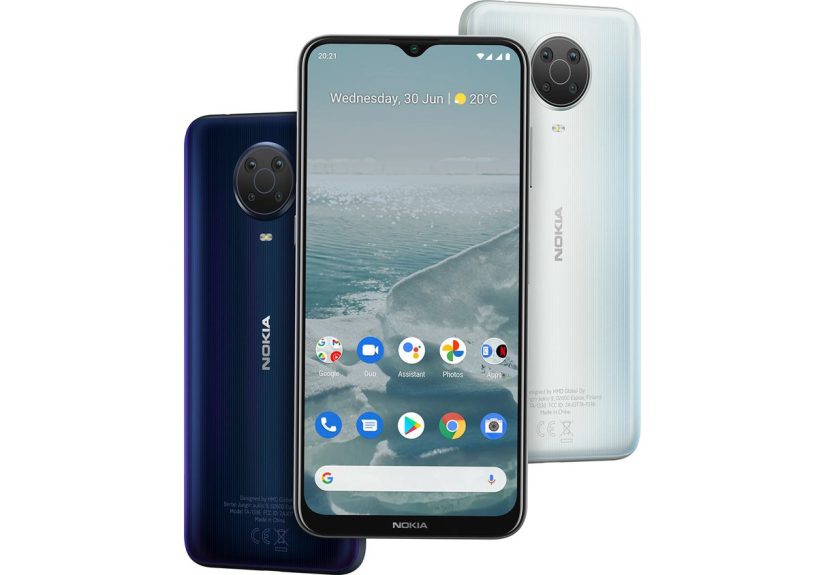
Nokia’s hardware design language also helps. The phone looks modern enough to avoid embarrassment, while still keeping costs under control. The rear camera module stands out visually, and the overall design feels practical rather than cheap in the worst sense of the word. There is a side-mounted fingerprint sensor, a dedicated Google Assistant button, a headphone jack, and USB-C charging. In budget-phone land, that combination is basically a nice little picnic.
Display and Design: Functional, Not Fancy
The Nokia G20 features a 6.52-inch HD+ screen, which gives it enough size for comfortable reading, YouTube watching, and scrolling through social apps. The display is not ultra-sharp by modern premium standards, and anyone used to higher-resolution panels will notice that text and graphics are not razor crisp. Still, at this price, the screen makes sense. It is large, usable, and good enough for the audience Nokia is targeting.
In fact, the lower-resolution display arguably supports the battery-first mission. A less demanding screen can help conserve power, which lines up nicely with the G20’s endurance-focused pitch. That means the trade-off is not random. Nokia is effectively saying, “Would you prefer a sharper display, or would you rather not hunt for a charger every evening?” For many budget-conscious buyers, that answer is easy.
The design itself avoids the toy-like look that some entry-level phones can fall into. The G20 comes in attractive color options, and its body has enough visual character to feel intentional. It is not luxury hardware, but it also does not scream, “I was purchased during a panic upgrade at 8:57 p.m.”
Camera Setup: More Versatile Than You Might Expect
Budget phones have a habit of bragging about camera count like they are collecting participation trophies. Four cameras! Three cameras! Two cameras and a partridge in a pear tree! The Nokia G20 does bring a quad-camera setup to the conversation, led by a 48MP main sensor, plus ultrawide, macro, and depth options.
Now, let us be realistic. More lenses do not automatically make a phone a photography powerhouse. But within its class, the G20 offers useful flexibility. The main camera is capable of producing solid daytime shots, especially when the lighting cooperates. The ultrawide option is handy for landscapes, group photos, or capturing a small room without standing inside the wall. The macro and depth sensors are more situational, but they at least add variety for users who like experimenting.
For a phone at this price, that matters. Many buyers are not looking for pro-level image processing or cinematic video wizardry. They want a camera that can capture family moments, receipts, food, pets, sunsets, awkward birthday parties, and the occasional “look what I found at the store” text. The G20 fits that job description reasonably well.
The 8MP front camera is similarly modest but functional. Video calls, selfies, and quick social posts are all within its comfort zone. Nobody is calling it studio equipment, but nobody shopping for a sub-$200 unlocked Nokia is expecting that either.
Software and Updates: A Strong Point for the Price
One of Nokia’s biggest selling points in recent years has been its cleaner Android approach, and the G20 benefits from that reputation. It launched with Android 11 and came with a promise of two years of OS upgrades. That is important because budget phones often get treated like disposable gadgets once they leave the shelf. Nokia at least tried to make the G20 feel like a device you could keep for a while rather than toss into a drawer after one awkward slowdown.
A cleaner Android experience also means fewer unnecessary apps cluttering the interface from day one. That is good news for users who want a phone that feels understandable right away. The result is a software experience that is approachable for students, parents, casual users, and anyone upgrading from an older device who does not want a tech support adventure every weekend.
Long-term value is not just about hardware. It is also about how long the phone remains secure, functional, and pleasant to use. In that context, the Nokia G20 makes a surprisingly respectable case for itself. It is a reminder that software support matters just as much as megapixels in the real world.
Performance: Manage Expectations and You Will Be Happier
The MediaTek Helio G35 inside the Nokia G20 is not designed to impress people who open fifteen apps while streaming music, gaming, and arguing in three group chats at the same time. This processor is built for basic daily tasks, and that is where the phone makes the most sense.
For messaging, web browsing, maps, email, social media, and standard video streaming, the G20 is serviceable. It is the kind of phone that works best when you use it like a normal person, not like a stress test with a caffeine problem. Open apps with a little patience, avoid expecting lightning-fast gaming performance, and the overall experience stays reasonable.
This is an important point for buyers comparing budget Android phones. The G20 is not about raw speed. It is about balance. You are trading some performance headroom for better battery life, decent storage, a clean interface, and a lower price. For many shoppers, that is a fair deal.
Why the Nokia G20 Makes Sense in the U.S. Market
The U.S. budget smartphone market is crowded, and that is putting it politely. Motorola, Samsung, OnePlus, TCL, and various prepaid-focused brands all battle for buyers who want something affordable but not miserable. In that environment, the Nokia G20’s best move is not trying to out-muscle everyone. It is carving out a lane based on battery life, simplicity, unlocked flexibility, and a recognizable brand name.
That brand still matters. Nokia carries nostalgia, trust, and a reputation for durability that many buyers remember fondly. Even though the smartphone era is a very different game from the indestructible candy-bar phone era, the Nokia name still suggests dependability. For shoppers burned out by disposable-feeling cheap phones, that emotional connection can go a long way.
The unlocked angle also helps. The G20 was marketed as compatible with GSM-oriented U.S. carriers such as AT&T and T-Mobile along with several prepaid options and MVNOs. That makes it appealing for buyers who want freedom to switch carriers, avoid contracts, or simply grab a sensible backup phone without jumping through corporate hoops.
Who Should Buy the Nokia G20?
The Nokia G20 is a strong fit for a few specific types of buyers. First, it works well for people who value battery life above almost everything else. If your phone regularly dies before dinner and you are tired of treating wall outlets like emotional support animals, the G20’s giant battery is a real selling point.
Second, it makes sense for light-to-moderate users who prioritize affordability. Students, older adults, first-time smartphone users, and budget-conscious families can all appreciate a phone that keeps things simple. It is also a reasonable pick as a backup device, travel phone, or secondary line for work.
Third, it suits users who want a clean Android phone without excessive software clutter. Some buyers do not care about advanced camera features or gaming horsepower. They just want a phone that handles daily life with minimal drama. The G20 is built for that crowd.
Who should skip it? Anyone who wants 5G, sharper display resolution, faster charging, or stronger gaming performance will probably want to spend more. The G20 is practical, but it does have limits, and those limits become obvious if your needs go beyond the basics.
The Bigger Picture: Nokia’s Budget Strategy
The Nokia G20 is more than a single inexpensive handset. It represents Nokia’s broader strategy of rebuilding relevance through approachable, low-friction devices. Instead of chasing flagship headlines, Nokia has often focused on practical phones with mainstream appeal. The G20 fits that philosophy perfectly.
It is easy to underestimate this kind of phone because it does not make dramatic promises. But there is value in making devices for people who just want something dependable. Not everyone is shopping for a pocket-sized supercomputer. Some people just need a phone that lasts, stores plenty of photos, runs Android cleanly, and does not require taking out a small loan.
In that sense, the Nokia G20 is refreshingly honest. It knows its audience. It knows its price range. And it shows up to the U.S. market with a practical set of features that are more useful than flashy.
Final Thoughts
Nokia bringing the budget-friendly G20 to the U.S. is not the kind of smartphone story that breaks the internet, but that is part of its charm. The phone was never meant to dominate headlines with futuristic features or luxury design. Its mission was simpler: offer a low-cost, unlocked Android device with strong battery life, solid everyday usability, and enough storage to feel like a smart purchase rather than a compromise.
And honestly, that mission still deserves respect. The Nokia G20 proves there is room in the U.S. market for a phone that values practicality over hype. It will not replace a premium flagship, and it will not wow power users who judge their phones by processing muscle alone. But for ordinary buyers looking for dependable basics at a fair price, the G20 makes a lot of sense.
Sometimes the best budget phone is not the one trying hardest to impress you. It is the one that quietly handles daily life, keeps going when you need it, and leaves enough money in your pocket for things like groceries, coffee, or one deeply unnecessary streaming subscription.
Everyday Experience With the Nokia G20 in the U.S.
Living with the Nokia G20 feels a bit like owning a practical sedan after years of hearing people rave about sports cars. It may not turn heads at every stoplight, but it gets the job done, rarely complains, and does not punish your bank account. That is the core experience of this phone in daily U.S. use. It is not exciting in the flashy sense, but it can be surprisingly satisfying in the real-life sense.
Imagine a typical day. You wake up, unplug the phone, check messages, scroll social media, confirm your weather forecast, stream a little music, and head out. Throughout the day, the G20 handles calls, maps, email, a few photos, and some casual YouTube watching without feeling like it is falling apart. You are not blown away, but you are also not stressed. That low-stress feeling is underrated. A lot of people do not need a phone that feels magical. They need a phone that feels cooperative.
The battery is where the good mood really starts. On a device like this, longer endurance changes behavior. You stop obsessively checking the battery percentage. You stop carrying a charger everywhere like it is a life-preserving medical device. You stop doing weird mental math about whether 23 percent is enough to survive the ride home. With the G20, many users will simply feel more relaxed. That may sound small, but in everyday use, peace of mind is a premium feature.
The large screen also contributes to comfort. Reading news, watching short videos, checking recipes, and browsing online stores all feel fairly pleasant. No, the panel is not especially sharp, and yes, anyone upgrading from a higher-end phone may notice the lower resolution. But after a while, many users adapt. What remains is a spacious screen that works well enough for ordinary tasks.
The camera experience is similar. In bright light, the main camera can deliver photos that are perfectly fine for sharing with friends or posting online. A weekend walk, lunch with family, a quick snapshot of your dog trying to fit into a shoebox for some reason, all of that is very doable. At night or in tricky lighting, the phone shows its budget roots more clearly, but that is not unusual in this price tier. The bigger takeaway is that the camera is useful, flexible, and adequate for daily memories.
Performance is the one area where users need the right mindset. If you jump from app to app, pile on browser tabs, and expect instant responses every time, you may notice the phone asking for a little patience. But if you approach it like a normal budget device and not a miniature gaming console, the G20 is easier to appreciate. It does the basics. It stays out of the way. It does not try to impress with speed, but it can still be a reliable companion.
That, ultimately, is the experience of the Nokia G20 in the U.S. It is a phone that rewards realistic expectations. It is best for people who value battery life, simplicity, and affordability over prestige. It feels less like a flashy upgrade and more like a smart household decision. In a market obsessed with bigger numbers and louder marketing, there is something refreshingly calm about that.
Note: This article is written for web publication, based on real public information, and intentionally omits direct source links and citation placeholders such as contentReference[oaicite:0]{index=0}.