Table of Contents >> Show >> Hide
- Why We Build Statues for Animals
- Balto: The Sled Dog Who Raced Against Time
- Hachikō: The Dog Who Waited Almost Forever
- Greyfriars Bobby: Loyalty Carved in Stone
- Fala: The Presidential Dog Immortalized in Washington, D.C.
- Smoky: The Four-Pound Therapy Dog of World War II
- Sergeant Stubby: From Stray to Decorated Soldier
- Cher Ami: The Pigeon Who Wouldn’t Quit
- The Animals in War Memorial: A Monument to All Who Served
- What These Animal Statues Teach Us
- How to Engage Respectfully with Animal Monuments
- Experiences Around Statues Dedicated to Animals
- Conclusion: Bronze, Stone, and Beating Hearts
We expect heroic statues to look like generals on horseback or marble
philosophers staring nobly into the distance. But in city squares, parks,
train stations, and memorials around the world, you’ll also find a quieter
kind of monument: bronze dogs, stone pigeons, and horses mid-stride. These
animal statues don’t just look cute in tourist photos. Behind them are
stories of loyalty, courage, and sacrifice so powerful that humans felt
compelled to capture them in metal and stone.
From a small sled dog in Alaska to a tiny therapy Yorkie in World War II,
these animals were not asking for fame. They were just doing what came
naturally to them guarding a grave, pulling a sled, carrying a message,
or simply staying by someone’s side. And that, in a way, is exactly why
their statues hit us right in the feelings. The stories behind animal
monuments remind us that heroism isn’t always loud, and love isn’t always
human.
Why We Build Statues for Animals
Across cultures, statues dedicated to animals serve a few overlapping
purposes. First, they are thank-you notes in bronze public,
permanent ways to honor animals that saved lives, boosted morale, or
offered a form of service that humans simply couldn’t provide on their own.
Second, these monuments work as
storytelling anchors. A visitor may not remember a long,
detailed plaque about a historical campaign, but they will remember the
little dog who refused to leave his owner’s grave, or the pigeon that kept
flying even after being wounded. The statue becomes a visual headline that
invites people to dig deeper into the story.
Finally, animal statues carry a powerful moral message. They remind us that
animals are not just background scenery in human history. They were
messengers, rescuers, teammates, and companions and often, they had no
say in the dangerous situations they were pulled into. Many monuments to
war animals explicitly acknowledge this, emphasizing that
“they had no choice”, but they served anyway.
Balto: The Sled Dog Who Raced Against Time
In New York City’s Central Park, just north of the zoo, crowds gather
around a bronze sled dog named Balto. Kids climb on his
back, tourists take photos, and dog owners sneak in a proud “that’s you
someday” pep talk. The statue is charming, but the story behind it is
downright cinematic.
A desperate race to save a town
In the winter of 1925, a diphtheria outbreak threatened the remote town of
Nome, Alaska. Antitoxin serum was hundreds of miles away, and with brutal
cold and blizzard conditions, planes and ships were out of the question.
The only hope was a relay of sled dog teams racing across nearly 700 miles
of snow and ice to deliver the medicine. Balto, part of musher Gunnar
Kaasen’s team, led the final leg into Nome after traveling through whiteout
conditions and sub-zero temperatures. The successful delivery helped
prevent a full-blown epidemic and turned the sled dogs into national
heroes.
From Alaska trail to Central Park pedestal
Balto’s statue was unveiled in Central Park later that same year, honoring
not just one dog, but all the sled teams that took part in the “Great
Race of Mercy.” The plaque thanks the “indomitable spirit of the sled dogs”
who carried the serum over mountains and frozen rivers. Today, the statue
works on two levels: children see a brave dog; adults see a story about
human–animal partnership in extreme conditions. And just for the record,
yes the metal nose looks extra shiny from decades of good-luck pats.
Hachikō: The Dog Who Waited Almost Forever
Outside Tokyo’s Shibuya Station, one of the busiest intersections in the
world, there’s a bronze Akita dog calmly sitting on a pedestal. His name is
Hachikō, and he’s famous for doing something simple:
showing up.
In the 1920s, Hachikō developed a daily routine. He walked with his owner,
a university professor, to the train station in the morning and returned
each evening to greet him after work. One day, the professor died suddenly
while at the university and never came back. Hachikō, however, kept
returning to the station at the same time every evening, waiting for a man
who would never step off the platform again. According to local accounts,
he continued this ritual for years, becoming a familiar sight to commuters
and a symbol of unwavering loyalty.
The original statue of Hachikō was erected in the 1930s, and a new version
was installed in 1948 after the war. Today, the statue is a popular meeting
spot and a reminder that love doesn’t always understand finality. The story
has inspired books, films, and a flood of visitors who show up to take a
picture and maybe secretly promise their own pets they’ll never be late
for dinner again.
Greyfriars Bobby: Loyalty Carved in Stone
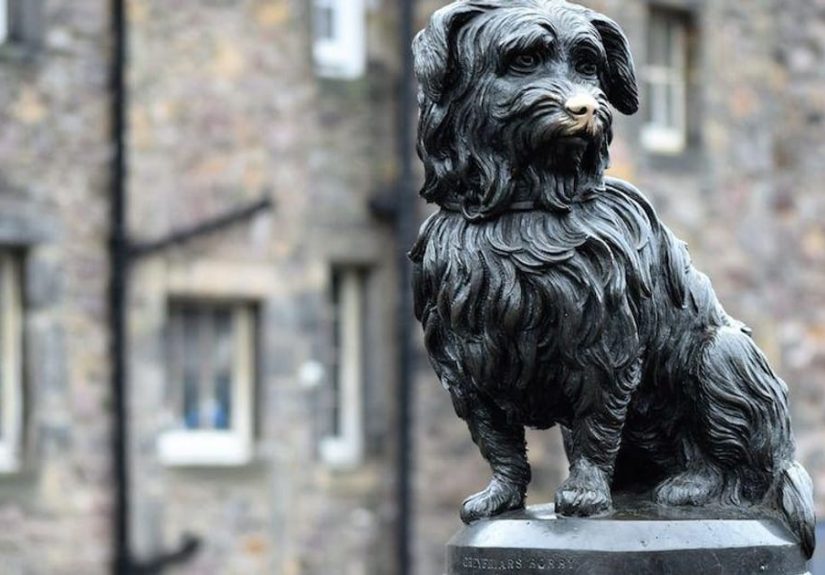
If you ever wander through Edinburgh, Scotland, you might find a small
Skye Terrier sitting proudly on a pedestal near Greyfriars Kirkyard.
That’s Greyfriars Bobby, a dog who reportedly spent about
14 years guarding his owner’s grave after the man passed away in the 19th
century.
Whether every detail of Bobby’s tale is historically precise or slightly
polished by local legend, the effect is the same: people are moved. The
statue, commissioned in the 1870s, was meant to celebrate loyalty so
steadfast that it literally refused to leave the cemetery. Visitors often
rub Bobby’s nose for luck and leave flowers nearby. The tradition became so
intense that the nose had to be restored after years of enthusiastic
affection proof that emotionally resonant animal stories never really go
out of style.
Fala: The Presidential Dog Immortalized in Washington, D.C.
In the Franklin Delano Roosevelt Memorial in Washington, D.C., the
president is not standing alone. Beside him, cast in bronze, is
Fala, his Scottish Terrier. Fala may be the only
presidential pet in U.S. history to receive such a prominent, permanent
spot in a national memorial.
Fala traveled frequently with Roosevelt, appeared in press coverage, and
even featured in one of FDR’s famous speeches when the president joked
about political opponents attacking his dog. Including Fala in the statue
does more than give us a cute photo op; it humanizes Roosevelt. It hints at
the companionship and emotional support that pets provide, even to people
making world-changing decisions. The statue quietly says: even in times of
war and depression, there was room at the president’s side for a small,
scruffy friend.
Smoky: The Four-Pound Therapy Dog of World War II
Not all heroes are big. Some fit into a soldier’s helmet.
Smoky, a Yorkshire Terrier discovered in a foxhole during
World War II, became a working war dog and, later, one of the earliest
documented therapy dogs.
Smoky helped with missions in the Pacific theater and once famously pulled
a communication cable through a narrow, debris-filled pipe, saving days of
dangerous labor for engineers. After the war, she visited hospitals and
entertained recovering veterans with tricks, offering comfort long before
“therapy dog” was a widely recognized term.
In Cleveland, Ohio, a bronze statue of Smoky sitting in a soldier’s helmet
marks the site of her burial. The monument is dedicated to
“Smoky and the Dogs of All Wars,” broadening the tribute from one tiny dog
to countless canines who served in conflict zones. Visitors see one small
figure, but the inscription nudges them to imagine the many animals whose
bravery never made headlines.
Sergeant Stubby: From Stray to Decorated Soldier
Sergeant Stubby started life as a stray dog and ended up
as one of the most famous U.S. military mascots of World War I. Adopted by
soldiers of the 26th “Yankee” Division, Stubby reportedly learned to
recognize incoming artillery and gas attacks, giving early warning to his
unit. He even helped locate wounded soldiers between the trenches.
Today, a statue of Stubby stands in the Connecticut Trees of Honor Memorial,
wearing his stubby tail and military-style gear with pride. Kids see an
adorable, slightly comical dog; veterans see a symbol of camaraderie,
survival, and the strange comfort of having a four-legged companion in the
middle of chaos.
Cher Ami: The Pigeon Who Wouldn’t Quit
Dogs aren’t the only animals with statues and stories. Meet
Cher Ami, a homing pigeon whose name means “dear friend”
in French. During World War I, Cher Ami carried a critical message that
helped save many members of the “Lost Battalion” of the U.S. Army’s 77th
Division. Despite being shot, losing a leg, and suffering severe injuries,
the pigeon completed the mission and delivered the message.
Cher Ami’s preserved form is displayed at the Smithsonian, and he has
inspired artwork, monuments, and military lore for over a century. The
symbolism is hard to miss: a small, fragile bird carrying the weight of an
entire battalion’s survival. It challenges the way we think about strength,
courage, and who gets to be called a “war hero.”
The Animals in War Memorial: A Monument to All Who Served
While many statues honor individual animals, some memorials speak for
thousands at once. The Animals in War Memorial in London’s
Hyde Park is one of the most powerful examples. The monument commemorates
all animals that served and died alongside British and Allied forces in
conflicts throughout history, from horses and mules to dogs, pigeons, and
other species pressed into wartime service.
The inscription “They had no choice” captures the moral heart of the
memorial. Animals did not enlist or understand geopolitics they followed
humans into danger because that’s what trust and training demanded.
The statue’s design, with carved reliefs and life-size figures, invites
visitors to contemplate both gratitude and responsibility: if animals gave
so much without understanding why, what do we owe them in return?
What These Animal Statues Teach Us
Put all these statues side by side Balto in New York, Hachikō in Tokyo,
Greyfriars Bobby in Edinburgh, war dogs and pigeons in memorial parks and
a pattern emerges.
- Loyalty matters. Many of these animals are remembered
not just for what they did, but for how long they kept doing it waiting
at a train station, guarding a grave, staying with soldiers through
hardship. - Service has many forms. Some animals carried medicine.
Others pulled sleds, detected danger, or simply gave comfort to people
who were scared, sick, or grieving. - Memory needs a face. It’s easier to connect with a
single dog or pigeon than with a statistic. Animal statues give a face
or a snout, or a beak to larger historical events.
On a practical level, these monuments also shape how we move through cities
and parks. They become landmarks and meeting points, adding warmth to
environments that might otherwise feel strictly functional. You don’t
remember exactly which exit you used, but you remember “the little dog
statue by the bridge.”
How to Engage Respectfully with Animal Monuments
As animal statues become popular selfie backdrops, it’s worth thinking
about how to interact with them in a way that respects the stories they
represent.
- Read the plaque. It takes 30 seconds and turns a random
bronze dog into a character in a real story. Knowing who Balto or Smoky
was changes how you see the statue. - Be gentle. Decades of climbing and rubbing can damage
statues. If there’s a sign asking visitors not to touch, it’s not because
the city hates fun it’s trying to protect the monument for future
generations. - Think about modern animals. Monuments to war horses and
message pigeons invite us to reflect on how we treat working animals
today from military dogs to service animals and therapy pets.
Experiences Around Statues Dedicated to Animals
You don’t have to be a historian to feel the emotional weight of these
monuments. Just spend a few minutes people-watching near one and patterns
quickly appear.
At Balto’s statue in Central Park, for example, visitors often line up
patiently to take photos. Children are usually the first to rush forward,
hands outstretched to touch the dog’s nose. Some parents quietly explain
the story of the serum run how a team of sled dogs helped save sick
children far away in Alaska. The kids may not recall every location or
date, but they understand the essentials: this dog was brave, and this
bravery helped real people.
Near memorials like Smoky’s statue in Cleveland or the Animals in War
Memorial in London, the mood can be more reflective. Veterans, families,
and tourists stand in front of the sculptures reading the names,
inscriptions, and dedications. Sometimes they leave flowers, small flags,
or even dog toys as informal offerings. The statues become a focal point
for grief, gratitude, and remembrance an outdoor space where emotions are
allowed to be visible.
Travel stories often include a surprise encounter with an animal statue.
A visitor might be on their way to a famous landmark and stumble instead on
a small bronze dog or pigeon they’ve never heard of. Curiosity kicks in:
Who is this? A quick search on a phone turns the statue into the
start of a mini history lesson. People learn about forgotten battles,
19th-century city life, or medical emergencies in remote towns. The statue
becomes an educational tool without ever saying a word.
These monuments also shape personal rituals. Someone living in Tokyo might
pass Hachikō every day on the way to work, gradually forming a quiet
attachment to the statue. They may start using it as a meeting point with
friends or as a mental checkpoint “If Hachikō can show up every day, so
can I.” In Edinburgh, residents and tourists alike pause near Greyfriars
Bobby, sometimes bringing their own dogs and snapping “dog meets dog”
photos. The statues turn abstract virtues like loyalty and devotion into
something you can literally stand next to.
In many cities, local guides now intentionally weave animal statues into
walking tours. They’ve learned that visitors connect with stories of pets,
mascots, and working animals just as strongly sometimes more strongly
than with stories of kings and generals. When a guide tells the tale of
Sergeant Stubby warning soldiers about gas attacks or Cher Ami flying while
injured, you can see people shifting from casual interest to genuine
fascination. The presence of a statue or memorial gives those stories a
physical anchor.
Even people who are not “animal lovers” in the traditional sense often find
themselves unexpectedly moved. There’s something disarming about a statue
that doesn’t celebrate conquest or political power, but instead honors
empathy, companionship, and mutual reliance between species. Standing in
front of these monuments, it’s hard not to think about the animals in your
own life the dog that sleeps at the foot of your bed, the cat that
supervises your laptop, or even the birds that nest outside your window.
Ultimately, experiences around statues dedicated to animals are about more
than sightseeing. They invite us to slow down, read a short story in metal
and stone, and consider just how deeply animals have been woven into human
histories and human hearts. You might arrive with a camera, but you usually
leave with something extra: perspective.
Conclusion: Bronze, Stone, and Beating Hearts
Statues dedicated to animals may look simple at first glance, but their
stories run deep. Balto’s frozen race against disease, Hachikō’s long
wait at the station, Greyfriars Bobby’s vigil at a grave, Fala’s presence
beside a world leader, Smoky’s therapy work, Sergeant Stubby’s battlefield
bravery, Cher Ami’s wounded flight, and the countless unnamed animals
honored by broader memorials together they form a shared narrative about
loyalty, courage, and partnership.
These monuments ask us to remember not just what animals have done for us,
but how we should treat them in return. They challenge us to recognize
animals as more than background characters in human drama. The next time
you pass a statue of a dog, pigeon, or horse, take a moment to stop, read,
and reflect. Behind the bronze is a beating heart that once followed, flew,
pulled, waited, or comforted and a story that still has the power to move
us decades, or even centuries, later.