Table of Contents >> Show >> Hide
- What makes MCL different from other lymphomas?
- When MCL is suspected: symptoms and first tests
- The diagnosis roadmap (the big picture)
- Biopsy: the cornerstone of MCL diagnosis
- Bloodwork: what it tells you (and what it can’t)
- Imaging: CT and PET/CT (the “where is it?” tests)
- Bone marrow aspiration and biopsy
- GI evaluation: colonoscopy and endoscopywhen do they matter?
- Staging and “how fast?” markers
- Questions to ask your doctor (copy/paste friendly)
- FAQ: quick MCL diagnosis answers
- Experiences during MCL diagnosis (about )
- Conclusion
- References (source names only; no links)
Medical note: This is educational information, not personal medical advice. If you have symptoms or you’re in the middle of testing, your hematologist/oncologist and a hematopathologist are the experts who can interpret results for your situation.
Mantle cell lymphoma (MCL) is a subtype of non-Hodgkin lymphoma. Diagnosing it isn’t usually one dramatic test that ends with a game-show buzzer. It’s more like detective work: a good tissue sample, the right lab tools, and a team that knows what clues to look for.
This guide walks through the most common tests used to diagnose and stage MCLwhat they measure, why they’re done, and what terms like cyclin D1 and t(11;14) actually meanplus real-world “what it feels like” experiences many patients describe during the workup.
What makes MCL different from other lymphomas?
MCL usually comes with a hallmark genetic change: a translocation between chromosomes 11 and 14, written t(11;14). That rearrangement leads to overexpression of cyclin D1, a protein involved in cell-cycle control. In simpler terms: cells get extra encouragement to keep dividing.[1][5][8]
Pathologists typically confirm MCL by combining:
- Morphology (how the cells and tissue pattern look under the microscope)
- Immunophenotyping (which protein “name tags” the cells express)
- Genetic testing (often looking for t(11;14) or related features)
A common pattern for MCL is B cells that are CD20-positive and CD5-positive, usually cyclin D1-positive, and often CD10-negative with CD23 negative or low.[1][2]
When MCL is suspected: symptoms and first tests
Many people are evaluated because of enlarged lymph nodes, fatigue, “B symptoms” (fever, drenching night sweats, unexplained weight loss), spleen enlargement, or abnormal blood counts. Sometimes it’s discovered incidentally on imaging or routine labs.[3][4]
Early evaluation often includes:
- History and physical exam (including lymph nodes, spleen, liver)
- Basic labs (CBC, chemistry panel, LDH, and others)
- Imaging (often CT and sometimes PET/CT)
- A biopsy of an involved site (the key step)
The diagnosis roadmap (the big picture)
- Confirm lymphoma with a quality tissue sample.
- Classify the subtype (MCL vs. other B-cell lymphomas) using markers and genetics.
- Stage the disease (where it is in the body) using imaging and sometimes bone marrow testing.
- Assess biology (how fast it seems to be growing) using markers like Ki-67 and, in some cases, gene testing.
That’s why you may hear “we’re waiting on additional stains” or “FISH is pending.” It’s not procrastination; it’s precision.
Biopsy: the cornerstone of MCL diagnosis
A tissue biopsy is usually essential. An excisional lymph node biopsy (removing all or part of a node) is often preferred because the tissue architecture helps classify lymphoma accurately.[5][6][12]
When a lymph node is deep or surgery is impractical, a core needle biopsy may be used. A fine needle aspiration (FNA) can provide clues, but it may not be enough by itself to fully classify lymphoma because it often doesn’t preserve architecture.[6][12]
What the pathology lab looks for
- Microscope review: cell size/shape and growth pattern.
- Immunohistochemistry (IHC): a panel of markers (often including CD20, CD5, cyclin D1, and sometimes SOX11; plus Ki-67 as a growth marker).[2][5]
- Flow cytometry: immunophenotyping that rapidly checks markers on many cells (useful in tissue, blood, or bone marrow).[2][10]
- Genetic confirmation: tests such as FISH to detect the t(11;14) CCND1/IGH rearrangement.[5][11]
Common “MCL tests” explained in plain English
| Test | What it does | Why it matters |
|---|---|---|
| Immunohistochemistry (IHC) | Stains the biopsy for specific proteins | Helps identify MCL’s marker pattern (including cyclin D1) |
| Flow cytometry | Measures markers on thousands of cells quickly | Defines the immunophenotype and can detect blood/marrow involvement |
| FISH for CCND1/IGH | Looks for the t(11;14) rearrangement | Supports diagnosis, especially in difficult or atypical cases |
| Ki-67 index | Estimates how many cells are actively dividing | Helps gauge how “fast” the lymphoma appears to be growing |
| Molecular tests (selected cases) | Checks for gene changes such as TP53 | May influence risk assessment and treatment planning |
Cyclin D1-negative? Rare, but it happens
Most MCL is cyclin D1-positive, but rare cases may not show cyclin D1 staining. When the overall picture still suggests MCL, labs may use additional markers (like SOX11) and lean more on genetic testing to avoid misclassification.[5][7]
Bloodwork: what it tells you (and what it can’t)
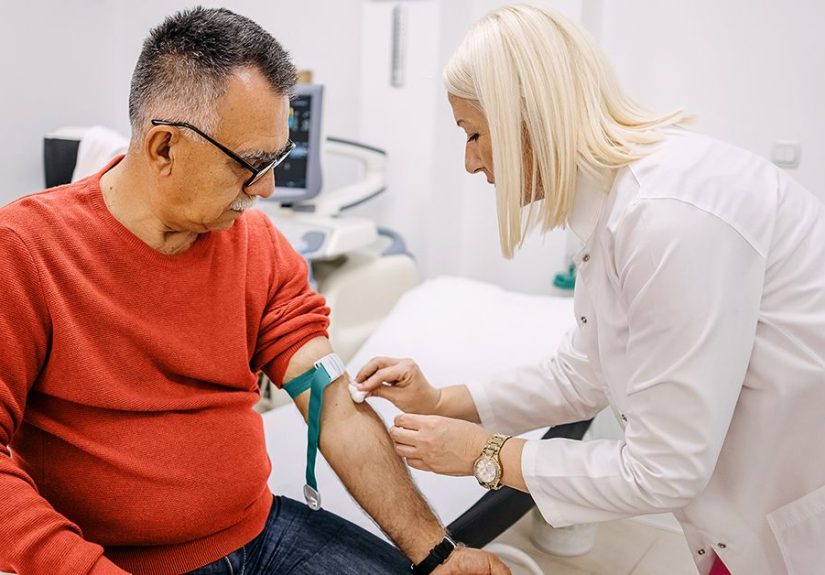
Blood tests help evaluate overall health, look for blood involvement, and contribute to risk assessment. Common labs include:
- CBC with differential (anemia, low platelets, abnormal lymphocyte counts)
- Comprehensive metabolic panel (kidney/liver function)
- LDH and sometimes beta-2 microglobulin[5]
If MCL cells are circulating in the blood, clinicians may order immunophenotyping by flow cytometry to define the B-cell population and its marker pattern.[10][11] This can help distinguish MCL from look-alikes such as chronic lymphocytic leukemia (CLL).
One common surprise: you can have lymphoma with relatively normal “routine” labs. Bloodwork supports the diagnosis; it doesn’t replace the biopsy.[9]
Imaging: CT and PET/CT (the “where is it?” tests)
Imaging is used mainly for stagingmapping where lymphoma is present. CT scans show anatomy (size and location of nodes and organs). PET/CT adds metabolic activity and can be helpful because MCL is typically FDG-avid, though some sites may be less conspicuous on PET.[5][13]
Doctors choose imaging based on your situation, but common studies include CT of the chest/abdomen/pelvis and, in many cases, PET/CT for a baseline assessment and later response evaluation.[5][13]
Bone marrow aspiration and biopsy
A bone marrow biopsy is often performed after lymphoma is diagnosed to see whether the marrow is involved, which affects staging. The marrow sample may also be analyzed with flow cytometry and genetic tests when appropriate.[6][5]
If the idea of this test raises your heart rate: ask about numbing medicine, positioning, and whether calming medication is an option. It’s fair to advocate for comfort.
GI evaluation: colonoscopy and endoscopywhen do they matter?
MCL can involve the gastrointestinal (GI) tract, sometimes subtly. Some centers include colonoscopy and/or upper endoscopy (EGD) during evaluationespecially if you have GI symptoms, anemia, abdominal pain, or unexplained changes in bowel habits.[4]
However, published reviews note that routine endoscopy/colonoscopy is not necessarily recommended for every newly diagnosed patient without symptoms, because it may not change initial management in many cases.[15] In practice, the decision is individualized. A helpful question to ask is: “What would you do differently depending on what the scope shows?”
Staging and “how fast?” markers
Staging describes how widely MCL is present in the body, often using lymphoma stages I–IV. MCL is frequently found in multiple regions (and sometimes bone marrow or spleen) at diagnosis, which is one reason staging tests matter.[5][3]
Beyond stage, doctors assess how the lymphoma is behaving:
- Ki-67 (proliferation index): higher values often indicate faster growth.[5]
- TP53 (p53) and other genetic features may be tested because they can influence prognosis and treatment planning.[3][6]
- Histology variants (such as blastoid or pleomorphic patterns) may suggest more aggressive biology.[5]
Some clinicians use scoring systems like MIPI (which may incorporate age, performance status, LDH, and white blood cell count) to summarize risk. These tools don’t replace clinical judgment; they help structure it.
Questions to ask your doctor (copy/paste friendly)
- Was my biopsy excisional or core needle, and was it enough tissue for full lymphoma testing?
- What markers were positive/negative (CD5, CD20, cyclin D1, SOX11, CD23, CD10)?
- Was t(11;14) tested (FISH), and what were the results?
- What is my Ki-67? Was TP53 testing done?
- Which staging tests do I still need (PET/CT, bone marrow biopsy, labs)?
- Do I need GI evaluation? If yes, what would it change?
- Should my pathology be reviewed by a lymphoma-specialist hematopathologist?
- What symptoms should prompt me to call you while workup is ongoing?
FAQ: quick MCL diagnosis answers
How long do results take?
Initial pathology can return quickly, but definitive classification often requires multiple stains, flow cytometry, and genetic studies (like FISH). It’s common for results to arrive in parts (a preliminary report followed by addenda).
Can MCL be diagnosed from blood alone?
Flow cytometry on blood can strongly suggest MCL when there’s blood involvement, but tissue diagnosis is usually still needed to confirm subtype and assess features like growth pattern and Ki-67.[10][5]
What does “cyclin D1 positive” mean?
It means the lymphoma cells show high cyclin D1 protein expressionoften related to t(11;14). This finding helps distinguish MCL from other small B-cell lymphomas.[1][8][14]
Do I need PET/CT?
PET/CT can be useful for baseline staging and later response assessment in MCL, but your team decides based on your clinical presentation and other results.[5][13]
Experiences during MCL diagnosis (about )
The diagnostic workup can feel like your life suddenly runs on two schedules: the clinic schedule (“biopsy Tuesday, scan Friday”) and the brain schedule (“I learned the word ‘translocation’ and now my mind won’t stop trans-locating to worst-case scenarios”). If you’re anxious, that’s not weaknessit’s a normal reaction to uncertainty.
The waiting is often the hardest part. Many people say the biopsy itself wasn’t the main stressor; it was the days afterward. Lymphoma workups often need extra testsspecial stains, flow cytometry, and genetic studiesso results can arrive in layers. A small but powerful coping move is to ask your team: “When will I have the first report, and when will the final report be complete?” A timeline turns the wait from infinite to finite.
“Alphabet soup” paperwork is real. CD5. CD20. Cyclin D1. FISH. Ki-67. TP53. Patients frequently describe feeling embarrassed to ask what those mean. Please don’t. These are not vocabulary quizzes; they’re tools that guide decisions. Bringing a notebook (or a friend who loves taking notes) can help, because appointments move fast and emotions can make memory unreliable.
Scans can be emotionally loud. CT is usually quick. PET/CT can feel like a long, quiet audition for “Most Patient Person.” People sometimes worry that every “bright spot” is cancer. In reality, PET activity can reflect inflammation or infection too, which is why imaging is interpreted alongside pathology. Practical tip: wear warm socksimaging suites are legendary for their air conditioning.
Bone marrow biopsy: fear vs. experience. This test has a reputation. Some people report pressure and discomfort more than sharp pain; others find it quite unpleasant. The difference often comes down to technique, positioning, and pain control. Ask what numbing medicine is used, whether you can take an anti-anxiety medication, and how long recovery typically takes. Planning a small reward afterward (favorite coffee, a gentle walk, a comfort-show episode) is not “dramatic”it’s basic self-care. It also gives the day a clear finish line: “I get through this, then I do something kind for myself.”
Second opinions are common. MCL can resemble other small B-cell lymphomas, and specialized hematopathology review can be valuable. Patients sometimes hesitate because they don’t want to “offend” their doctor. In cancer care, a second opinion is usually viewed as good practice, not a betrayalmore like having a second pilot double-check the flight plan.
Control what you can. You can’t speed up the lab, but you can keep your records organized, write down questions, and choose how much you read online. Many people find it helpful to limit late-night searching, stick to a few high-quality sources, and save deeper reading for daytime when you’re less exhausted.
Finally, remember what diagnosis is trying to do: replace uncertainty with accuracy. Getting the subtype right (and understanding stage and biology) is the foundation for building a treatment plan. The workup is exhaustingbut it’s purposeful.
Conclusion
Mantle cell lymphoma diagnosis typically requires a high-quality biopsy reviewed by an experienced hematopathologist, supported by immunophenotyping (IHC and/or flow cytometry) and genetic confirmation (often FISH for t(11;14) and cyclin D1–related changes). Blood tests, imaging (CT and PET/CT), and sometimes bone marrow or GI evaluation help stage the disease and understand how it’s behaving. If you’re in the middle of this process, don’t hesitate to ask for claritybecause in MCL, the details are what turn a scary question mark into a clear plan.
References (source names only; no links)
- National Cancer Institute (NCI) Mantle Cell Lymphoma Treatment (PDQ): diagnostic immunophenotype and genetics
- Memorial Sloan Kettering Cancer Center Mantle Cell Lymphoma patient education (PDF)
- Mayo Clinic Mantle cell lymphoma: diagnosis and staging overview
- Dana-Farber Cancer Institute MCL diagnostic tests (labs, imaging, and GI evaluation)
- NIH/NCBI Bookshelf (StatPearls) Mantle Cell Lymphoma: diagnostic workup and biomarkers
- American Cancer Society Tests for Non-Hodgkin Lymphoma (diagnosis & staging)
- NCBI/PubMed/PMC literature on cyclin D1-negative MCL and SOX11 markers
- MD Anderson Cancer Center Cyclin D1 translocation testing by FISH (pathology resource)
- Cleveland Clinic Mantle cell lymphoma overview
- MedlinePlus (NIH) Immunophenotyping/flow cytometry overview
- ARUP Laboratories IGH-CCND1 fusion t(11;14) by FISH (test description)
- UCSF Health Lymphoma diagnosis: role of biopsy and imaging
- Memorial Sloan Kettering Cancer Center Lymphoma diagnosis overview (imaging and marrow testing)
- Peer-reviewed PET/CT evidence for MCL (indexed by PubMed/NIH)
- NIH/PMC review on GI involvement in MCL and endoscopy considerations