Table of Contents >> Show >> Hide
- First: What “All the Way Up” Actually Means (So We Don’t Create New Problems)
- Reason #1: You’re More Likely to Trigger the Traffic Light Sensor
- Reason #2: You Help the Signal Run the Way It Was Designed (Less Delay for Everyone)
- Reason #3: You Make Left Turns, Right Turns, and Lane Use Work Better
- Reason #4: You’re More Visible (and Predictable) to Other Road Users
- Reason #5: You’re More Likely to Stay Out of the Crosswalk (Which Is the Whole Point)
- Reason #6: It Can Reduce Rear-End Risk and Prevent “Accordion Traffic”
- Reason #7: It’s Often the Law (and It’s Definitely the Standard)
- How to Pull All the Way Up Correctly (Without Becoming a Crosswalk Villain)
- Common Myths That Keep People Stopping in the Wrong Spot
- Bottom Line: “All the Way Up” Is a Small Habit with Big Payoff
- Extra: Real-World Experiences That Make You a Stop-Line Believer (500+ Words)
- Conclusion
Ever been stuck at a red light long enough to develop a friendship with the car next to you, name the birds on the power line, and reconsider every life choice that led you to this intersection? Sometimes the problem isn’t the signal timing or a cosmic vendetta. Sometimes… it’s the first car in line stopping a full car-length back like the stop line is lava.
“Pull all the way up” doesn’t mean inching into the crosswalk or planting your bumper in the intersection. It means stopping where you’re supposed to stop: at the stop line (also called the limit line or stop bar), with your vehicle positioned so you’re detected properly, visible to others, and not blocking people on foot. Do that consistently, and you’ll help traffic flow, reduce confusion, and make the whole intersection feel less like a reality TV competition.
First: What “All the Way Up” Actually Means (So We Don’t Create New Problems)
The goal is simple: stop with your front bumper just behind the painted stop line. If there’s a crosswalk, the stop line is usually set back from itso you can be “all the way up” while still keeping the crosswalk clear.
Quick visual check
- See a thick white line across your lane? That’s your stopping target.
- No line? Stop before the crosswalk area or, if there’s no crosswalk, before entering the intersection.
- Crosswalk present? Don’t stop on it. Pedestrians shouldn’t have to squeeze around your hood ornament like it’s a museum exhibit.
Think of the stop line as the intersection’s “front desk.” If you don’t check in there, the system may not know you exist.
Reason #1: You’re More Likely to Trigger the Traffic Light Sensor
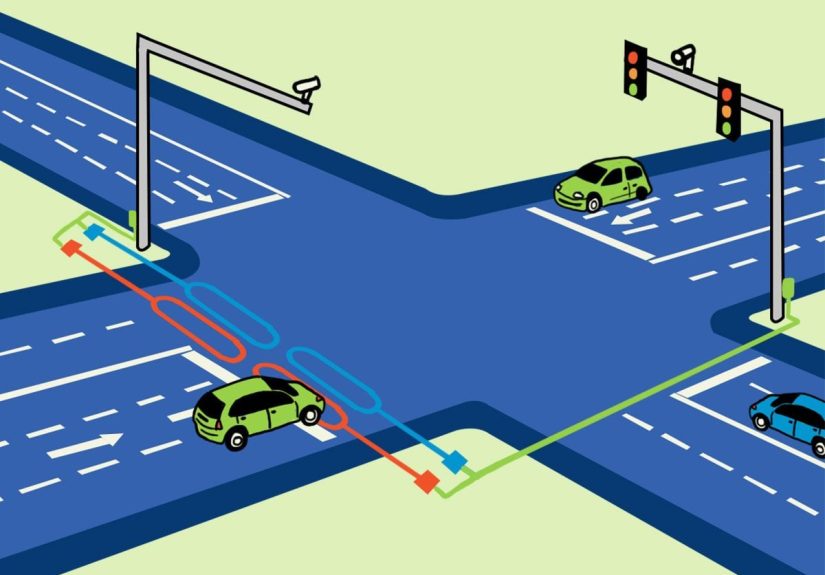
Many signals aren’t on a fixed timer 24/7. A huge number are actuated or semi-actuated, meaning they adjust based on whether vehicles are present. To do that, intersections use detection systemsoften placed at or near the stop lineso the controller can “see” a car waiting.
How detection works (in human terms)
Traffic signals commonly detect vehicles using one (or a mix) of:
- Inductive loop detectors (wire loops cut into pavement that sense changes when a vehicle is over them)
- Video detection (cameras watching defined “boxes” near the stop bar)
- Radar/microwave (units aimed at lanes to detect presence and movement)
- Magnetic sensors/magnetometers embedded in or near the roadway
Here’s the punchline: these systems define where “waiting” is supposed to happen. If you stop too far back, you may be outside the detection zone, which can mean the signal doesn’t call your phase, delays it, or skips it during low traffic.
Real-world example
You’re first in line on a quiet side street at 10:30 p.m. Cross traffic keeps getting green. Your light stays red. No one’s coming behind you to “accidentally” roll forward and fix it. That’s not bad luckit can be bad positioning. Pulling up to the stop line puts your car where the system expects it.
Reason #2: You Help the Signal Run the Way It Was Designed (Less Delay for Everyone)
Signals are engineered around assumptions: vehicles queue up to the stop bar, lanes fill in a predictable pattern, and detectors measure presence where it matters. When the first driver stops way back, a weird chain reaction starts:
- The signal may not detect a waiting vehicle promptly.
- Drivers behind can’t pull into turn pockets efficiently.
- Some people start changing lanes late (and angrily) to “go around the mystery gap.”
- The intersection’s timing feels “broken,” even when it’s behaving exactly as coded.
One car stopping short can create the illusion that the entire city’s traffic engineers took the day off. Pulling up correctly is a tiny action that helps the system run smoothlyespecially at off-peak hours when signals rely heavily on detection.
Reason #3: You Make Left Turns, Right Turns, and Lane Use Work Better
Turn lanes often have their own detection. If you’re in a left-turn pocket and you stop back like you’re saving space for a parade float, you might not be detected as “present,” and the protected left arrow may not show in the cycle (or it may come later than necessary).
Turning movement example
Picture a left-turn lane with a sensor near the stop bar. If the first driver hangs back, the controller might not register a queue, so it allocates less time (or no protected phase at all). Meanwhile, the line behind grows, horns appear, and someone mutters, “This light is useless.” The light is fine. The stopping position is not.
Pulling up to the stop bar also helps keep turn lanes from spilling into through lanes. That means fewer last-second merges and fewer “Oops, I guess this is a left-turn lane now” surprises.
Reason #4: You’re More Visible (and Predictable) to Other Road Users
Intersections are a high-stakes place to be vague. When you stop where markings indicate, you’re easier for others to read:
- Oncoming drivers can better judge whether you’re waiting, creeping, or about to turn.
- Drivers behind you can line up properly instead of guessing why there’s a suspicious gap.
- Pedestrians get a clear crosswalk instead of a vehicle nose hovering where their feet should go.
- Cyclists can position safely without having to share the “mystery zone” between you and the line.
Predictability is underrated. It’s basically road safety’s love language.
Reason #5: You’re More Likely to Stay Out of the Crosswalk (Which Is the Whole Point)
This is where “pull all the way up” becomes a precision sport. The stop line exists for a reason: it’s the place you can stop while still giving pedestrians usable space and sight lines. Blocking crosswalks forces people to step into traffic to go around you, and it can reduce visibility between drivers in adjacent lanes and pedestrians crossing.
Crosswalk logic in one sentence
Stop at the stop line so the crosswalk stays for walking.
If you’ve ever watched someone pushing a stroller do an awkward side-step into the street because a vehicle is parked on the stripes, you’ve seen why that line matters. Pulling up correctly is not only legal-mindedit’s decent-human-minded.
Reason #6: It Can Reduce Rear-End Risk and Prevent “Accordion Traffic”
Stopping too far back isn’t automatically safer. In fact, it can be confusing. When the first car leaves a huge gap, drivers behind may continue rolling forward expecting the line to start sooner, then brake harder when they realize the lead car has stopped early. That’s a recipe for an accordion effectespecially when there’s distraction, rain, glare, or heavy traffic.
Stopping where markings indicate creates a consistent “stopping pattern” at intersections. Consistency reduces surprise. Reduced surprise reduces abrupt braking. Abrupt braking reduces bumper-to-bumper introductions no one asked for.
Reason #7: It’s Often the Law (and It’s Definitely the Standard)
Driver handbooks across the U.S. consistently instruct drivers to stop at the limit line (stop line) and, if none exists, before the crosswalk or intersection. Those markings aren’t decorative. They’re the agreed-upon boundary that keeps vehicles, pedestrians, and signal operations from stepping on each other’s toes.
Translation: stopping a car-length back isn’t “extra cautious.” It’s often just “not following the rule the intersection is built around.”
How to Pull All the Way Up Correctly (Without Becoming a Crosswalk Villain)
Step-by-step
- Pick your target: the stop line. Not the crosswalk stripes. Not the shadow of the traffic pole. The actual line.
- Stop smoothly: front bumper just behind the line. If you can still see the line in front of your hood, you’re usually in a good spot.
- Stay put: don’t creep. Creeping can push you into the crosswalk and can also move you out of some detection zones.
- Night tip: if the line is faded, look for pavement cuts (rectangles/diamonds) that hint at detection loops near the stop bar.
- If you’re on a motorcycle or bicycle: positioning over loop edges can help at some intersections, but don’t do gymnastics in trafficsafety first.
If the light still doesn’t change
- Double-check you’re at the stop line (not a car-length behind it, and not past it).
- Be patient for a full cycle; some signals have minimum timing before they serve a movement.
- If it repeatedly fails, it may be a maintenance issue with detection. Many cities and DOTs accept reports for malfunctioning signals.
- Some states have specific rules for certain vehicles when a signal fails to detect them. That varies widelyknow your local law and prioritize safety.
Common Myths That Keep People Stopping in the Wrong Spot
Myth: “Stopping way back is safer.”
Reality: stopping correctly is safer. The intersection is designed around the stop bar. Stopping far back can confuse drivers behind you, reduce efficiency, and keep you out of detection zones. Safety isn’t “farther.” It’s “right place, right behavior.”
Myth: “The sensor is in the traffic light, not the road.”
Reality: sometimes there are overhead sensors, but many systems still rely on detection areas near the stop linewhether that’s loops in the pavement, video detection zones, or radar aimed at the queue.
Myth: “If I pull up, I’ll block pedestrians.”
Reality: pulling up to the stop line generally keeps you out of the crosswalk because the stop line is typically placed before it. The problem isn’t pulling upit’s pulling up too far.
Bottom Line: “All the Way Up” Is a Small Habit with Big Payoff
Pulling all the way up at stoplightsmeaning up to the stop linehelps the signal detect you, keeps traffic moving as designed, improves visibility and predictability, protects crosswalks, and reduces weird intersection drama. It’s one of those tiny driving habits that quietly upgrades everyone’s day.
And if you’re thinking, “Sure, but does it really matter?”ask the person behind you who has been staring at your generous, unnecessary gap like it’s a personal insult. (Don’t actually ask them. They’re already holding a horn-shaped opinion.)
Extra: Real-World Experiences That Make You a Stop-Line Believer (500+ Words)
Experience #1: The Eternal Red. You roll up to a quiet intersection late at night. No traffic. No pedestrians. Just you, the streetlights, and the unsettling realization that the universe is very large and this red light might outlive you. The cross street keeps cycling green because the signal thinks someone is there. You? Apparently not. Then you notice: you stopped a full car-length back. You pull forward to the stop line, and suddenly the intersection “remembers” you exist. It’s like getting verified on social media, but for your vehicle.
Experience #2: The Honk Chorus. You’re not even the driverjust a passenger observing human behavior. The first car in line stops way back, leaving enough space to park a food truck. The second car pulls up… and can’t get into the left-turn pocket because the first car is occupying the exact spot where the queue should compress. The third car can’t decide whether to go around. Someone honks. Someone else honks in harmony. A third person adds percussion. None of this makes the signal change faster. The only thing that would have helped was the lead car pulling up to the stop bar like the lane markings politely requested.
Experience #3: The Crosswalk Shuffle. A pedestrian steps up to cross, sees a vehicle stopped halfway into the stripes, and does that awkward side-step where they’re half walking, half negotiating a boundary dispute. Another pedestrian hesitates because they can’t tell if the driver will creep more. Meanwhile, the driver is thinking, “I pulled up like everyone told me!”but they pulled up to the crosswalk, not the stop line. The lesson here is simple: pull all the way up to the correct place. Crosswalks are not bonus stopping lanes.
Experience #4: The Motorcycle Mystery. A rider pulls up properly, lines up carefully, and still doesn’t get detected at a particular light. It happens. Some detection setups are more sensitive than others, and smaller vehicles can be harder to detect in some conditions. But here’s the part people miss: positioning still matters. Stopping far back makes detection less likely; stopping near the stop bar gives you the best chance the system was designed to offer. When detection still fails, the “fix” isn’t blowing the redit’s knowing local rules, staying safe, and reporting the problematic signal so it can be adjusted or repaired.
Experience #5: The Day You Realize the Line Is a Tool. Once you start paying attention, you see how often the stop line solves problems before they start. It keeps vehicles out of pedestrian space. It helps drivers line up consistently. It makes your intentions obvious. It puts you where detection is expected. And it reduces that low-grade chaos where everyone is guessing what everyone else is doing. It’s not glamorous. Nobody writes songs about the stop bar. But if traffic had a user manual, the stop line would be printed in bold with three exclamation points.
So yes: pull all the way up at stoplights. Not because you’re trying to be “that perfect driver,” but because you’re choosing the easiest, most practical way to make intersections work better for youand for the people who share the road with you.
Conclusion
Pulling up to the stop line is one of the simplest habits that improves traffic signal detection, intersection efficiency, and pedestrian safetyall while making you look like someone who reads road markings on purpose. Stop at the line, keep the crosswalk clear, and let the signal do its job.