Table of Contents >> Show >> Hide
- Why Inflatable Costumes Work So Well
- What “Goofy, Poofy” Really Means in Maker Terms
- Best Materials for a DIY Inflatable Costume
- How the Inflation System Does the Real Magic
- Construction Tips That Separate Great Builds From Puffy Chaos
- Safety: The Part That Is Not Funny Until It Is Too Late
- Comfort and Wearability Matter More Than Most Makers Admit
- Design Ideas That Shine in Inflatable Form
- Common Mistakes to Avoid
- Why This Category Keeps Winning Makers Over
- Real-World Experiences With Goofy, Poofy Inflatable Costumes
- Conclusion
Some costumes whisper. Inflatable costumes absolutely do not. They wobble into the room like a parade balloon that made one questionable life choice and decided to attend your party. That is exactly why people love them. They are oversized, silly, portable, surprisingly practical, andwhen designed wellmuch more comfortable than they look.
The maker appeal is obvious. A good inflatable costume combines sewing, materials knowledge, airflow, lightweight structure, and a little performance art. It folds into a small bundle, springs to life in seconds, and turns an ordinary entrance into a full comedy event. One moment you are a normal human carrying a bag. The next moment you are a puffed-up alien, a lumpy mascot, a dragon-shaped fever dream, or an overconfident tube man with legs.
This is what makes goofy, poofy inflatable costumes such a smart DIY category. They are funny by nature, but they also reward real design decisions: fabric choice, seam strength, fan placement, ventilation, sight lines, mobility, and safety. That combination of absurdity and engineering is pure maker gold.
Why Inflatable Costumes Work So Well
Inflatable costumes succeed because they create drama with almost no rigid structure. Instead of depending on foam armor, wire frameworks, or pounds of padding, they use moving air to form volume. That keeps the costume lightweight and easy to store while still delivering a huge visual effect. In plain English: a little fan does a lot of theatrical heavy lifting.
Commercial inflatable costumes have made this idea familiar. Most rely on a battery-operated fan to maintain shape, and many use lightweight polyester shells. Some retail versions run on four AA batteries, which tells you something useful as a DIY builder: the airflow system does not need to be massive to be effective if the fabric, seams, and openings are well planned.
The best part is the contrast between scale and portability. A well-made inflatable costume can cover the body from head to toe, then collapse into a backpack-sized bundle when the party is over. For Halloween, cosplay, parades, school events, comic conventions, or social media videos, that combination is hard to beat.
What “Goofy, Poofy” Really Means in Maker Terms
The phrase sounds playful, but it points to real design principles. “Goofy” is the character concept: exaggerated shapes, cartoon proportions, impossible silhouettes, and visual jokes that land instantly. “Poofy” is the build logic: soft volume instead of rigid mass, rounded chambers instead of hard edges, and air pressure replacing bulky stuffing.
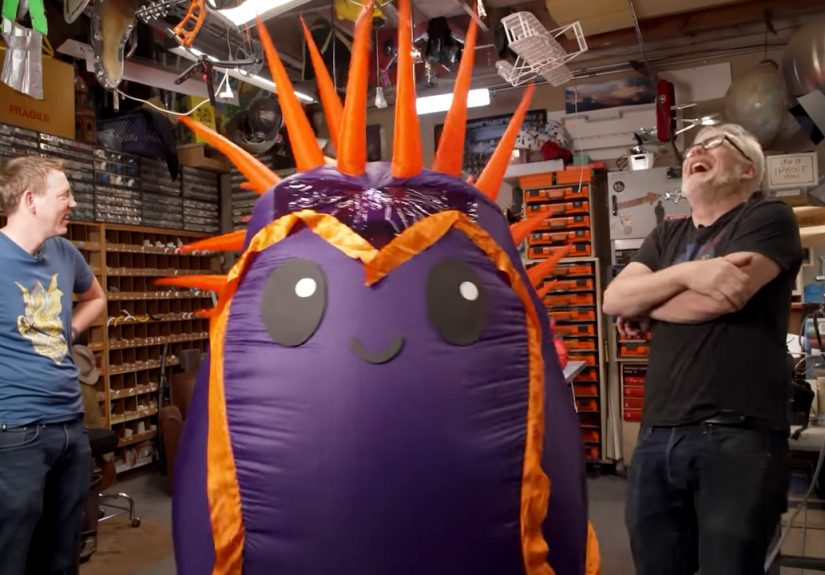
That is why inflatable builds are perfect for concepts that need oversized charm. Think absurdly round monsters, inflatable dragons, blobby mascots, giant food items, alien-abduction gags, bulbous astronauts, puffed-up creatures, or fake muscle suits that look one deep breath away from emotional collapse. Inflatable wearables have even inspired experimental fashion and textured surface work, where makers add pattern, dimensional details, or 3D-printed accents to keep the costume from looking like a plain balloon with commitment issues.
In other words, the humor is not separate from the construction. The air itself becomes part of the joke.
Best Materials for a DIY Inflatable Costume
1. Lightweight synthetic fabric
If you want a costume to inflate efficiently, the fabric has to be light enough for comfortable wear but tight enough to hold shape. That is why makers keep circling back to nylon and polyester. These synthetics are widely recommended for safety and performance, and they show up again and again in both retail costume listings and DIY builds.
Ripstop nylon is especially appealing because it is lightweight, durable, and designed to resist tearing. A reinforced grid helps prevent small damage from becoming dramatic failure, which is exactly what you want when you are trying to avoid becoming “sad deflated dragon” halfway through an event. Specialty ripstop sailcloth goes even further, with tight construction and low porosity that help hold air more effectively.
2. Water-repellent coatings and finishes
Not every inflatable costume needs weather protection, but coatings can help. Water-repellent nylon and taslan-style fabrics can offer a nice balance of breathability, comfort, and resistance to light moisture. They also look cleaner and crisper than many bargain-bin costume textiles. Just remember that “water resistant” is not the same thing as “fully waterproof,” and a costume party in light mist is not the same thing as a thunderstorm ambush.
3. Repair-friendly materials
Inflatable costumes live dramatic lives. They brush door frames, bump chairs, scrape walls, and sometimes lose arguments with zipper teeth. Materials that can be patched quickly are a gift. Ripstop repair tape is a practical backup for emergency fixes, especially on lightweight nylon surfaces. It is not glamorous, but neither is hissing air escaping from your costume’s left butt cheek.
4. Smart inner layers
The costume shell is only half the comfort equation. Underneath, a wicking base layer in nylon or polyester blends can help manage sweat, reduce that trapped-humidity feeling, and keep the inside of the costume cleaner. That sounds minor until you have worn an enclosed costume for an hour and started negotiating with your own pores.
How the Inflation System Does the Real Magic
At the heart of every inflatable costume is a simple truth: it does not need to be airtight, just balanced. The fan pushes air in continuously while the costume leaks a controlled amount out through openings or imperfect seals. That steady flow keeps the shape full while also helping with ventilation.
For many standard builds, a small costume fan is enough. Commercial examples prove the concept every season. But makers also experiment with stronger airflow systems for faster inflation or more dramatic shapes. Make: has highlighted everything from simple fan-driven systems to more custom motor approaches for inflatable wearables, showing how the category can range from Halloween gag to serious fabrication project.
The most important engineering decisions are fan placement, intake protection, and air path. Put the blower where it can draw air without being blocked by fabric, body movement, or costume accessories. Keep it secure. Protect it from loose material. And make sure the inflated chambers actually receive airflow instead of creating weird dead zones that leave one side majestic and the other side emotionally flattened.
Construction Tips That Separate Great Builds From Puffy Chaos
Start with shape, not decoration
Before worrying about color, paint, eyes, horns, or foam details, get the silhouette right. Inflatable costumes succeed from across the room. If the outline reads well in plain fabric, everything else becomes easier.
Pattern big, then test bigger
Inflated forms behave differently than flat sewing patterns. Curves swell. Volume pushes outward. Seams travel visually. Draft with extra testing in mind, and make a mock-up if the concept is complicated. This is one of those times when “close enough” can become “why does my dinosaur look like a haunted beanbag?”
Respect slippery fabrics
Light technical fabrics can be annoyingly slippery under a presser foot. Makers who work with slick materials often rely on basting methods instead of excessive pinning, especially when they want to avoid extra holes. That is useful logic for inflatable costumes too. Cleaner handling leads to cleaner seams, and cleaner seams lead to better inflation.
Seal strategically
You do not need submarine-level sealing for every costume, but selective seam sealing can improve performance. If your design needs stronger air retention, use seam-sealing products appropriate to the fabric. Just test first. Some coatings, glues, and sealers are compatible only with certain materials.
Build access points on purpose
Zippers, battery pockets, fan mounts, and hand exits should feel intentional, not like last-minute panic repairs. A costume that looks perfect but is impossible to enter is less a wearable and more a colorful life lesson.
Safety: The Part That Is Not Funny Until It Is Too Late
Inflatable costumes are entertaining, but they still need practical safety planning. U.S. safety guidance for costumes consistently points to a few big priorities: use flame-resistant materials when possible, keep the costume from dragging, maintain full vision, and improve visibility in low light.
That matters even more with inflatable designs because they are often oversized and attention-grabbing. A huge costume can limit awareness, catch on objects, or drift too close to candles, heaters, jack-o’-lanterns, and other bad ideas wearing festive lighting.
- Choose nylon or polyester fabrics that are appropriate for costume use.
- Avoid huge trailing hems, oversized loose sleeves, or dramatic shapes that sweep the floor.
- Add reflective trim if the costume will be worn outdoors at dusk or night.
- Make eye openings large enough for full vision and keep masks well ventilated.
- Use soft accessories rather than hard or sharp costume props.
- Keep battery packs and blower systems away from excessive heat.
There is also a simple rule that deserves to be framed and hung in every costume workshop: if you cannot see, walk, breathe, or sit down without drama, the costume is not finished yet.
Comfort and Wearability Matter More Than Most Makers Admit
A costume can look spectacular on a mannequin and still be miserable on a human. Inflatable builds trap warmth, concentrate movement around limited openings, and ask the wearer to coexist with a fan humming near their body for long periods. That means comfort is not a bonus. It is part of the design brief.
Start with airflow. The same system that inflates the costume can also improve comfort, but only if it is not blocked. Next, think about the layer worn underneath. Wicking base layers help more than cotton in enclosed costumes because they handle perspiration better. Then consider cleanup. Costume experts recommend drying the inside thoroughly after wear; trapped moisture is a shortcut to odor, funk, and the kind of regret that no amount of glitter can disguise.
Battery management matters too. Keep spare batteries ready. Test run time before the event. Secure the battery pack so it does not bounce like a tiny angry metronome. Reliable power is the difference between a triumphant reveal and a slow-motion deflation that feels suspiciously metaphorical.
Design Ideas That Shine in Inflatable Form
Cartoon creatures
Round monsters, baby dragons, puffy ghosts, marshmallow-style mascots, and alien blobs all benefit from inflatable volume. The softness helps them read as funny instead of threatening.
Illusion costumes
Alien-abduction costumes, fake ride-on animals, absurd muscle suits, and oversized heads use inflation to create visual tricks without heavy frameworks.
Textured inflatables
Adding appliqué, printed patterns, segmented chambers, or lightweight dimensional details can make a costume feel more designed and less like a plain balloon. This is where maker craftsmanship separates “store-bought funny” from “custom unforgettable.”
Fast-build versions
Not every project needs to be a full sewing epic. Some makers chase the inflatable look with streamers, tube-man styling, or simplified forms. It is not the same as a sealed wearable, but it can deliver the same comic energy with less build complexity.
Common Mistakes to Avoid
The first mistake is choosing fabric that is too heavy. The second is choosing fabric that is too leaky. The third is assuming you can solve both problems by believing in yourself harder.
Other classic errors include weak seams, poorly placed fan intakes, no testing under actual movement, tiny eye openings, decorative add-ons that block airflow, and forgetting that doors exist. Inflatable costumes are often wider, taller, and more optimistic than their wearers realize. Build for real-world navigation, not just the mirror selfie.
Another frequent problem is over-decoration. A giant inflatable form already does a lot visually. You do not need to add every trim, gadget, horn, and LED you have ever loved. Pick a few bold details and let the inflated silhouette do its job.
Why This Category Keeps Winning Makers Over
Inflatable costumes sit in a sweet spot between costume design, soft goods fabrication, and physical comedy. They are approachable enough for ambitious DIYers, but open-ended enough for expert makers who want to refine airflow, patterning, texture, and finish. They also reward iteration. Even a slightly wonky version can be hilarious, which is not true for every build category.
That forgiving quality is part of the charm. A flawless inflatable costume is impressive. A slightly awkward inflatable costume is often even funnier. As long as it is safe, wearable, and structurally sound, a little wobble only adds personality. You are not building a stealth aircraft. You are building a puffed-up spectacle meant to delight strangers and mildly confuse neighbors.
Real-World Experiences With Goofy, Poofy Inflatable Costumes
Makers and wearers tend to report the same thing after trying inflatable costumes for the first time: the emotional return on investment is ridiculous. You can spend weeks building a realistic costume and get respectful nods. Or you can spend a shorter time building a giant puffy alien taco and get immediate laughter, photos, high-fives, and at least one person doubling over because they were not ready for your entrance. Inflatable costumes are crowd magnets. They are visual punchlines that work before you say a single word.
The second common experience is surprise at how portable they are. A big foam costume looks impressive at home and miserable in transit. An inflatable costume can look enormous once powered on, then fold down into something that fits in a tote bag, suitcase, or small bin. That practicality becomes a huge advantage at conventions, school events, or parties where changing on-site is easier than arriving dressed like a full-size cartoon turnip.
Then comes the reality check: wearing one is funny, but it is also physical. People often notice the fan sound at first, then stop hearing it after a while. What they do notice is heat buildup, especially if the costume is worn indoors for long stretches. That is why experienced builders care so much about base layers, airflow, and breaks. Even a costume with decent ventilation can feel warm once the room fills with people, music, and the shared body heat of fifty pirates and three questionable superheroes.
Mobility is another memorable lesson. The first time someone tries to sit, climb stairs, squeeze through a doorway, or use a restroom in an inflatable costume, they discover that comedy is not just a design style. It is now a lifestyle. The smartest makers test everyday motions before the event. The less smart makers discover, in public, that their giant inflatable tail has unionized against them.
There is also a social side to the experience. Inflatable costumes tend to invite interaction more than many detailed cosplay builds do. Kids point. Adults laugh. Strangers ask how it works. Friends want to poke it. Someone always asks whether you made it yourself, and that question is one of the most satisfying parts of the whole project. A handmade inflatable costume has the same effect as a good prop or puppet: people instantly recognize that there is cleverness behind the silliness.
Makers also talk about the weirdly satisfying engineering loop. After one successful build, it is hard not to start designing the next one in your head. You begin noticing silhouettes differently. Could that mascot be lighter? Could that dragon be rounder? Could that fan inflate two chambers instead of one? Could that ridiculous concept become even more ridiculous with segmented air pockets and printed scales? Inflatable costumes create that kind of creative momentum because they are playful without being trivial. They solve real design problems while staying gloriously unserious.
And finally, there is the reveal. Every inflatable costume has a tiny theatrical moment when it goes from fabric blob to full character. That transformation never really gets old. It is part engineering demo, part comedy sketch, and part magic trick. People lean in. The shape grows. The room reacts. For a few seconds, everyone becomes eight years old again. That experience alone explains why goofy, poofy inflatable costumes keep earning a place in the maker world.