Table of Contents >> Show >> Hide
- Why the ABCs Matter
- How to Check Airway, Breathing and Circulation in 12 Steps
- Step 1: Make sure the scene is safe
- Step 2: Check for responsiveness
- Step 3: Call 911 and get help moving
- Step 4: Position the person carefully
- Step 5: Open the airway
- Step 6: Check for breathing for no more than 10 seconds
- Step 7: Check circulation the smart way
- Step 8: Control life-threatening bleeding
- Step 9: Start CPR if the person is not breathing normally
- Step 10: If the person is breathing, keep the airway open and monitor
- Step 11: Use the recovery position when appropriate
- Step 12: Reassess constantly until help arrives
- What to Look For During Each Part of the ABC Check
- Common Mistakes to Avoid
- When the ABC Check Is Especially Important
- Final Thoughts
- Experience-Based Lessons: What These 12 Steps Feel Like in Real Life
- SEO Tags
In an emergency, your brain may want to do three things at once: panic, guess, and suddenly remember every medical drama you have ever watched. Sadly, none of those are especially helpful. What is helpful is knowing how to check airway, breathing, and circulation, often called the ABCs of first aid.
The ABC approach gives you a simple, practical order for spotting life-threatening problems fast. First, make sure air can get in. Second, check whether the person is actually breathing. Third, look for signs that blood is circulating and that severe bleeding is not stealing precious time. It is not fancy. It is not glamorous. It is just one of the most useful things an ordinary person can learn.
This guide breaks the process into 12 clear steps, explains what to look for, and points out the mistakes people make when adrenaline turns them into unlicensed chaos coordinators. It is written for general education, not as a substitute for hands-on CPR or first-aid certification, but it will help you understand what to do while waiting for emergency professionals.
Why the ABCs Matter
Airway, breathing, and circulation are the body’s emergency essentials. If the airway is blocked, oxygen cannot get in. If breathing stops, oxygen cannot reach the lungs. If circulation fails, oxygen-rich blood cannot reach the brain, heart, and other organs. In other words, the body runs on a brutally simple policy: no oxygen, no time.
That is why first-aid responders are taught to focus on the most dangerous problems first. A scraped knee can wait. A blocked airway cannot. The ABC method helps you sort urgent from merely dramatic.
How to Check Airway, Breathing and Circulation in 12 Steps
Step 1: Make sure the scene is safe
Before you touch the person, look around. Is there traffic, fire, exposed electricity, falling debris, smoke, water, or anything else that could turn one victim into two? If the area is dangerous, do not rush in blindly. Call 911 and wait for trained help if needed. Hero points are great, but staying alive is still the better strategy.
Step 2: Check for responsiveness
Try to get a response right away. Speak loudly and clearly: “Are you okay?” Tap the person on the shoulder if appropriate. If there is no response, treat the situation as an emergency. A person who is unresponsive may have a serious airway, breathing, or circulation problem even if they look peaceful at first glance.
Step 3: Call 911 and get help moving
If the person is unresponsive, have someone call 911 and bring an AED if one is nearby. If you are alone, call emergency services yourself as soon as possible. Fast activation of EMS matters because first aid is the opening act, not the whole concert. Professional care, oxygen, advanced airway tools, and defibrillation may be needed.
Step 4: Position the person carefully
If you need to assess or perform CPR, place the person on their back on a firm, flat surface when it is safe to do so. If you suspect a head, neck, or spinal injury, move them as little as possible unless remaining where they are would be more dangerous. This is where first aid gets annoyingly realistic: sometimes the best action is careful action, not fast flailing.
Step 5: Open the airway
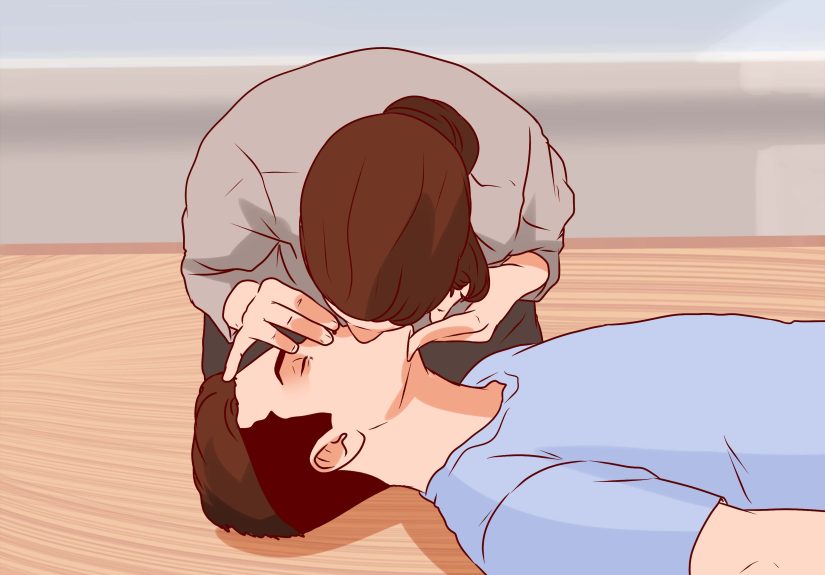
To check the airway, gently tilt the head back and lift the chin. This head-tilt, chin-lift maneuver helps open the airway in many unconscious adults and children. Once the airway is open, look into the mouth for anything obvious blocking it, such as vomit, food, or a loose object.
If you can clearly see a loose obstruction, remove it carefully. Do not do a blind finger sweep. Sweeping around without seeing the object can push it deeper and make a bad problem worse. If trauma is suspected, keep neck movement limited and use extra caution.
Step 6: Check for breathing for no more than 10 seconds
With the airway open, look for chest rise and fall. Listen for normal breathing sounds. Feel for air coming from the nose or mouth. Do this quickly. Do not spend half a minute starring in your own suspense movie. A short check is enough.
Pay special attention to gasping. Occasional gasps, irregular snorts, or agonal breathing are not normal breathing. They are a danger sign. If the person is not breathing normally, you should treat it as a life-threatening emergency.
Step 7: Check circulation the smart way
For most lay rescuers, circulation is not just about hunting for a pulse like you are defusing a bomb with two fingers. It means checking for signs of life and looking for severe bleeding. If the person is unresponsive and not breathing normally, do not delay CPR because you are unsure whether you feel a pulse.
If you are a trained healthcare professional, a pulse check may be part of your assessment, but it should be brief. For most bystanders, the safer rule is simple: no normal breathing means act fast. Also scan the body for major bleeding, because circulation can fail from blood loss even when the airway is open.
Step 8: Control life-threatening bleeding
If you see severe bleeding, apply firm direct pressure with a clean cloth, dressing, or your gloved hand if available. Keep pressure steady. If blood soaks through, add more material without removing the first layer. Massive bleeding can be fatal quickly, so circulation is not just a chapter in a textbook. It is a countdown clock.
In some emergencies, the person may be breathing but losing blood fast. That is why a complete ABC check matters. Airway and breathing are not the whole story.
Step 9: Start CPR if the person is not breathing normally
If the person is unresponsive and not breathing normally, begin CPR right away. Push hard and fast in the center of the chest and use an AED as soon as it becomes available. If you are trained in CPR and rescue breaths, follow your training. If not, hands-only CPR is far better than doing nothing.
This is the point where hesitation becomes the enemy. You do not need perfect conditions. You need action.
Step 10: If the person is breathing, keep the airway open and monitor
If the person is unconscious but breathing normally, continue to watch their airway and breathing closely. Breathing can change suddenly. Keep looking for chest movement, changes in skin color, and any signs that the airway is becoming blocked. Loosen tight clothing around the neck or chest if needed.
Do not assume a quiet person is a stable person. Silence is not a medical report.
Step 11: Use the recovery position when appropriate
If the person is unconscious but breathing normally and you do not suspect spinal injury, place them in the recovery position on their side. This helps keep the airway open and reduces the risk of choking on vomit or fluids. Make sure the head stays tilted slightly back so the airway remains open.
If you suspect spinal injury, keep the person still unless vomiting or another immediate danger forces movement. In that case, roll the whole body together as one unit if possible.
Step 12: Reassess constantly until help arrives
The ABC check is not a one-and-done checklist. Keep reassessing airway, breathing, and circulation until EMS takes over. A person who was breathing a minute ago may stop. A wound that looked manageable may begin bleeding heavily. An open airway can become blocked again. Stay with the person, keep them warm, and keep monitoring.
What to Look For During Each Part of the ABC Check
Airway clues
Look for visible obstruction, snoring sounds, gurgling, choking motions, or vomit in the mouth. Snoring in an unconscious person can mean the tongue is partially blocking the airway. Gurgling can suggest fluid. Both deserve attention.
Breathing clues
Watch the chest. Is it rising evenly? Is breathing slow, fast, shallow, labored, or absent? Are the lips or fingertips turning bluish? Is the person using neck muscles to breathe? Breathing that looks wrong often is wrong.
Circulation clues
Check skin color, temperature, and moisture. Pale, cool, clammy skin can be a warning sign. Look for severe external bleeding. In trained hands, pulse checks can help, but for the average bystander, the key question is whether the person is responsive and breathing normally. If not, act.
Common Mistakes to Avoid
One common mistake is spending too long checking for a pulse. Another is mistaking gasping for normal breathing. People also forget to call 911 early, fail to look for severe bleeding, or put a pillow under the head of an unconscious person, which can actually make the airway worse.
Another classic error is performing a blind finger sweep in the mouth. Unless you can clearly see a loose object, keep your fingers out. Finally, do not leave the person alone, even if they “seem better.” Emergency conditions can change fast.
When the ABC Check Is Especially Important
You should think about airway, breathing, and circulation in cases of collapse, choking, drowning, overdose, seizure recovery, severe allergic reaction, major trauma, head injury, or unexplained unresponsiveness. These are exactly the situations where a calm, fast primary assessment can buy valuable time.
For example, if someone collapses at a gym, your first job is not to diagnose the mystery. It is to check responsiveness, open the airway, check breathing, and start CPR if needed. If someone faints in a restaurant, you still follow the same logic. If a child becomes unresponsive after choking, the same priorities apply. Different settings, same lifesaving order.
Final Thoughts
Learning how to check airway, breathing and circulation is not about becoming a paramedic overnight. It is about being useful in the first few minutes, when useful matters most. The ABCs give you a clear order, a calmer mind, and a better chance of helping instead of freezing.
If there is one takeaway to remember, let it be this: open the airway, check for normal breathing, look for signs of circulation and severe bleeding, and do not delay emergency action when something is clearly wrong. Your job is not to be perfect. Your job is to notice the danger fast and respond.
And if all of this feels important, that is because it is. A short first-aid class can turn this article from knowledge into muscle memory, which is exactly where lifesaving skills belong.
Experience-Based Lessons: What These 12 Steps Feel Like in Real Life
Reading about the ABCs is one thing. Doing them in a real emergency feels very different. Time gets weird. Your hands suddenly seem enormous and unhelpful. Every breath the person takes sounds either too quiet or way too dramatic. That is why experience, even secondhand experience, matters.
One common story comes from youth sports. A parent sees a teenager go down after a collision and rushes over ready to do everything at once. The most effective responders are usually the ones who slow themselves down for five seconds. They check the scene, call for help, and start with responsiveness and breathing instead of immediately moving the person or shouting ten different questions. The lesson is simple: calm is a skill, not a personality trait.
Another real-world pattern happens in offices, stores, and family gatherings. Someone faints, and the room instantly fills with amateur consultants. One person wants water. Another wants to sit the person up. Somebody else decides waving a scented candle near their face is apparently science now. The better response is boring but correct: check airway, check breathing, check circulation, watch for recovery, and call for help when the situation is unclear. Good first aid often looks less dramatic than bad first aid.
People who have faced choking emergencies also talk about how fast the mood changes. One second someone is coughing and embarrassed, and the next second the room is silent in a very bad way. That silence teaches an unforgettable lesson: airway problems can escalate in moments. If a person can cough or speak, encourage coughing. If they cannot breathe, speak, or make sound, the emergency is already in progress. Hesitation feels polite, but action is kinder.
Caregivers of older adults often describe a different challenge: the person may still be breathing, but the airway is partly blocked by position, weakness, vomit, or reduced awareness. In those moments, the recovery position and repeated reassessment make a huge difference. The person is not “fine” just because they are still taking breaths. Breathing has quality, not just quantity.
Even trained people say the same thing after real emergencies: the checklist matters because your brain becomes unreliable under stress. That is why the 12 steps are useful. They give you a script when your thoughts are trying to sprint in six directions. You do not need to be fearless. You need a sequence.
The best experience-based advice may be this: practice saying the steps out loud before you ever need them. Scene safe. Responsive? Call 911. Open airway. Check breathing. Look for severe bleeding. Start CPR if needed. Reassess. Those words can organize a chaotic moment better than raw confidence ever will.