Table of Contents >> Show >> Hide
When period cramps hit, “curling up in a ball and watching three seasons of your favorite show” can feel like the only reasonable treatment plan.
But there’s a gentler option that doesn’t require leaving your comfy clothes: restorative yoga. Slow, supported poses can help your body relax,
ease menstrual pain, and calm your nervous system so you feel a little more like yourself again.
In this guide, we’ll walk through how yoga may help with menstrual cramps, how to practice safely, and four specific restorative yoga poses
you can try right on your bedroom floor. No fancy studio requiredjust a mat (or rug), a few pillows or blankets, and a willingness
to move slowly and listen to your body.
Why Yoga Can Help with Period Cramps
Period cramps (the medical name is dysmenorrhea) happen when the uterus contracts to shed its lining.
Those contractions are driven by hormone-like chemicals called prostaglandins, which can also trigger inflammation and
pain in your lower belly, back, and even your thighs. For some people, underlying conditions like endometriosis or fibroids make cramps even more intense.
Gentle movement and restorative yoga can help in several ways:
- Improved circulation. Slow stretching and supported poses encourage blood flow to the pelvis, lower back, and legs, which may help ease pain and stiffness.
- Muscle relaxation. When you’re in pain, it’s common to clench your abs, glutes, and jaw. Restorative poses teach your body to release that tension instead of guarding against it.
- Stress and cortisol reduction. Chronic stress can make pain feel worse. Deep breathing and mindful movement help calm the nervous system and may lower stress hormones.
- Better body awareness. Over time, yoga can help you notice early signs of tension and cramps so you can respond with heat, rest, or stretching before pain spikes.
Research suggests that yogaespecially when practiced regularlycan reduce menstrual pain and improve quality of life for people with dysmenorrhea.
Even low-intensity yoga a few times a week has been associated with less cramping and better mood. While it’s not a cure-all and doesn’t replace
medical care, it can be a helpful, low-cost tool in your period-care toolbox.
Important: This article is for informational purposes only and is not a substitute for professional medical advice.
Talk with a healthcare professional if your cramps are severe, new, or interfering with daily life, or if you have conditions like
endometriosis, fibroids, or PCOS.
Before You Roll Out Your Mat: Safety and Setup
Create a cozy “restorative” environment
Restorative yoga is all about support and comfort. Instead of “How far can I stretch?” the question becomes,
“How gently can I rest here without strain?” That’s very period-friendly energy.
- Props you can use at home: bed pillows, couch cushions, folded blankets, a firm rolled towel, or a yoga bolster if you have one.
- Temperature: Keep the room warm or add a blanket over you. Warm muscles tend to release more easily.
- Lighting: Dim lights or use a lamp or candle for a calm, sleep-adjacent vibe.
- Timing: Many people like to do these poses at night, before bed, or when cramps flare during the day.
When to be cautious or stop
Yoga should never make your cramps dramatically worse. Stop and talk with a healthcare professional if:
- your pain suddenly spikes or feels sharp and different from your usual cramps;
- you feel dizzy, faint, or unusually short of breath;
- you have heavy bleeding that’s out of character for you;
- you have known pelvic conditions and your doctor has advised against certain movements.
It’s also okay to skip yoga entirely on days when fatigue is overwhelming. Rest is productive.
These poses are here for the days when gentle movement feels like it might help, not when you feel pressured to “push through.”
4 Restorative Yoga Poses for Period Cramps
The four poses below are adapted from restorative yoga practices often recommended for menstrual cramps.
Aim to hold each pose for 3–5 minutes to start, and up to 10–15 minutes if you feel comfortable and supported.
Move slowly in and out of the shapes, and keep your breath easy and natural.
1. Supported Cobbler’s Pose (Supta Baddha Konasana)
This pose gently opens the hips, pelvis, and inner thighs while lightly stretching the lower belly.
Because your upper body is supported, you can soften into the shape and let your breath do the work.
How to do it
- Place a long pillow or folded blankets lengthwise on your mat to create a “ramp” for your back.
- Sit with your lower back against the short end of the pillow or blankets, knees bent, feet flat on the floor.
- Bring the soles of your feet together and let your knees gently open out to the sides, forming a loose diamond shape.
- Slowly lean back and lie down over the pillow, supporting your head and upper back. Adjust until your spine feels evenly supported.
- Slide rolled towels, cushions, or blocks under your thighs if your hips or groin feel strained.
- Rest your hands on your belly or by your sides, palms up. Let your jaw and shoulders relax.
Tips to make it more comfortable
- If your low back feels tight, slide your feet a little farther away from your hips.
- If your chest feels exposed, drape a blanket across your ribs and shoulders.
- Focus on long, gentle exhales, as if you’re sighing tension out of your belly.
2. Supported Bridge Pose (Setu Bandha Sarvangasana)
Supported Bridge is like a friendly upgrade to your usual “pillow under the hips” position.
Elevating the pelvis slightly can ease lower back pressure and create a soothing, gentle stretch across the front of the body.
How to do it
- Lie on your back with your knees bent and feet hip-width apart, soles on the floor.
- Lift your hips just enough to slide a yoga block, stacked books wrapped in a towel, or a firm pillow under your sacrum (the back of your pelvis, just above your tailbone).
- Gently lower your hips onto the support so your weight feels stable and grounded.
- Let your arms rest by your sides, palms up or down, whichever feels more natural.
- Close your eyes and breathe into the space across your lower belly and front hips.
Tips to make it more comfortable
- If your low back feels pinched, use a lower support or move it slightly closer to your tailbone.
- If you feel pressure in your neck, slide your shoulders slightly away from your ears and lengthen the back of your neck.
- Start with 1–2 minutes in the pose and gradually increase as your body gets used to it.
3. Forward Fold Over a Bolster (Restorative Paschimottanasana)
Traditional seated forward folds can be intenseexactly what you don’t want when your uterus is already throwing a tantrum.
This restorative variation lets you drape your torso over props for a soft, comforting stretch along the back body while giving your belly a gentle rest.
How to do it
- Sit on a folded blanket with your legs stretched out in front of you. If your lower back rounds a lot, bend your knees or sit up higher.
- Place a long pillow, rolled blanket, or stack of cushions on your thighs. You want them high enough that your chest and head can rest easily.
- Gently hinge forward from your hips and lower your torso onto the support. Let your arms relax alongside your pillow or loosely hug it.
- Rest one cheek on the pillow. Halfway through your time, turn your head to the other side.
- Soften your belly completely and imagine the muscles around your uterus melting over your thighs.
Tips to make it more comfortable
- If your hamstrings complain, bend your knees and slip a rolled towel under them.
- Build the pillow stack higher rather than forcing yourself lowerthis is a no-strain zone.
- Feel free to place a blanket over your back for extra warmth and grounding.
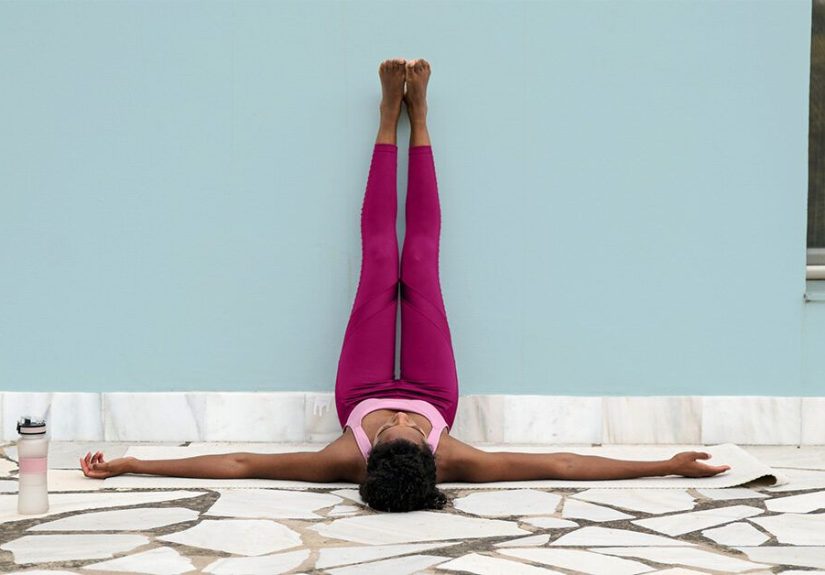
4. Legs-Up-the-Wall Pose (Viparita Karani)
Legs-Up-the-Wall is a classic restorative pose for a reason. It helps drain some fluid from the legs, ease lower back tension, and invite full-body relaxation.
For period cramps, it can feel like a reset buttonespecially when paired with slow, regular breathing.
How to do it
- Place the short end of your mat or a folded blanket against a wall.
- Sit sideways with one hip touching the wall, knees bent.
- Gently roll onto your back as you swing your legs up the wall, so the backs of your legs rest against it.
- Slide your hips away from the wall an inch or two until your low back feels neutral and relaxed.
- Optionally, slide a folded blanket or small pillow under your sacrum for a gentle lift.
- Rest your arms out to the sides, on your belly, or in a comfortable position.
Tips to make it more comfortable
- If the stretch behind your legs is too strong, scoot farther away from the wall or slightly bend your knees.
- If you feel tingling in your feet, bend your knees and slide the soles of your feet down the wall, or come out of the pose slowly.
- Use an eye pillow or cover to encourage deeper relaxation.
Putting It Together: A Simple 20-Minute Sequence
On days when cramps are nagging but not completely knocking you out, you can combine these four poses into a short, soothing flow:
- Supported Cobbler’s Pose – 5 minutes
- Supported Bridge Pose – 3–5 minutes
- Forward Fold Over a Bolster – 5 minutes
- Legs-Up-the-Wall Pose – 5–10 minutes
Move between poses slowly, taking a few neutral breaths in a simple lying-down position before switching.
Keep the focus on comfort, steady breathing, and the sense that you’re doing something kind for your body during a demanding time.
Frequently Asked Questions
Can I do yoga on every day of my period?
Usually, yesas long as you feel up to it and your healthcare professional hasn’t given you specific restrictions.
On heavy or very painful days, restorative poses and deep breathing may feel better than more active flows.
Some days, your body will vote for “blanket burrito” instead of yoga, and that’s okay too.
Are inversions safe during my period?
There’s no strong scientific evidence that gentle inversions (like Legs-Up-the-Wall) are dangerous during menstruation for most people.
However, traditional yoga teachings sometimes suggest avoiding “strong” inversions (like headstands) in the first few days of your cycle.
Ultimately, it comes down to listening to your body and following your provider’s advice, especially if you have any medical conditions.
How often should I practice these poses?
You can use them just during your period or sprinkle them throughout your cycle as a regular relaxation practice.
Many people find that doing restorative yoga a few times a week helps them feel more resilient and better prepared when cramps arrive.
Real-Life Experiences with Restorative Yoga for Period Cramps
If you’ve ever searched “how to get rid of period cramps immediately,” you’ve probably seen everything from chocolate to strange TikTok stretches.
Restorative yoga sits somewhere in the middle of that spectrum: it’s gentle, realistic, andmaybe most importantlydoesn’t require superhuman motivation
when you’re already tired and uncomfortable.
Many people who practice yoga during their period describe a similar pattern. At first, the idea of moving at all feels like too much effort.
Lying still under a heating pad sounds far more appealing than unrolling a mat. But once they commit to just one poseoften something simple like
Legs-Up-the-Wall or Supported Cobbler’s Posethey notice subtle shifts: their breathing slows, their shoulders drop, and the loud, sharp edge of the pain
softens into something more manageable.
One common experience is realizing how much the body “armors up” during cramps. You might notice you’re clenching your jaw, hugging your belly inward,
or tensing your glutes without meaning to. In a supported pose, there’s time and space to gently let those muscles go. You may not feel instant relief,
but a five- or ten-minute reset can make the difference between feeling completely hijacked by your period and feeling like you still have some control.
Another thing people often report is the emotional side of restorative practice. Cramps don’t show up alonethey tend to bring friends like irritability,
low mood, and anxiety. Restorative yoga gives you permission to step out of “productivity mode” and simply rest, without having to fall asleep.
The quiet, repetitive nature of the poses can feel almost like a moving meditation. Even if your pain doesn’t vanish, your relationship to the pain can shift.
Instead of fighting your body, you’re working with it.
Over time, some people find that their whole cycle changes when they build a small self-care ritual around menstruation. That ritual might include
making a cup of tea, lighting a candle, putting on comfy clothes, and doing just two restorative poses before bed. Others like to pair yoga with
practical tools like heating pads, anti-inflammatory foods, or medication recommended by their provider. The yoga doesn’t replace those options;
it complements them, giving your nervous system a chance to downshift when everything feels amplified.
Of course, experiences vary. Some people will feel noticeable relief after one session; others may feel only a slight difference, or none at all.
That doesn’t mean you’re “bad at yoga” or doing it wrongit just means your body has its own story. Severe cramps, especially those caused by conditions
like endometriosis, may need a more comprehensive medical approach. In those cases, restorative yoga can still serve as a supportive practice for stress
and sleep, even if it doesn’t fully solve the pain.
The biggest takeaway from real-life experiences is this: restorative yoga is less about perfect poses and more about creating moments of kindness
toward your body during a time when it’s working very hard. If a few pillows, a quiet room, and 10–20 minutes of supported rest help you feel even
10% better, that’s a win worth keeping in your monthly routine.
The Bottom Line
Period cramps can be frustrating, exhausting, and sometimes downright disruptive. While there’s no single solution that works for everyone,
restorative yoga offers a gentle, low-pressure way to support your body during your cycle. Supported Cobbler’s Pose, Supported Bridge,
Forward Fold over a bolster, and Legs-Up-the-Wall are four accessible shapes that invite your muscles to relax, your breath to slow down,
and your nervous system to calm.
Think of these poses as an act of self-respect, not self-improvement. You’re not trying to “fix” your bodyyou’re giving it a softer landing
during a demanding time. Pair these practices with your healthcare professional’s guidance and any other treatments you use, and you’ll have
a more complete, compassionate plan for navigating your next cycle.