Table of Contents >> Show >> Hide
- What “Yesterday” As It Was really captures
- Why these 7 pics hit so hard
- 1. They turn beauty into proof
- 2. Landscapes can hold memory better than words
- 3. Tradition keeps the past alive without making it dusty
- 4. Exhibition photos remind us that art is social
- 5. The project understands the ache of “before”
- 6. Nostalgia is not fluff; it is emotional technology
- 7. Small archives often outlive big noise
- Why old images matter far beyond this one series
- How to read a visual project like this without rushing past it
- Experiences that make “Yesterday” feel personal
- Conclusion
There are images you glance at for two seconds before your thumb keeps scrolling like it is late for a meeting. Then there are images that stop you cold, tap you on the shoulder, and say, “Hey, remember when ordinary life felt ordinary?” “Yesterday” As It Was (7 Pics) belongs to the second category. It is a small visual series, but emotionally, it swings way above its weight class.
At first glance, the project feels simple: seven images, several paintings, exhibition views, and a quiet sense of reflection. But the title does a lot of heavy lifting. “Yesterday” is not just about the past. It is about the version of life people assumed would continue. It is about routine, beauty, celebration, and the strange heartbreak of realizing that what once felt normal can later look almost unreal. That is why this series lands so hard. It does not beg for attention. It earns it.
In a digital world stuffed with fast takes and faster captions, this set of images feels refreshingly human. It reminds us that art is not always a loud protest sign or a giant theoretical speech wearing a turtleneck. Sometimes art is a field, a ritual, a gallery wall, a remembered landscape, or a room full of people trying to make meaning before the lights change. And sometimes that is exactly what makes it unforgettable.
What “Yesterday” As It Was really captures
The title suggests nostalgia, but not the syrupy kind that shows up in retro ads and says things like, “Remember when cereal tasted better?” This is deeper than that. The emotional charge of “Yesterday” As It Was comes from the gap between then and now. The images point toward life before disruption, before uncertainty swallowed the calendar, before beauty had to compete with survival for mental space.
That tension gives the seven-image series its power. The works do not merely show the past; they preserve a feeling of the past. And that is a crucial difference. Facts tell you what happened. Images tell you what it felt like to stand there, breathe there, celebrate there, and believe there would be a next week that looked roughly like this one. In that sense, these pictures are not just visual objects. They are emotional evidence.
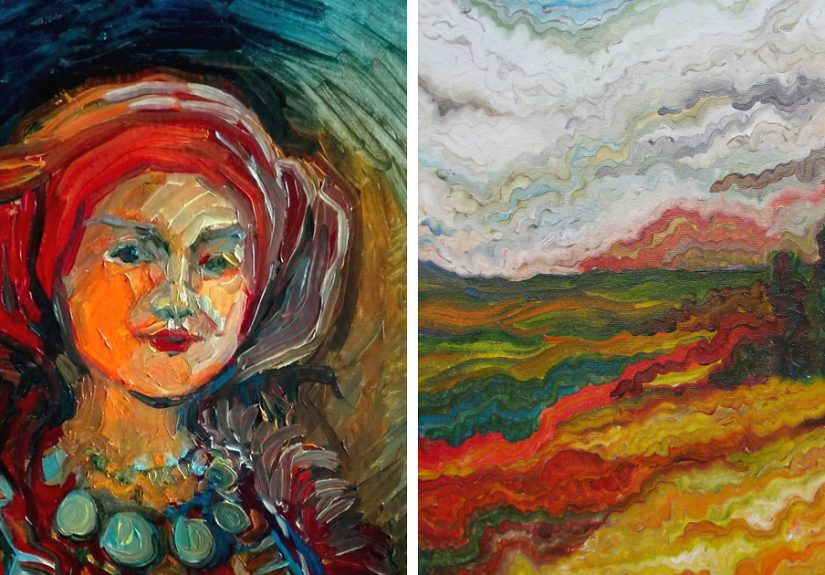
Some of the works featured in the series, including Kolodivna, Kozatsky Prostory, and The Night of Ivan Kupala, carry the texture of memory through landscape, symbolism, and atmosphere. The exhibition views add another layer: art seen not in isolation, but in community. That matters. Paintings on a wall are one thing. Paintings shared with other people, in a room full of fragile hope, are something else entirely.
Why these 7 pics hit so hard
1. They turn beauty into proof
One reason this series works so well is that it makes beauty feel like testimony. A landscape is no longer just a landscape. A painted scene is no longer just color and line. These things become proof that a place was lived in, loved in, celebrated in. They say: this existed, this mattered, this was somebody’s everyday world.
That shift is powerful because people often underestimate ordinary life. We think history is made only of battles, elections, and giant speeches by men standing in stiff jackets. But the real substance of human life lives elsewhere: in rooms, customs, fields, gatherings, songs, and quiet routines. “Yesterday” As It Was understands that instinctively. It gives the viewer something richer than spectacle. It gives the viewer texture.
2. Landscapes can hold memory better than words
Words are wonderful. I say this as someone currently making a living out of sentences. But even I will admit that a single image can sometimes carry what five paragraphs cannot. A road, a horizon, a tree line, a stretch of open land, or a color-soaked sky can communicate belonging faster than explanation ever will.
That is part of what makes the paintings in this series feel so personal. They do not over-explain themselves. They invite you in. They leave room for your own memory to start rummaging around in the attic. Suddenly you are not only looking at someone else’s yesterday. You are thinking about yours: the backyard that is now a parking lot, the family house that got sold, the fairground that felt enormous when you were ten and suspiciously medium-sized when you returned at thirty-two.
3. Tradition keeps the past alive without making it dusty
One of the smartest things about this visual set is how it lets cultural memory breathe. Tradition is often treated like a museum label: important, yes, but maybe a little stiff around the knees. Not here. Here, tradition feels alive. It is not trapped behind glass. It moves through image, symbolism, ritual, and mood.
That matters because living culture is one of the clearest ways a community resists erasure. A painting rooted in place or folklore is not just decorative. It carries inheritance. It says that identity is not an abstract speech topic; it is something people feel in their bodies, celebrations, seasons, and visual language. In other words, culture is not an accessory. It is architecture for memory.
4. Exhibition photos remind us that art is social
The exhibition images in “Yesterday” As It Was are especially striking because they show art in motion, among people, under pressure, in real time. That changes the emotional temperature of the piece. You are not just seeing finished works. You are seeing a moment of gathering, and gathering itself becomes meaningful.
There is something almost rebellious about people choosing to make room for art when the future feels shaky. It says that creativity is not a luxury item stored on the top shelf until conditions improve. It is part of how people remain human. A shared exhibition can be a celebration, a coping mechanism, a declaration of continuity, and a stubborn little light switch flipped on in the dark.
5. The project understands the ache of “before”
The most haunting word in this whole idea may be “before.” Before chaos. Before fear. Before life split into old life and new life. Many of us know that feeling in smaller ways. We talk about life before a move, before a breakup, before a storm, before a diagnosis, before the kids grew up, before the neighborhood changed. “Yesterday” As It Was taps into that universal structure of feeling.
That is why the series feels broader than one story. It opens a door into a human experience almost everybody recognizes: the delayed shock of realizing that a moment was precious only after it became unreachable. Yesterday always looks more organized in hindsight. It never had all its wrinkles ironed out at the time, of course, but memory is an excellent stylist.
6. Nostalgia is not fluff; it is emotional technology
Let us clear something up: nostalgia is not automatically sentimental nonsense. At its best, nostalgia helps people reconnect to identity, continuity, belonging, and meaning. It can be tender without being weak. It can ache without collapsing. And when it is tied to art or photographs, nostalgia often becomes a bridge between private feeling and public understanding.
This is exactly why old images hit differently from ordinary content. They do not just show you something. They pull a thread. Once that thread starts moving, it drags behind it all kinds of things: smell, weather, voices, furniture, music, worries, hopes, jokes, grief. Suddenly one picture is carrying half your emotional attic, and you are standing there pretending you are absolutely not getting misty-eyed over a school hallway or a faded living room curtain.
7. Small archives often outlive big noise
Another reason this project works is that it feels archival in the best possible way. Not dusty. Not stiff. Archival as in: this matters, keep it, remember it, do not let the moment vanish without a trace. That impulse is deeply human. We save photos, ticket stubs, letters, snapshots, screenshots, and family recipes for the same reason. We want proof that our lives were more than deadlines and grocery receipts.
Seven images may not sound like much in an era when people upload more photos before lunch than previous generations took in a year. But curation changes everything. A small, deliberate set can say more than an endless scroll. “Yesterday” As It Was proves that memory does not need to be massive to be meaningful. It just needs to be honest.
Why old images matter far beyond this one series
Part of what makes this project resonate is that it taps into a much larger truth: visual records shape how people understand history. Photographs, paintings, and exhibition images do more than decorate memory. They organize it. They give form to the past. They help communities preserve not only major events, but also the seemingly modest details that explain how people actually lived.
That includes the everyday stuff, which is often the first thing people dismiss and the first thing future generations desperately want back. What did the streets look like? What did people wear to a local show? How were rooms arranged? What colors felt familiar? What rituals filled the year? How did a community represent itself when it was not posing for history books? Images answer those questions with a directness that no summary can match.
That is also why preservation matters so much. Old pictures are fragile. Paintings can be displaced, damaged, or cut off from the communities that gave them meaning. Photographs fade, curl, crack, and disappear. Digital files feel immortal until a hard drive fails, a platform disappears, or a folder named “sort later” becomes a tomb. Memory needs caretakers. Always has.
When people preserve visual culture, they are doing more than saving objects. They are protecting continuity. They are defending the right of future viewers to say, “So that is how it looked. That is how it felt. That is how people kept living.” In that sense, preservation is not passive. It is a form of cultural stubbornness, and sometimes stubbornness is exactly what history requires.
How to read a visual project like this without rushing past it
Look for the emotional weather
Do not just ask what is in the image. Ask what climate it creates. Calm? Defiance? Loss? Celebration? Longing? The emotional weather of “Yesterday” As It Was is a mix of warmth and fracture. That combination is why it lingers.
Notice the ordinary details
Major symbols matter, but tiny details often do the real emotional damage. A wall arrangement. A posture. A patch of open land. The spacing between people in a gallery room. Details are where memory hides, usually with its shoes kicked off.
Pay attention to what the title is doing
The title is not decoration. It is the key. “Yesterday” suggests time, but “As It Was” suggests preservation. Together, they frame the work as an act of witness. The phrase does not say yesterday as we imagine it, romanticize it, or market it. It says yesterday as it was. That is an important distinction.
Let your own memories answer back
The best visual projects are not one-way lectures. They start conversations. This one does exactly that. It invites viewers to place their own yesterdays beside the images and ask what they still carry, what they have lost, and what they want preserved before it slips away.
Experiences that make “Yesterday” feel personal
Most people do not need an art degree to understand why a series like this works. They only need a past. Think about what happens when you open an old family photo album. At first, you are practical. You are identifying faces, dates, hairstyles that clearly committed crimes against common sense. Then, out of nowhere, a single image gets you. Maybe it is your mother in a kitchen that no longer exists, with a wallpaper pattern so specific it practically starts talking. Maybe it is your grandfather standing beside a car the size of a submarine. Maybe it is a birthday party in a living room with wood paneling, paper hats, and one cousin making the exact same weird expression he still makes today. Suddenly, the room changes. You are no longer just looking. You are visiting.
That is the real magic of yesterday. It does not arrive as a lecture. It sneaks in through detail. The bowl on the table. The scuffed shoes. The curtain fabric. The hand on someone’s shoulder. That is why visual art and old photographs feel so intimate. They restore texture. And texture is what memory misses most. We do not just miss people and places. We miss the atmosphere around them. We miss how a room sounded, how summer light hit the porch, how everyone seemed too busy living to realize they were making the stuff nostalgia would later feed on for decades.
A lot of readers will recognize this feeling from community exhibits, local museums, or even social media posts where someone shares “old photos of our town.” You click for one picture and end up staring at ten. The grocery store sign is different. The street is wider than you remembered. The diner is still there in the picture but gone in real life. And then you have the oddest emotional reaction of all: grief mixed with gratitude. Grief because the moment is gone. Gratitude because somebody bothered to save it.
There is also something deeply relatable in seeing art made before everything changed. People who have lived through moves, breakups, natural disasters, political turmoil, or family upheaval know this feeling well. You look at an object from “before” and realize it carries more than beauty. It carries innocence, assumption, continuity. It reminds you of the version of yourself that did not yet know what was coming. That is not weakness. That is human awareness catching up with time.
And maybe that is the deepest reason “Yesterday” As It Was stays with people. It does not just show a past moment. It recreates the shock of recognizing that a past moment was once a present one. Someone painted that field, planned that exhibition, hung that work, stood in that room, and fully expected tomorrow to exist. We all live like that until life reminds us otherwise. So when we respond to images like these, we are not only honoring one artist’s memory. We are defending our own fragile archives too. The little boxes in closets. The digital folders. The shoebox snapshots. The saved screenshots. The paintings on walls. The evidence of life, still saying softly, stubbornly: this was here.
Conclusion
“Yesterday” As It Was (7 Pics) succeeds because it does something many visual projects fail to do: it makes the past feel immediate without flattening it into cliché. It treats memory as living material. It understands that art can preserve not only appearance, but atmosphere. It shows that beauty, routine, and cultural identity are never trivial. In difficult times, they become part of the record of what must not be erased.
More than anything, the series reminds us that yesterday is not valuable because it is gone. It is valuable because it was lived. And when artists preserve that fact through image, they give viewers something rare: a way to feel time, not just measure it. That is why seven pictures can carry the weight of something much larger. They do not merely show what was. They help protect it.