Table of Contents >> Show >> Hide
- Manila Clams in One Minute
- Why Are They Called “Manila” Clams?
- How to Identify Manila Clams
- Where Do Manila Clams Live?
- Are Manila Clams the Same as Littleneck Clams?
- How Manila Clams Eat (And Why That Matters)
- How Manila Clams Are Farmed
- Is Eating Manila Clams Sustainable?
- How to Buy Fresh Manila Clams (Without Playing “Shellfish Roulette”)
- How to Store Manila Clams at Home
- How to Cook Manila Clams (The Delicious Part)
- Shellfish Safety: The Stuff You Should Actually Take Seriously
- Frequently Asked Questions About Manila Clams
- Experiences Around Manila Clams (Real-Life Moments You’ll Recognize)
- 1) The “clam digging workout” you didn’t sign up for
- 2) The moment you realize clams are better at hiding than you are at searching
- 3) The “we should’ve brought a cooler” lesson
- 4) The kitchen scene where “a little grit” becomes “why is my soup crunchy?”
- 5) The first successful steam pot (and the instant bread shortage)
- 6) The “one clam that won’t open” debate
- 7) The “check advisories first” habit that sticks for life
- Conclusion
Manila clams are the little overachievers of the shellfish world: small enough to fit in your palm,
tough enough to live where the ocean literally disappears twice a day, and tasty enough to make a pot of
garlic-butter broth feel like a special occasion. If you’ve ever ordered “steamers” or “littlenecks” at a
seafood spot and wondered what, exactly, showed up in the bowl (besides the world’s most persuasive invitation
to buy crusty bread), you’re in the right place.
In this guide, we’ll break down what Manila clams are, how to recognize them, where they live, why they’re so
widely farmed, how to cook them without turning dinner into a science experiment, and what safety tips actually
matter. No fluff, no weird “robot voice”just the clam facts (with a side of fun).
Manila Clams in One Minute
Manila clams (often called Japanese littlenecks) are a type of bivalve molluska two-shelled
shellfish related to oysters and mussels. Their scientific name is Ruditapes philippinarum.
They’re famous for being sweet-briny, quick to cook, and well-suited to aquaculture, especially along the U.S.
West Coast.
Why people love them
- Flavor: clean, mildly sweet, and pleasantly briny.
- Size: small enough to cook fast and serve in big, satisfying piles.
- Versatility: steam, grill, toss into pasta, or drop into chowder.
- Farming-friendly: they don’t need feed like fish or shrimpmore on that soon.
Why Are They Called “Manila” Clams?
The name can be a little confusing. “Manila” points to the clam’s broader native range in the western Pacific,
while “Japanese littleneck” is a common market name in North America. Either way, this species is
not originally from the Pacific Northwesteven though it’s now a major part of West Coast shellfish
culture and cuisine.
Native home vs. U.S. home
Manila clams are native to East Asia and became widely cultivated for food. Over time, they were introduced to
other regions (including parts of North America) largely because they grow well and are popular to eat.
Today, you’ll commonly see them associated with tidal flats and shellfish beds in places like Washington’s
protected bays and inlets.
How to Identify Manila Clams
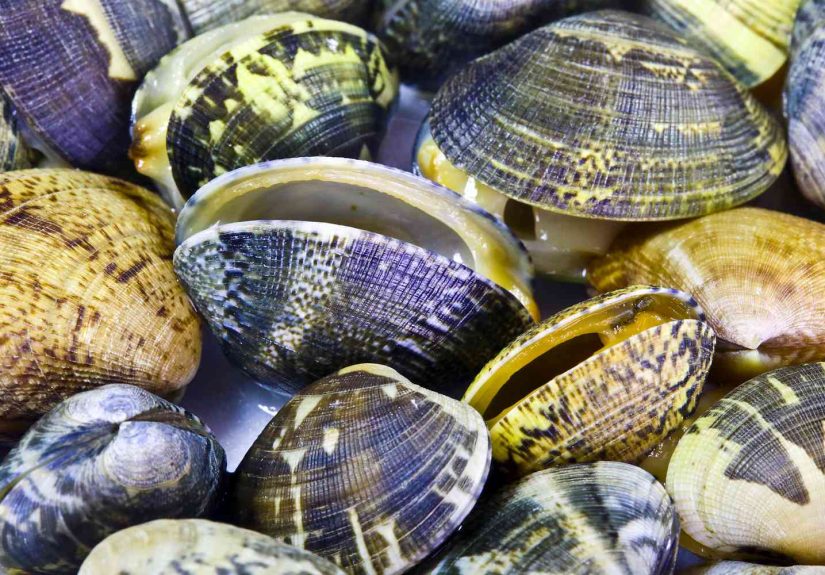
Manila clams are basically the “patterned socks” of the clam aisle: their shells often show bold streaks or
angular markings, and the surface has a texture that can look like a subtle crosshatch or lattice.
They’re typically oblong rather than perfectly round and can grow up to about
3 inches long.
Key visual features
- Shape: oblong/oval, sometimes slightly squared at the ends.
- Shell texture: concentric rings plus radiating lines that create a lattice-like look.
- Color: variableoften streaked or patterned; interiors can show purple or yellow tones.
- Hinge detail: the front/lower side of the hinge tends to be indented compared with some native littleneck species.
If you’re clamming recreationally, use local identification guidesbecause “close enough” is a risky strategy
when the ocean is handing out look-alikes.
Where Do Manila Clams Live?
Manila clams are intertidal specialists. Translation: they’re happiest in zones that are underwater at high
tide and exposed at low tide. They typically burrow a few inches down into sandy, gravelly, or muddy
substrate and extend siphons to feed and breathe while staying safely tucked away.
Favorite neighborhoods
- Protected bays and inlets with stable beaches
- Mixed sediments (think sand + gravel + mud + bits of shell)
- Middle intertidal zones where they can feed regularly but avoid constant pounding surf
They can tolerate being out of water during low tide by “clamming up” (closing their shells to hold moisture).
It’s like packing a lunchbox for a commuteexcept the commute is “the ocean left for a few hours.”
Are Manila Clams the Same as Littleneck Clams?
“Littleneck” can describe a size class of clams in restaurants, and it can also refer to certain types
of clams depending on the region. In the Pacific Northwest, you’ll often hear about native littlenecks
and Manila littlenecks as related but different clams. Manila clams are commonly farmed and sold
widely, while native littleneck clams may be discussed separately in local regulations and ecology.
Quick practical takeaway
If a menu says “littlenecks,” you might be eating Manila clamsespecially on the West Coastbut the label isn’t
always precise. If you need a sure answer (allergies, sourcing, curiosity, bragging rights), ask the fishmonger
or the restaurant.
How Manila Clams Eat (And Why That Matters)
Manila clams are filter feeders. They pull water in through a siphon, use their gills to capture
tiny food particles (mainly phytoplankton), and then expel the filtered water. This feeding style is a big reason
clams can be considered a lower-input seafood choice: they don’t need formulated feed the way many farmed fish do.
The bonus and the caution
Filter feeding can be an ecological plusshellfish can help remove particles from the water column. But it also
means clams can accumulate hazards present in their environment, including certain bacteria, viruses,
and algal toxins. That’s why shellfish safety rules and harvest closures are such a big deal.
How Manila Clams Are Farmed
Along parts of the U.S. West Coast, Manila clams are a major aquaculture species. Farming methods vary by location,
but the basic idea is straightforward: raise young clams (often from hatcheries), plant them in suitable intertidal
areas, protect them from predators, and harvest them when they reach market size.
Common farming steps (simplified, not a license application)
- Seed production: juvenile clams are produced in hatcheries or collected, then prepared for planting.
- Planting: seed is placed in intertidal areas with the right sediment and water flow.
- Predator protection: netting is often used to reduce losses to crabs, birds, and other hungry locals.
- Grow-out: clams feed naturally and grow over months/years depending on conditions.
- Harvest: frequently done during low tides, using hand tools or farm-specific methods.
In many Pacific Northwest settings, Manila clams can reach a harvestable size in roughly a couple of years,
depending on conditions like temperature, food availability, sediment, and predator pressure.
Is Eating Manila Clams Sustainable?
Sustainability isn’t a single yes/no stickerit’s a collection of questions. How are they farmed? Do they harm
sensitive habitats? Are there pollution concerns? What about escapes into places they aren’t native? The good news
is that many farmed clam operations are considered relatively low-impact compared to high-feed,
high-waste aquaculture, because clams don’t require feed inputs and can be grown with modest infrastructure.
Why clams often score well
- No feed required: they eat naturally occurring plankton.
- Low freshwater use: marine farming doesn’t rely on irrigated crops for feed.
- Efficient protein source: you get nutrient-dense seafood with minimal processing.
What to watch for
- Habitat interactions: gear placement and beach modification can affect eelgrass and other habitats.
- Water quality closures: pollution events can shut down harvest areas.
- Non-native species concerns: in some regions, Manila clams are monitored as introduced species.
If you want the simplest consumer move: buy from reputable sellers, pay attention to region-specific guidance, and
choose sources with transparent handling and compliance practices.
How to Buy Fresh Manila Clams (Without Playing “Shellfish Roulette”)
Manila clams are usually sold live in the shell. Freshness is everythingbecause “live seafood” is the rare food
category where “still alive” is actually a feature, not a customer service complaint.
Shopping checklist
- Smell: should be clean and ocean-like, not sour or “low-tide dumpster.”
- Shells: should be mostly closed, or close when tapped (a sign the clam is alive).
- Storage at the store: kept cold and moist (not sitting in fresh water).
- Broken shells: skip heavily cracked clams.
How to Store Manila Clams at Home
Clams are not houseplants. They don’t want sunshine, they don’t want a bowl of tap water, and they definitely
don’t want to “soak overnight” like beans. Keep them cold, breathable, and used fairly soon.
Simple storage rules
- Refrigerate in a breathable container (a bowl with a damp towel works).
- Don’t seal them airtightlive clams need to breathe.
- Use them promptly for best quality.
How to Cook Manila Clams (The Delicious Part)
Manila clams cook fast. That’s great for dinner and also great for your ego because it’s hard to overthink a meal
that finishes in minutes. The classic approach is steaming: heat + flavorful liquid + lid on the pot until most
shells open.
Classic steamed Manila clams
- Base: olive oil or butter
- Aromatics: garlic, shallot, chili flakes
- Liquid: white wine, beer, or broth
- Finish: lemon, parsley, crusty bread (mandatory, spiritually)
Tip: when shells open, don’t assume “done” means “stop immediately.” Many food safety guidelines emphasize that
shellfish should be cooked thoroughlyso give them enough time/heat to finish properly, not just “pop open.”
Shellfish Safety: The Stuff You Should Actually Take Seriously
Manila clams are wonderfuluntil they aren’t. Safety comes down to two big categories:
bacteria (like Vibrio) and toxins (from harmful algal blooms). They’re different,
and your strategy should be different too.
1) Vibrio (bacteria): handle cold, cook well
Vibrio bacteria occur naturally in marine waters and multiply faster in warm conditions. Illness is commonly
associated with eating raw or undercooked shellfish and with poor temperature control after harvest.
The fix is unglamorous but effective: keep shellfish cold and cook them thoroughly.
- Cook shellfish thoroughly rather than relying on “the shells opened” as your only cue.
- Prevent cross-contamination (hands, cutting boards, and sinks matter).
- If you’re harvesting recreationally, don’t leave clams baking in the sunchill them fast.
- High-risk individuals (immunocompromised, certain chronic conditions) should avoid raw shellfish.
2) Algal toxins: you can’t “cook them out”
During harmful algal bloom events, shellfish can accumulate toxins that may not be destroyed by freezing or
cooking. That’s why monitoring programs and closures existand why “but I boiled it” is not a reliable safety plan.
Always check current advisories before harvesting, and pay attention to recalls and regional alerts.
What about regulations and monitoring?
In the U.S., shellfish safety is supported through federal-state cooperation and programs designed to reduce risk
as shellfish move through commerce. Recreational harvest areas are also monitored by state health authorities, and
closures are used to protect the public when conditions change.
Frequently Asked Questions About Manila Clams
Do Manila clams taste “fishy”?
Fresh Manila clams should taste briny and slightly sweet, not fishy. Strong off-odors can indicate poor handling
or age.
Are they safe to eat raw?
Eating raw shellfish always carries risk. Many public health agencies advise cooking shellfish thoroughly,
especially for people at higher risk of severe illness.
Why do some clams not open when cooked?
Sometimes a clam was already dead before cooking; sometimes it’s just stubborn. Many food safety guidelines say
to discard shellfish that don’t open during cooking. When in doubt, throw it outno one wants to lose a weekend
to a clam that refused to cooperate.
Experiences Around Manila Clams (Real-Life Moments You’ll Recognize)
Manila clams aren’t just “food”they’re a whole set of experiences that can range from wholesome coastal fun to
mildly chaotic kitchen comedy. If you’ve ever watched someone try to look graceful on a muddy tidal flat, you
already know what I mean. Here are some common Manila clam experiencespart practical, part “welcome to the ocean.”
1) The “clam digging workout” you didn’t sign up for
On paper, clam digging sounds gentle: stroll a beach, find clams, go home. In reality, it can feel like a
full-body circuit routine designed by a personal trainer who lives inside a sandcastle. You bend, you squat,
you dig, you carry a bucket that mysteriously gains five pounds every three minutes, and you learn that “soft sand”
is a polite way of saying “ankle trap.” The first time out, people often underestimate the tide schedule and
overestimate how long their lower back will remain cheerful.
2) The moment you realize clams are better at hiding than you are at searching
Manila clams burrow. That’s their thing. Many new diggers start by poking randomly like they’re searching for lost
keys in a couch. Then someone more experienced points out the subtle signstiny siphon holes, slightly firmer patches
of sand, or the way certain areas consistently produce. After that, it’s like your brain switches from “beach day”
to “clam detective.” You begin noticing everything. You also begin suspecting the clams are laughing.
3) The “we should’ve brought a cooler” lesson
A classic rookie mistake is treating harvested clams like souvenirs. They are not souvenirs. Clams need to stay
cold after harvesting, especially in warm weather. Many people learn this after a drive home with the windows down,
the sun blasting, and a bucket of clams having a tiny heatwave party in the trunk. The fix is simple: plan ahead
with ice or a cooler and treat temperature control like it’s part of the recipebecause it is.
4) The kitchen scene where “a little grit” becomes “why is my soup crunchy?”
Manila clams can carry sand. If you’ve ever taken a bite and felt that unmistakable crunch, you’ve met the reason
people talk about purging. Home cooks often run experiments: salted water, time in the fridge, changing the water,
and hoping for the best. Sometimes it works beautifully. Other times, you learn a deeply personal truth:
grit always shows up when you’re trying to impress someone.
5) The first successful steam pot (and the instant bread shortage)
There’s a specific joy in opening a lid and seeing shells popped wide like tiny theater curtains. The broth smells
like garlic, herbs, and victory. Then you realize you didn’t buy enough bread. This is nearly universal.
People also discover that Manila clams turn any casual dinner into a “we should light a candle” meal, even if the
candle is actually just the stove burner you forgot to turn off.
6) The “one clam that won’t open” debate
Every clam cook eventually faces the same tiny drama: one shell stays shut. Is it dead? Is it shy? Is it making a
philosophical statement about boundaries? In real kitchens, this becomes a group discussion, followed by either a
cautious toss or a second attempt at cooking. Most experienced cooks adopt a simple rule: if it won’t open, it
doesn’t get to join the party.
7) The “check advisories first” habit that sticks for life
Coastal communities treat shellfish advisories seriously, and many recreational harvesters build a routine around
checking closures before heading out. Once you’ve seen a beach posted as closedor heard about a toxin event or
bacterial riskyou tend to remember. It becomes part of the ritual: tide chart, license (if required), gear,
and the latest safety updates. It’s not just about following rules; it’s about protecting your friends and family
from problems that no amount of lemon juice can fix.
Taken together, these experiences are why Manila clams have such a strong place in coastal food culture: they’re a
meal, a memory, and sometimes a mild adventure story you tell while rinsing sand out of your shoes.
Conclusion
So, what are Manila clams? They’re small, patterned, sweet-briny bivalves (a.k.a. Japanese littlenecks) that thrive
in intertidal habitats and have become a major shellfish species in West Coast aquaculture and cuisine. They’re easy
to love because they cook quickly and taste greatbut they also demand a little respect: proper handling, thorough
cooking, and attention to harvest advisories, especially during warm months or harmful algal bloom events.
If you remember just three things: buy them alive and fresh, keep them cold,
and check local safety updates when harvesting. Do that, and Manila clams will reward you with the
kind of meal that makes you wonder why you don’t cook shellfish more often (right up until you realize you need more
bread).