Table of Contents >> Show >> Hide
- Violence as Policy: Why Punishment Was Central to American Slavery
- Top 10 Horrible Punishments For Slaves In America
- 10. Whipping: The “Everyday” Terror
- 9. Mutilation: Marking Bodies for Life
- 8. Branding: Human Beings as Livestock
- 7. Smoked Alive in the Smokehouse
- 6. The Hogshead: A Barrel Turned into a Weapon
- 5. Suspended Beneath a Cooking Fire
- 4. Demotion or Sale: Punishment Without a Whip
- 3. Public Burnings and Spectacle Violence
- 2. Long-Term Chaining and Iron Collars
- 1. Forced Reproduction and Sexual Violence
- What These Punishments Reveal About American Slavery
- Experiences and Reflections on “Top 10 Horrible Punishments For Slaves in America”
The phrase “horrible punishments for slaves in America” sounds like the setup for a dark history podcast, but this isn’t entertainment – it’s the machinery that kept an entire system of racial slavery running. Under American slavery, violence wasn’t a glitch; it was the operating system. Owners, overseers, and slave codes all relied on deliberate, public, and often inventive cruelty to keep millions of people terrified and under control.
Listverse’s “Top 10 Horrible Punishments For Slaves In America” rounds up some of the most shocking examples of that cruelty. In this article, we’ll walk through those punishments one by one – whipping, mutilation, branding, suffocating smokehouses, and more – and place them in the wider context of American history. The goal isn’t to gawk at pain, but to understand how calculated terror powered slavery and how its legacy still echoes today.
We’ll lean on historians, museum collections, slave narratives, and legal histories to unpack how these punishments worked, who ordered them, and what they were meant to achieve. It’s uncomfortable reading, but that discomfort is exactly why it matters.
Violence as Policy: Why Punishment Was Central to American Slavery
In colonial America and the early United States, “slave codes” – special laws controlling enslaved people – gave owners sweeping power to punish. These codes explicitly allowed whipping, branding, maiming, imprisonment, and even execution for a wide range of “offenses,” from running away to “insolence.” Slavery was a system in which one group of people legally owned another; the threat of punishment was the everyday glue holding that system together.
Plantation records and newspaper ads show that enslaved people could be punished for working “too slowly,” speaking their own languages, learning to read, traveling without a pass, or even for being suspected of resistance. Because enslaved people were also considered valuable property, owners walked a twisted line: punish hard enough to terrify, but not so hard that they destroyed what they viewed as an “investment.” In practice, that line was crossed constantly.
First-person narratives by formerly enslaved people – like those of Frederick Douglass, Harriet Jacobs, Moses Roper, and William Wells Brown – confirm what historians have reconstructed from laws and plantation records: torture was not rare or exceptional. It was routine.
Top 10 Horrible Punishments For Slaves In America
10. Whipping: The “Everyday” Terror
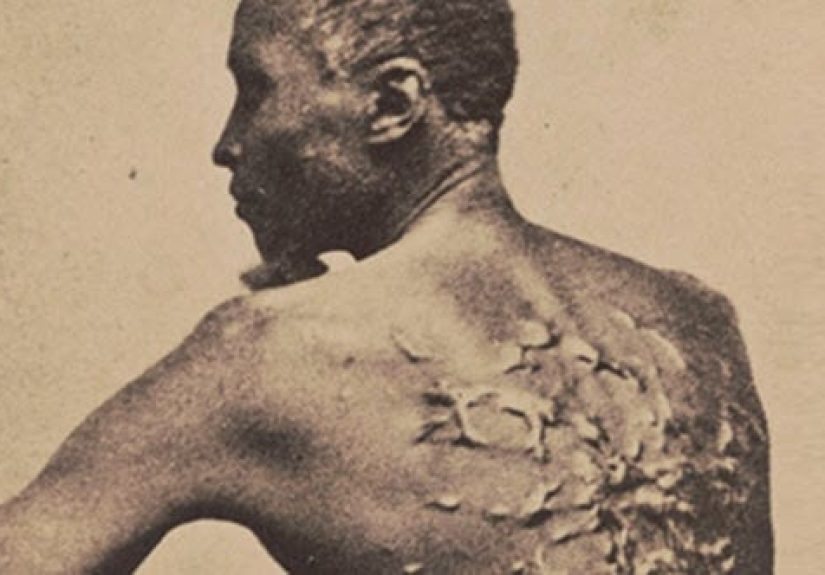
If there is a single image that captures American slavery, it’s the famous photograph of an enslaved man whose back is covered in raised scars from repeated whippings – the body literally turned into a record of violence. Whipping (or flogging) was the default punishment on plantations: a reflex response for overseers whenever they wanted to “correct” behavior or speed up work.
Slave codes often specified how many lashes were allowed for different “offenses,” but those limits were weakly enforced. Some enslaved people described being tied to a post, tree, or even the ground while being whipped with rawhide or other instruments. Salt, pepper, turpentine, or other substances were sometimes rubbed into the wounds to intensify pain and prevent infection just enough to keep the person alive.
Whipping worked as both physical punishment and public messaging. Other enslaved people were forced to watch, turning one person’s agony into a warning for everyone else.
9. Mutilation: Marking Bodies for Life
Mutilation – cutting off ears, fingers, toes, or other body parts – was another way enslavers tried to break resistance. Historians have documented cases where “troublesome” or repeatedly runaway slaves had their ears cropped or faces slashed to make any future escape nearly impossible to conceal.
Some enslaved people were hamstrung – tendons in the legs cut – to prevent running. Others endured even more severe forms of mutilation, including castration, especially when sexual control and humiliation were part of the punishment. Listverse highlights these acts not as rare horrors, but as punishments owners resorted to when they wanted to make an example of someone.
This kind of punishment did double duty: it inflicted immediate pain and permanently branded a person as “defiant,” inviting further abuse wherever they went.
8. Branding: Human Beings as Livestock
Branding – searing a mark into flesh with a hot iron – was widely used in the Atlantic slave trade and continued on American soil. Enslaved people might be branded with initials, symbols, or letters on the shoulders, chest, or even the face.
In some regions, laws explicitly allowed branding as punishment for running away. New Orleans, one of the major slave markets in the United States, was notorious for this practice. Branding turned a person’s body into a legal document: proof of ownership and a permanent criminal “record” that could never be erased.
Museum collections today preserve branding irons, shackles, and other tools of torture – stark physical reminders that “property” in enslaved bodies was backed up by fire and iron, not just paper and law.
7. Smoked Alive in the Smokehouse
One particularly chilling punishment involved using the plantation smokehouse – normally a place to cure meat – as a torture chamber. Enslaved people could be bound, whipped, and then subjected to choking smoke from tobacco stems or other fuels, essentially being “smoked” alive.
Formerly enslaved writer William Wells Brown described this method as a common practice in parts of Virginia, where owners used smokehouses to extend suffering over time, mixing suffocation, heat, and confinement. It was a way to torture without necessarily leaving as many visible scars, though the internal damage and trauma were immense.
The smokehouse punishment shows how everyday farm structures could be turned into instruments of terror, reminding us that slavery twisted even ordinary spaces into sites of violence.
6. The Hogshead: A Barrel Turned into a Weapon
Moses Roper, who escaped slavery and wrote about his experiences, recalled a slaveholder who hammered nails into a large barrel (a hogshead) so the points stuck through the inside. Enslaved people could be forced into that barrel and rolled down hills, the nails tearing at their flesh with every rotation.
Tortures like this weren’t just punishment; they were also “sport” for some enslavers, who watched and laughed as people were injured for their amusement. Roper’s account undercuts any romantic idea that brutality was rare or reluctantly used – for some owners, it was entertainment.
The hogshead is a reminder that creative cruelty doesn’t require high technology. It only requires a mindset that refuses to see enslaved people as human.
5. Suspended Beneath a Cooking Fire
Harriet Jacobs, who spent years hiding in a tiny attic crawl space to escape the sexual predation of her owner, shared stories of nearby enslavers whose “favorite” punishments involved suspension over fire.
One horrifying method: tie a person up, suspend them near a cooking fire, and roast meat overhead so the hot fat dripped down onto their bare skin. This turned domestic work – cooking – into an instrument of deliberate torture.
Jacobs’ testimony is crucial because it reveals both the physical brutality and the psychological terror of living in constant fear that routine household activities could suddenly become lethal.
4. Demotion or Sale: Punishment Without a Whip
Not all punishments relied on visible violence. Sometimes the most devastating blows were social and economic. Enslaved people working in the house, in skilled trades, or in relatively “privileged” positions could be demoted to field labor as punishment for displeasing an owner.
Others were punished by being sold “down the river” to harsher plantations or to owners with reputations for extreme cruelty. Frederick Douglass described how enslaved people who resisted or were deemed “unmanageable” could be whipped and then sold to slave traders as a warning to others.
Demotion and sale weaponized relationships. Being torn from family, community, and even the relative familiarity of a particular plantation was a fear so great that the mere threat of sale could keep many people from risking open resistance.
3. Public Burnings and Spectacle Violence
Public burning was one of the most extreme punishments used against enslaved people, especially in the context of alleged uprisings or “plots.” People might be tied to stakes or placed over fires in front of crowds that mixed enslaved people, free whites, and sometimes free Black spectators forced to attend.
The purpose wasn’t just to kill; it was to stage a spectacle. Public punishments – including burnings, hangings, and later lynchings – were designed to communicate power and erase any illusion that Black lives might be protected by law or morality.
These events blurred the line between execution and community entertainment, illustrating how deeply normalized racial terror became in American public life.
2. Long-Term Chaining and Iron Collars
Chains were part of slavery from the moment of capture and transport, but long-term chaining was also used as punishment for repeated attempts to escape or for “stubbornness.” Enslaved people could be chained to workstations, to other workers, or forced into iron collars with spikes or bells that made movement painful and escape nearly impossible.
Museums like the Bullock Texas State History Museum and national collections preserve iron collars and shackles used on enslaved people; some collars included bells so that every movement announced the wearer’s presence. Enslaved people themselves described how these devices made sleep, work, and travel excruciating.
Over time, chained labor would also become associated with chain gangs in the post-slavery prison system, showing how the methods of control in slavery didn’t disappear – they mutated.
1. Forced Reproduction and Sexual Violence
One of the most devastating “punishments” – and ongoing practices – in American slavery was forced reproduction. After the U.S. banned the importation of enslaved Africans in 1808, slaveholders in the South increasingly relied on the “domestic slave trade,” which meant they had a financial incentive to force enslaved women (and sometimes men) into repeated pregnancies.
Enslaved women were routinely subjected to sexual assault by owners, overseers, and others. Enslaved men could be forced to have sex with specific partners chosen for perceived “breeding” qualities, with no regard for their wishes or relationships. In many cases, refusal or resistance to these demands brought other brutal punishments.
Forced reproduction turned people’s bodies and children into profit streams. It was a form of punishment and a business strategy at the same time – a chilling example of how slavery combined economic calculation with total disregard for bodily autonomy and family bonds.
What These Punishments Reveal About American Slavery
Looking at these ten punishments together, patterns emerge. Torture was not random; it was structured, legal, and often publicly endorsed. Slave codes spelled out harsh penalties, courts frequently turned a blind eye to cruelty, and communities normalized the use of terror to protect white economic and political power.
At the same time, the very existence of such extreme punishments tells us something else: enslaved people never stopped resisting. Owners didn’t chain, burn, whip, and mutilate people for fun alone (though some certainly did it for sport); they did it because enslaved people ran away, sabotaged work, preserved culture, and fought back in ways big and small.
Today, museums, memorials, and scholarship in the United States work to make these histories visible and to connect them to ongoing issues like mass incarceration, police violence, and racial inequality. The punishments may be historical, but the logic of using violence and confinement to control Black lives did not vanish in 1865.
Experiences and Reflections on “Top 10 Horrible Punishments For Slaves in America”
So what does it feel like to sit with a list like this – whether on Listverse or a history site – and really let it sink in? Most people don’t finish reading about these punishments and think, “Well, that was a fun listicle.” They feel heavy, angry, or numb. That emotional whiplash is part of confronting a system that combined everyday life with industrial-scale cruelty.
Visiting museums or historic sites that address slavery can make this history even more real. Standing in front of an iron collar or a slave whip in a glass case, you’re suddenly aware that these aren’t metaphors – they touched skin, sliced flesh, and shaped generations. Some visitors describe feeling physically sick, others say they finally understand why enslaved people risked everything to escape.
Reading firsthand narratives is another kind of experience entirely. When you hear Frederick Douglass calmly explain how a central plantation building functioned like a “seat of government” for punishment and sale, or Harriet Jacobs describe years spent hiding in a cramped attic to avoid sexual abuse, it’s hard not to rethink every soft-focus plantation image you’ve ever seen. The stories move punishment out of the realm of abstract “horrors” and into the lives of specific people who thought, loved, and hoped – just like we do.
In classrooms across the U.S., teachers increasingly use these sources, along with artifacts and legal documents, to help students connect dots between past and present. Discussing whipping or branding is uncomfortable, especially with younger students, but many educators argue that discomfort is necessary to understand why topics like racial justice, policing, and reparations are so charged today.
There’s also a growing public conversation about how these histories appear in popular media. When a site like Listverse presents “Top 10 Horrible Punishments For Slaves in America,” it can be a gateway for people who might not otherwise search out a scholarly article. But it also raises hard questions: How do we talk about torture without turning it into clickbait? How do we balance attention-grabbing headlines with deep respect for the people who suffered?
One healthy response is to treat lists like this as a starting point, not the final word. Curious readers can follow references to museum collections, academic research, and slave narratives to get a fuller picture. That might mean exploring online exhibits from institutions that preserve artifacts of slavery, reading modern histories that center Black voices, or listening to descendants talk about how family stories of whip scars, forced sale, or sexual violence still circulate today.
Ultimately, learning about horrific punishments for enslaved people isn’t about memorizing a list of gruesome facts. It’s about reshaping how we understand American freedom and democracy. The same country that celebrates ideas like “liberty” and “equality” also built wealth and institutions on the backs of people held in bondage and kept in place by calculated cruelty.
If there’s a “takeaway experience” worth holding onto, it’s this: whenever we face modern debates about race, justice, or inequality, we’re not starting from a blank slate. Behind today’s arguments stand centuries of whips, collars, branding irons, smokehouses, and forced reproduction. Knowing that history doesn’t solve today’s problems, but it does keep us from pretending that they came out of nowhere – or that they can be fixed without confronting the violence that shaped the United States in the first place.