Table of Contents >> Show >> Hide
- The First Plot Twist: The Stars Don’t Really Hit Each Other
- Why Collisions Trigger Star Formation (AKA: How to Make a Galaxy Panic-Bake Stars)
- What It Looks Like: A Multiwavelength “Glow-Up”
- Real Examples: Famous Galactic Pileups and Their Star-Forming Signatures
- How Astronomers Tell the Star Formation Story
- Do All Collisions Cause Starbursts?
- What This Means for the Milky Way (Yes, We Have an Appointment with Andromeda)
- Conclusion: The Beauty Is in the Physics
- Experiences: How to “See” Star Formation in Colliding Galaxies (Without Owning a Space Telescope)
- SEO Tags
If you’ve ever watched two cars meet at an intersection and thought, “Wow, that’s a lot of crumpling,” you’re already halfway to understanding
galaxy collisionsminus the airbags, plus a few billion stars and a whole lot more drama. When galaxies collide, they don’t usually “smash” in the
way your brain wants them to. Instead, they interweave, tug, stretch, and stir each other’s gas until vast regions of space light up with
newborn stars.
And the best part? We can actually see the process happening. Not in real time (galaxies move on “geologic time, but for the universe”), yet clearly
enough to piece together a compelling story: gravity pulls the strings, gas does the heavy lifting, and star formation is the confetti cannon that goes off
when the pressure gets ridiculous.
The First Plot Twist: The Stars Don’t Really Hit Each Other
Here’s the cosmic secret nobody tells you at the planetarium concession stand: in most galaxy collisions, individual stars almost never collide.
Galaxies are huge, but they’re also mostly empty space. So what’s actually “colliding” is the stuff between the starsgas and dust cloudsplus the
gravitational fields that yank everything into new shapes.
Think of two swarms of bees passing through each other. The bees rarely bonk heads, but the swarm patterns change, the airflow gets weird, and suddenly
the whole thing reorganizes. In galaxies, that “reorganization” is what sets off the fireworks: gas gets compressed, shocked, and funneled into dense pockets
that collapse into star-forming regions.
Why Collisions Trigger Star Formation (AKA: How to Make a Galaxy Panic-Bake Stars)
Star formation needs cold, dense gasespecially molecular hydrogen tucked inside giant molecular clouds. Left alone, gas in a normal spiral galaxy forms stars
at a modest pace. But when another galaxy shows up and starts yanking on the gravitational steering wheel, the gas doesn’t just politely stay in its lane.
It piles up, sloshes inward, and gets squeezed into conditions that make gravity’s job way easier.
1) Tidal Forces: The Universe’s Least Gentle Massage
As galaxies pass close, tidal forces stretch them into long tails and bridges. These dramatic features are not just pretty; they’re evidence that gravity is
redistributing mass and momentum. As gas is pulled and torqued, it can lose angular momentum and drift inward, feeding dense central regions primed for
starbursts.
2) Shocks and Cloud Collisions: When Gas Has a Bad Day
Gas clouds aren’t like starsgas is squishy and collisional. When streams of gas slam together, they create shock fronts, increase pressure, and can trigger
rapid cooling in dense pockets. The result is a sudden boost in the number of places where gravity can win the tug-of-war and collapse gas into stars.
3) Pressure Cooker Environments: Building Star Clusters on “Hard Mode”
In collision zones, the interstellar medium can become a high-pressure mess. That’s excellent news if you want to form massive clusters. Under extreme
pressure, star formation can become more efficient and more concentrated, leading to compact, bright clusters packed with young, massive stars.
What It Looks Like: A Multiwavelength “Glow-Up”
If you only look at colliding galaxies in visible light, you’ll miss half the plot. Star formation is a multiwavelength eventdust hides the earliest stages,
hot gas and stellar remnants shine in X-rays, and cold molecular fuel glows at millimeter wavelengths. To really see “what star formation looks like,” you
want a band tour: optical, infrared, X-ray, and radio/mm.
Optical: Blue Knots and Pinkish Nebulae
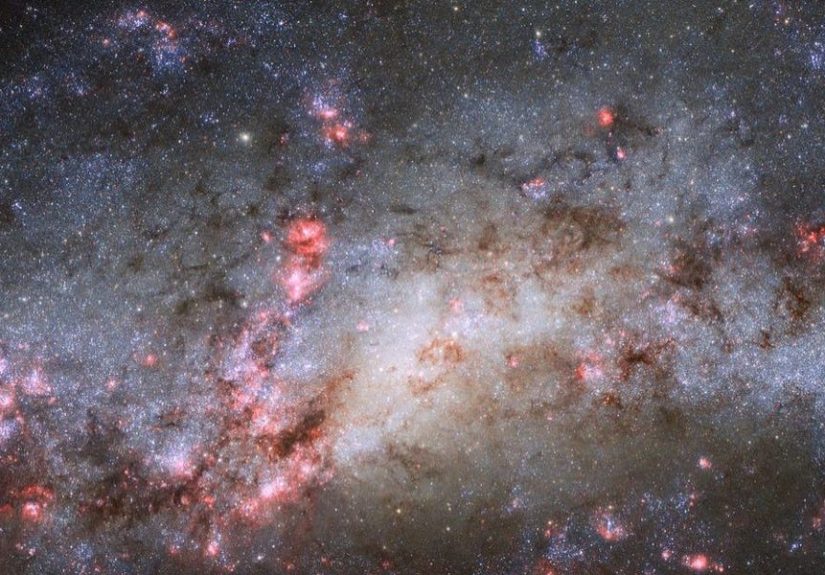
In optical images, collision-triggered star formation often shows up as bright blue knotsyoung star clusters full of hot, short-lived massive stars.
You may also see reddish or pinkish patches from ionized hydrogen regions (H II regions), where ultraviolet radiation from newborn stars makes surrounding
gas fluoresce. If a merger were a city, the optical view is the neon nightlife: loud, bright, and very young.
Infrared: Dust Lifts the Curtain
Infrared is where colliding galaxies become brutally honest. Many star-forming regions are wrapped in dust, and dust is excellent at blocking visible light
while reradiating energy in the infrared. Modern infrared observatories can reveal embedded starbirth sites, glowing dust lanes, and complex structures where
gas is being compressed and rearranged. This is often where you realize the collision isn’t just “two galaxies with tails”it’s a whole ecosystem of
star formation happening behind the scenes.
X-ray: The Aftermath, the Feedback, the “Spicy” Physics
Star formation isn’t quiet. Massive stars blow strong winds, explode as supernovae, and heat surrounding gas to millions of degrees. X-ray images trace
hot gas bubbles and energetic point sources (like X-ray binaries involving neutron stars or black holes). In many interacting systems, you’ll see sprawling
hot gas structures that reveal where feedback is reshaping the star-forming environment.
Radio and Millimeter: The Fuel Map
Want to know where future stars will form? Follow the cold molecular gas. Observations at radio and millimeter wavelengths can trace molecular clouds and
the distribution of star-forming “raw ingredients.” In collisions, these maps often show gas piled up in ridges, arms, overlap regions, or central zonesexactly
where the visible and infrared images show star formation lighting up.
Real Examples: Famous Galactic Pileups and Their Star-Forming Signatures
The Antennae Galaxies: A Star Cluster Factory (With a High Failure Rate)
The Antennae Galaxies are the poster children of collision-driven star formation: two spirals in the process of merging, flinging out long tidal tails
like cosmic ribbons. In their overlap regionwhere gas and dust are strongly disturbedstar formation ramps up and produces dense, bright clusters.
Many of these are “super star clusters,” meaning they’re unusually massive, compact, and luminous compared to typical open clusters.
Here’s a fun (and slightly tragic) detail: even when collisions produce loads of clusters, many don’t survive long as bound clusters. They disperse as
stellar winds, supernova feedback, and internal dynamics kick in. The stars still exist, of coursethey just stop living in a tidy cluster neighborhood and
become part of the galaxy’s background population. In other words: the universe is great at making star clusters, and also great at immediately stress-testing them.
IC 2163 and NGC 2207: A Grazing Encounter with “Dozens” Energy
Not every collision is a head-on demolition derby. Some are more like a high-speed graze that still manages to throw everything off balance. In the system
of IC 2163 and NGC 2207, the interaction distorts spiral structure and rearranges gas into star-forming regions across the disks. Multiwavelength views reveal
dusty star-forming pockets and bright young regions where gas has been compressed by the encounter.
Systems like this are especially helpful because they show how increased star formation can happen outside the center tooalong arms, in dust lanes, and in
regions shaped by tidal forces. It’s a reminder that collisions don’t just “turn on” star formation in one location; they can turn a whole galaxy into a
complicated, patchy star-making machine.
Stephan’s Quintet: When a Galaxy Group Gets a Sonic Boom
Stephan’s Quintet is less “two galaxies collide” and more “a whole neighborhood gets involved.” In this compact group, gravitational interactions and a
fast-moving intruder galaxy create large-scale shocks in intergalactic gas. The result is a spectacular environment where shock fronts, turbulence, and
disturbed gas coexist with bursts of star formation.
What makes this example especially fascinating is that it highlights a nuance: shocks can both trigger and complicate star formation. On one hand, compressing
gas can encourage collapse. On the other, strong turbulence can also keep gas stirred up and prevent it from settling down into star-forming clouds. Stephan’s
Quintet is a vivid illustration that “more violence” doesn’t always translate to “more stars everywhere”it depends on where the gas ends up and what state it’s in.
M82 and Its Neighborly Drama: A “Fossil Starburst” Memory
Not all collision-driven star formation is happening right now in front of our eyes. Some galaxies carry the aftermath like a scaror like a very bright
scrapbook page. M82 is a classic starburst system influenced by interactions with its neighbor M81. Observations of clusters in M82 help astronomers reconstruct
the timeline of past interaction-triggered star formation episodes. It’s a reminder that collisions can have long-lasting consequences: bursts of star formation,
feedback-driven outflows, and a galaxy that looks forever changed by an ancient gravitational argument.
Tidal Tails and “String of Pearls” Cluster Formation
The tidal tails flung out during mergers aren’t just decorative. In some cases, they host their own star formationsometimes in clumpy sequences that resemble
a “string of pearls.” These chains of clusters can form where gas fragments under gravity along the tail, creating repeating pockets of star birth.
It’s a gorgeous example of order emerging from chaos: gravity taking a messy, stretched-out gas structure and turning it into a patterned series of nurseries.
How Astronomers Tell the Star Formation Story
Colliding galaxies are like crime scenes, and astronomers are the detectives with a very fancy toolkit. They estimate star formation rates using tracers like
ultraviolet light (young stars), hydrogen emission lines (ionized gas), and infrared luminosity (dust heated by star formation). They “age date” star clusters
by comparing colors and spectrayoung clusters are dominated by hot, blue stars, while older ones redden as the most massive stars die off.
They also study the fuel. Observations of molecular gas reveal whether starbursts are driven mainly by an increase in dense gas, changes in star formation
efficiency, or both. In the most dust-enshrouded, intensely star-forming mergersoften luminous infrared galaxiesthe energy budget can be dominated by
infrared output because dust is catching starlight and re-emitting it.
Do All Collisions Cause Starbursts?
Noand that’s one reason this topic stays interesting even after the thousandth gorgeous image. Whether a collision triggers a huge starburst depends on
geometry (head-on vs. grazing), gas content (gas-rich galaxies are more dramatic), and timing (different stages of a merger produce different results).
Sometimes turbulence and feedback can actually suppress star formation in certain regions, even as other regions flare up.
In short: galaxy collisions are not a single recipe. They’re more like reality TV. Same premise every time (“two galaxies enter!”), wildly different outcomes.
What This Means for the Milky Way (Yes, We Have an Appointment with Andromeda)
Our Milky Way is expected to merge with Andromeda in the far future on multi-billion-year timescales. Will it trigger star formation? Probably some increase,
though the details depend on how much cold gas is available at that time and how the encounter unfolds. Either way, it won’t be a “Hollywood crash” of stars
collidingmore like a drawn-out gravitational dance where gas gets rearranged, new structures form, and star formation changes its pace.
Conclusion: The Beauty Is in the Physics
Star formation in colliding galaxies looks like bright clusters, dusty ridges, glowing nebulae, and hot gas bubblesbut the visuals are really just the
surface of a deeper story. Collisions reorganize galaxies from the inside out: they redistribute gas, create shocks, build dense clouds, and sometimes ignite
starbursts that can reshape a galaxy’s future. The next time you see a pair of galaxies with long tidal tails, remember: you’re not just looking at a pretty
picture. You’re looking at gravity doing architectureand gas turning that architecture into stars.
Experiences: How to “See” Star Formation in Colliding Galaxies (Without Owning a Space Telescope)
Most of us can’t pop outside with a backyard telescope and watch star clusters ignite inside the Antennae Galaxies (unless your telescope budget is
“small nation’s GDP”). But you can have surprisingly hands-on experiences with this topicbecause modern astronomy is as much about exploring data
and imagery as it is about standing under the night sky.
One of the most satisfying experiences is comparing the same interacting system across wavelengths. Start with an optical image and you’ll notice blue
star clusters sprinkled like confetti across distorted arms. Then switch to an infrared view and suddenly the galaxy looks like it’s wearing a different outfit:
dust lanes become the main character, embedded star-forming pockets appear, and regions that looked “quiet” in visible light reveal that they were just
hiding behind a dust curtain. If you’ve never done that side-by-side comparison before, it feels like learning a new senselike realizing you’ve been watching
a movie on mute and someone just turned the sound on.
Another experience is learning to recognize collision “signatures” the way birders recognize species. After a while, tidal tails stop being generic
“pretty streaks” and become clues: a bridge suggests strong interaction, a messy overlap region hints at gas compression, and an unusually bright central core
can suggest gas being funneled inward. The payoff is that your brain starts reading these images as narratives instead of wallpapers. You’re no longer seeing
“two galaxies,” you’re seeing “two galaxies in the middle of a complicated negotiation over where all the gas is allowed to live.”
If you want a more sky-and-heart kind of experience, visit a planetarium show or astronomy museum exhibit focused on galaxy evolution. The best ones
don’t just show images; they explain what’s happening physicallywhy dust matters, why hot gas glows in X-rays, and why newborn star clusters are such
powerful clocks for reconstructing merger timelines. It’s one of those rare topics where the visuals are jaw-dropping and the explanation makes the
visuals even better. Understanding the physics doesn’t demystify it; it upgrades it.
For the creatively inclined, there’s also an “experience” in translating these systems into your own languagesketching the shapes, writing a short story
where gravity is the villain (or matchmaker), or even building a simple visualization of tidal tails and gas inflows based on what you learn. The humor here
writes itself: galaxies don’t collide like bumper cars; they collide like two swirling crowds trying to pass in a hallway while carrying giant bags of flour
that burst open at the slightest bump. The “flour” is gas, the mess is dust, and the cleanup crew is star formationshowing up everywhere you didn’t expect.
Finally, there’s a quiet, surprisingly personal experience: realizing that cosmic collisions are normal. They’re not rare accidents; they’re part of how
galaxies grow and change. In the early universe, collisions were more frequent, and many galaxies built their stellar populations through repeated interactions.
So when you look at a colliding pair today, you’re not just seeing a spectacleyou’re seeing a process that helped shape the universe’s history, including the
long chain of events that eventually made galaxies like ours possible. It’s hard to look at a tidal tail the same way after that. It stops being a pretty arc
and becomes a timeline you can almost feel.