Table of Contents >> Show >> Hide
Most people survive the daily commute by doing one of three things: scrolling, zoning out, or pretending they are absolutely not eavesdropping on the person loudly explaining crypto to a stranger. Illustrator October Jones took a much better route. Instead of letting train time dissolve into the usual blur of station names and tired faces, he turned fellow commuters into cartoonish characters with a few well-placed doodles and a wicked sense of timing. The result is playful, oddly affectionate, and far more entertaining than staring at a subway ad for tooth whitening.
What makes this series so memorable is not just the visual joke. It is the way it transforms ordinary public transit into a tiny stage where everyday people suddenly become superheroes, washed-up mascots, grumpy storybook icons, or delightfully unhinged comic-book side characters. In one image, a stressed rider can feel like a perfect Hulk. In another, a blank commuter stare somehow becomes the exact emotional range of a Monday-morning Mickey Mouse. The magic is quick, visual, and incredibly human.
That is why these 21 pictures work so well online. They are funny at first glance, but they also tap into something deeper: the weird theater of commuting. Trains, buses, and subways are places where strangers share a space, a mood, and a temporary story without ever speaking. Artists have been fascinated by that energy for years, and this series captures it with the kind of comic precision that makes you laugh, then immediately send it to a friend with the message, “This is exactly what my train looks like.”
The Artist Behind the Commuter Cartoons
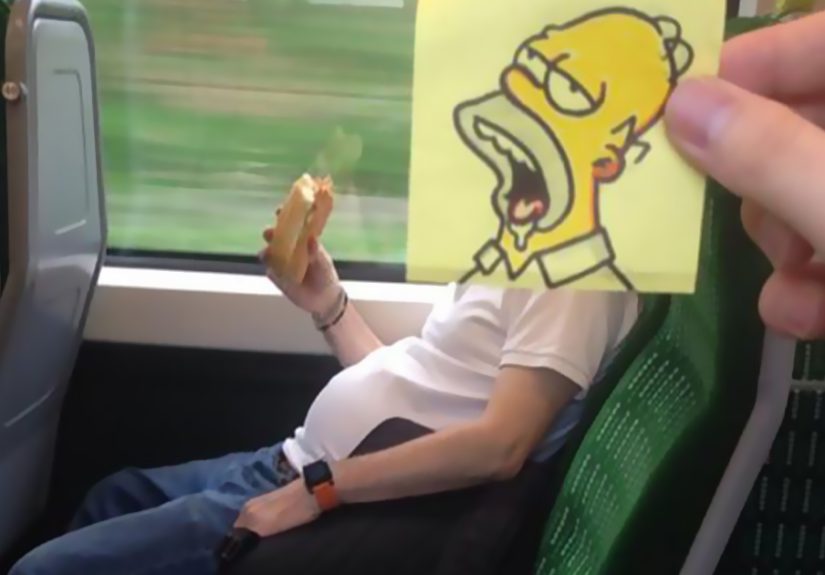
October Jones, the online persona of illustrator and animator Joe Butcher, became widely known for turning fellow passengers into improvised cartoon characters during train rides. His method was simple, which is probably part of its genius. He would draw expressive faces on sticky notes, line them up with unsuspecting commuters, snap the image, and suddenly a sleepy office worker looked like a battle-worn cartoon legend. It was low-tech, clever, and absolutely perfect for the internet.
There is a lesson here for creators of every kind: you do not always need a studio, a giant budget, or a dramatic backstory. Sometimes all you need is a marker, a Post-it note, and the ability to spot that one guy across the aisle who somehow already looks like he has been through three reboots and a questionable streaming spin-off.
Butcher’s commuter cartoons stand out because they do not feel mean. They are observational, yes, but not cruel. The humor comes from recognition and exaggeration, not humiliation. He is not mocking people for being tired, stylish, awkward, or eccentric. He is simply noticing that public transit already contains every possible character type. He just nudges them one inch further into comic-book territory.
Why the idea instantly clicked online
The internet loves visual mashups, but this concept had extra fuel. First, it was easy to understand in half a second. Second, it used familiar pop-culture references. Third, it made boredom feel productive. Viewers were not just looking at a joke; they were watching an artist win a small creative battle against dead time. That is satisfying in a deeply modern way. Everyone has had a dull commute. Not everyone has the nerve or imagination to turn it into a cartoon gallery.
Why These 21 Pics Are So Addictive
There is a reason you can keep scrolling through a gallery like this much longer than you planned. These images rely on a handful of visual tricks that are simple in structure but powerful in effect.
1. Instant recognition
When a familiar character face appears on an ordinary body, your brain solves the joke immediately. Batman on a train is funny. Batman looking mildly inconvenienced on a train is funnier. Batman looking like he missed his stop because someone was blocking the doors? That is art.
2. The body does half the work
What makes many of these commuter cartoons land is that the real passenger is already giving the character most of what it needs. A hunched posture, crossed arms, a long coat, a defeated slouch, or a thousand-yard stare can do more storytelling than a full animation sequence. The sticky-note face is just the finishing touch.
3. Public transit is full of accidental drama
Commuting is repetitive, but it is never visually empty. You get strange lighting, unusual angles, mismatched outfits, frozen expressions, and a rotating cast of people who all seem to be living in different genres at the exact same time. One rider is in a legal thriller. Another is in a sci-fi reboot. The person by the door is somehow in a very depressing children’s cartoon.
4. The humor feels universal
You do not need to know a specific station, city, or route to get the joke. A commute is a commute. Fatigue is global. So is the face people make when someone starts playing audio from their phone without headphones. These cartoons travel well because the emotional language is universal.
What the Gallery Really Captures
Even without reproducing every image here, the spirit of the 21-picture set is easy to understand. Across the gallery, viewers see a parade of commuters transformed into familiar cartoon, comic, and pop-culture archetypes. Some become superheroes with terrible timing. Others resemble storybook favorites who clearly have not had enough coffee. A few look like villains who are, frankly, too tired to do anything villainous before 9:00 a.m.
The fun comes from contrast. Cartoon characters are usually exaggerated, noisy, and larger than life. Commuters are trapped in the opposite mode: contained, silent, inward, and committed to pretending nothing strange is happening. Merging the two creates instant tension. The cartoon face says chaos. The body language says “I still have four stops left and then a meeting.” That mismatch is where the laugh lives.
It also helps that many of the character choices feel emotionally accurate. A rider leaning forward in frustration can become the Hulk without much effort. A scruffy, weary expression can echo a rough-around-the-edges Winnie the Pooh. A suspicious sideways glance can become a superhero having the worst Tuesday of his career. These are not random overlays. They are tiny acts of visual casting.
The commuter becomes a character, not a punchline
That distinction matters. Great visual humor does not flatten people; it reveals something about them through exaggeration. In these images, the commuter remains a person, but the doodle highlights an attitude, mood, or accidental aura they were already carrying. That is why the series feels more observational than invasive. The artist is not forcing a joke onto the scene. He is uncovering one that was already there, hiding between a scarf, a posture, and a fluorescent train light.
The Bigger Tradition of Commuter Art
October Jones’s work feels fresh, but it also belongs to a bigger creative tradition. Artists, photographers, illustrators, and public-art programs have long treated the commute as more than a logistical headache. Trains and subways are where cities reveal themselves at close range. That is why so many creators return to them again and again.
Street photographers have used subway cars to document mood, style, class, intimacy, exhaustion, and urban rhythm. Illustrators have turned cramped platforms and crowded carriages into covers, visual essays, and sketchbook studies. Public-art programs in transit systems have spent decades trying to make the trip feel less like a delay and more like a shared cultural space. Even the smallest piece of creativity can interrupt commuter autopilot and remind people they are still awake, still observant, and still surrounded by stories.
That context makes Butcher’s sticky-note drawings more interesting than a one-off gag. They sit in the same broad family as sketchbook subway portraits, transit mosaics, poetry in motion, and illustrated covers about commuting life. His version is simply the most mischievous cousin at the reunion.
Why commuters make such compelling subjects
People in transit are full of contradiction. They are together but separate, visible but private, moving yet temporarily stuck. Their guard is down, but their expressions are often unreadable. That tension is gold for artists. On a commute, people are not posing. They are inhabiting themselves. They are tired, distracted, focused, irritated, dreamy, anxious, or blissfully detached. In other words, they are already halfway to becoming characters.
What Creators Can Learn From This Series
This gallery is also a sneaky masterclass in content creation. It proves that originality often comes from format, not from inventing a brand-new universe. Butcher did not need elaborate world-building. He took an everyday setting, added a consistent visual rule, and repeated it with enough variation to keep it surprising.
That is a smart formula for modern storytelling. Take something familiar. Add one strange but readable twist. Make it repeatable. Make it visually clear. Make it short enough to share. Then make sure the tone feels human rather than mechanical. The commuter cartoons succeed because they feel observed, not mass-produced.
For bloggers, illustrators, meme makers, and digital creators, there is another lesson here too: constraint can be a gift. A train carriage is a limited space. A sticky note is a limited canvas. A commuter pose lasts only a moment. Those limitations force sharp decisions, and sharp decisions usually make better art than endless options.
Why People Keep Coming Back to These Images
Part of the answer is obvious: they are funny. But the bigger reason is that they rescue something dull and make it memorable. A commute is usually framed as lost time. These cartoons argue the opposite. They suggest that boring moments are often just under-edited scenes waiting for the right artist.
There is also comfort in seeing the public commute treated with affection. Transit life is often discussed in the language of delays, crowds, smells, noise, and inconvenience. All true, of course. Heroically true. But there is another side to it. Trains are also one of the last places where people from wildly different corners of a city end up sharing a frame. That makes them visually rich, socially strange, and artistically irresistible.
So yes, the gallery is funny because a tired passenger can look uncannily like a scruffy cartoon bear. But it lingers because it says something hopeful: even on the most repetitive route, imagination can still board the train.
Experiences That Make This Series Feel So Real
Anyone who has taken public transit long enough knows the peculiar feeling this kind of artwork captures. You step onto a train early in the morning, and the whole car seems to be running on half a battery. Nobody is speaking. Somebody is guarding a coffee like it contains the secret to civilization. Another person is staring into the middle distance with the intensity of a philosopher who has just remembered they forgot to send an email. You do not know these people, but for twenty minutes, they are your cast.
That is what makes commuter-based art so satisfying. It turns a familiar but emotionally slippery experience into something visible. The commute often feels like a suspended zone between private life and public performance. You are dressed for work or school, but your mind is still at home. You are physically surrounded by strangers, but mentally miles away. And all around you are people doing the same thing in completely different styles. One person is serene. One is spiraling. One looks like they have already lived three days before 8:30 a.m.
When an illustrator turns those riders into cartoonish characters, it feels less like invention and more like translation. Suddenly the woman holding the pole with dramatic determination does look like a superhero preparing for impact. The man slumped into his scarf really does resemble a retired cartoon icon who has seen some things. The teenager by the door, all limbs and attitude, absolutely belongs in an animated reboot with a cult following and a confusing soundtrack.
The best part is that commuters themselves probably recognize the truth in it. Most people have had the experience of looking around a train and privately assigning genres to everyone in the car. That couple arguing in whispers? Prestige drama. The guy eating something from a foil wrapper at 7:12 a.m.? Psychological thriller. The person doing makeup with impossible precision as the carriage shakes like a shopping cart with one broken wheel? Action movie with elite fine-motor control.
These experiences are funny because they are shared. You may not know another rider’s name, job, or destination, but you know the expression of someone who has accepted that the train will be delayed. You know the posture of a person pretending not to notice they are being stared at by a toddler. You know the look of someone who wants to sit but is too polite to ask if that backpack deserves its own seat. Commuting creates a silent library of gestures, and artists like October Jones simply check those gestures out and return them in a more colorful form.
That is why the series hits home. It does not just show funny pictures. It captures the tiny rituals, emotional weather, and accidental performances that make public transit feel exhausting, ridiculous, communal, and weirdly alive. It reminds us that even in the most routine part of the day, there is character everywhere. Sometimes all it takes to see it is a marker, a sticky note, and a refusal to let the ride be boring.
Final Thoughts
This Illustrator Turned Fellow Commuters Into Cartoonish Characters (21 Pics) works because it is more than a visual gag reel. It is a sharp, warm, and highly shareable reminder that public transit is one of the greatest accidental stages in modern life. October Jones did not just draw over commuters. He noticed what was already there: mood, posture, fatigue, absurdity, and the strange little mythologies people carry with them before the first coffee fully kicks in.
In a digital world crowded with overdesigned content, that kind of light-touch creativity still feels refreshing. These 21 images are silly in the best way, smart without showing off, and rooted in a truth every commuter knows: the ride may be routine, but the characters are never boring.