Table of Contents >> Show >> Hide
- What Exactly Is the Ruscombe Gentleman’s Steam Bicycle?
- A Modern Machine with One Boot in the 19th Century
- Why Steam and Bicycles Were Once Natural Partners
- The Engineering Problem Steam Never Stops Giving
- Why Steam Lost the Race
- The Aesthetic Power of the Ruscombe Bicycle
- What the Ruscombe Gentleman’s Steam Bicycle Really Represents
- The Experience of Meeting a Steam Bicycle in Real Life
- Final Thoughts
- SEO Tags
Some machines are practical. Some are beautiful. A rare few stroll in, tip their hat, hiss like a tea kettle with a PhD, and ask why modern transportation got so boring. That is the charm of The Ruscombe Gentleman’s Steam Bicycle, a hand-built steam-powered bicycle that looks like it pedaled out of a Victorian daydream and straight into the age of CAD files, synthetic lubricants, and serious engineering.
At first glance, it feels like a joke told by a master machinist. A steam bicycle? In the age of featherweight carbon frames, whisper-quiet hub motors, and apps that track your heartbeat, here comes a machine powered by water, fire, pressure, and nerve. But the joke lands because the machine is real. More than that, it is usable. The Ruscombe bike was created by Mark Drake as a steam-powered bicycle that could actually function on the road rather than sit around looking theatrical and dangerous in a highly decorative way.
That balance is what makes it fascinating. The Ruscombe Gentleman’s Steam Bicycle is not merely a steampunk costume on wheels. It is a serious mechanical answer to a wonderfully unreasonable question: What if the steam cycle had kept evolving instead of being shoved aside by gasoline and later electricity?
What Exactly Is the Ruscombe Gentleman’s Steam Bicycle?
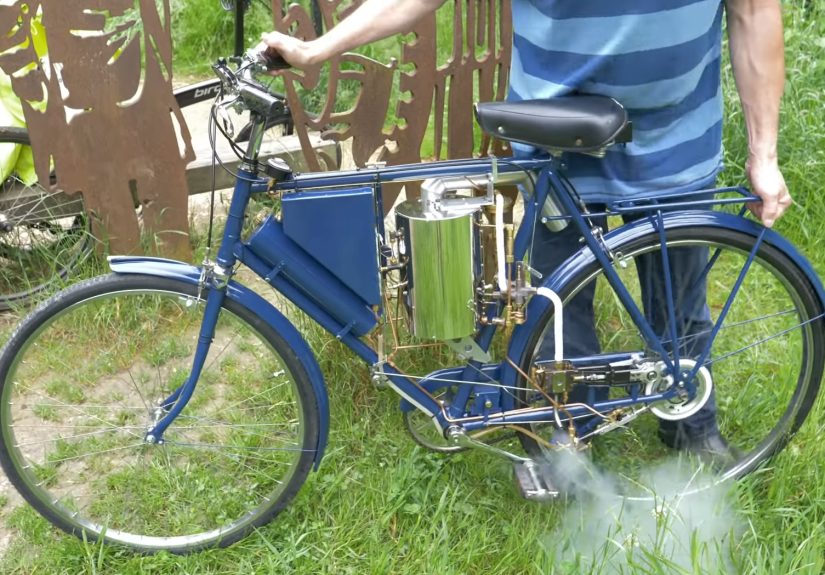
The Ruscombe Gentleman’s Steam Bicycle is a modern custom steam cycle designed with old-world visual grace and modern engineering logic. Reports on the build describe a petrol-fired vaporizing burner, a hybrid steam generator that combines monotube coils with a small fire-tube boiler, and superheated steam running above 300 degrees Celsius. Power is sent to the rear wheel by a single-cylinder slide-valve engine through a toothed belt. In plain English, this is not a museum prop. It is a rolling pressure vessel with manners.
Its performance numbers are modest by motorcycle standards and entirely delightful by human standards. The bike is described as being comfortable at about 15 miles per hour, with a range limited to roughly 16 miles by water capacity. That range figure tells you everything important about the machine. Steam bicycles are not about winning drag races or replacing commuter scooters. They are about making motion feel theatrical again.
The “gentleman’s” part of the name matters too. It suggests civility, polish, and a certain refusal to rush. This is not a machine for lane-splitting maniacs or caffeine-fueled delivery sprints. It belongs more to the tradition of elegant mechanical touring, where the ride is the event, the machinery is part of the conversation, and every hiss from the boiler sounds faintly like the machine clearing its throat before offering a witty remark.
A Modern Machine with One Boot in the 19th Century
To understand why the Ruscombe bicycle grabs attention so quickly, you have to place it in the longer story of powered two-wheelers. Steam bicycles are not new. They are older than the motorcycle as most people imagine it. In the late 1860s, American inventor Sylvester Roper built a steam velocipede that many historians and motorcycle enthusiasts still treat as one of the earliest surviving ancestors of the motorcycle. Lucius Copeland followed with steam-powered bicycles and tricycles in the 1880s, pushing the idea closer to practical road use and even limited commercial production.
Those early machines emerged during a period when inventors were still figuring out what powered personal transport should even look like. Put another way, everyone was freelancing. Boiler here, wheels there, leather belts, hand pumps, strange frames, fearless riders, and enough optimism to light a small city. Steam, at the time, was familiar technology. It already powered factories, locomotives, and industrial progress itself. Mounting it on a bicycle was not absurd in that era. It was experimental, ambitious, and perhaps only slightly more alarming than everything else engineers were trying.
The Ruscombe bicycle fits beautifully into that lineage. It is modern in materials and methods, but its spirit belongs to the age when mobility still felt like an invention in progress. Where an electric bike says, “I am efficient,” the Ruscombe says, “Observe, please, as I make propulsion interesting.”
Why Steam and Bicycles Were Once Natural Partners
The pairing of steam and bicycles makes more sense when you remember how quickly bicycle technology matured in the 19th century. Early two-wheelers were awkward, unstable, and occasionally eager to throw riders over the bars with educational force. The penny-farthing brought speed and style, but it also put the rider high above the ground in a position best described as “one pothole away from regret.”
Then came the safety bicycle. Equal-sized wheels, a lower center of gravity, and chain drive transformed cycling from a dare into transportation. By the 1890s, the United States was deep in a bicycle craze. Cycling clubs flourished. Roads mattered more. Riders pushed for better surfaces, better routes, and greater freedom of movement. Women, especially, found new independence on bicycles, which became tools of mobility as much as recreation.
That cultural moment is important because it created the audience for something like a steam bicycle. Once bicycles stopped being novelties and became practical machines, inventors naturally started asking how they might be powered. Steam was one answer. Not the final answer, obviously, but for a while it was a compelling one.
The Engineering Problem Steam Never Stops Giving
Steam power is charming in the same way that restoring a mansion with original woodwork is charming: gorgeous, noble, and very interested in your spare time. A steam bicycle asks a lot from its builder. It must carry water, fuel, burner hardware, boiler or generator components, feed systems, lubrication, controls, and drive mechanisms without becoming too heavy or too terrifying to ride.
The Ruscombe build stands out because it appears to address those classic steam-cycle headaches with unusually polished engineering. The burner uses pressurized petrol delivered to a vaporizing system. The steam generator combines different design ideas to create superheated steam for better performance. Modern synthetic oil handles temperatures that would punish traditional lubricants. Safety features reportedly include a pressure release valve and an automatic fuel shutoff when pressure exceeds a set level.
That is the key difference between nostalgia and craft. Nostalgia dresses up the past. Craft solves the same problems the past struggled with. The Ruscombe Gentleman’s Steam Bicycle does not merely imitate historical steam vehicles; it revisits their toughest compromises with better tools. Spreadsheets replace guesswork. CAD helps package components that 19th-century builders would have had to place by instinct, experiment, and crossed fingers.
Even so, steam keeps its old habits. Water supply limits range. Exhaust steam is lost to the atmosphere unless a condenser is added. Warm-up and control are more involved than simply pressing a button and rolling away. Steam is elegant, but it is rarely casual. It insists on ritual.
Why Steam Lost the Race
If steam cycles were so clever, why did they not conquer the road? Because charm is not the same thing as scale. Steam power worked, but internal combustion eventually proved better suited to small, fast-starting, commercially practical road vehicles. Gasoline machines did not require the same dance of water management, boiler design, burner tuning, and pressure control. They were easier to package, easier to refuel, and more adaptable to mass production.
By the late 19th century, gasoline motorcycles were rising while steam faded from the two-wheeled mainstream. That shift was not purely about power. It was about convenience, infrastructure, and manufacturing momentum. Steam on two wheels remained ingenious, but gasoline became easier to sell to people who wanted transportation rather than a relationship with their machine.
And that, perhaps, is why the Ruscombe bicycle feels so fresh today. Modern riders live in a world overflowing with convenient machines. Efficiency has won. Friction has lost. The Ruscombe reminds us that there was another path, one filled with valves, heat, polished metal, and the kind of engineering that demands both patience and style.
The Aesthetic Power of the Ruscombe Bicycle
Let’s not pretend appearance is secondary here. The Ruscombe Gentleman’s Steam Bicycle looks fantastic because steam power is visually honest. Electric propulsion often hides its magic in batteries, controllers, and sealed housings. Steam puts the whole drama on stage. You can see where the heat lives. You can trace the route from fuel to flame to pressure to motion. Mechanical causality is out in the open, dressed in brass and discipline.
That visibility matters for storytelling and SEO alike because readers do not just search for “steam bicycle.” They search for steam-powered bicycle, Victorian bicycle engineering, early motorcycle history, steampunk bicycle, and custom steam bike. The Ruscombe sits right at the intersection of those interests. It is a maker project, a historical homage, a design object, and a conversation starter. It appeals to cyclists, tinkerers, industrial design fans, motorcycle historians, and anyone who has ever looked at modern commuting and thought, “This could use more boiler pressure.”
What the Ruscombe Gentleman’s Steam Bicycle Really Represents
Machines like this survive because they answer emotional questions as much as technical ones. The Ruscombe bicycle asks what happens when progress is no longer measured only by speed, range, or convenience. What if delight counts too? What if a machine earns its keep not by dominating a spreadsheet, but by making people stop mid-sentence and grin like they just discovered locomotives can flirt?
In that sense, the Ruscombe Gentleman’s Steam Bicycle is more than a working machine. It is a mechanical essay. It argues that obsolete technologies are not always dead ends. Sometimes they are unfinished conversations. Steam did not win the road, but it left behind an aesthetic and engineering legacy that still inspires builders who value craft over shortcuts and personality over bland perfection.
The bicycle also taps into a broader truth about transportation history: the future was never inevitable. Steam, electricity, and gasoline all competed at various points. The roads we inherited were shaped by economic pressure, manufacturing capability, public policy, rider culture, and plain old practicality. The Ruscombe reminds us that history is full of paths not taken, and some of those paths are wonderfully shiny.
The Experience of Meeting a Steam Bicycle in Real Life
If you want to understand the emotional pull of the Ruscombe Gentleman’s Steam Bicycle, imagine not reading about it but encountering it. You do not hear the sharp bark of a modern motorcycle or the near-silence of an e-bike. You hear preparation first: the whisper of fuel being managed, the suggestion of heat building, the faint industrial suspense of a machine becoming ready. A steam bicycle does not simply start. It gathers itself.
That matters because modern vehicles tend to hide their effort. Turn the key, press the button, twist the throttle, gone. The Ruscombe invites you to notice every stage of becoming mobile. It asks for attention before motion even begins. There is an odd dignity in that. You are not commanding a device so much as cooperating with a process.
Visually, the experience is even richer. Steam machines reward the eye. Pipework, burner hardware, metal fittings, drive belts, the compact engine, and the disciplined arrangement of components all make the bike feel legible. You can look at it and sense that each part has a job, and none of them are shy about being seen. Modern transportation often aims for seamlessness. The Ruscombe offers the opposite: glorious, unapologetic mechanical texture.
Then comes movement. A machine like this does not blast away from the curb in a fit of aggression. It proceeds with a kind of cultivated determination. That changes the mood entirely. The ride appears less like an act of domination and more like a negotiation between rider, machine, temperature, pressure, and road. Even at a modest speed, it feels eventful because every yard traveled has visible cause behind it.
For spectators, the effect is almost unfair. People are wired to respond to moving things that make unfamiliar sounds, and steam brings an entire sensory vocabulary the modern street mostly lacks. There is the hiss, of course, but also the suggestion of heat, the faint scent of warm metal and oil, the sense that energy is being made and spent right there in front of you rather than invisibly managed inside a sealed pack or hidden under molded plastic. It feels closer to a miniature locomotive than a bicycle with an attitude problem.
For the rider, the experience is likely more intimate than fast. You would notice management as much as motion: watching the road while staying alert to what the machine is telling you, reading the behavior of the system, respecting its limits, and appreciating the craftsmanship that makes the whole balancing act possible. There is no autopilot mood here. Steam refuses passive ownership. It rewards engagement.
And that may be the greatest pleasure of all. In a world of frictionless technology, the Ruscombe Gentleman’s Steam Bicycle turns operation into participation. It makes travel feel handmade again. Not efficient. Not scalable. Not especially sensible. But unforgettable. The machine does not ask, “How quickly can I get there?” It asks, “Would you like the journey to have character?” For a certain kind of rider, that is not a drawback. That is the entire point.
Final Thoughts
The Ruscombe Gentleman’s Steam Bicycle is a tribute to engineering curiosity, historical memory, and the stubborn human desire to build something magnificent simply because it can be built. It nods to steam-cycle pioneers like Roper and Copeland, borrows the visual poetry of the 19th century, and uses modern tools to make an old idea rideable again.
No, steam bicycles are not about to replace electric bikes or commuter motorcycles. That is not the contest. The Ruscombe wins a different category entirely. It proves that craftsmanship still has the power to stop us in our tracks, that transportation can still feel personal and dramatic, and that even in an age obsessed with optimization, there is still room for a machine that arrives with a plume of history and the confidence of a gentleman who knows he is overdressed on purpose.
Note: This article is a historically grounded feature-style interpretation based on real museum, archive, and engineering sources, with the final experiential section written as informed descriptive commentary rather than a firsthand ride report.