Table of Contents >> Show >> Hide
- Why the Pi Zero Is Such a Good Brain for a Small Indoor Rover
- What “Pi Zero Powers A Little Indoor Rover” Usually Means in Real Build Terms
- The Hardware Choices That Make or Break the Build
- Indoor Robotics Is a Lot Harder Than Your Hallway Thinks
- Why This Kind of Rover Is More Than a Novelty
- What I Would Improve on a Pi Zero Indoor Rover
- Real-World Experience: What It Feels Like to Build and Drive One Indoors
- Conclusion
This article synthesizes practical ideas from U.S.-based maker and tech coverage, tutorials, and project write-ups about Raspberry Pi Zero rover builds, camera streaming, motor control, indoor robotics, and small-format robot design.
There is something deeply funny and deeply wonderful about a computer roughly the size of a stick of gum deciding it is now an explorer. That is the charm of a Pi Zero indoor rover. It is not trying to be a Mars mission, a warehouse robot, or the next startup with a buzzword problem and a funding deck. It is just a tiny machine with wheels or tracks, a camera, a wireless link, and a suspicious amount of confidence as it rolls under a chair like it pays rent.
The appeal of a build like this is obvious the moment you see it moving. A Raspberry Pi Zero or Pi Zero 2 W has the right mix of size, price, connectivity, and computing power to run a small robot indoors without turning the project into a mechanical soap opera. You can control it from a browser, stream video back to your phone or laptop, drive motors with PWM, and still leave room for future upgrades such as obstacle detection, light sensors, telemetry, or basic autonomy. In other words, it is a project that starts simple and then politely dares you to overengineer it.
Why the Pi Zero Is Such a Good Brain for a Small Indoor Rover
The magic starts with scale. A little indoor rover works best when the computer does not dominate the chassis. The Pi Zero family is small enough to fit in compact builds, yet capable enough to run Linux, host a web interface, handle wireless networking, and support a camera feed. That combination is the whole party. A microcontroller can absolutely drive motors, but once you want browser-based controls, live streaming, easy remote access, and flexible software stacks, the Pi Zero starts looking like the smarter choice.
The Pi Zero 2 W is especially attractive here. It keeps the familiar compact form factor while offering a much stronger processor than the original Zero. For a rover, that matters because a small robot is always multitasking more than people expect. It is reading control input, serving a page, pushing video, managing motor output, and trying not to do something embarrassing like wedge itself under the couch. More CPU headroom means the rover feels more responsive and less like it is making decisions through a bowl of oatmeal.
Wireless connectivity is another big reason these builds work so well indoors. A small rover can be controlled through your home network, or it can act as its own access point in some designs so you connect directly from a phone. That makes setup surprisingly flexible. Add a camera module, and now the robot becomes a first-person-view machine that can peek behind furniture, inspect awkward corners, or simply entertain anyone who enjoys seeing the world from ankle height.
What “Pi Zero Powers A Little Indoor Rover” Usually Means in Real Build Terms
Behind the cute headline is a very practical architecture. Most successful indoor rover projects follow the same general pattern. The Pi handles the high-level work: networking, browser controls, camera streaming, logic, and software. The drivetrain then uses either small DC gear motors through a motor driver or continuous-rotation servos receiving PWM signals. The chassis is often 3D-printed or based on a compact robot platform with a front caster, two driven wheels, or a tracked layout.
That division of labor is important. The Pi is a flexible computer, but it is not a magic battery fairy. It should not be asked to power motors directly. Motors and servos need their own appropriate power path, and the control system needs a shared ground so the signals behave. Ignore that rule and your rover may begin its career by twitching, browning out, freezing, or doing the robotic equivalent of forgetting its own name.
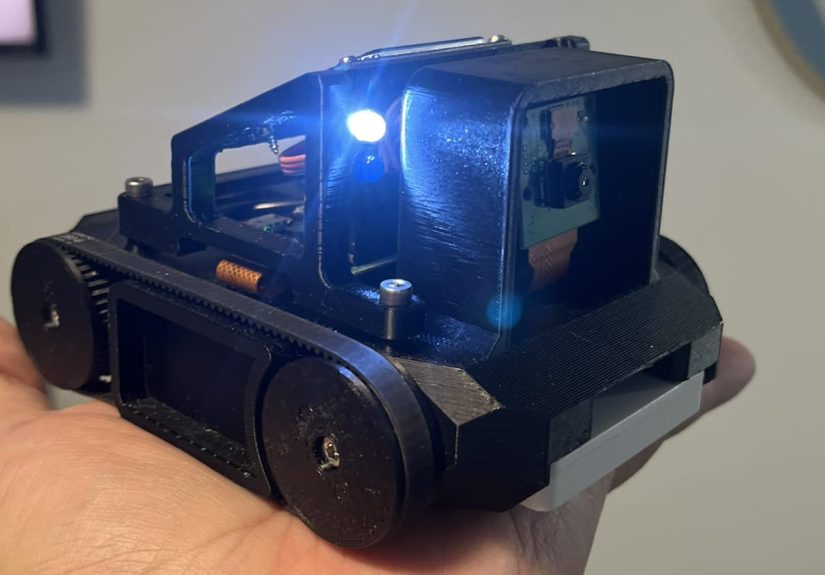
In one especially appealing version of the idea, the rover uses a Pi Zero 2-class board, drives a pair of tracked servos through PWM, rides on a 3D-printed chassis, and is steered through a custom web interface while a camera provides live video. That recipe works because it respects the strengths of the platform. The Pi handles the interface and vision. The drivetrain stays mechanically simple. The body stays light. Everything about it says, “I was designed by someone who wanted this to fit through chair legs, not cross a desert.”
There are wheeled versions too, and those are often easier for beginners. A two-wheel-drive robot with a front caster is about as approachable as mobile robotics gets. It teaches the fundamentals of differential steering, motor wiring, and motion control without making you print fifty-seven tiny suspension parts that look cool in renders and terrifying on your workbench.
The Hardware Choices That Make or Break the Build
Chassis and Drivetrain
For indoor use, compactness beats bravado. A small chassis with two DC motors and a caster is often the best starting point because it is simple, light, and easy to tune. Tracked rovers look fantastic and can handle rugs and threshold bumps a little better, but they usually add friction, complexity, and battery demands. If your goal is smooth exploration in apartments, offices, classrooms, or workshops, a clean wheeled platform is usually the easier win.
That said, tracks do have style. They make a little rover feel like it has watched too many science fiction movies and taken all the wrong lessons from them. Indoors, that can be charming as long as the steering is dialed in and the robot is not chewing through power just to pivot away from a table leg.
Motors, Drivers, and PWM
Motor control is where beginner optimism often collides with physics. The Pi’s GPIO pins are for control signals, not for driving a rover’s motors by brute force. If you are using DC motors, you want a proper motor driver or motor HAT. If you are using servos, you want an external supply and stable signal control. PWM is the key technique because it lets you vary speed or position in a controlled way rather than treating motion like an on-off light switch.
For a tiny rover, you do not need monster torque. Small gear motors or compact continuous-rotation servos are usually enough. The trick is choosing components that match the chassis weight and intended runtime. Overbuild the drivetrain and the robot becomes a battery-draining bulldozer. Underbuild it and the machine gets defeated by a rug seam, which is funny the first time and a design flaw every time after that.
Power
Power is where good rover dreams either become elegant reality or smoky regret. The Pi Zero wants stable power. The motors want separate, appropriate power. Your wiring wants common sense. Small builds often use USB power banks, boost converters, rechargeable battery packs, or dedicated motor supplies, depending on how the robot is laid out. The goal is clean, reliable current delivery without voltage sag that causes the Pi to reset or corrupt storage.
Indoor rovers are not huge energy hogs, but video streaming, Wi-Fi, and motion still add up. The build becomes much better once you stop thinking only about voltage and start thinking about runtime, transient loads, weight, and balance. A rover with perfect code but a sloppy power setup is still just a very expensive way to study disappointment.
Camera and Control Interface
A live camera feed changes the project from “small robot” to “small robot you cannot stop driving.” Once you can steer from the robot’s point of view, the appeal jumps immediately. The Pi Zero line supports camera modules nicely, and that is one reason it keeps showing up in rover builds. A browser-based interface is often the smartest control layer because it works across phones, tablets, and laptops without forcing users to install a special app.
The best interfaces are simple. A responsive page with directional controls, speed adjustment, and a live stream is more useful than a fancy dashboard that looks like a space shuttle and responds like a fax machine. Low latency matters. Indoors, the distances are short and the obstacles are close. A half-second delay can turn “careful navigation” into “boldly headbutting a chair.”
Indoor Robotics Is a Lot Harder Than Your Hallway Thinks
Small indoor rovers seem easy because the environment looks controlled. Then reality enters the chat. Floors change texture. Lighting changes from room to room. Wi-Fi coverage is strong in one corner and weirdly cursed in another. Furniture creates narrow passages. Table legs become forests. Pets become chaos with opinions.
And then there is navigation. Outdoors, GPS helps humans cheat. Indoors, robots do not get that luxury. Even advanced robots struggle with darkness, dust, occlusion, mapping, and communication in cluttered environments. A little Pi Zero rover is not trying to solve industrial autonomy, but it does live on the same learning curve. The moment you try obstacle avoidance, mapping, or semi-autonomous movement, you discover why indoor robotics is still such an active engineering challenge.
That is actually part of the fun. A compact rover becomes a hands-on lesson in control systems, networking, computer vision, battery management, mechanics, and user interface design. Very few DIY projects give you that many disciplines in one cheerful little machine.
Why This Kind of Rover Is More Than a Novelty
At first glance, a Pi Zero indoor rover looks like a weekend toy. Build it, drive it under the sofa, annoy the family, done. But the platform is more useful than that. It can become a classroom robot, a remote inspection device, a camera platform, a networking experiment, a vision test bed, or a software playground. You can add line following, distance sensing, object detection, battery telemetry, or even light autonomy without rebuilding from scratch.
That expandability is the real value. A good rover project leaves room for version two, version three, and the completely unreasonable version where you suddenly decide it needs night vision, speech, autonomous docking, and a tiny cargo bay for no business-related reason whatsoever. The Pi ecosystem encourages exactly that kind of growth.
It also teaches good engineering habits. You learn quickly that elegant builds are not just about code. Wire routing matters. Weight distribution matters. Latency matters. Thermal behavior matters. Mechanical slop matters. Even naming the robot matters, although that part is less scientific and more emotionally inevitable.
What I Would Improve on a Pi Zero Indoor Rover
If I were taking a basic indoor rover and pushing it one step further, I would prioritize four things: better obstacle awareness, cleaner power management, smarter steering control, and stronger user feedback. A front distance sensor or compact time-of-flight sensor would help prevent low-speed collisions. A better power monitor would make runtime less mysterious. A refined control loop would make turning feel smoother and more predictable. And basic telemetry in the browser, such as battery state or signal status, would make the rover feel much more polished.
I would also keep the design light. This is where many projects go sideways. Makers fall in love with features and suddenly the rover is carrying a camera, lights, extra sensors, a giant battery, a pan-tilt mount, decorative armor, and the emotional burden of every feature request it has ever received. Small robots are happiest when they stay small. Restraint is not boring. Restraint is why the rover still moves.
Real-World Experience: What It Feels Like to Build and Drive One Indoors
The best part of a Pi Zero indoor rover is not the spec sheet. It is the moment the project stops being a pile of parts and becomes a personality. The early stage feels classic maker: the chassis is upside down on the desk, wires are pretending to be organized, the SD card has been re-flashed at least once, and you are convinced one motor lead is wrong even before you test it. Then the Pi boots, the browser page loads, the stream appears, and suddenly this tiny robot has a face. From there, the project gets surprisingly addictive.
The first drive is usually clumsy in a very educational way. One side pulls harder. The steering is touchy. The camera angle feels wrong by about five degrees, which somehow matters more than it should. The rover lurches forward like it just remembered an appointment. Then you start tuning. You lower the speed, smooth the control values, adjust the center of gravity, secure a cable that keeps brushing a wheel, and try again. Every pass across the floor teaches you something. By the fifth or sixth run, the machine begins to feel less like a test rig and more like a small vehicle.
Indoor driving also changes how you think about space. A hallway becomes a course. Chair legs become slalom poles. Shadows look dramatic through the live feed. Carpet edges become engineering events. You realize quickly that a rover camera exaggerates every obstacle. A tiny floor transition feels like a canyon. A table overhang becomes a cave entrance. The whole house starts looking like a miniature expedition map, which is either delightful or a sign that the project has fully taken over your brain.
There is also a specific joy in watching other people react to the rover. Even people who do not care about boards, kernels, or PWM immediately understand the appeal of a tiny camera bot cruising around the room. They lean down to look at it. They ask to drive it. They laugh when it gets too ambitious and nudges a wall. It is one of those rare DIY builds that communicates its own purpose in about three seconds. No explanation needed. Small robot go vroom. Everybody gets it.
What sticks with most builders, though, is how much the project sharpens practical instincts. You begin by thinking the hard part will be code. Then you learn that reliable robotics is really a balancing act between software, mechanics, and power. A messy cable can ruin steering. A slightly weak supply can cause weird resets. A camera stream with too much delay can make the whole rover feel worse, even if every other subsystem is technically fine. Those lessons are valuable because they are real. They make you better at building not just robots, but systems.
And when the rover finally feels dialed in, the experience becomes weirdly satisfying. You sit back, drive it around from a browser, peek under furniture, make careful turns through narrow gaps, and realize a tiny Pi Zero is running the whole show. It is not just cute. It is competent. That is why these builds keep showing up. They are affordable, expandable, educational, and genuinely fun. A little indoor rover may not change the world, but it will absolutely change the mood of a workbench.
Conclusion
Pi Zero rover projects hit a rare sweet spot in DIY tech. They are small enough to feel approachable, advanced enough to feel meaningful, and flexible enough to reward long-term tinkering. A compact indoor rover can teach motor control, Linux-based robotics, camera streaming, browser UI design, and power discipline all in one build. More importantly, it turns those lessons into something physical and memorable. A blinking board on a desk is interesting. A blinking board that drives under your chair and streams video back to your phone is unforgettable.
So yes, “Pi Zero Powers A Little Indoor Rover” sounds modest. That is part of the trick. The project is small, but the learning curve, creativity, and replay value are huge. For makers who want a build that is part robot, part software lab, part rolling camera platform, and part irresistible toy, this little rover makes a very strong case for itself.