Table of Contents >> Show >> Hide
- A Modern House That Knows Where It Landed
- Why the Perforated Facade Is More Than a Pretty Trick
- Sacred Geometry Without Religious Cliché
- Inside the Retreat: Gallery, Home, and Hideout
- What This House Gets Right About Building on Historic Grounds
- Lessons Homeowners and Designers Can Steal, Respectfully
- What It Feels Like to Experience a Place Like This
- Conclusion
Some houses want to impress you from the driveway. Others quietly wait for you to notice what they are doing with light, proportion, silence, and the occasional very dramatic tree. House Oskar belongs to the second camp. Designed by Czech architect Jan Žaloudek on land that once formed part of a neighboring château’s garden, this retreat is modern without acting smug about it, historical without slipping into costume drama, and serene without becoming boring. That is a tricky balance, because the line between “timeless sanctuary” and “expensive yoga brochure” can be alarmingly thin.
What makes this project compelling is not just its clean white volume or its poetic perforations. It is the way the house negotiates with history instead of trying to win an argument against it. On protected grounds rich with memory, old masonry, mature trees, and the residue of a Baroque setting, Žaloudek creates a home that feels both respectful and unmistakably contemporary. The result is a rare thing in residential architecture: a building that understands context is not a burden. It is the good stuff.
A Modern House That Knows Where It Landed
At first glance, the retreat reads as elemental: a gabled form, white stucco surfaces, a tiled roof, carefully carved openings, and a silhouette that nods to rural outbuildings rather than flashy luxury villas. That move matters. Instead of dropping a glass spaceship into a historic landscape and calling it “contrast,” the house borrows from local agricultural and sacred architecture. It looks as though it belongs to the region, even while its detailing and spatial choreography are unmistakably of the present.
This is what good context-driven design does. It does not mimic the château next door, nor does it perform fake nostalgia with distressed beams and mood-board authenticity. Instead, it translates local forms into a new architectural language. The scale remains disciplined. The massing stays calm. The materials feel rooted. Even the roofline participates in the conversation, echoing vernacular structures while giving the house a chapel-like profile that reinforces its meditative character.
The setting does much of the emotional heavy lifting. Historic grounds come preloaded with atmosphere, but atmosphere alone does not make architecture successful. It can just as easily swallow a weaker building whole. Here, the house earns its place by framing views, preserving the dignity of the landscape, and letting the stone walls, trees, and remnants of older structures remain active participants in the experience. In other words, the architecture does not shout over the site. It listens first.
Why the Perforated Facade Is More Than a Pretty Trick
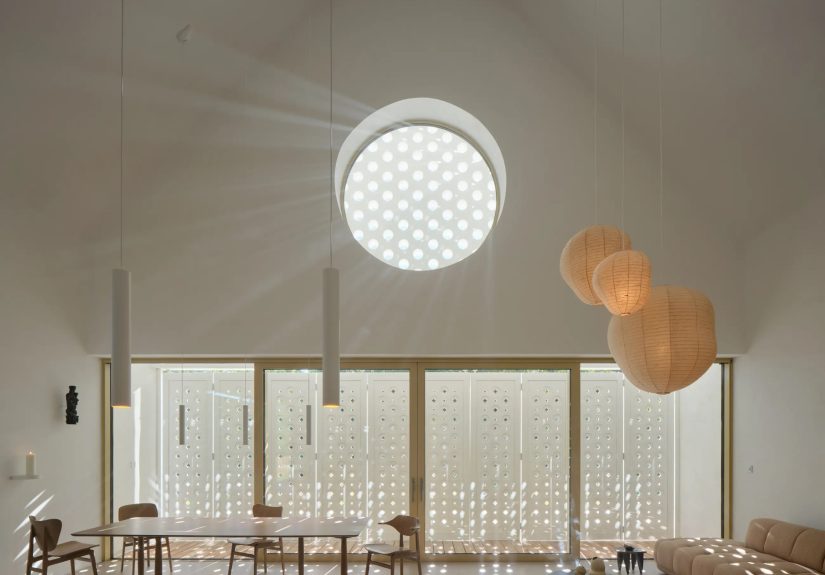
The most memorable feature of the house is its perforated skin, especially the southern gable wall, where openings transform sunlight into shifting patterns across the interior. This is not facade decoration for facade decoration’s sake. The perforations work spatially and emotionally. They filter brightness, create privacy, allow air and atmosphere to move, and give the house a changing mood throughout the day. Morning light arrives differently than late-afternoon light. Shade is not flat; it performs.
Filtered Light, Not Floodlight
Modern houses often treat glass as a personality trait. The usual message is simple: more glazing equals more sophistication. House Oskar takes a smarter route. Instead of exposing every room to total visual surrender, it modulates light. The perforations soften direct sun and create what can only be described as architectural lacework, a pattern of illumination that makes the rooms feel alive. It is the difference between being lit and being composed.
That makes the interiors more comfortable, of course, but it also makes them more memorable. Light becomes an active material, not a background condition. The house feels different by the hour, which is one reason it seems less like a static object and more like a lived-in retreat. The architecture is not frozen in a perfect photograph; it keeps happening.
Privacy Without the Fortress Vibe
Perforation is also how the house avoids an old trap in rural retreat design: the false choice between complete exposure and total seclusion. Here, shutters and openings allow the building to open generously to the landscape or withdraw into itself. That flexibility is crucial. A sanctuary should not behave the same way at all times. Sometimes you want orchard views, fresh air, and the feeling that indoors and outdoors are practically dating. Sometimes you want to shut the world out and read a book while the walls perform a quiet magic show with shadow.
That duality gives the house emotional range. It can act like a lookout, a chapel, a gallery, a family home, or a temporary hideaway for creative work. The building does not lock itself into one mood. It adapts.
Sacred Geometry Without Religious Cliché
One of the most interesting things about this project is the architect’s use of sacred references without turning the home into a theatrical imitation of worship space. The chapel influence appears in the gabled form, the arches and niches, the restrained palette, and the way the main interior gathers light around a large circular opening. There is ceremony here, but it is subtle. The house suggests contemplation rather than demanding reverence.
That matters because contemporary minimalism can sometimes feel emotionally underfed. You get clean lines, pale surfaces, and a lot of “restraint,” but not much soul. House Oskar avoids that problem by using proportion and spatial sequence to build atmosphere. A vaulted recess around the entry. A dramatic round window. A double-height living zone. Carefully framed niches that read almost like altars or curated installations. These moves give the house a sense of ritual.
And yet nothing feels precious. The home still works as a domestic environment, not a conceptual essay where someone forgot to include a comfortable place to sit. The sacred quality comes from rhythm, light, and composition, not from symbolic overload. That is why it feels modern. The house borrows the emotional intelligence of religious architecture while remaining fully committed to contemporary living.
Inside the Retreat: Gallery, Home, and Hideout
The interior extends the house’s central tension between openness and inwardness. The main living and dining zone is airy, double-height, and oriented toward the garden. It connects easily to terraces and outdoor areas, which helps the home feel larger than its footprint. But the palette stays tightly controlled: white surfaces, concrete floors, warm timber, stone accents, and furniture with sculptural presence rather than decorative noise. The effect is serene without being sterile.
Art plays an important role in that balance. Because the home was created for an architect and an art historian, the rooms feel curated rather than merely furnished. Objects, sculptures, textiles, and selected pieces of vintage and contemporary design give the house its human temperature. This is an important lesson for anyone who loves minimalist architecture but fears living in a laboratory. Restraint works best when it leaves room for meaningful things.
The Kitchen as Quiet Theater
Even the kitchen participates in the house’s larger story. Framed by a niche that reads almost like a secular altar, it turns a practical room into a moment of architectural focus. That is a clever move because it elevates everyday rituals without overdesigning them. Making coffee, chopping onions, opening a bottle of wine at dusk: these actions gain a bit of gravity when the space around them is composed with care. Domestic life becomes more intentional, not more complicated.
An Upstairs Retreat Within the Retreat
The upper level deepens the house’s idea of layered privacy. Instead of simply stacking bedrooms above the living room and calling it a day, the design creates a more inward, skylit realm suited to reading, working, resting, and hosting guests. This internal shift in mood is one of the project’s strongest achievements. Good houses do not just provide rooms; they provide emotional options.
Downstairs, the house can feel social, open, and landscape-oriented. Upstairs, it becomes quieter and more introspective. That contrast makes the home unusually rich for a compact retreat. It supports multiple tempos of living, which is exactly what a modern sanctuary should do.
What This House Gets Right About Building on Historic Grounds
Designing on land marked by heritage is easy to get wrong. Go too deferential, and the new building becomes timid. Go too aggressive, and it looks like an ego trip with planning approval. House Oskar finds a third path. It acknowledges the Baroque history of the site, the neighboring château, and the rural context without flattening them into decorative references. Instead, it absorbs their logic: proportion, rhythm, enclosure, procession, and the relationship between building and garden.
That approach feels increasingly relevant. Across architecture and interiors, the most successful work in historic settings is moving away from imitation and toward interpretation. Rather than replicating old forms detail for detail, designers are asking what the older environment values: material honesty, shade, thickness, threshold, permanence, craft, and connection to landscape. House Oskar answers those questions with a contemporary vocabulary.
Its white stucco and tiled roof do not pretend to be centuries old. Its perforations do not belong to Baroque architecture in any literal sense. Its openings and shutters are clearly modern interventions. But the house still feels deeply compatible with its surroundings because compatibility is about more than style. It is about attitude.
Lessons Homeowners and Designers Can Steal, Respectfully
Not everyone has access to château grounds, centuries-old trees, or the opportunity to build a poetic retreat in South Bohemia. Rude, honestly. But the underlying lessons of this project are widely useful.
1. Context Beats Trend-Chasing
A house becomes more convincing when it responds to where it is rather than to whatever is currently popular on social media. House Oskar succeeds because it belongs to its place first and to design culture second.
2. Light Should Be Shaped, Not Just Maximized
Big windows are wonderful, but controlled light is often better than indiscriminate brightness. Screens, perforations, shutters, niches, and layered thresholds create atmosphere as well as comfort.
3. Minimalism Needs Texture and Meaning
White walls alone do not create peace. What creates peace is proportion, material warmth, visual rhythm, and a few objects that actually deserve to be there.
4. Historic Settings Reward Humility
Building near heritage is not an excuse for pastiche, but it is a reason to pay attention. The best new architecture on old ground understands that continuity can be more powerful than contrast.
What It Feels Like to Experience a Place Like This
Imagine arriving in late afternoon, when the light has softened and the house appears less like an object and more like a pale instrument tuned to the landscape. The old stone boundary walls still hold the memory of the site, the trees cast long shadows over the garden, and the retreat sits there with a calm confidence that makes most luxury properties seem a little too eager. You do not walk into House Oskar and think, “Wow, expensive.” You walk in and think, “Ah, somebody here understood the assignment.”
The first sensation would likely be compression followed by release. Outside, the building is composed and almost guarded. Inside, it opens in a way that feels generous but never careless. Light enters through perforations, a round window, skylights, and carefully placed openings, so the rooms do not simply brighten; they unfold. You would notice how the sun marks the concrete floor differently from hour to hour, how shadows behave like quiet companions, and how even a still room seems to move because the light is always doing something.
In the morning, the retreat would feel almost monastic in the best possible way. Not severe, not chilly, just focused. Coffee at the kitchen island would feel oddly ceremonial because the niche framing the space lends everyday routines a little dignity. The textures would start to register more clearly then: the softness of white stucco, the grounded heft of stone, the warmth of wood, the tactile relief of textiles and artworks that keep the interiors from drifting into abstraction. You would hear the house too. Or rather, you would hear the absence of the usual domestic racket. That silence is part of the design.
By midday, with shutters opened and terraces engaged, the house would shift personality. It would become less chapel, more pavilion. Air would move. Views would extend. The boundaries between inside and outside would blur enough that reading on a sofa, stepping out to the terrace, and wandering toward the garden might feel like one continuous act. This is where the project’s flexibility becomes real. It supports solitude, yes, but it is not antisocial. It can host conversation, shared meals, slow afternoons, and creative work without losing its calm center.
At night, the experience would probably become the most memorable. Perforated surfaces that filtered daylight would begin to glow from within, turning the house into a lantern on historic ground. That reversal is part of the magic. During the day, the landscape enters the house through light. After sunset, the house gives something back to the landscape. The atmosphere would feel protective, intimate, and slightly cinematic, but never staged. More than anything, you would remember the emotional clarity of the place. House Oskar does not overwhelm you with novelty. It recalibrates your attention. It reminds you that architecture can still create refuge, depth, and wonder without yelling, overdecorating, or covering every surface in glass and self-importance.
Conclusion
House Oskar stands out because it treats modern retreat design as an act of editing rather than excess. On historically charged château grounds, Jan Žaloudek creates a home that filters light instead of flaunting it, honors context without copying it, and turns minimalism into something atmospheric, tactile, and humane. The perforated facade may be the project’s headline feature, but the deeper success lies in how every move supports the same idea: a sanctuary should help people feel more present, not more impressed.
That is why this house lingers in the mind. It is not trying to be louder than history or trendier than the next design feed. It is trying to make room for stillness, art, landscape, and daily ritual. In a world full of houses performing for the camera, that feels almost radical.