Table of Contents >> Show >> Hide
- What Makes Lithium-Titanate Different?
- Why an LTO Pack Still Needs a Serious BMS
- What “Open Source BMS” Really Means
- LTO-Specific Design Requirements in an Open-Source BMS
- Passive vs. Active Balancing for LTO Packs
- Real Open-Source Patterns in the Market
- How to Build an Open Source LTO BMS Responsibly
- Common Mistakes to Avoid
- Practical Experience: What Builders Learn After the First Prototype
- Final Thoughts
- SEO Metadata
Note: This article is written for web publication in standard American English and is based on real technical information, translated into human language so it does not read like a lab report that accidentally learned to yawn.
Lithium-titanate, usually shortened to LTO, is one of those battery chemistries that engineers love and marketers politely avoid inviting to the energy-density prom. It does not win the bragging contest for watt-hours per kilogram. What it does win, quite often, is the long game: fast charging, high power, strong low-temperature performance, and an unusually long cycle life when the pack is designed well.
That is exactly why the phrase open source lithium-titanate battery management system is getting more attention. Builders want the durability of LTO, but they also want transparency, modifiable firmware, repairable hardware, and freedom from black-box battery settings that treat every chemistry as if it were the same cell wearing a different hat. Spoiler alert: it is not.
A good LTO battery pack still needs a very good battery management system, or BMS. In fact, because LTO has a different voltage window and different behavior than more common lithium chemistries, an off-the-shelf BMS can become the electrical equivalent of putting dress shoes on a marathon runner. It may technically work, but it is awkward, limiting, and somebody is going to regret it.
What Makes Lithium-Titanate Different?
LTO cells use lithium titanate on the anode side rather than the graphite found in many conventional lithium-ion cells. That chemistry shift changes the personality of the battery in a big way. LTO cells typically have a nominal voltage around 2.4V, commonly charge to about 2.8V per cell, and often use a lower cutoff around 1.8V per cell. Compared with more familiar lithium-ion chemistries, that means lower cell voltage and lower specific energy, but also excellent safety, strong cycle life, and very good low-temperature behavior.
Those traits are not trivial. LTO is widely respected for fast charging and high current handling. It is also associated with a “zero-strain” structure, very low risk of lithium plating during fast charging, and better thermal stability than many mainstream lithium-ion options. In real-world terms, that makes it attractive for use cases where abuse tolerance, long service life, and dependable performance matter more than squeezing every last watt-hour into a tiny box.
So yes, LTO is the chemistry for people who say, “I want this battery to survive winter, abuse, and my future overconfidence.” It is not magic. It is just unusually tough.
Why an LTO Pack Still Needs a Serious BMS
Because “safe chemistry” does not mean “no management required.” A battery pack can still fail because of over-voltage, under-voltage, over-current, short circuits, poor thermal behavior, cell imbalance, bad wiring, or faulty charging logic. A solid BMS protects the cells, the pack, the charger, the inverter, and, ideally, the builder’s dignity.
At minimum, an LTO BMS should handle:
- Cell voltage monitoring for each series cell or module
- Current sensing during charge and discharge
- Temperature monitoring at cells and hot spots
- Protection logic for over-voltage, under-voltage, over-current, and short circuits
- Cell balancing to reduce mismatch and preserve usable capacity
- SOC and SOH estimation so the system is smart, not merely alarmed
- Communications such as CAN, UART, RS485, I2C, Modbus, or inverter-facing protocols
Open-source BMS projects often add logging, dashboards, MQTT, web interfaces, or inverter bridges. That matters because modern battery packs are not just storage devices anymore. They are data systems with opinions.
What “Open Source BMS” Really Means
When people hear open source battery management system, they sometimes imagine a single universal board that can do everything from a tiny radio node to a house battery bank to a rugged industrial backup pack. That is a lovely dream. It is also fiction.
In practice, open-source BMS usually means one or more of these things:
1. Open Firmware
The monitoring and protection logic can be inspected, modified, and tuned. This is especially important for LTO because chemistry-specific thresholds matter. If firmware assumes LiFePO4 or NMC voltage behavior, your LTO pack may be badly managed even when every sensor is technically “working.”
2. Open Hardware
Schematics, PCB files, and bill of materials are available. That makes repair easier and lets builders adapt the design for different pack sizes, current levels, or environmental conditions.
3. Open Integration
The BMS can speak to other systems instead of behaving like a moody appliance. Open integration is a huge advantage for DIY solar, vehicle conversions, lab prototypes, and backup power systems because the pack may need to talk to inverters, telemetry nodes, data loggers, or custom controllers.
That is why the open-source ecosystem around battery management is no longer just about the core monitor board. It also includes balancers, dashboards, CAN bridges, inverter adapters, and monitoring software.
LTO-Specific Design Requirements in an Open-Source BMS
Use the Right Voltage Window
This sounds obvious, yet it is one of the easiest mistakes to make. LTO cells live in a different voltage range than more common lithium chemistries. A BMS designed around the wrong assumptions may trip too early, miss unsafe conditions, or report a wildly misleading state of charge.
For LTO, the BMS should be explicitly configured around the pack’s actual chemistry, cell model, and operating limits. Not “close enough.” Not “it worked on a forum.” Actual measured behavior.
Measure Current Accurately
LTO packs are often chosen for high-power applications and fast charging, so current sensing is not a background detail. It is the part that keeps your SOC estimate honest and your protection logic fast enough to matter. If your current measurement drifts, your fuel gauge drifts with it, and then your shiny open-source dashboard starts telling fairy tales.
Account for Temperature Even If LTO Handles Cold Better
One of LTO’s big advantages is strong performance in cold weather. That does not remove the need for temperature monitoring. The BMS still has to watch for hot spots, charge conditions, enclosure heat rise, balancing heat, and ambient extremes. LTO is forgiving, not indestructible.
Do Not Rely on Voltage Alone for SOC
Modern BMS design increasingly combines voltage data with coulomb counting and model-based estimation. That is smart engineering for almost any lithium pack, and it is especially important when accuracy matters over long runtimes, fast cycling, or mixed loads. If you are building an open source lithium-titanate battery management system, SOC and SOH algorithms deserve real attention instead of a shrug and a spreadsheet.
Passive vs. Active Balancing for LTO Packs
Cell balancing is where many open-source builds go from “clever” to “actually useful.” In any series pack, slight differences between cells grow over time. The weakest cell becomes the pack’s limit. That means lower usable capacity, lower runtime, and more stress near the ends of the charge window.
Passive Balancing
Passive balancing is simple and common. It bleeds excess charge from higher-SOC cells through resistors so the rest of the pack can catch up. It is relatively low cost and easier to implement, which is why many DIY and open-source designs use it. The downside is heat and wasted energy. It works, but it is a little like solving a storage problem by setting part of the storage on fire.
Active Balancing
Active balancing redistributes energy between cells instead of dumping it as heat. That can support higher balancing currents, lower thermal stress, faster equalization, and better energy efficiency. For larger LTO packs used in stationary storage or high-cycle applications, active balancing can be very attractive. The tradeoff is higher complexity in hardware, firmware, and validation.
For small and moderate DIY LTO packs, passive balancing is often enough. For large ESS builds, high-current systems, or designs that cycle hard and often, active balancing becomes much more tempting.
Real Open-Source Patterns in the Market
The open-source side of battery management is not one project. It is a family reunion with several different toolboxes.
LTO-Specific Small-Pack Projects
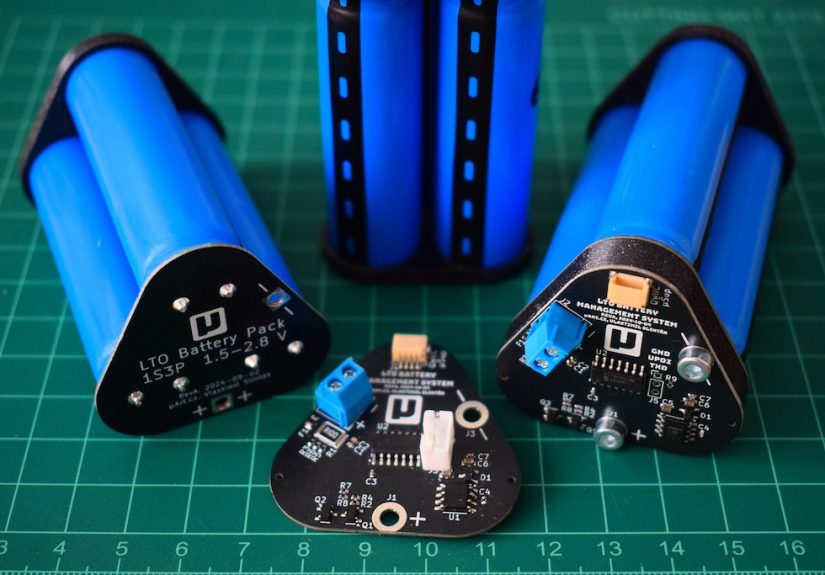
There are now open-source examples built specifically for 1S LTO packs, including designs aimed at low-power devices and solar-fed embedded systems. These projects show a useful truth: open-source LTO BMS does not always mean giant storage racks. Sometimes it means a compact board with under-voltage, over-voltage, over-current protection, and lightweight telemetry for small electronics.
Modular DIY Balancer Architectures
Projects such as the broader DIY BMS ecosystem focus on scalable balancing and monitoring for battery banks. These are often chemistry-flexible at the architecture level, which makes them interesting for LTO builders willing to tune thresholds and algorithms correctly.
Chemistry-Tunable Reference Platforms
Some open reference designs and example codebases built around professional battery controller ICs are explicitly configurable for different cell chemistries. That matters because many modern battery-monitor front ends are not married to one chemistry. The magic is in the thresholds, models, diagnostics, and system design around them.
Bridges, Mergers, and Inverter Integration
A big slice of the modern open-source battery world is not the core BMS at all. It is the software that reads one or more BMS units and then translates the data into something an inverter, EMS, or dashboard understands. Open projects now aggregate multiple BMS devices, forward data over CAN or Modbus, expose alarms on web interfaces, and let custom packs behave like supported commercial batteries. For home energy storage, that is a very big deal.
How to Build an Open Source LTO BMS Responsibly
Start With the Pack, Not the Board
Define the number of series cells, parallel groups, current levels, charger type, inverter type, expected ambient temperature, and fault response. A 1S sensor node and a 16S stationary bank do not belong in the same design conversation for long.
Choose an Architecture
You may want a centralized design, a modular cell-board approach, or a hybrid architecture with separate monitoring and control layers. Open-source hardware is appealing here because it lets you adapt the design instead of adapting your battery to somebody else’s assumptions.
Validate, Then Validate Again
BMS testing should include bench testing, fault injection, thermal checks, and communication testing. Hardware-in-the-loop methods are increasingly used because they let developers emulate cells, sensors, and external control units without gambling on a full live pack every time they change the code. Open source is great. Open smoke is less great.
Document the Safety Layer
A BMS is not the entire safety system. Builders still need proper fusing, wiring, connectors, isolation strategy where applicable, contactors or disconnect mechanisms, enclosure design, and charger coordination. Publish the wiring logic and fault behavior, not just the pretty dashboard screenshot.
Common Mistakes to Avoid
- Using the wrong chemistry profile: LTO is not LiFePO4 in a trench coat.
- Ignoring balance heat: Passive balancing can add meaningful heat, especially in dense enclosures.
- Trusting SOC estimates that are never calibrated: Even smart algorithms need good measurements and real pack data.
- Skipping communication planning: A wonderful battery that cannot talk to the inverter may become an expensive brick with good manners.
- Assuming open source equals safe by default: Transparency helps, but validation is still mandatory.
Practical Experience: What Builders Learn After the First Prototype
The first thing many builders discover is that LTO feels easy right up until the BMS settings matter. On paper, the chemistry looks wonderfully forgiving. The cells charge fast, behave well in the cold, and generally seem less dramatic than some other lithium options. That creates confidence, which is useful, but it can also create laziness. The first prototype often works “pretty well” with generic settings. Then real use begins, and the weirdness shows up: SOC drifts, low-voltage alarms come too early, balancing takes longer than expected, and the inverter acts like it has never met this battery before. That is usually the moment when an open-source design starts proving its value, because the builder can actually go in and fix the logic instead of begging a closed vendor for a firmware update that may never arrive.
Another recurring experience is that communication becomes half the project. The pack itself may be healthy and stable, but the energy system around it is picky. One builder wants a CAN profile an inverter accepts. Another wants RS485 polling for a solar controller. Someone else wants MQTT, Home Assistant, and a web UI because if the battery is silent, it somehow feels suspicious. Open-source tools are strong here. Even when the core BMS hardware is modest, the surrounding software often becomes the feature that makes the project practical. A pack that can report cell voltages, alarms, temperature, and usable capacity in a clean, hackable way is much easier to live with than a “smart” commercial pack that behaves like a secretive toaster.
Thermal behavior is another lesson. People choose LTO partly because it tolerates difficult environments better than many other lithium chemistries. That is true, but it does not cancel out heat from wiring losses, balance resistors, enclosure design, or repeated fast cycling. In small prototypes, heat can hide in silly places: a resistor bank tucked near a sensor, a cramped enclosure with poor airflow, or a connector that looked fine on paper and then got grumpy under current. Experienced builders learn to watch the whole system, not just the cells.
There is also a very practical lesson about scale. A tiny open-source LTO BMS for a one-cell or low-power pack can feel almost elegant. A large pack with inverter integration, fault handling, balancing strategy, logging, and long-term calibration is a different beast. That is why successful projects tend to grow in layers. First comes safe measurement. Then basic protection. Then balancing. Then communications. Then dashboards. Then inverter behavior. Then the very human urge to add “just one more feature,” which is how many good engineering weekends disappear forever.
Most builders who stick with LTO come away saying the same thing in different words: the chemistry is rewarding, but the BMS has to respect it. When an open-source system is tuned properly, LTO can be a fantastic match for stationary storage, specialty vehicles, harsh weather projects, and long-life equipment. When it is tuned lazily, the battery may still survive, but the system around it becomes confusing, inefficient, and harder to trust. In other words, the cells may forgive you. The rest of the design usually will not.
Final Thoughts
An open source lithium-titanate battery management system is not just a trendy hardware project. It is a practical answer to a real problem: LTO is valuable, but it does not always fit neatly inside the assumptions baked into mass-market BMS products. Open-source approaches solve that by giving designers access to the firmware, logic, interfaces, and hardware decisions that actually define battery behavior.
The best designs understand three things at once. First, LTO is different enough to deserve chemistry-aware settings. Second, open source is strongest when it combines protection, measurement, and communication instead of focusing on only one. Third, no battery project becomes trustworthy because the GitHub page looks nice. It becomes trustworthy because the measurements are accurate, the protections are tested, the thermal behavior is understood, and the pack behaves predictably in the messy real world.
If you get those pieces right, LTO rewards you with the kind of battery system engineers tend to appreciate most: the one that keeps working long after the exciting part of the project is over.