Table of Contents >> Show >> Hide
- Why Small-Town Horror Still Hits So Hard
- What Part 2 Should Do Better Than Part 1
- How A Horror Webcomic Keeps Readers Scrolling
- The Look of the Series Matters as Much as the Plot
- Why Readers Love Creepy Small-Town Secrets
- Extra Reflections: What It Feels Like To Build A Creepy Town, One Episode At A Time
- Conclusion
Small-town horror has a special kind of mischief. It does not need a castle on a cliff, a spaceship full of slime, or a villain who enters the room twirling an imaginary mustache. Sometimes all it needs is a quiet main street, a church bell that sounds a little too lonely, a diner where everyone knows your order, and one resident who says, “That road? We don’t go there after dark.” Suddenly the whole town feels like it has a basement.
That is exactly why this kind of story works so well in a webcomic. Horror loves suspense, comics love visual tension, and webcomics love the slow, delicious torture of making readers scroll one more inch before the truth shows up wearing muddy boots. Part 2 of a horror webcomic is where the fun really begins. Part 1 gets the lights flickering. Part 2 makes you realize the house was built wrong on purpose.
In this installment, I want to dig into why a dark comic series packed with creepy small-town secrets is such a perfect recipe for reader obsession. I’m talking about atmosphere, pacing, character tension, visual storytelling, and the sneaky art of withholding just enough information to make people mutter, “Okay, one more episode,” at 1:17 a.m. like that has ever ended responsibly.
Why Small-Town Horror Still Hits So Hard
Big-city horror can be thrilling, but small-town horror has an unfair advantage: intimacy. In a tiny town, every rumor has legs. Every old building has witnesses. Every family has history, and that history usually has teeth. A secret in a crowded city can disappear into noise. A secret in a small town becomes part of the weather.
That’s what makes the setting feel alive. In a strong horror comic, the town is not just a backdrop. It behaves like a character. It has habits, blind spots, loyalties, and a very suspicious relationship with silence. The best creepy towns feel ordinary enough to recognize but slightly off in the way a smile can look friendly until it lasts one second too long.
For a horror webcomic, that town can become an engine for everything else. The abandoned theater is not abandoned enough. The sheriff knows more than the sheriff says. The school mascot has an origin nobody wants to discuss. The water tower has a local nickname that sounds funny until it doesn’t. These details make the world feel real before the comic starts twisting it into something uncanny.
And that balance matters. Readers are more likely to follow a strange story when the foundations feel believable. If the comic starts with recognizable places, routines, and social dynamics, then the eerie stuff lands harder. A whisper in a hallway is scarier when the hallway already feels real. Horror is not only about what appears in the dark. It is also about what the familiar world refuses to explain.
What Part 2 Should Do Better Than Part 1
Part 1 of a horror webcomic gets readers interested. Part 2 gets them invested. This is where you stop merely hinting that something is wrong and start proving that wrongness has roots. A smart second installment does not rush to explain the monster, the curse, or the missing person board covered in red string like the town mayor took up crafts in a panic. Instead, it deepens the mystery.
In practical terms, Part 2 should do three things. First, it should complicate the central question. Second, it should make at least one character harder to read. Third, it should leave the reader with a fresh reason to worry. If Part 1 says, “This town is hiding something,” Part 2 should say, “Actually, several people are hiding different things, and at least one of them is pretending to help.”
This is also the stage where clues become more interesting than answers. A horror comic becomes sticky when readers can participate. They want details they can remember, symbols they can interpret, and background elements that make them feel clever for noticing them. A broken streetlight, a missing church record, a stain under fresh paint, a child’s drawing that shows a place nobody mentioned yet. None of that solves the mystery, but it gives the audience something to hold onto while dread does its cardio.
The Town Should Start Feeling Like a Suspect
One of the most satisfying tricks in small-town horror is making the place itself feel complicit. Not cursed in a flashy, thunderclap way. Worse. Quietly complicit. A town that shrugs too fast. A town that has turned denial into a civic hobby. A town where people keep saying “That was a long time ago,” which is usually code for “Please stop asking questions before the festival starts.”
In comic form, this can be shown visually as much as verbally. The same storefront appears in daylight and then at dusk, suddenly more watchful. A cheerful town banner hangs over a street where nobody makes eye contact. Smiling faces in old photos keep reappearing in places they should not. Readers do not need a lecture. They need recurring patterns that tell them something underneath the town’s politeness is rotten.
Character Secrets Matter More Than Jump Scares
Good horror readers want fear. Great horror readers also want gossip. That is where character secrets become gold. The strongest creepy stories are not built on random shocks. They are built on pressure. Who is lying? Who remembers more than they admit? Who benefits if the truth stays buried under six inches of civic pride and one seasonal pie contest?
A dark comic series becomes unforgettable when the emotional mystery runs alongside the supernatural one. Maybe the protagonist came back to town for a funeral and left with a family secret. Maybe the local golden boy is terrified of the woods for reasons he cannot explain. Maybe the librarian knows where the missing map is but will not hand it over unless someone finally admits what happened fifteen years earlier. Suddenly the horror is not just “What is out there?” It is also “What have these people done?”
How A Horror Webcomic Keeps Readers Scrolling
Webcomics live and die by pacing. That is not dramatic. It is just true. In a scroll format, rhythm becomes part of the storytelling. The distance between panels can feel like a held breath. A long stretch of vertical space can create anticipation. A sudden close-up can work like a whisper in your ear. The reader controls the speed, but the creator controls the experience.
That makes horror a natural fit for digital comics. You can delay a reveal by just enough space to make the reader nervous. You can break a tense conversation into tiny beats so the silence becomes part of the scene. You can end an episode on a visual note that practically shoves the audience into the next chapter with all the grace of a haunted elevator.
Every Episode Needs a Story Beat, Not Just a Scream
A common mistake in serialized horror is confusing cliffhangers with random shock. A real cliffhanger is not just a loud ending. It is a meaningful interruption. The reader should feel like the story has advanced, the stakes have changed, and a new question has opened at exactly the wrong moment. That is the sweet spot.
In Part 2, the ending should not simply say, “Boo!” It should say, “You thought this mystery belonged to one person, but it belongs to the whole town,” or “The thing outside the window is scary, but the person who already knew it would be there is scarier.” That kind of ending earns the next click because it expands the story instead of merely jolting it.
Silence Is a Visual Tool, Too
Horror comics do not have sound, which is funny because silence is one of their best weapons. In a webcomic, an empty corridor, a panel with no dialogue, or a repeated image with a tiny change can create more tension than a wall of exposition ever could. Let the reader linger. Let them notice the door that was closed before. Let them realize the scarecrow has moved one inch to the left. That is nightmare fuel on a budget, and I mean that as a compliment.
The art does not need to shout every moment. Sometimes horror becomes stronger when the comic lowers its voice. A foggy road, a motionless porch swing, a smile in the wrong place, a shape half-hidden by the frame. Suggestion is powerful because the reader’s imagination is a dedicated overachiever.
The Look of the Series Matters as Much as the Plot
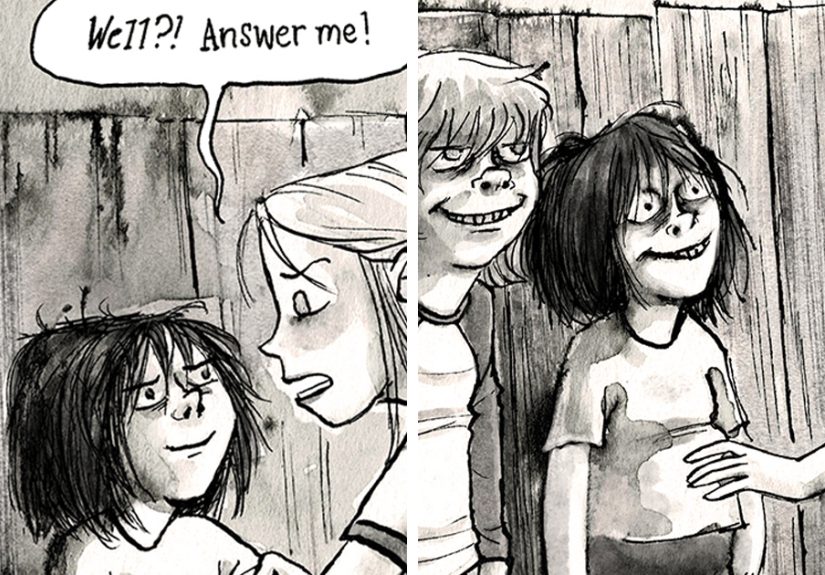
A dark comic series needs a visual identity that readers can feel immediately. That does not necessarily mean every page must be drenched in black ink and moonlight like the night itself signed a contract. It means the art should understand tone. Color choices, shadows, lettering, facial expressions, and panel spacing all contribute to mood.
In a small-town horror comic, contrast can do a lot of heavy lifting. Friendly locations should feel just a little wrong. Bright settings can still be disturbing if the composition is too symmetrical, too still, or too clean. Meanwhile, dark scenes should not become mud. Readers still need to follow the action. Confusion is not suspense. It is just confusion wearing a cheap cape.
Local Details Make the Horror Personal
One of my favorite things about this type of story is the weird little community details that turn a town from generic to unforgettable. The annual parade route. The nickname for the old bridge. The grocery store corkboard with a missing flyer that leaves a rectangular ghost on the wall. The roadside statue everyone jokes about, until somebody notices it has a new crack that looks suspiciously fresh.
These details do more than decorate the story. They create emotional texture. Readers begin to understand what this town values, what it avoids, and what it has normalized. The creepiness lands harder when the horror grows from culture instead of dropping out of the sky like a random bat with main-character energy.
Humor Keeps the Story Human
Yes, this is a dark comic series. Yes, there are secrets, shadows, and enough unease to season an entire county fair. But humor still matters. Not because it undercuts horror, but because it sharpens it. A dry joke from the wrong person at the wrong time can reveal character, release tension, and make the next eerie beat hit harder.
Besides, small towns are funny. Endearingly, accidentally, suspiciously funny. Somebody always has a cousin who “knows a guy.” Somebody is deeply committed to a local myth for reasons nobody can explain. Somebody is trying to discuss possible supernatural wrongdoing while holding a Styrofoam cup of coffee and wearing a shirt from the 2009 Catfish Jubilee. That contrast makes the world feel lived in.
Why Readers Love Creepy Small-Town Secrets
Readers come to horror for fear, but they stay for pattern recognition. They want to connect the dots. They want to suspect the right people, then realize they were wrong for the right reasons. They want the thrill of discovering that the old mural in chapter one mattered, that the town founder’s name keeps resurfacing, that the protagonist’s family history is not background at all but the fuse.
That is why small-town secret stories are so addictive. They offer layers. There is the public version of the town, the private version of the town, and the buried version of the town. Every new revelation shifts all three. The best part is that the reader feels like an investigator without needing a badge, a corkboard, or three red strings and a nervous breakdown.
In Part 2 of a horror webcomic, that layered feeling is everything. Readers should leave the episode with more confidence in the world and less confidence in the people inside it. They should know the town better and trust it less. That tension is the heartbeat of the genre.
Extra Reflections: What It Feels Like To Build A Creepy Town, One Episode At A Time
One of the strangest and most enjoyable parts of creating a story like this is realizing that horror is often built from very normal things. You do not sit down and think, “Today I will invent pure terror.” Usually you sit down and think, “What if the church bake sale flyer is covering something important?” and somehow that becomes the beginning of an emotional spiral. The trick is not to make every element loud. The trick is to make everything feel connected. A town becomes creepy when even its harmless details start to look like they are cooperating with the mystery.
I also think a lot about memory when writing this kind of comic. Small towns run on memory, but not always honest memory. People remember what flatters them. They repeat stories that make the community look sturdy, decent, and blessedly normal. So when a webcomic starts peeling that back, it feels personal in a way that monster-only horror often does not. The fear is not just that something bad is happening now. The fear is that everyone quietly agreed not to talk about how long it has been happening.
Visually, that opens up so many fun choices. A welcome sign can feel threatening. A school hallway can look more sinister than a graveyard if the lighting is wrong and the lockers seem to stretch too far. A family photo can become one of the scariest objects in the entire episode if one face keeps appearing where it should not. Horror webcomics do not always need giant set pieces. Sometimes the biggest win is turning a postcard-pretty location into a place readers never want to visit alone.
Another thing I love is how a webcomic lets dread arrive in installments. In print, you turn the page. In a webcomic, you scroll toward your own bad decision. That is delicious. The reader knows something is coming, but they still participate in revealing it. That partnership between creator and audience is part of what makes digital horror so effective. You are not just showing them a scene. You are teaching them how to fear the space between scenes.
And honestly, the most rewarding part of writing a story like this is not the spooky imagery. It is when a reader starts caring about the town even while suspecting it. That is the magic trick. You want them to feel the texture of the place: the old traditions, the chipped paint, the awkward reunions, the gossip, the grief, the bad coffee, the seasonal decorations that somehow make everything worse. If they can imagine living there, then the horror has somewhere to nest.
That is why Part 2 matters so much. It is the chapter where atmosphere has to prove it can carry story. The pretty gloom is no longer enough. Now the comic needs emotional hooks, sharper clues, richer tension, and at least one moment that makes readers stop scrolling and whisper, “Oh, that is not good.” Preferably while sitting in a perfectly safe room they suddenly do not trust anymore. That is when you know the series is working.
So if I am building a dark comic series full of creepy small-town secrets, I am not just trying to scare people. I am trying to make them curious, suspicious, and a little protective of characters who are probably making terrible choices for understandable reasons. I want the town to feel old enough to hide things well and familiar enough that every lie hurts. I want each episode to uncover one truth and open two worse questions. Most of all, I want readers to feel that the shadows are not random. They belong to something. And it has been waiting there long before page one.