Table of Contents >> Show >> Hide
- Why This Skill Matters More Than People Think
- Before You Use a Fire Extinguisher, Ask These 6 Questions
- Know Your Fire Extinguisher Classes First
- How to Use a Fire Extinguisher Step by Step
- A Simple Memory Trick for the Whole Process
- What to Do Immediately After the Fire Looks Out
- Common Fire Extinguisher Mistakes to Avoid
- Best Places to Keep a Fire Extinguisher
- How to Prepare Before an Emergency Happens
- Quick Example Scenarios
- Real-World Experiences and Lessons People Often Learn the Hard Way
- Conclusion
- SEO Metadata
A fire extinguisher is one of those tools you hope stays gloriously boring forever. It hangs on the wall, collects very little applause, and quietly waits for the one day everyone suddenly becomes deeply interested in it. The catch? That is a terrible time to read the label for the first time.
Knowing how to use a fire extinguisher matters because small fires can grow fast, especially in kitchens, garages, workshops, and utility areas. But this skill is not about becoming the action hero of your hallway. It is about making a quick, smart decision: Can I put this out safely, or is it time to leave immediately? That decision is everything.
In this guide, you will learn exactly how to use a fire extinguisher step by step, when to use one, when not to use one, which extinguisher works on which type of fire, and what mistakes can turn a manageable situation into a bigger emergency. We will also cover what to do after the flames appear to be out, because fires love a dramatic comeback.
Why This Skill Matters More Than People Think
Many home fires start in everyday places and during everyday routines, especially cooking. That is one reason fire safety experts keep repeating the same message: have the right extinguisher, know where it is, and know how to use it before something catches fire. A fire extinguisher is most useful in the earliest stage of a small fire. Once smoke thickens, flames spread, or your exit becomes uncertain, the extinguisher stops being your first move and escape becomes the only move that matters.
Think of it like a seatbelt or a spare tire. It is not exciting. It is not glamorous. It is absolutely worth knowing.
Before You Use a Fire Extinguisher, Ask These 6 Questions
Before you pull the pin, pause for two seconds and run through this checklist. If the answer to any of these is “no,” leave immediately and call 911.
- Is the fire small and contained? A wastebasket-size fire is one thing. Flames racing up a wall are another story.
- Has someone called 911? Do not delay emergency help while you test your confidence.
- Do you have a clear exit behind you? Never let the fire get between you and the way out.
- Is the room relatively clear of smoke? Heavy smoke is your cue to leave, not negotiate.
- Do you have the right extinguisher for that type of fire? The wrong extinguisher can make a fire worse.
- Do you feel physically able and calm enough to use it? Panic and poor footing are not helpful coworkers.
If those boxes are checked, then you can move forward. If not, evacuate. Close doors behind you if possible, and let firefighters handle the rest.
Know Your Fire Extinguisher Classes First
Not every extinguisher works on every fire. This is the part many people skip, and it is exactly why some fires get worse.
Class A
Used for ordinary combustibles such as wood, paper, cloth, cardboard, and many common household materials. Think of a trash can fire, not a skillet full of burning oil.
Class B
Used for flammable liquids such as gasoline, oil, paint, and certain solvents. These fires need the right agent because splashing fuel is not a hobby anyone wants.
Class C
Used for energized electrical equipment, such as appliances or tools that are still plugged in or powered. Once the electricity is shut off, the fire is treated according to whatever material is actually burning.
Class D
Used for combustible metals. This is more of an industrial setting issue than a typical home problem.
Class K
Used for cooking oils and fats, especially in commercial kitchens. If a grease fire starts in a pan at home, your first move is usually to turn off the heat if it is safe and smother the flames with a lid or sheet pan. Never throw water on a grease fire.
For many homes, a multipurpose ABC fire extinguisher is the common all-around choice because it covers several everyday fire hazards. Still, read your unit’s label. The label is not decoration. It is the rulebook.
How to Use a Fire Extinguisher Step by Step
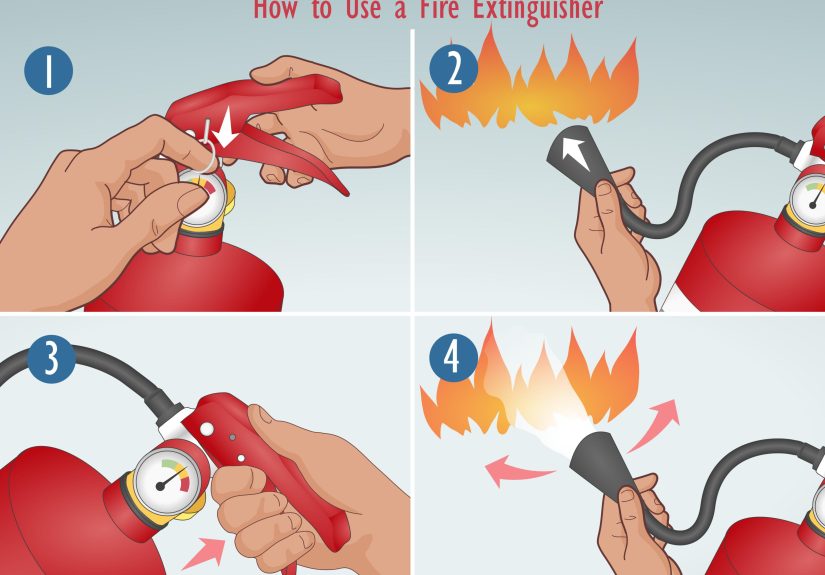
The easiest way to remember the process is the acronym PASS. It stands for Pull, Aim, Squeeze, Sweep. If you remember nothing else, remember PASS.
Step 1: Pull the Pin
Pull the pin at the top of the extinguisher. This breaks the tamper seal and unlocks the handle so the unit can discharge. Keep the nozzle pointed away from you while you do this. Accidentally blasting your own shoes is not the kind of practice you want.
Step 2: Aim Low at the Base of the Fire
This is the step people get wrong most often. Do not aim at the flames dancing around up top. Aim at the base of the fire, where the fuel is actually burning. If you only spray the flames, you may look busy, but the fire can keep feeding itself underneath.
Start from a safe distance. Many consumer guides suggest beginning around 5 feet back, though you should always follow the instructions on your specific extinguisher label. If needed, move in carefully as the fire begins to shrink.
Step 3: Squeeze the Lever Slowly and Evenly
Squeeze the handle to release the extinguishing agent. Use controlled pressure. A smooth squeeze helps you direct the stream better and avoid wasting the charge too quickly. Some fires may flare up briefly when the agent first hits them. That can be normal, but stay alert and keep your exit clear.
Step 4: Sweep Side to Side
Sweep the nozzle from side to side across the base of the fire until it appears to be out. Keep aiming low and continue the motion until the flames are fully knocked down. If the fire reignites, repeat the process only if conditions are still safe and you still have a clear way out.
A Simple Memory Trick for the Whole Process
If you are the kind of person who forgets acronyms under stress, here is an easier version:
- Unlock it.
- Point low.
- Press.
- Paint the floor line of the fire.
That is not the official training version, but it works in your head when your heart rate is trying to break a record.
What to Do Immediately After the Fire Looks Out
This part matters. A fire that looks finished can restart.
- Back away slowly and keep watching the area.
- Be ready for re-ignition.
- If smoke increases or flames return, leave immediately.
- Do not assume one blast solved everything forever.
- Have the fire area inspected if needed, especially after kitchen, electrical, or appliance fires.
Also, remember that many extinguishers are single-use or require professional servicing after use. Even if you used only part of the charge, the extinguisher may need replacement or recharge. A half-used extinguisher is not a comforting surprise for your next emergency.
Common Fire Extinguisher Mistakes to Avoid
Using the Wrong Extinguisher
This is the big one. Water-based or inappropriate extinguishers can worsen grease fires or create extra danger around energized electrical equipment. Always match the extinguisher to the fire class.
Aiming at the Flames Instead of the Base
Flames are the symptom. Fuel is the problem. Attack the base.
Standing Too Close Too Soon
Give yourself room. Moving too close too early can push you into heat, smoke, or splatter you did not bargain for.
Letting the Fire Block Your Exit
If the fire shifts, spreads, or starts cutting off your path, stop fighting it and leave. No houseplant, toaster, or workshop shelf is worth your lungs.
Trying to Fight a Grease Fire with Water
Never do this. Water can spread burning grease fast. For a pan fire, turn off the burner if safe and slide a lid or cookie sheet over the pan. For an oven fire, turn off the heat and keep the door closed.
Forgetting to Maintain the Extinguisher
A fire extinguisher is not a “buy it, mount it, forget it forever” tool. Check that the gauge is in the proper range, make sure it is not damaged or corroded, and confirm it is easy to access. In workplaces, extinguisher inspection and maintenance schedules are specifically required. At home, a quick monthly check is a smart routine.
Best Places to Keep a Fire Extinguisher
You want the extinguisher close enough to reach quickly, but not so close to the hazard that you have to step into danger to grab it. Good locations often include:
- The kitchen, but not right next to the stove
- The garage
- The workshop or utility room
- Near fireplaces or grill access areas
- On each level of the home
The goal is simple: fast access without forcing you to walk through flames to get there. That would be a very bad storage strategy.
How to Prepare Before an Emergency Happens
The best time to learn how to use a fire extinguisher is when nothing is on fire and everyone is calm. Read the label. Note the fire classes listed on the unit. Learn where extinguishers are stored in your home or workplace. Make sure adults in the household know the PASS method and the exit plan.
It is also smart to pair extinguisher readiness with broader fire safety habits: smoke alarms, a home escape plan, and kitchen awareness. Fire extinguishers are one useful tool, but they are not your whole fire strategy.
Quick Example Scenarios
Scenario 1: Small Trash Can Fire
You have an ABC extinguisher, the fire is contained, smoke is light, and the door is behind you. This is the kind of early-stage fire where PASS may work well.
Scenario 2: Grease Fire on the Stove
You see flames in a frying pan. Do not pour water on it. Turn off the heat if safe. Slide a lid or baking sheet over the pan. If the fire grows or spreads, get out and call 911.
Scenario 3: Outlet or Appliance Fire
If an appliance is sparking or burning while still energized, use the proper extinguisher only if the fire is small and your exit is clear. If you can safely disconnect power, do so. If not, do not linger.
Real-World Experiences and Lessons People Often Learn the Hard Way
One of the most common experiences people describe after using a fire extinguisher is how unbelievably fast everything happened. A small kitchen flare-up rarely announces itself with a polite memo. One second someone is making grilled cheese or heating oil, and the next second there is fire, smoke, noise, and a brain that suddenly forgets every safety poster it has ever seen. That is why practicing the idea of PASS ahead of time matters so much. Under stress, people do not rise to the occasion as much as they fall back on whatever they already know.
Another real-life lesson is that most people underestimate how loud, forceful, and messy an extinguisher can be. It is not like spraying a gentle mist from a cleaning bottle. The discharge can be startling, especially indoors. Dry chemical extinguishers can leave a cloud and residue everywhere. People often expect the fire to disappear neatly. Instead, the room can become chaotic for a moment, which is why standing with your back to an exit is such a big deal. When the extinguisher goes off, you do not want to be trapped in a corner wondering why heroism suddenly tastes like chemicals.
Many people also remember being surprised by how short the discharge time feels. A home extinguisher does not usually spray forever. In real-world use, a few seconds can feel like no time at all. That experience teaches an important lesson: do not waste the charge by aiming high, hesitating too long, or treating the extinguisher like a magic wand. Aim low, use controlled motion, and focus on the base of the fire immediately.
There are also countless stories from kitchens where someone’s first instinct was the wrong one. People panic and think “water,” because water solves a lot of everyday problems. It does not solve burning grease. People who have seen grease flare when water hits it rarely forget that lesson. The more useful experience-based takeaway is to keep a lid or sheet pan nearby when cooking with oil. That tiny habit can matter more than people realize.
In garages and workshops, a common lesson is that access matters just as much as ownership. Plenty of people technically have a fire extinguisher, but it is buried behind storage bins, mounted behind a door, or tucked in the most inconvenient corner imaginable. In an emergency, five extra seconds feels long. Real experience teaches that “I own one somewhere” is not the same as “I can grab it immediately.”
Another lesson people often mention after a small fire is emotional whiplash. Even when the fire is handled successfully, the event can rattle everyone in the home. That is why it helps to review what happened afterward: Was the extinguisher easy to reach? Did everyone know the exit route? Did anyone freeze? Was the extinguisher the correct type? These are practical questions, not dramatic ones, and answering them can turn one bad moment into better preparedness.
Perhaps the biggest experience-based truth is this: people who handle these moments best are usually not the bravest people in the room. They are the most prepared. They know where the extinguisher is. They know what kind it is. They know when to stop and leave. That is the real skill. Not showing off. Not improvising wildly. Just recognizing the situation, using the tool correctly if it is safe, and getting out when it is not.
Conclusion
Learning how to use a fire extinguisher is really about learning two skills at once: how to act quickly and how to recognize when it is time to stop. Remember PASS: Pull, Aim, Squeeze, Sweep. Aim at the base of the fire, keep your exit behind you, and only fight a fire that is small, contained, and matched to the correct extinguisher. For anything larger, smokier, faster, or more uncertain, leave immediately and call 911.
If you take one useful action today, make it this: find your extinguisher, read the label, check the gauge, and make sure everyone in your household knows where it is. That tiny chore may be the most practical thing you do all week.