Table of Contents >> Show >> Hide
Clear quartz has a talent for looking innocent while causing all kinds of shopping drama. At first glance, a real quartz point, a polished glass pebble, and a suspiciously cheap “crystal healing” paperweight can all look like long-lost cousins. That is exactly why buyers get confused. Clear quartz is common, beautiful, and affordable enough to be sold everywhere, but it is also easy to imitate with glass, resin, or mislabeled man-made material.
The good news is that you do not need a full gem lab to make a smart first pass. You can learn a handful of practical clues that help separate real clear quartz from obvious fakes. The even better news is that these clues work whether you are shopping for jewelry, crystal towers, palm stones, rough points, or that one chunky sphere that looks like it belongs in a wizard’s office.
In this guide, you will learn seven easy ways to tell if clear quartz is real, what each test can and cannot prove, and when it is time to stop playing detective and let a gemologist take over. Because sometimes the answer is “real quartz,” sometimes it is “nice glass,” and sometimes it is “synthetic quartz wearing a convincing disguise.”
What Real Clear Quartz Actually Is
Clear quartz is the colorless variety of quartz, a mineral made of silicon dioxide. In the gem and mineral world, it is often called rock crystal. Real quartz has a vitreous, or glassy, luster, a Mohs hardness of 7, and no cleavage. Instead of splitting into neat flat planes, it tends to break with a curved, shell-like pattern called conchoidal fracture.
That matters because these are not random science-class details. They are the exact physical traits that help you identify real quartz and spot common imitations. A fake may look convincing from across the room, but the closer you inspect it, the more likely it is to reveal the wrong inclusions, the wrong hardness, the wrong weight, or the wrong break pattern.
One more important point before we dive in: “real” can mean two different things in the crystal market. A stone can be genuine quartz but still be synthetic, meaning it was grown in a lab. Synthetic quartz has the same chemistry as natural quartz, which makes it trickier to separate than simple glass or plastic. So this article focuses on the easiest ways to catch obvious fakes first, while also showing you where at-home testing reaches its limits.
Why Fake Clear Quartz Is So Common
There is a simple reason fake clear quartz shows up so often: people love the look, and imitators love easy profits. Clear material is especially tempting to fake because it hides flaws well in photos. A shiny, transparent object can be marketed as a “natural healing crystal” even when it is just molded glass, acrylic, or low-cost man-made material.
Online shopping makes the problem worse. A listing can use dramatic lighting, mystical adjectives, and approximately forty-seven mentions of “high vibration” while never saying anything useful about the stone itself. Meanwhile, the real questions buyers should ask are much less glamorous: Are there natural inclusions? Does the hardness fit quartz? Is the shape plausible for a rough crystal? Does the price make sense? Is the seller describing it as natural, synthetic, or imitation?
That is why the best approach is not one magical trick. It is a combination of clues.
How to Tell if Clear Quartz Is Real: 7 Easy Ways
1. Use a Loupe and Look for Inclusions, Not Cartoon Bubbles
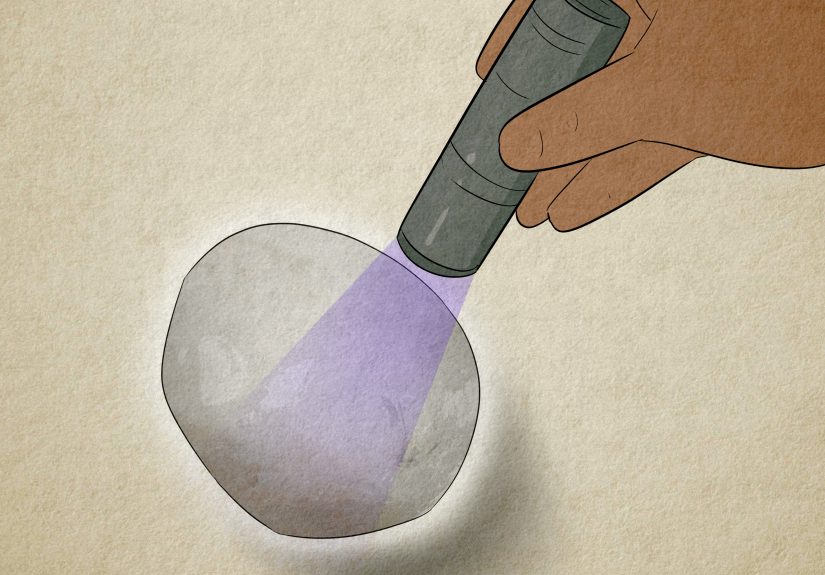
If you only do one test, do this one. Grab a 10x loupe or any strong magnifier and inspect the stone in bright light. Real clear quartz often contains tiny internal features such as wispy veils, feather-like fractures, healed cracks, mineral inclusions, or fluid inclusions. These do not automatically make a stone low quality. In fact, they often make it more believable.
What you do not want to see are lots of perfectly round gas bubbles floating inside the material. Rounded bubbles are a classic sign of glass imitation. They can appear singly or in clusters, and once you notice them, the mystery starts solving itself.
This does not mean every flawless-looking stone is fake. Some natural quartz can be very clean, and some synthetic quartz can look impressively tidy too. Still, when you find rounded bubbles in a supposedly natural clear quartz piece, your skepticism should stretch its legs and go for a brisk walk.
2. Try a Careful Hardness Check
Quartz has a Mohs hardness of 7. Ordinary window glass is usually around 5.5, and many softer imitations fall below quartz. That means real clear quartz should be able to scratch glass, while glass usually should not scratch quartz.
But use common sense here. Do not go full pirate and start scratching the polished face of a new pendant. If you are testing a rough specimen or a low-value piece, use an inconspicuous area. The better move is often to use a known softer object on the stone rather than the stone on your favorite tabletop.
If the material scratches very easily with steel or behaves softer than expected, it is probably not quartz. If it resists scratching and can mark glass, that supports quartz identification. It is a useful clue, not a courtroom verdict.
3. Study the Breaks and Chips
Real quartz has no cleavage, which means it does not split along neat, repeating flat planes the way some other minerals do. Instead, when it breaks, it tends to form curved, shell-like surfaces known as conchoidal fractures. On chipped edges, quartz can look smooth, glassy, and slightly curved.
This is especially useful if you are examining rough material or damaged edges on a carving. If the piece shows strange molded seams, unnaturally uniform edges, or signs that it was cast rather than grown or cut, that is a warning sign. Plastic and resin often look too soft at the edges. Cheap glass may show fracture behavior that resembles quartz, but it often pairs that with bubble-filled interiors and a lower hardness.
In other words, break pattern works best when you combine it with the loupe test and the hardness test. Think of it as corroborating evidence from the mineral witness stand.
4. Check the Crystal Shape if the Piece Is Rough
If you are buying a raw point or cluster, look at the crystal habit. Quartz commonly forms six-sided prisms with pointed terminations. Rough crystals can be imperfect, distorted, or intergrown, but they usually still look like they obeyed some kind of natural geometry instead of being invented by a craft store.
Be careful, though. Many sellers polish quartz into towers, points, eggs, hearts, stars, moons, and other shapes that do not reflect how quartz naturally grows. A polished tower can still be real quartz. So use crystal shape as a test only for pieces sold as “natural rough crystal” or “raw point.”
If a seller claims a specimen is raw and natural, but it has suspicious mold-like symmetry, frosted seams, or a shape that looks manufactured rather than mineral, it deserves a raised eyebrow and maybe a closed wallet.
5. Judge Clarity Realistically
Many shoppers assume real clear quartz must be perfectly transparent. That sounds reasonable until you see how nature actually works. Natural quartz can be impressively clear, but it also commonly shows tiny fractures, slight cloudiness, subtle zoning, or internal growth features. Milky areas and faint veils are not deal-breakers. Often, they are the opposite.
What should make you cautious is a combination of factors: ultra-cheap price, identical mass-produced pieces, perfectly sterile interiors, and a seller who avoids saying whether the material is natural, synthetic, or glass. One clue alone is not enough. Four suspicious clues together start telling a story.
So do not reject a stone just because it is not crystal-clear enough to read a menu through it. Real quartz is a mineral, not a smartphone screen protector.
6. Compare the Weight and Overall Feel
This one is not a lab test, but it is surprisingly useful in person. Quartz has a specific gravity around 2.65, which gives it a solid, substantial feel for its size. Plastic and acrylic imitations usually feel too light. Resin can also seem warmer and less “mineral-like” in the hand.
You do not need to say, “Aha, this weighs exactly 2.65 times water.” You just need to compare pieces side by side when possible. If one “clear quartz” tower feels suspiciously lightweight for its size, that is worth noticing. Experienced buyers get good at this over time. The first few comparisons may feel awkward. The tenth one will feel obvious.
This clue is best used to eliminate plastic and resin, not to distinguish natural quartz from synthetic quartz or well-made glass. Still, it is a great screening tool when you are shopping in person.
7. Ask Better Questions and Know When to Get a Pro Involved
Sometimes the smartest identification trick is simply asking the seller precise questions. Is it natural quartz, synthetic quartz, or imitation glass? Has it been treated? Is it carved from quartz or molded from something else? Does the seller offer gemological testing, a return policy, or any documentation?
If the answers are vague, evasive, or drenched in mystical language but short on material facts, treat that as useful information. Serious sellers can usually describe what they are selling in plain English.
And here is the big one: some synthetic quartz can be extremely convincing. Hydrothermal synthetic quartz can share the same basic chemistry and many physical properties as natural quartz. In those cases, gemologists may need tools like microscopy, refractive index testing, specific gravity measurement, or advanced spectroscopic methods to sort things out. So if the item is expensive, collectible, or represented as rare, do not rely on guesswork. Get professional confirmation.
Common Mistakes People Make When Testing Clear Quartz
The most common mistake is trusting only one clue. A real stone can be clean. A fake can be heavy. A synthetic can pass a simple hardness check. Identification works best when you use several observations together.
The second mistake is performing destructive tests on finished jewelry. Scratching a polished gem, tapping it aggressively, or “testing” it with random tools from the garage is a great way to damage something valuable while learning very little.
The third mistake is confusing “natural” with “real.” Synthetic quartz is real quartz chemically, but it is not natural. Glass sold honestly as glass is not a scam. Glass sold as natural clear quartz is the problem.
The fourth mistake is assuming spiritual marketing equals material truth. A description can mention chakras, cleansing, moon water, and cosmic optimism all it wants. None of that tells you whether the object in your hand is quartz, glass, acrylic, or a tiny transparent liar.
Real-World Experiences: What Buyers Usually Learn the Hard Way
A lot of people first learn how to tell if clear quartz is real after making an avoidable purchase. It usually starts with excitement. The stone looks gorgeous in the listing photos. The price seems like a steal. The seller uses phrases like “museum quality,” “ethically sourced,” and “ultra-clear master healer,” which sound impressive right up until the package arrives and the crystal looks like a decorative ice cube with commitment issues.
One common experience is buying a clear quartz tower online and noticing that it looks too perfect in a strangely artificial way. Under normal room light, it may seem fine. Under a loupe, though, tiny round bubbles suddenly appear. That is often the turning point. A buyer realizes that what looked like exceptional clarity was actually a clue that the piece was not natural quartz at all. It was just well-polished glass with excellent confidence.
Another very common experience happens at flea markets, gift shops, and tourist stores. A shopper picks up two “clear quartz” points that look almost identical, but one feels more substantial. The heavier one often turns out to be actual quartz, while the lighter one may be acrylic or resin. That moment is useful because weight is hard to appreciate in abstract terms, but easy to notice once you compare objects in your hand. After that, many buyers start trusting their sense of heft much more.
Collectors also learn that inclusions are not always bad news. Beginners often want a stone that is perfectly transparent because they assume flaws equal low quality. Then they examine a natural quartz point with tiny internal veils or healed fractures and realize those features actually make the crystal look more believable, not less. In many cases, a stone with a few natural-looking inclusions inspires more confidence than one that is completely sterile and suspiciously cheap.
There is also the experience of buying a rough crystal that turns out to be oddly shaped in a way nature probably did not intend. Maybe the terminations look molded. Maybe the sides are too uniform. Maybe the “raw” point somehow has the geometry of something made in a factory mold on a Tuesday afternoon. Buyers who have handled enough natural quartz start spotting these red flags quickly. The lesson is that natural rough material usually has structure, but not the kind of structure that looks machine-perfect in all the wrong ways.
More experienced shoppers eventually run into the trickiest category of all: stones that are not obvious fakes. These pieces may be genuine quartz, but synthetic rather than natural. That is where people discover the limits of home testing. A loupe, a hardness clue, and a visual inspection may tell you that the material is quartz, but not always whether it formed underground or in a lab. That realization is frustrating at first, yet it is actually a sign of progress. It means you have moved beyond spotting cheap imitations and into the more advanced part of gem identification.
Perhaps the most valuable experience of all is learning that a trustworthy seller matters almost as much as the stone. Buyers who work with clear, knowledgeable vendors usually get direct answers, realistic prices, and honest labeling. Buyers who chase miracle bargains often get mystery material. In the end, the real skill is not just identifying quartz. It is learning how to shop with curiosity, caution, and just enough skepticism to save yourself from paying natural-stone money for glorified glass décor.
Final Takeaway
If you want the simplest answer to how to tell if clear quartz is real, here it is: look for realistic inclusions, watch for round bubbles, check the hardness carefully, study the break pattern, evaluate the shape if it is rough, compare the weight, and ask smarter questions. Real quartz usually holds up well under that kind of inspection. Fakes usually start slipping on one or more details.
The most reliable approach is to combine clues rather than fall in love with one dramatic test. A loupe plus hardness plus shape plus seller transparency will take you much farther than any single trick. And if the piece is expensive or unusually clean, professional testing is worth every penny.
Because in the crystal world, “trust your intuition” is nice. “Trust your loupe” is better.