Table of Contents >> Show >> Hide
- The 30-Second Label Read (A Simple Routine That Works)
- Step 1: Serving SizeThe Label’s Favorite Magic Trick
- Step 2: CaloriesDo the Math They Hope You Won’t
- Step 3: % Daily ValueYour Built-In Lie Detector
- Step 4: Added SugarsThe Sweet Sneak
- Step 5: Fats, Sodium, and the “Health Halo” Trap
- Step 6: Ingredient ListWhere the Truth Lives
- Step 7: Don’t Let the Front of the Package Negotiate With You
- Step 8: Allergens and Special-Diet Labels (Don’t Skip These)
- Two Side-by-Side Examples (So You Can See the Tricks in the Wild)
- Shopping Strategies That Make This Easier (Because You Have a Life)
- Real-World Experiences: What Label Tricks Look Like in Everyday Life
- Conclusion: You Don’t Need to Eat “Perfect”You Just Need Better Info
Food labels are supposed to help you make smarter choices. In practice, they sometimes feel like a magic show: Look over here! (a big “HIGH PROTEIN” badge) while the sneaky stuff (hello, added sugar) slips out the back. The good news? Once you know where the “tricks” live, reading a label becomes less like decoding a secret message and more like checking a receipt.
This guide will walk you through how to read food labels without being trickedusing real, regulation-based clues (Nutrition Facts, ingredient lists, and defined claims) and a little healthy skepticism for the marketing confetti on the front of the package.
The 30-Second Label Read (A Simple Routine That Works)
If you only have half a minute in the grocery aisle (and you do), use this order. It’s fast, reliable, and annoying to misleading packagingwhich is exactly what we want.
- Serving size + servings per container (the label’s favorite hiding place)
- Calories (do the math for what you’ll actually eat)
- Added sugars, saturated fat, sodium (common “limit these” trio)
- Fiber + protein (often separates “filling” from “snacky air”)
- Ingredient list (where the truth lives, in descending order)
- Front-of-pack claims (treated as “interesting,” not “proof”)
Step 1: Serving SizeThe Label’s Favorite Magic Trick
Serving size is not a wellness recommendation. It’s a measurement used to standardize the label. And yes, it can make a product look “better” if the serving is smaller than what most humans pour, scoop, sip, or inhale during a Netflix episode.
What to check
- Serving size: the amount the Nutrition Facts numbers are based on
- Servings per container: how many servings are in the package
- Units: cups, grams, pieces, tablespoonsdon’t skip these
A quick example
If a granola says: Serving size: 1/3 cup (30g) and Calories: 150, but your bowl is closer to a cup, you didn’t eat 150 calories. You ate about 450. The granola didn’t “lie.” It just counted on you not doing the math.
Dual-column labels (the rare time packaging is actually helpful)
Some products show two columns: per serving and per package/per unit. This is meant for foods that could reasonably be eaten in one sitting, so you can see the full impact without playing calculator roulette.
Step 2: CaloriesDo the Math They Hope You Won’t
Calories aren’t “good” or “bad.” They’re just energy. The trick is that calories are only meaningful when they match what you’ll really eat.
Try this: (Calories per serving) × (servings you’ll eat) = your actual intake. If the package says 2.5 servings, that’s not a fun fact. That’s a warning label in disguise.
Step 3: % Daily ValueYour Built-In Lie Detector
The % Daily Value (%DV) tells you how much a nutrient in one serving contributes to a daily total (based on a 2,000-calorie reference diet). Even if you don’t track calories, %DV helps you compare products quickly.
The rule of thumb that actually works
- 5% DV or less is considered low
- 20% DV or more is considered high
Use that to your advantage: aim for higher %DV of fiber (and other nutrients you’re trying to get more of), and lower %DV of saturated fat, sodium, and added sugars (the usual “limit” suspects).
Step 4: Added SugarsThe Sweet Sneak
“Total Sugars” includes naturally occurring sugars (like those in fruit and milk) plus added sugars. “Added Sugars” is the line that shows what manufacturers put in during processingthink cane sugar, syrups, honey, dextrose, fruit juice concentrate, and friends with great PR teams.
Why added sugars matter
Added sugars can crowd out nutrients and make it easier to overshoot daily recommendationsespecially in foods that pretend to be “health” foods (granola bars, smoothies in bottles, flavored yogurt, cereal that “supports immunity,” and basically anything with a cartoon athlete on it).
How to spot sugar when it’s wearing a fake mustache
Look at the ingredient list. Sugar shows up as many different ingredients, and splitting it into multiple forms can move each one lower on the list. If you see several sugar-y ingredients sprinkled throughout (syrup + sugar + concentrate + honey), the product is still sugar-forward even if no single one is first.
Step 5: Fats, Sodium, and the “Health Halo” Trap
Labels love to spotlight what they removed (“fat-free!”) while quietly ignoring what they added (“…so it tastes like something!”). Your job is to look at the full picture.
Saturated fat
Saturated fat is one of the nutrients many guidelines suggest limiting. A product can be “keto,” “low carb,” or “high protein” and still be high in saturated fat. Don’t let the diet trend vocabulary distract you from the numbers.
Sodium
Sodium is famously sneaky in foods you don’t expect: breads, sauces, deli meats, frozen meals, and “healthy” soups that taste suspiciously like comfort. Compare brandssodium often varies wildly between similar items.
Trans fat: the rounding loophole
Here’s a classic trick: if a serving contains a small amount of trans fat (below a defined rounding threshold), the label can show 0g. That’s not “none,” it’s “small enough to round down.” The defense: check the ingredient list for partially hydrogenated oils (a major source of trans fat historically) and consider how many servings you’ll eat.
Step 6: Ingredient ListWhere the Truth Lives
If the Nutrition Facts panel is the numbers, the ingredient list is the story. And it has one very important rule: ingredients are listed in descending order by weight. Most of the product is near the top of that list.
What to look for first
- The first 3 ingredients: this is usually the “core identity” of the food (whole grains? refined flour? sugar? oils?)
- Repeated sweeteners: multiple forms of sugar spread through the list can still mean “high added sugar”
- Whole grains vs. “grain-ish” language: “multigrain” can still mean mostly refined grains. Look for “whole” in the grain name (e.g., whole wheat, whole oats) near the top.
- Oils and fats: compare products with similar caloriesoil type can change the nutrition profile
- “Natural flavors”: a broad category that doesn’t automatically mean “healthy,” just “flavoring”
One more ingredient-list move to know
Watch for “ingredient stacking.” Example: instead of listing “sugar” as #1, a product might list “brown rice syrup,” “cane sugar,” and “barley malt” separately, pushing each down the list. Your taste buds don’t care how the sugar is arranged on a spreadsheet.
Step 7: Don’t Let the Front of the Package Negotiate With You
Front-of-pack claims are marketing. Some are regulated and meaningful. Others are… motivational speaking for snacks. Treat the front like a movie trailer: interesting, maybe exciting, but not legally required to include the plot holes.
Nutrient content claims (the ones with actual definitions)
Terms like “free,” “low,” “reduced,” “light,” “good source,” and “high” are regulated categories. That’s goodbecause definitions limit how much companies can freestyle. It’s still on you to check:
- “Reduced” generally means less of something compared with a reference versionnot necessarily “low.” A “reduced sodium” soup could still be very salty if the original was basically ocean water.
- “Light/Lite” can refer to calories, fat, sodium, or even color/texture depending on context. Translation: don’t assume it means “healthy,” assume it means “compared to something else.”
- “Good source” or “high in” refers to how much of a nutrient a serving provides. It does not mean the overall product is balanced.
“Healthy” has a stricter meaning than it used to
You’ll see “healthy” used as a packaging claim, and the rules around it have been updated in recent years. The main takeaway for shoppers: “healthy” isn’t supposed to be a vibeit’s supposed to meet specific criteria. Still, “healthy” doesn’t mean “perfect for everyone.” It’s a helpful shortcut, not a personalized nutrition plan.
“Natural” is not a nutrition guarantee
“Natural” sounds comforting, like a gentle hug from a meadow. But it doesn’t automatically tell you whether a product is high in added sugar, saturated fat, or sodium. In practice, it’s more about what’s not in the food (artificial/synthetic ingredients) than about overall healthfulness. Always bring “natural” back to the Nutrition Facts and ingredient list.
“No artificial colors” and other moving-target phrases
Label language can evolve. For example, “no artificial colors” has become a phrase with policy nuance depending on what color additives are used. That’s not a reason to panicit’s a reason to rely on the parts of the label that don’t play word games: the ingredient list and the Nutrition Facts panel.
Organic labels: what they actually mean
If you buy organic, the category matters:
- “100% organic”: all ingredients (except salt/water) are organic
- “Organic”: typically means at least 95% organic ingredients (with specific rules for the remainder)
- “Made with organic …”: at least 70% organic ingredients
- Specific organic ingredients: some ingredients are organic, but the product isn’t in the top categories
Important: organic doesn’t automatically mean low sugar, low sodium, or low calorie. Organic cookies are still cookies. (Delicious cookies. But still.)
Step 8: Allergens and Special-Diet Labels (Don’t Skip These)
If you have allergies or intolerances, the allergen statement is non-negotiable reading. Major allergens must be declared clearly, and sesame is now included as a major allergen that must be labeled on packaged foods.
Gluten-free
“Gluten-free” has a specific meaning under FDA rules, including a threshold for unavoidable gluten presence. If you rely on gluten-free labeling for medical reasons, stick to products that use the regulated term, and still scan the ingredient list (especially if you’re sensitive to cross-contact risks).
“Net carbs,” “keto-friendly,” and other unofficial math
Some front-of-pack terms aren’t standardized the same way Nutrition Facts is. “Net carbs” is the best example: companies often calculate it differently. If carb intake matters to you, use the Nutrition Facts numbers (total carbs, fiber, and sugars) instead of trusting the front label’s custom equation.
Two Side-by-Side Examples (So You Can See the Tricks in the Wild)
Example 1: Flavored yogurt
Two yogurts both say “high protein.” Here’s how to choose the one that actually supports your goals:
- Serving size: are you comparing the same amount (by grams), or one tiny cup vs. one large tub?
- Added sugars: many flavored yogurts sneak in dessert-level added sugar
- Protein: higher protein can be more filling, but don’t let it excuse a sugar bomb
- Ingredients: look for milk/yogurt cultures near the top; watch for multiple sweeteners
The “trick” yogurt usually wins on the front (bigger “PROTEIN!” font) and loses in the Nutrition Facts (higher added sugar per serving, and the serving is suspiciously small).
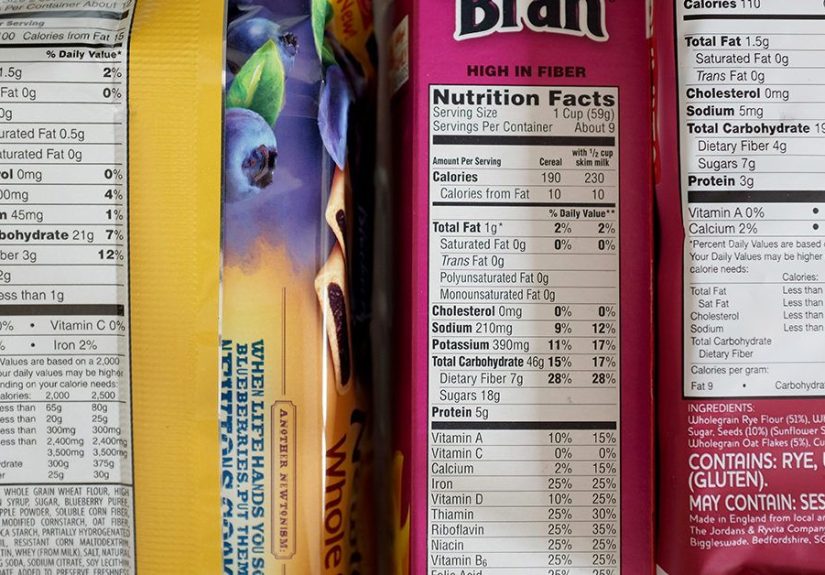
Example 2: Breakfast cereal
Cereal packages are basically billboards. Ignore the cartoon’s confidence and check:
- Serving size: cereal servings can be tiny compared with a real bowl
- Fiber: more fiber often means better staying power
- Added sugars: compare grams and %DV (some “healthy” cereals are candy wearing a lab coat)
- Ingredients: if sugar is in the top 2–3 ingredients, you’re buying sweetened grains
Shopping Strategies That Make This Easier (Because You Have a Life)
The goal isn’t to become a full-time label investigator. The goal is to stop getting tricked. These habits make label reading faster over time:
- Compare within a category. Compare salsa to salsa, bread to bread, yogurt to yogurt. “Is this good?” is hard. “Is this better than the other one?” is easy.
- Pick 2–3 priorities. For example: lower added sugars, higher fiber, moderate sodium. If you try to optimize everything, you’ll leave with… nothing and a mild headache.
- Use %DV as a shortcut. 5% low, 20% high. Repeat until it becomes automatic.
- Trust the back more than the front. The front sells. The back tells.
- Keep perspective. One “imperfect” item doesn’t define your diet. Your overall pattern does.
Real-World Experiences: What Label Tricks Look Like in Everyday Life
Let’s make this real. Here are a few label-reading moments you might recognizebecause they happen to basically everyone who shops for food while being a person with limited time and unlimited exposure to marketing.
The “It’s Healthy Because It’s From the Health Aisle” moment
You’re in the “better-for-you” section holding a bag of granola clusters that look like they were blessed by a yoga instructor. The front says “made with whole grains,” “plant-based,” and “contains antioxidants” (which sounds like it should come with a cape). Then you flip it over and realize the serving size is 1/3 cup, the calories jump fast if you eat it like actual food, and the added sugars are… not subtle.
The takeaway isn’t “never eat granola.” It’s: the health aisle can still sell dessert. Your best defense is serving size + added sugars + ingredients near the top of the list. If sugar shows up early (or shows up repeatedly in different forms), you’re looking at a sweet snack, not a neutral breakfast base.
The “Reduced” label that reduces your trust
You grab a “reduced sodium” soup because you’re trying to be mindful. Great move. Then you check the sodium and realize: it’s lower than the regular version… but still high enough that one bowl feels like it could preserve a small ham. “Reduced” did its job legallyit compared to a reference product. But it didn’t promise “low,” and it definitely didn’t promise “heart-friendly.”
The takeaway: when you see “reduced”, ask “reduced compared to what?” and then check the actual number. Sometimes “reduced” is meaningful. Sometimes it’s just “slightly less intense problem.”
The “High protein” snack that’s basically a candy bar with a gym membership
Protein bars can be helpful. They can also be candy bars that learned a few fitness phrases. The experience goes like this: the front says “20g protein,” you feel proud, you flip it over, and the added sugars are surprisingly highor the ingredient list includes multiple sweeteners, syrups, and coatings that sound like they belong on a donut, not a “performance” product.
The takeaway: protein is a tool, not a free pass. If you’re using a bar as a snack, check: added sugars, fiber, and total calories for the portion you’ll actually eat. If you’re using it as a meal replacement, look for more fiber and a more balanced macro profile.
The “Gluten-free” confusion spiral
If you’re shopping gluten-free, it’s common to assume “gluten-free” equals “healthier.” But gluten-free cookies still have sugar, gluten-free chips still have sodium, and gluten-free crackers can still be refined starch with vibes. The “gluten-free” claim is about gluten, not overall nutrition.
The takeaway: use “gluten-free” for what it isa dietary suitability markerthen run the same label routine you’d run on any snack: serving size, calories, added sugars, sodium, and ingredients.
The “Wait… sesame?” moment
You’re scanning allergen statements and notice sesame listed clearlysometimes in foods you wouldn’t expect. That’s not paranoia; sesame can show up in buns, crackers, dressings, and spice blends. The labeling change is there to help you spot it quickly, especially if you (or someone you cook for) needs to avoid it.
The takeaway: if allergens matter in your household, make the allergen statement your first stopbefore serving size, before calories, before anything else.
The common thread in all these experiences is simple: the front of the package tries to start a conversation. The back of the package ends it with facts.
Conclusion: You Don’t Need to Eat “Perfect”You Just Need Better Info
Knowing how to read food labels without being tricked isn’t about fear, restriction, or turning grocery shopping into a courtroom drama. It’s about getting clarity. Start with serving size, use %DV as your shortcut, scan added sugars and sodium, and always consult the ingredient list. Do that consistently, and you’ll stop buying “health halos” and start buying foods that actually match your goals.