Table of Contents >> Show >> Hide
- What Makes an Orthodox Icon Look Like an Icon?
- Step 1: Learn the Icon’s “Grammar” Before You Write a Paragraph
- Step 2: Choose a Prototype (Don’t Start With a 47-Figure Feast Day Scene)
- Step 3: Gather the Right Drawing Tools (Simple Is Smart)
- Step 4: Block In the Composition With Geometry
- Step 5: Draw the Face Using Icon Proportions (Big Eyes, Quiet Mouth)
- Step 6: Draw Hands and Gestures (The Hardest Part Everyone Pretends Is Easy)
- Step 7: Design Garments and Folds With Stylized Highlights
- Step 8: Plan Light, Color, and Symbolic Details (Even If You’re Only Drawing)
- Step 9: Add Inscriptions, Borders, and Finish Cleanly
- Common Mistakes (And How to Fix Them Without Panic)
- Mini Practice Plan (So You Actually Improve)
- Conclusion: Drawing Icons Is a Skilland a Discipline
- Extra: of Real-World “What It Feels Like” Experience (From Typical Learners)
Orthodox icons aren’t just “religious art.” In the Orthodox tradition, an icon is theology in color and linemeant to help prayer, not decorate a wall like a trendy poster. That’s why you’ll often hear people say icons are “written,” not painted: the goal is to communicate the Church’s faith visually, using a shared visual language that has developed over centuries.
But here’s the good news: you can absolutely begin by drawing icons. Drawing is how iconographers learn the forms, proportions, and design logic before paint (and especially before the “oh no, that’s real gold leaf” stage). This guide walks you through a practical, beginner-friendly approach to drawing Orthodox icons in nine clear stepswhile staying respectful of the tradition.
Quick note: If you plan to create icons for liturgical use or veneration, it’s wise to learn under a trained iconographer and follow your local priest’s guidance. For practice drawings, studies, and learning the style, this tutorial will keep you on a solid path without turning your first attempt into a dramatic three-act tragedy.
What Makes an Orthodox Icon Look Like an Icon?
Before the steps, it helps to understand the “icon look,” because it’s not an accident or a lack of skill. Orthodox iconography is intentionally different from Western naturalism. You’ll notice:
- Stylized proportions (large eyes, elongated noses, small mouths) to emphasize spiritual watchfulness and inner stillness.
- Reverse (or “inverse”) perspective where lines may open toward the viewer instead of vanishing into the distancebecause the icon invites you into the scene.
- Light that builds from dark to light, symbolizing illumination and transfiguration rather than a single “realistic” light source.
- Clear contours and rhythmic linealmost calligraphicso the image reads well even from a distance.
- Traditional prototypes (established compositions) so the icon communicates reliably across time and place.
Step 1: Learn the Icon’s “Grammar” Before You Write a Paragraph
If you try to freestyle icon drawing with only your usual realism habits, your icon may drift into “Renaissance cosplay.” Not eviljust not iconography. Start by studying a handful of classic prototypes and noticing repeated patterns:
- How faces are structured (forehead, nose bridge, cheek planes)
- How hands are simplified but expressive
- How garments fold in stylized “broken” highlights
- How the halo is placed and sized
- How inscriptions identify the figure
Tip: Choose 2–3 icons you love and do “slow looking.” Set a timer for 10 minutes and just observe. You’ll start seeing design decisions you missed beforelike how eyebrows are shaped to suggest compassion or severity, or how shadows are placed to carve form without realism.
Step 2: Choose a Prototype (Don’t Start With a 47-Figure Feast Day Scene)
Beginner-friendly icons are usually a single figure or a simple half-length composition. Great first choices:
- Christ Pantocrator (bust or half-length)
- Theotokos Hodegetria (Mother of God pointing to Christ)
- St. Nicholas or another beloved saint (half-length)
- An archangel (clean lines, strong shapes)
Work from a reputable example with clear lines (museum images, church sources, established iconographers). This isn’t “copying” in the lazy senseit’s how traditional arts teach the vocabulary before improvisation.
Step 3: Gather the Right Drawing Tools (Simple Is Smart)
You can draw icons with minimal materials. Here’s a practical kit:
- Hard pencil (H or 2H) for light construction lines
- HB pencil for main lines
- Kneaded eraser (gentle corrections)
- Ruler + compass (yes, reallyhalos love geometry)
- Fine liner or ink pen (optional, for final linework)
- Smooth drawing paper or Bristol board
If you eventually move from drawing to traditional panel iconography, you’ll add a prepared board, gesso, bole, gold leaf, and egg tempera. But for now, keep it focused: learn the forms, not the supply shopping Olympics.
Step 4: Block In the Composition With Geometry
Orthodox icon drawings are quietly geometric. Start by placing your figure using simple shapes:
- Mark the frame (your border). Icons often have a margin; leave breathing room.
- Find the centerline (vertical axis). This keeps the figure stable and symmetrical when needed.
- Place the head using an oval or egg shape (wider at the top, slightly narrower at the chin).
- Add the halo with a compass. Center it carefully and keep consistent spacing from the head.
- Map shoulder and chest lines with gentle anglesicon bodies often read as calm, grounded forms.
Example: For a half-length Christ Pantocrator, place the head slightly above center, keep the halo large enough to feel “present” but not like a life preserver, and block the shoulders as a broad trapezoid to anchor the figure.
Reverse Perspective (The Icon’s Subtle Superpower)
If your icon includes a book, throne, or architecture, practice reverse perspective: instead of lines converging away from you, they may open toward you. A simple exercise is drawing a book so the front edge appears slightly wider than the back edgeinviting the viewer in.
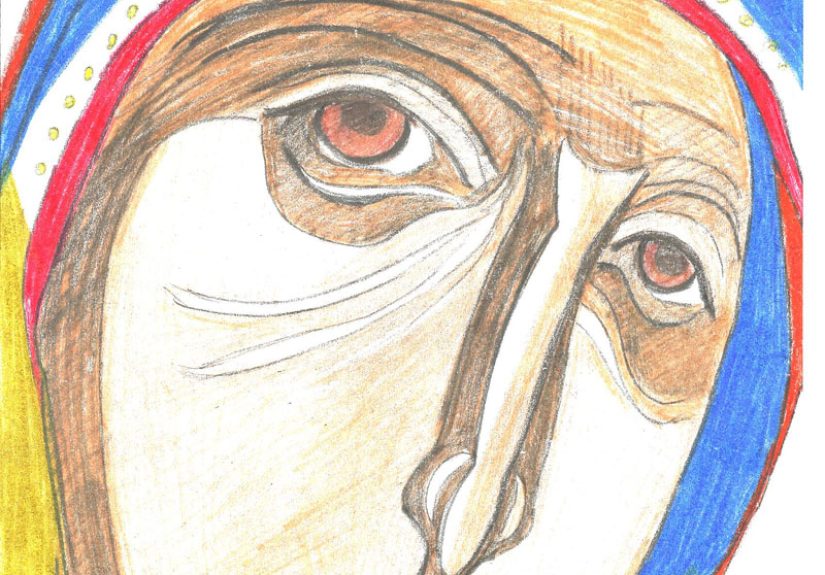
Step 5: Draw the Face Using Icon Proportions (Big Eyes, Quiet Mouth)
Icon faces communicate inner life, not photographic likeness. Here’s a beginner-friendly construction approach:
- Draw a centerline down the face (even in 3/4 view, it curves).
- Place the eye line slightly below the midpoint of the head oval (often lower than you’d do in realism).
- Build the nose long and structured, with a strong bridge. In icons, the nose often helps “organize” the face planes.
- Keep the mouth small and closed, suggesting restraint and stillness.
- Use simplified planes for cheeks and forehead rather than soft shading.
Practical proportions tip: If your first attempt looks like the saint is startled by a surprise math quiz, reduce the whites of the eyes and soften the eyebrow angle. Icon eyes are large, but not “cartoon shocked.”
Hair and Beard: Think “Rhythm,” Not “Individual Strands”
Icon hair is drawn in grouped locks and flowing shapes. Start with the main silhouette, then add a few purposeful interior lines to suggest form. Too many hair strands can make the icon look like it’s auditioning for a shampoo commercial.
Step 6: Draw Hands and Gestures (The Hardest Part Everyone Pretends Is Easy)
Hands in icons are simplified but meaningful. A blessing gesture, a book held upright, or a saint holding a crossall are readable symbols. To draw icon hands:
- Block the hand as a mitten shape first (palm mass), then add fingers as tapered cylinders.
- Keep fingers long and elegant, with clear joints indicated by minimal lines.
- Avoid hyper-realistic knuckles and veins; aim for clarity and calm.
Example: In many Christ icons, the blessing hand is drawn with fingers arranged in a traditional pattern. If you’re unsure, use your prototype carefully and prioritize legibility over “hand anatomy flexing.”
Step 7: Design Garments and Folds With Stylized Highlights
Icon garments are not random wrinkles. Folds tend to follow a rhythm that supports the figure’s dignity. Think in three layers:
- Main garment shapes: big simple masses (cloak, tunic, sleeves).
- Major folds: a few strong lines that describe structure.
- Highlight paths: “broken” angular strokes that will later become bright highlights in paint.
Example: For Theotokos, the maphorion (veil) often has strong fold lines that frame the face and fall in dignified angles. Keep the silhouette clean; let folds support the pose, not overwhelm it.
Step 8: Plan Light, Color, and Symbolic Details (Even If You’re Only Drawing)
Even in a pencil drawing, you should plan where the light will “rise.” Traditional icon technique typically builds from darker underlayers toward lighter highlights. In drawing, you can map this by:
- Lightly shading shadow zones (under brow ridge, sides of nose, under chin)
- Leaving highlight areas clean (forehead planes, nose bridge, cheek tops)
- Indicating highlight strokes on garments as crisp, intentional lines
Color Symbolism (Helpful for Planning)
Icon colors often carry meaning. While practices vary by tradition, beginners commonly learn ideas like:
- Gold suggests divine light and the Kingdom
- Blue often suggests mystery or heavenly truth
- Red can suggest life, love, sacrifice, or royal dignity
- White often signals transfiguration or purity
You don’t need to memorize a secret decoder ring. Just plan thoughtfully so your icon isn’t “random colors because the pencil box demanded it.”
Step 9: Add Inscriptions, Borders, and Finish Cleanly
In Orthodox icons, inscriptions matter because they identify who is depicted. Even a beautifully drawn face can become confusing without the name. For practice drawings:
- Keep lettering neat, evenly spaced, and aligned with the icon’s geometry.
- Use your prototype for traditional abbreviations (for example, Christ is often labeled with well-known Greek abbreviations).
- If you’re not confident, leave a blank space for inscriptions rather than guessing.
Finally, clean up:
- Erase construction lines gently so the drawing stays crisp.
- Strengthen final contours with a consistent line weight (not a “bold outline everywhere” cartoon effect).
- Optional: scan your drawing so you can compare progress across studies.
Common Mistakes (And How to Fix Them Without Panic)
Mistake: The face looks too realistic
Fix: simplify shading into planes, reduce “soft blending,” and strengthen the structural lines (nose bridge, brow, jaw). Icons read as spiritual portraits, not studio headshots.
Mistake: The eyes look surprised
Fix: reduce the visible whites, lower the upper eyelid slightly, and soften eyebrow angles. Calm is the vibe.
Mistake: The folds look messy
Fix: delete half of them. Seriously. Keep only the folds that support the body’s structure and gesture.
Mistake: Everything feels cramped
Fix: add margins. Icons often use space intentionallyyour figure should feel “placed,” not stuffed into the frame like a suitcase on an overbooked flight.
Mini Practice Plan (So You Actually Improve)
- Week 1: Draw 10 halos perfectly (circles + spacing). Boring? Yes. Effective? Also yes.
- Week 2: Draw 10 icon noses and 10 icon mouths from prototypes.
- Week 3: Draw 10 blessing hands (slowly, carefully).
- Week 4: Complete one full head study with clean linework and planned highlights.
Iconography rewards repetition. The goal is not to “be original” on day oneit’s to become fluent, like learning a language. First you learn the alphabet; later you write poetry.
Conclusion: Drawing Icons Is a Skilland a Discipline
Learning how to draw Orthodox icons is a blend of craft, design logic, and reverence. With a strong prototype, simple geometry, and patient practice, you’ll start to see your lines become calmer, clearer, and more icon-like. Don’t rush. A good icon drawing looks effortless because it’s built on careful decisionsone steady line at a time.
Extra: of Real-World “What It Feels Like” Experience (From Typical Learners)
People who first try Orthodox icon drawing often expect one of two things: either (1) it will feel like any other drawing style with a slightly religious costume, or (2) it will feel like a mystical lightning bolt where your pencil suddenly becomes a holy fountain pen. In reality, most beginners discover something more ordinaryand more helpful: icon drawing feels like learning to slow down.
In workshops and classes, students commonly talk about the surprise of discipline. You spend a lot of time doing things that seem almost comically basic: drawing circles for halos until your wrist wants to file a formal complaint, measuring margins, and repeating the same face structure again and again. At first, it can feel like the art is “too controlled.” Then something shifts. You realize the control is what creates peace in the image. The lines stop fighting each other.
Another common experience: your first icon face may look… how do we say this kindly… like a “saintly potato.” That’s normal. Many learners go through a stage where features are placed correctly, but the expression feels offtoo stern, too sad, too startled, or weirdly smug. The fix usually isn’t adding detail. It’s reducing noise: fewer random marks, clearer planes, and more faithful attention to the prototype’s calm geometry. Beginners often improve quickly once they stop trying to “invent” the face and start trying to understand it.
People also report that icon drawing teaches humility in a way other art forms don’t. In realism, you can hide behind shading tricks and dramatic lighting. In iconography, the line has nowhere to hide. If the curve is wrong, it’s wrong. If the proportions wobble, the whole image feels unsettled. That can be frustratingbut it’s also why improvement is so visible. One month of steady practice often produces a surprisingly big jump in clarity.
Learners often remember a specific “aha” moment: the first time their drawing starts to look quiet. Not boringquiet. The eyebrows soften, the mouth becomes restrained, the highlights begin to make sense, and the figure looks steady, as if it belongs in the frame. Many people describe that moment as deeply satisfying because it feels less like “showing off” and more like serving the image.
Finally, many students say the best part is realizing that icon drawing can be practiced in small, doable sessions. You don’t need a full studio day. Ten minutes of halos. Fifteen minutes of hands. One focused head study on a weekend. Over time, those small sessions build real skill. And yeseventually, you’ll draw a halo that looks less like a bagel and more like the radiance of the Kingdom. Progress!