Table of Contents >> Show >> Hide
- The "Gift-Giving Dolphin" Story: Real Examples Behind the Viral Vibe
- Why a Dolphin Would Do This (Without Needing a Tiny Gift Shop)
- How Dolphins Find "Gifts" on the Seafloor
- What These "Gifts" Hint About Dolphin Minds
- Cute, Yes. Risk-Free, No.
- If a Dolphin Tries to Hand You a "Present"
- So… Is It Really a Gift?
- Experiences: What It's Like When the Ocean Offers You Something
Picture a dolphin cruising in like he owns the place (because, technically, he does), then dropping a “present” at your feet: a shell, a bit of coral, a fish, maybe a perfectly aerodynamic piece of driftwood. You laugh. You gasp. You tell your friends you’ve been chosen by Poseidon’s favorite extrovert.
And that’s when the dolphin learns something important: humans love this. If the dolphin is already comfortable around people–docks, boats, tourism hotspots, or a regulated provisioning site–your big reaction can become instant feedback. Bring object. Get attention. Sometimes even get food (which is basically dolphin currency). Repeat. Before you know it, the ocean has a door-to-door salesperson, and you are the target market.
But is it really “gift giving,” or are we just slapping a bow on animal behavior we don’t fully understand? The best answer is: sometimes it may function like a gift, and sometimes it’s object play plus learning. Either way, scientists and marine mammal experts have real documentation of dolphins presenting items–and even prey–to humans in certain contexts.
The “Gift-Giving Dolphin” Story: Real Examples Behind the Viral Vibe
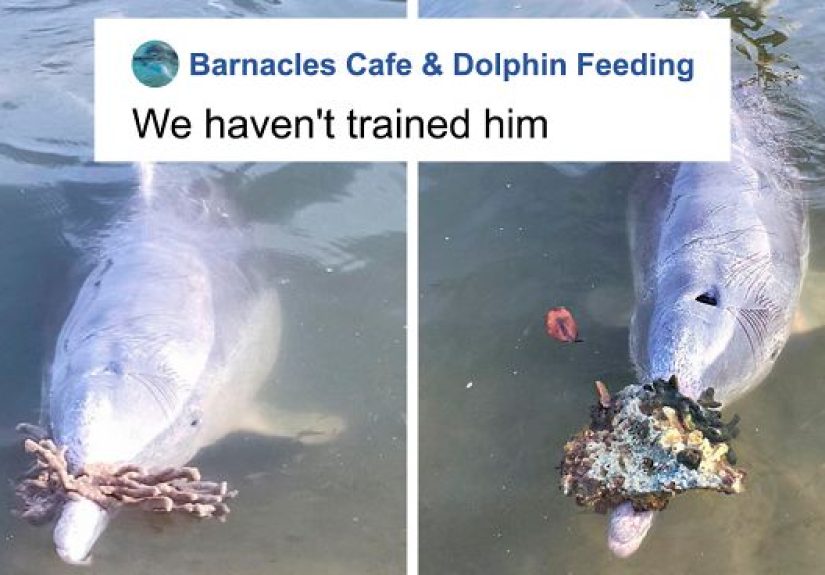
Most modern “dolphin brings gifts” stories follow the same pattern: a dolphin that frequently visits the same shoreline, people who are there every day (volunteers, fishers, dock regulars), and a growing pile of seafloor souvenirs. In one long-running case, a well-known wild dolphin repeatedly arrived with shells, bits of wood, coral fragments, and other objects–seemingly “offering” them to familiar humans.
Researchers have also reported rarer cases that look even more like true giving: dolphins approaching people with wild-caught prey–fish or cephalopods–in a way that resembles an offering rather than an accidental drop. That matters because prey is valuable. Sharing it is socially meaningful in many species, including dolphins.
What dolphins tend to “bring”
- Seashells, coral pieces, seaweed: common, easy to carry, often tied to object play.
- Driftwood and manmade debris: sometimes the ocean’s “lost and found” becomes part of the pattern.
- Fish, squid, octopus: less common, more biologically significant, and definitely not what most humans expected to receive today.
Why a Dolphin Would Do This (Without Needing a Tiny Gift Shop)
There probably isn’t one single reason. The strongest explanations blend dolphin cognition, dolphin social life, and human behavior (which is… loud).
1) Dolphins are curious object-handlers–and some use tools
Dolphins manipulate objects for play all the time: carrying, tossing, nudging, and “presenting” items to each other. In some populations, dolphins even use tools. A famous example is “sponging,” where dolphins wear marine sponges on their rostrums while foraging along the seafloor. The takeaway is simple: dolphins can deliberately pick up and transport objects from the bottom, then repurpose them as part of an interaction.
2) Social animals use objects and food to start interactions
Dolphins live in complex social networks where attention, alliances, and recognition matter. In some dolphin species, males have been observed presenting objects (like sponges) during courtship attempts. Even if a shell isn’t romance, it can still function as a social opener: “I’m here–engage with me.”
3) Humans accidentally “train” dolphins with our reactions
Humans squeal, point, chatter, and hang around–big rewards for a social animal. In places where dolphins are provisioned (or illegally fed), the learning loop gets even stronger: present something, get extra interaction, sometimes get fish. Over time, a dolphin can shape a habit that reliably pays off: bring item -> wait for reaction -> repeat. It’s operant conditioning with a splash of celebrity.
4) Curiosity plus boundary-testing
Dolphins investigate boats, nets, kelp, and anything new. “Offering” an item can also be a test: Will the human take it? Throw it back? Follow me? Dolphins learn patterns fast, and they may be probing the “rules of humans” the way they probe objects in the water.
How Dolphins Find “Gifts” on the Seafloor
To humans, the seafloor is a dark, chaotic drawer where the ocean keeps its spare parts. To a dolphin, it’s searchable. Dolphins use echolocation–rapid clicks that bounce off objects and return as detailed echoes–to navigate and hunt in murky water. Many prey species hide in sand or around structure, so dolphins spend plenty of time investigating the bottom. If a dolphin is already nosing around for food, it’s not a huge leap to grab an interesting shell or coral fragment while it’s down there.
That “bottom-of-the-ocean gift” detail also helps explain why the offerings can look random. Dolphins aren’t scuba-diving for artisanal souvenirs; they’re opportunists. The object that ends up on the shoreline may be the one that felt novel in the moment–odd shape, unusual texture, satisfying to carry, or simply convenient to present. Unfortunately, in many coastal areas, human litter becomes part of the selection. When a dolphin arrives with a bottle or plastic fragment, it’s less “aww” and more “we really need to do better,” because marine debris is dangerous for wildlife and a sign of environmental stress.
What These “Gifts” Hint About Dolphin Minds
To repeatedly deliver objects to the same humans, a dolphin has to remember a place, recognize routines, and time its approach. That aligns with what we know about dolphin learning and memory–and with their sophisticated communication.
Bottlenose dolphins, for instance, produce distinctive “signature whistles” that function as individual identifiers, and research suggests dolphins use these whistles in social contexts where recognizing “who is who” matters. Combine that with social learning–behaviors that spread and persist like traditions–and it’s easy to see how a successful “gift routine” could be refined over time, and even copied by other dolphins in the right conditions.
And dolphins aren’t strangers to interspecies teamwork, either. In a famous cooperative fishery in Brazil, wild dolphins herd fish toward shore and signal fishers when to cast nets, boosting catches for humans and improving hunting success for dolphins. That kind of mutual adaptation shows dolphins can integrate human behavior into their own strategies–sometimes for collaboration, sometimes for attention.
Cute, Yes. Risk-Free, No.
Here’s the part the internet often skips: close interactions can harm dolphins and people. Dolphins are powerful predators; they can bite, ram, or injure swimmers–especially when humans crowd them, touch them, or feed them. For dolphins, habituation to humans increases the risk of boat strikes, entanglement, hook ingestion, and conflict when expectations aren’t met.
In the United States, NOAA Fisheries warns that feeding or harassing wild marine mammals (including dolphins) is illegal and dangerous. The safest way to appreciate a “gift-giving dolphin” is to avoid becoming part of the reinforcement that makes the behavior stick.
How humans unintentionally make the habit worse
- Feeding (or “just once” tossing bait): teaches dolphins to approach people and boats.
- Turning it into a game: taking and returning objects can escalate repeat visits.
- Creating crowds: attention attracts more humans, which raises stress and accident risk.
If a Dolphin Tries to Hand You a “Present”
- Keep your distance and your cool. Let the dolphin choose to move away.
- Don’t feed or attempt to touch. Food rewards are the fastest way to create risky behavior.
- Don’t play fetch. Dolphins learn quickly–and they will absolutely remember you started this.
- Report concerning behavior. If a dolphin is repeatedly approaching people, begging, or appears injured, contact local wildlife authorities or a marine mammal stranding hotline.
So… Is It Really a Gift?
Sometimes, it may function like one: an intentional presentation followed by the dolphin waiting for a response. Other times, it’s object play plus social learning, amplified by human excitement. Either way, the behavior is a reminder that dolphins aren’t just reacting to us–they’re reading us. A dolphin that discovers humans like “gifts” is showing off a powerful kind of intelligence: the ability to influence another species by understanding what gets a reaction.
If the story makes you smile, let it nudge you toward the kind of appreciation dolphins actually benefit from: clean water, fewer boat strikes, less discarded fishing gear, and respectful viewing. The best way to keep dolphins curious and healthy is to make the ocean safer–then let them decide whether humans are worth the extra effort.
Experiences: What It’s Like When the Ocean Offers You Something
People who spend time around coastal dolphins often describe a moment that feels unreal: a dolphin approaches with purpose, slows down, and releases an object where a human will notice. Even if you know the science, your brain still goes, “I have been selected.” Here are a few experience-based snapshots–common patterns reported by volunteers, fishers, and water-users in dolphin-heavy places–that capture the awe and the responsibility.
The Dock Regular’s Dilemma
You’re watching the water when a familiar dolphin surfaces closer than usual. Something pale is tucked near its mouth. It nudges forward and drops a shell with a neat little clack. Your first instinct is to pick it up like treasure. Your second instinct is the grown-up one: “If I reward this with attention, will this dolphin do it again tomorrow?” That internal tug-of-war–joy versus caution–is the real “experience.” Locals who love their dolphins learn to celebrate quietly, because staying boring is sometimes the kindest thing you can do.
The Swimmer Who Becomes “The Audience”
In the water, proximity feels personal. A dolphin can glide in, circle once, then reappear with a bit of seaweed or debris and let it drift toward you. Some people describe dolphins returning if the human reacts, as if checking whether the “move” worked. It’s easy to interpret that as friendship. It might also be pattern-testing: “When I do this, humans act different.” The safest response is to back away slowly and give space–no chasing, no reaching, no attempts to “complete the moment.” Your best souvenir is the memory, not the object.
The Volunteer Who Notices the Pattern Over Time
At busy shorelines, long-time volunteers start seeing what tourists can’t: the dolphin that presents objects is often the bold one–first to approach, last to leave, most interested in new stimuli. Over weeks, the behavior can sharpen: objects delivered more precisely, longer pauses afterward, repeat passes if humans respond. From a learning perspective, it looks like the dolphin is shaping its routine to maximize interaction. From a human perspective, it feels like being chosen. Both feelings can exist at once–so long as humans don’t turn that feeling into feeding, touching, or crowding.
The Moment When the “Gift” Is Food
When the offering is a fish, the mood changes. Food is costly, and prey-sharing has social meaning in many animals. Some observers interpret it as sharing; others see it as a learned exchange in places where dolphins already associate humans with provisioning. Either way, accepting the prey or rewarding the dolphin can push it toward riskier, more demanding behavior. The most responsible choice is the least cinematic one: keep distance, don’t feed, don’t take, and let the dolphin decide what to do next. The ocean doesn’t need us to finish the interaction.
Ultimately, these experiences teach a surprising lesson: dolphins can be charming and wild at the same time, and our reactions matter. If you’re lucky enough to witness a dolphin’s strange little “offering,” treat it like a privilege–not an invitation. Wonder is free. Harassment is not.