Table of Contents >> Show >> Hide
- Who Is John D’oh (and Why His Work Hit a Nerve)
- Why COVID-19 Street Art Exploded
- The Pandemic Visual Vocabulary: Masks, Viruses, Hearts, and Distance
- John D’oh’s Superpower: Satire That Stays Understandable
- America’s Pandemic Walls: Murals as Thanks, Protest, and Survival
- Street Art as Pandemic Politics
- What Makes Coronavirus Street Art “Work”
- How to Read John D’oh’s Pandemic Pieces Like a Critic (Without Becoming Unbearable at Parties)
- Conclusion: The Wall as a Diary, the City as the Reader
- Experiences From the Pandemic Street-Art Era (A 500-Word Add-On)
In the early days of COVID-19, cities did something they almost never do: they got quiet. Storefronts
rolled down their shutters. Sidewalks emptied. The normal roar of traffic turned into an awkward
hushlike the whole world had been muted while someone fumbled for the remote.
And then, on those suddenly blank walls, a different kind of “breaking news” showed up: street art.
Some of it was tender. Some of it was furious. A surprising amount of it was hilarious in that
“laugh so you don’t cry” way. Few artists captured that blend of pop-culture wit and public-health
urgency as consistently as John D’oh, whose coronavirus-era work treated the pandemic like a
daily diaryone stencil at a time.
This article dives into John D’oh’s pandemic street artwhat it said, why it worked, and how it fits
into the bigger wave of coronavirus murals and graffiti that spread across cities (including in the
United States) during lockdowns, reopenings, and the long weird middle. Expect satire, healthcare
tributes, boarded-up storefronts turned into galleries, and a reminder that sometimes the most
honest commentary is the one you accidentally encounter while buying milk.
Who Is John D’oh (and Why His Work Hit a Nerve)
John D’oh is a pseudonymous street artist known for sharp, stencil-based pieces that remix
familiar pop culture into timely commentary. During the pandemic, he became especially visible
for work that tackled COVID-19 head-onreflecting not just the virus, but the social reactions
orbiting it: panic buying, misinformation, government missteps, and the emotional whiplash of
“two more weeks” stretching into “what year is it again?”
His signature move is to borrow a universally recognizable imageoften from film or celebrity
culturethen twist it into a public-service message or a political jab. That approach matters
because street art has about three seconds to earn attention. The viewer is walking, biking,
scrolling their phone, or mentally reheating leftovers. John D’oh’s work uses familiarity as a
shortcut: you recognize the reference, you stop, and then the message lands.
The “Pulp Fiction” Vaccine Stencil: Pop Culture as a Public Health Nudge
One of his best-known COVID-era pieces riffs on a famous scene from Pulp Fiction to encourage
vaccination. The logic is very John D’oh: take a dramatic injection everyone remembers from
a movie, then convert it into a blunt, street-level reminder that “injections save lives.”
It’s funny, it’s slightly absurd, and it’s also a surprisingly efficient way to pull vaccine
messaging out of abstract charts and into everyday life.
What made that particular piece travel (online and in conversation) is that it didn’t lecture.
It recruited the viewer’s memory. If you’ve seen the film, you’re already emotionally primed;
the stencil just reroutes that energy toward a real-world decision.
Why COVID-19 Street Art Exploded
Street art thrives when official messaging feels either too slow or too polished. The pandemic
was both: public guidance changed as knowledge evolved, and in many places the tone of “stay calm”
clashed with the lived reality of fear, grief, and uncertainty.
Add the visual conditions of lockdownsempty streets, boarded-up businesses, and wide surfaces
suddenly availableand you get a perfect storm. Walls became bulletin boards. Plywood became
canvas. The street turned into a low-budget museum with extremely high emotional stakes.
Artists responded fast because the moment demanded it. Unlike gallery shows that take months
to plan, street art can react to yesterday’s headline before today’s coffee gets cold. During
COVID-19, that speed turned murals into a kind of public diary: documenting the phases of the
pandemic in real time.
The Pandemic Visual Vocabulary: Masks, Viruses, Hearts, and Distance
COVID-19 street art developed a recognizable “look” across countries and cities. Certain symbols
kept repeating because they were instantly legible:
- Masks as protection, obedience, care, or sometimes political identity.
- The spiky virus icon as a cartoon villaineasy to draw, easy to fear.
- Hearts and healthcare tributes as gratitude and grief.
- Distance markers (two meters, six feet) as a new social geometry.
- Everyday objectstoilet paper, sanitizeras symbols of panic and coping.
These symbols weren’t just decorative. They were functional. A mural doesn’t need a press
conference; it needs clarity from a moving vehicle. That’s why the best pandemic street art
leaned into bold shapes and simple ideaseven when the emotions underneath were complicated.
John D’oh’s Superpower: Satire That Stays Understandable
Satire can be tricky in a crisis because the “joke” risks drowning out the point. John D’oh’s
stronger works tend to follow a simple rule: one big idea per wall. You can laugh, but you
also know what you’re laughing at.
This matters because pandemic life already felt like information overload. People were tracking
case numbers, rules, closures, reopenings, and arguments about all of the above. If a piece of
street art requires a 12-step explanation, the sidewalk wins and the art loses.
John D’oh’s pop culture references act like a handleyou grab the reference, and it pulls you
into the message. The humor isn’t the destination; it’s the delivery system.
America’s Pandemic Walls: Murals as Thanks, Protest, and Survival
While John D’oh’s work is rooted in the UK, the U.S. saw its own surge of coronavirus-era street
artoften shaped by local conditions: dense cities, hard-hit hospital systems, political conflict,
and a public that learned to read emotions through masks.
Healthcare Workers as Icons (and Why It Wasn’t Just “Feel-Good”)
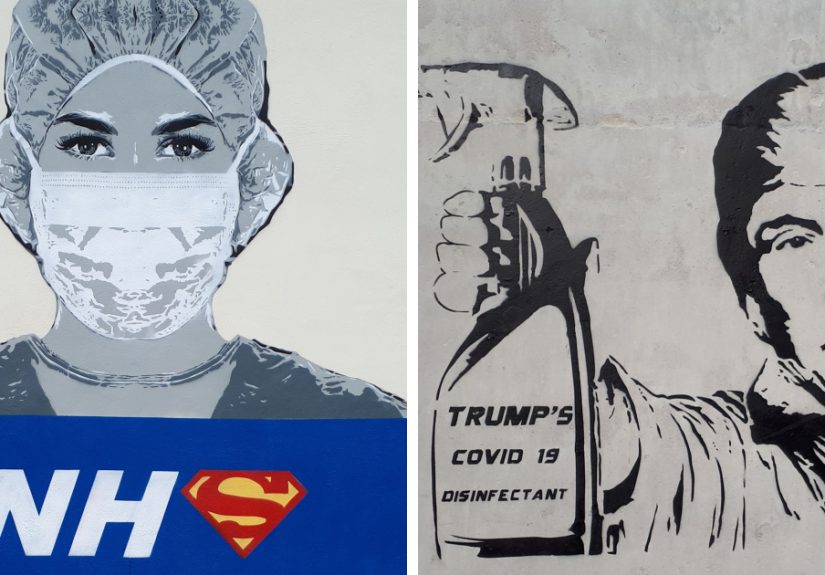
Some of the most visible American pandemic murals centered healthcare workersturning nurses,
doctors, and essential staff into monumental figures. These weren’t merely thank-you cards on a
large scale. They also functioned as public memory: a way to mark who carried the most risk when
staying home wasn’t an option.
Large-format public murals and portraits made the invisible visible. They reminded passersby that
the crisis wasn’t only an abstract “case count”; it was people in PPE, long shifts, exhaustion,
and loss.
Boarded-Up Businesses Became Galleries
In many American cities, plywood went up for practical reasonssecurity, vandalism prevention,
uncertainty about how long closures would last. But that same plywood became an invitation.
Artists painted murals on boarded windows and storefronts, transforming anxious streets into
places that still felt lived in.
This shift did something subtle but powerful: it changed the emotional temperature of a block.
A boarded-up store signals fear and retreat. A mural signals presence. Even when the art was angry
or mournful, it still told the neighborhood, “We’re here. We’re watching. We’re making meaning.”
Humor as a Coping Tool: Toilet Paper, Sanitizer, and the “Everyday Artifact”
Not all pandemic art aimed for solemnity. Some of it leaned into the absurd details that defined
early COVID life: empty shelves, panic buying, and the surreal sight of everyday products becoming
symbolic treasure.
Street artists (and adjacent public artists) treated these items like cultural artifacts. A roll
of toilet paper became shorthand for fear, scarcity, and the strange herd instincts that show up
when people feel powerless. In that way, humor wasn’t escapismit was diagnosis.
Street Art as Pandemic Politics
COVID-19 didn’t just disrupt health systems; it strained trust. Street art often stepped into
that tension because it can criticize without needing permission.
In Washington, D.C., for example, political street posters appeared that tied the pandemic to
leadership and accountability. Elsewhere, public artworks tracked grief directlytreating death
counts not as numbers but as moral weight. Pandemic street art became a public argument about
responsibility, truth, and who pays the price when systems fail.
John D’oh’s work fits this tradition. He doesn’t just illustrate the virus; he illustrates the
human behavior around itcompliance, denial, courage, cynicism, exhaustion. The wall becomes a
mirror, and the viewer becomes part of the story.
What Makes Coronavirus Street Art “Work”
Great pandemic street art tends to do at least one of these things exceptionally well:
- Translate public health into human language (simple, visual, immediate).
- Honor people (healthcare workers, neighbors, the dead) without flattening them into slogans.
- Process collective emotionfear, grief, rage, hopeout in the open where it can be shared.
- Challenge power when official narratives feel inadequate or dishonest.
- Create a pause: that moment where a stranger stops, looks, and feels less alone.
John D’oh’s coronavirus work is a case study in that first category: translation. Pop culture is
his dictionary. Humor is his amplifier. And the sidewalk is his distribution network.
How to Read John D’oh’s Pandemic Pieces Like a Critic (Without Becoming Unbearable at Parties)
1) Identify the reference first
John D’oh often starts with a borrowed image. Recognize it and you’ve already solved half the
puzzle. The reference is there to speed up comprehension.
2) Ask what the reference is doing
Is it making the message friendlier? Sharper? More insulting? More emotional? A film reference can
disarm you long enough to make you listen.
3) Look for the target
Pandemic street art usually points at something: fear, policy, misinformation, gratitude, grief.
The target tells you whether the piece is a comfort blanket, a warning sign, or a slap in the face.
4) Notice the “street logic”
A gallery has quiet lighting and wall labels. A street has weather, traffic, and people who didn’t
agree to be your audience. If a piece communicates under those conditions, it’s doing something right.
Conclusion: The Wall as a Diary, the City as the Reader
Coronavirus street art wasn’t a side note to the pandemicit was part of how communities processed
the experience in real time. John D’oh’s work stands out because it used pop culture as a Trojan horse
for public health: you show up for the recognizable image, and you leave with a question, a laugh,
or a new way to think about what’s happening around you.
Years from now, when people try to remember what the pandemic felt like, they’ll have data and
timelinesand they’ll also have walls. Stencils. Murals. Plywood canvases. The unofficial archive
that recorded the emotional truth of the era in plain sight.
Experiences From the Pandemic Street-Art Era (A 500-Word Add-On)
If you talk to people about pandemic street art, the stories rarely start with “I went to see a mural.”
They start with “I was on my way to…”to the grocery store, to work, to a test site, to nowhere in
particular because nowhere was open anyway. That’s the strange magic of street art: it ambushes you
in the middle of real life, when your guard is down and your brain is already full.
One common experience was the sudden sensation of being seen. During lockdowns, many people felt
anonymous in a mask, moving through a quiet city like a background character in someone else’s movie.
Then you’d turn a corner and spot a stencil that captured exactly what you were thinkingpanic buying,
vaccine anxiety, gratitude for nurses, anger at leaders, exhaustion with rules that kept changing. The
message didn’t have to be profound. Sometimes it just had to be accurate.
People also describe how street art created “micro-moments” of community. You’d see a mural and slow
down. Someone else would slow down too. No one was hugging strangers in 2020, but you might exchange a
look that said, “Yep. This is where we are.” Occasionally someone would actually speak: a quick joke, a
complaint, a thank-you, a little burst of human contact that felt rarer than toilet paper.
Another recurring experience: the emotional roller coaster of humor. Pandemic street art was often
genuinely funnyespecially when it leaned into the absurd details of the era. But the laugh usually had
a second layer, like a delayed echo: “Why is this funny?” “Because it’s true.” And if it’s true, it’s
also a little sad. That double-hit became a form of relief. Humor didn’t erase the crisis; it gave
people a way to hold it without breaking.
For some, these artworks became personal landmarks. “Meet me by the nurse mural.” “Turn left at the
stencil with the mask.” In a time when routines collapsed and days blurred together, a wall painting
could serve as a memory hookproof that time was passing, that the neighborhood was still speaking
even when businesses were closed and calendars were meaningless.
And then there was the experience of change. Street art isn’t permanent, and that impermanence matched
the pandemic’s shifting reality. A piece might be covered a week later. A message might feel outdated
a month later. But in the moment, it was aliveresponding to the same headlines you were reading and
the same anxieties you were carrying. That’s why, for many people, pandemic street art doesn’t just
represent what happened. It represents how it felt to live through it: uncertain, communal, and oddly
creative even in the middle of fear.