Table of Contents >> Show >> Hide
- The Short Answer (Because Your Basil Is Waiting)
- Why LED Lights Work for Plant Growth
- Do You Need a “Grow Light,” or Will Any LED Bulb Do?
- What to Look for in an LED Grow Light
- How Far Should an LED Grow Light Be From Plants?
- How Long Should You Leave LED Grow Lights On?
- Best Plants to Grow Under LED Lights
- Common Mistakes (and How to Fix Them Fast)
- LED vs. Sunlight: Can LEDs Fully Replace the Sun?
- Conclusion: Yes, You Can Grow Plants With an LED Light (and Enjoy It)
- Real-World Experiences: What It’s Actually Like Growing Under LEDs (About )
If you’ve ever stared at a sad winter windowsill plant and thought, “Buddy, we both need more sun,” you’re not wrong.
The good news: you can grow plants with an LED light. The even better news: you don’t need to build a spaceship
greenhouse or start speaking exclusively in acronyms… although indoor gardeners do love their acronyms.
LEDs can absolutely replace or supplement sunlightas long as you give plants the right kind of light, at the right
brightness, for the right amount of time. In other words: yes, but with a tiny dash of science and a pinch of
common sense (and maybe a timer, because humans forget things).
The Short Answer (Because Your Basil Is Waiting)
Yes. You can grow houseplants, seedlings, herbs, leafy greens, and even fruiting plants with LED grow lights.
The key isn’t “LED” by itselfit’s spectrum + intensity + duration. Get those three right, and your plants will
photosynthesize like they’ve got a tiny solar panel subscription.
Why LED Lights Work for Plant Growth
Plants don’t care if light comes from the sun, a greenhouse fixture, or a sleek desk lamp that looks like it belongs in a sci-fi movie.
They care about usable photonsspecifically, the wavelengths that power photosynthesis.
Plants Want PAR, Not “Bright”
When people shop for lights, they often look at lumens (how bright it looks to humans). Plants are unimpressed by your lumens.
They respond to PAR (Photosynthetically Active Radiation), which is light in the 400–700 nm range.
That’s basically “blue through red,” the sweet spot leaves can use to turn light into sugars.
Meet the Numbers: PPFD and DLI (Friendly Versions)
Two measurements matter most when you’re growing plants under LED:
- PPFD (Photosynthetic Photon Flux Density): how much usable light hits the plant each second, measured in
micromoles per square meter per second (µmol/m²/s). - DLI (Daily Light Integral): the total usable light your plant gets in a day, measured in moles per square meter per day (mol/m²/day).
Think of DLI as your plant’s “daily calorie target,” except it’s light.
Why this matters: a plant can thrive under a moderate PPFD if it gets enough hours of light to hit a good DLI.
Or it can struggle under a “bright” light if it’s too far away or only on for a few hours.
Do You Need a “Grow Light,” or Will Any LED Bulb Do?
You can grow plants with regular LED bulbs in a pinchespecially low- to medium-light houseplants.
But for strong growth (especially seedlings and edible plants), a full-spectrum LED grow light is usually the better tool.
Here’s the difference:
- Regular LEDs: designed so your living room looks nice. Plant performance varies wildly.
- LED grow lights: designed to deliver plant-usable light efficiently (often with published coverage maps and specs like PPFD).
Full Spectrum vs. “Blurple” (Red/Blue) Lights
Older-school grow lights often used heavy red and blue LEDs, creating the infamous purple glow that makes your kitchen look like a nightclub for ferns.
Those wavelengths are importantblue supports leafy/vegetative growth and structure, while red supports flowering cues and development.
But modern home setups often do great with full-spectrum white LEDs that cover a broad range and are easier to live with.
What to Look for in an LED Grow Light
If you want to grow plants with an LED light successfully (and not just keep them alive out of spite), focus on these factors:
1) Light Intensity That Matches Your Plant
Seedlings and sun-loving edibles generally need more light than pothos, snake plants, or peace lilies.
Many reputable fixtures provide a PPFD chart showing light levels at different hanging heights and coverage areas.
That chart is gold. Treat it like a treasure map.
2) Coverage Area (a.k.a. Don’t Light the Carpet)
A grow light that’s perfect for one basil pot may be wildly underpowered for a 2’×4’ seed-starting shelf.
Match the fixture to your footprint:
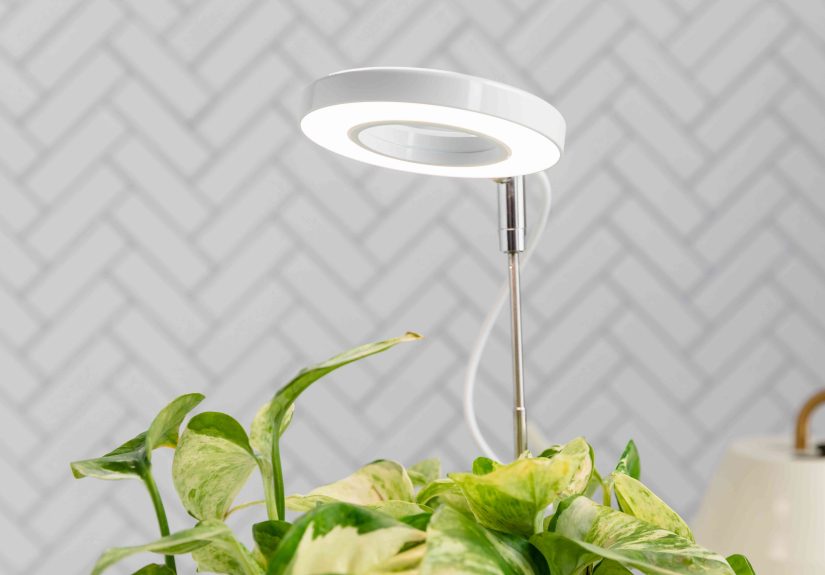
- Single plant: small clip-on or gooseneck grow light
- Seed trays: light bars or shop-light style fixtures
- Multiple plants: panel-style LED with wider, more even spread
3) Adjustable Height and/or Dimming
Light intensity drops fast as you move the light away from the leaves. Adjustable hanging is one of the easiest “growth hacks” there is.
Dimming is also useful when you’re transitioning plants or preventing leaf scorch.
4) Efficiency and Heat
LEDs are popular because they’re energy-efficient and run cooler than many older technologies. Cooler doesn’t mean “cold,” thoughlights still add heat,
especially in small spaces. Airflow helps keep leaves happy and reduces fungal issues.
How Far Should an LED Grow Light Be From Plants?
There’s no single perfect distance because different LEDs have different power and optics. But these practical guidelines work well as a starting point:
- Seedlings: commonly around 8–12 inches above the leaves for LED fixtures (adjust if plants stretch or bleach).
- Houseplants: often 2–4 feet away can work for broader coverage, depending on the fixture’s strength and plant type.
Watch the plant and adjust:
- Too far: leggy growth, pale leaves, slow growth, leaning toward the light
- Too close/too strong: bleached spots, crisping edges, drooping that looks like “I regret everything”
How Long Should You Leave LED Grow Lights On?
Most plants need a dark period, so avoid blasting light 24/7 as your default. A common home range is:
- Houseplants: roughly 12–14 hours daily (especially when supplementing window light)
- Seedlings and veg growth: often 14–16 hours daily for stocky, sturdy growth
- No natural light at all: some plants may need 16–18 hours depending on their needs
A timer is the MVP here. It keeps the schedule consistent and prevents the “Oops, I left it on all weekend” lifestyle choice.
A Simple PPFD/DLI Example (No Calculator-Induced Tears)
If you know your target DLI and how many hours you’ll run the lights, you can estimate the PPFD you need.
For example, if you want a DLI of 12 mol/m²/day and you plan to run lights 16 hours/day, you’re aiming for a PPFD in the neighborhood of ~208 µmol/m²/s.
(That’s the kind of math growers use to plan setups without guessing.)
Best Plants to Grow Under LED Lights
LEDs are flexible. Here’s what tends to thrive indoors with a solid light setup:
Easy wins
- Herbs: basil, mint, parsley, cilantro
- Leafy greens: lettuce, arugula, spinach, kale
- Houseplants: pothos, philodendron, snake plant, spider plant
Medium difficulty (but very doable)
- Seedlings: tomatoes, peppers, flowers (start strong to avoid the “spaghetti stem” problem)
- Flowering houseplants: African violets, orchids (light + consistent routine matters)
High reward (needs higher intensity and consistency)
- Fruiting plants: tomatoes, peppers, dwarf citrus (more light, more patience, more pruning)
Common Mistakes (and How to Fix Them Fast)
Mistake #1: Buying by watts or “looks bright”
Wattage tells you power draw, not how much useful light reaches the plant. Look for published PPFD info or reputable testing,
and prioritize coverage + distance + duration.
Mistake #2: Hanging the light too high
Light intensity drops quickly with distance. If your seedlings are stretching, lower the light (or increase intensity) before they turn into tiny green giraffes.
Mistake #3: No dark period
Plants aren’t solar calculators; they have biological rhythms. Many do best with a daily rest cycle.
Consistent “day/night” timing can also improve flowering for photoperiod-sensitive plants.
Mistake #4: Overwatering under lights
More light usually means more growth and more water usebut not always immediately. Check soil moisture, use airflow,
and remember: damp + warm + still air is basically a spa day for fungus.
LED vs. Sunlight: Can LEDs Fully Replace the Sun?
In many cases, yesespecially for leafy greens, herbs, and houseplants. But sunlight is incredibly intense and broad-spectrum.
If LED is the only light source, you often compensate by running it longer and keeping it at an effective distance.
The goal is to deliver enough total daily light (DLI), not to perfectly imitate noon in July.
Conclusion: Yes, You Can Grow Plants With an LED Light (and Enjoy It)
Growing plants with an LED light works because plants need usable photons, not magical outdoor vibes.
Choose a fixture with a plant-friendly spectrum (full-spectrum is usually easiest), deliver enough intensity to the leaves,
run the light long enough to hit a healthy daily total, and keep the schedule consistent with a timer.
Do that, and your indoor garden can thrive year-roundeven when the weather outside is doing its best impression of a gray screensaver.
Real-World Experiences: What It’s Actually Like Growing Under LEDs (About )
Ask ten indoor gardeners about LEDs and you’ll get twelve opinionsplus one person who insists their plants “only respond to jazz.”
But a handful of experiences show up again and again, and they’re weirdly comforting because they prove you’re not the first person
to accidentally roast a basil plant like it offended your family.
One of the most common “aha” moments happens with seedlings. People set up a light, step back proudly, and think,
“Wow, this is bright.” Two weeks later: leggy stems, tiny leaves, seedlings leaning like they’re trying to escape. The fix is almost
always the samebring the LED closer and keep it there as the seedlings grow. Once the light is close enough to deliver
useful intensity, seedlings often change fast: stems thicken, growth tightens up, and everything looks less like a baby deer learning to walk.
The moral: seedlings don’t need inspirational lighting; they need effective lighting.
Houseplants tell a different story. A pothos or philodendron can look “fine” for months in mediocre light, which tricks people into thinking
the setup is perfect. Then they notice slow growth, smaller new leaves, or fading variegation. A modest LED (even a small full-spectrum bulb
in a clamp lamp) can flip that script. The fun part is that the improvement isn’t always dramatic at firstthen you realize you’re pruning vines,
rotating pots, and quietly bragging to friends that your living room is now a “tropical microclimate.” (It’s still a living room. But let us have this.)
Herbs under LEDs are where optimism meets reality. Basil, mint, and parsley can absolutely thrive, but they’re picky about consistency.
The gardeners who do best tend to use a timer and treat light like a schedule, not a suggestion. They also learn that harvesting
is part of the system: pinch basil early, encourage branching, and suddenly you’re not “growing basil,” you’re producing basil like a tiny
countertop farm. The not-so-fun lesson: if the light is weak or too far away, herbs stretch and get floppy. A small upgrade in intensity
often beats adding more hours.
Then there’s the “oops” category: leaves bleaching under a powerful light, or plants drying out faster than expected. These are usually solved
with tiny adjustmentsraise the fixture a few inches, dim it, add a little airflow, or simply stop treating the soil like it owes you money.
Many growers eventually adopt a calm routine: check leaves for stress, check soil moisture, and adjust one variable at a time. It’s less “mad scientist”
and more “patient coach.” And honestly? That’s where LEDs shine. They give you controlpredictable light, repeatable results, and a fighting chance
at fresh greens when the outdoor world is… not cooperating.