Table of Contents >> Show >> Hide
- The 50-Year “Birthday” That Felt Like a Cliffhanger
- How the 747 Changed Air Travel (and Why It Was a Big Deal)
- The Engineering Flex: A Jumbo Built Like an Idea Factory
- So Why Is the 747 “Fighting for Survival”?
- The Second Act: Cargo Is Where the 747 Refuses to Quit
- Passenger 747s Aren’t GoneThey’re Just Rare (and That’s the Point)
- The Government and Special-Mission Lifeline
- What “Survival” Looks Like for the 747 in 2026 and Beyond
- A Legacy That’s Bigger Than the Plane
- Experiences: What It Feels Like to Meet (or Fly) the 747
- Conclusion
The Boeing 747 didn’t just enter commercial aviation it cannonballed into it. When the “Queen of the Skies” began flying
paying passengers in January 1970, it made the world feel smaller in a very literal way: more seats, longer routes, bigger dreams,
and a cabin so wide it practically dared airlines to invent new ways to sell snacks.
By the time the 747 hit its 50-year milestone in 2020, it was also staring down a harsh reality: the modern airline industry
had fallen out of love with four engines, mega-capacity, and hub-to-hub bravado. Yet the 747 still refuses to take a bow quietly.
It’s survivingsometimes gloriously, sometimes stubbornlyby reinventing itself as a cargo workhorse, a government platform, and an
aviation icon people still chase to airports just to watch it lift off.
The 50-Year “Birthday” That Felt Like a Cliffhanger
Turning 50 is usually the time for a victory lap. For the 747, the half-century mark looked more like a season finale: dramatic retirements,
changing travel patterns, and a pandemic that accelerated the goodbye tour for many passenger jumbos. Still, “fighting for survival” doesn’t mean
“about to disappear.” It means the 747 is no longer the default choiceit’s the specialist. And specialists can stick around for a long time.
Think of today’s 747 as a legendary veteran athlete who no longer plays every position, every game, in every stadiumbut still shows up when the moment
demands it. Need to haul oversized cargo that won’t fit through a standard freighter door? Need a high-profile governmental aircraft with massive space and range?
Need a plane that makes passengers post photos before they’ve even found their seat? The 747 still raises its hand.
How the 747 Changed Air Travel (and Why It Was a Big Deal)
The 747’s impact is hard to overstate. It helped normalize long-haul international travel for millions of people by pushing down the cost per seat on busy routes.
It also shaped airport infrastructure: larger gates, stronger pavement, new boarding concepts, and the expectation that a single flight could deliver hundreds of passengers
in one go. The jumbo era encouraged hub-and-spoke networkspacking travelers into big flights between major airportsbecause the economics worked when you could fill the cabin.
Culturally, the 747 became shorthand for “global.” Heads of state used it. Tourists trusted it. Airlines turned it into a symbolpainting special liveries, installing lounges,
and marketing the upper deck like a private club in the sky. Even people who couldn’t name the aircraft model could recognize the silhouette: that unmistakable hump, like the plane
was perpetually raising an eyebrow at smaller jets.
The “Hump” Wasn’t Just for Style
The upper deck gave the 747 its instantly recognizable shape, but its design also supported a practical idea: a raised cockpit makes room for a nose-loading freighter door.
That design choice turned out to be a survival superpower. When passenger demand softened over the decades, the 747’s cargo-friendly DNA helped keep it relevant.
The Engineering Flex: A Jumbo Built Like an Idea Factory
The 747 arrived as a massive engineering gamble, powered by early high-bypass turbofan engines that helped make wide-body efficiency possible.
Boeing built a gigantic assembly site in Everett, Washington, specifically to produce itbecause nothing else was big enough.
The plane itself was big, but so was the belief behind it: that air travel would keep expanding, that airports would adapt, and that people would keep showing up in numbers that justified a flying stadium.
Over time, the 747 family evolved through multiple variants, with the 747-400 becoming a global mainstay and the 747-8 extending the line into a new generation.
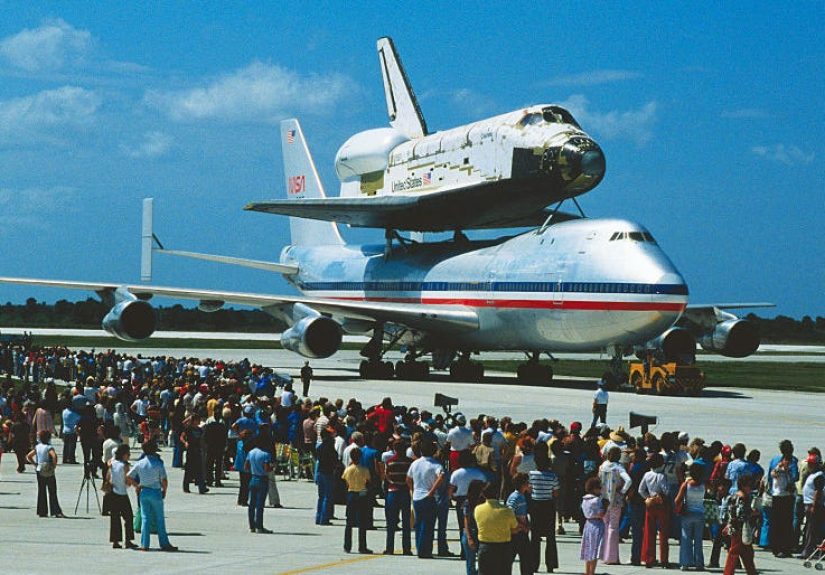
The airplane was roomy, long-legged, and tough. It also became a platform: NASA used modified 747s to carry Space Shuttle orbiters, and later used a specialized 747 as a flying observatory.
The 747 wasn’t just transportation; it was infrastructure with wings.
So Why Is the 747 “Fighting for Survival”?
The 747 didn’t get worseits competition got smarter. Over the last two decades, airlines shifted toward modern twin-engine wide-bodies that burn less fuel per seat, require less maintenance,
and offer more flexible route planning. The rise of point-to-point flying (more nonstop city pairs, fewer mega-hub transfers) made it harder to justify a jet designed for filling a huge cabin
on trunk routes. Add stricter noise and emissions expectations, expensive heavy maintenance cycles, and the math gets brutal.
In plain English: a four-engine jumbo is fantastic when it’s full and flying a route that needs all those seats. When it’s half-fullor when demand is spread across many smaller nonstopsairlines
would rather fly an aircraft that matches the market precisely. A big jet that leaves seats unsold is basically a very expensive way to transport empty air.
The Pandemic Accelerated the Goodbye Tour
Even before 2020, many airlines had retirement timelines for older 747 passenger fleets. Then global travel demand plunged, and the 747already pricey to operatebecame an easy target.
Retirements that were supposed to happen gradually happened fast. Some carriers brought jumbos back temporarily when demand surged, but the overall trend didn’t reverse.
The Second Act: Cargo Is Where the 747 Refuses to Quit
If passenger flying is the 747’s glamorous movie career, cargo is its long-running hit TV series: less red carpet, more seasons.
The 747 freighterespecially the 747-8Ffits a niche that’s still valuable: it can haul huge payloads and accept oversized items through a nose door, which is a big deal for certain loads
that can’t be squeezed through side cargo openings.
That’s why the 747’s “survival story” is closely tied to logistics. E-commerce growth and global supply chains created steady demand for large freighters,
even as passenger fleets shrank. In 2023, Boeing delivered the final 747 ever builtan emotional moment for aviation fansyet it was also a practical statement:
the last new 747 was a freighter, because cargo is where the jumbo still earns its keep.
What Makes the 747 Freighter Special?
- Nose-loading capability: helpful for outsized freight (think aerospace components, industrial equipment, and awkward cargo that hates corners).
- High payload and long range: strong for intercontinental freight missions when speed matters.
- Proven global support network: decades of operational history, training pipelines, and maintenance knowledge.
Is it the cheapest way to move every box? No. But for specific missionsurgent freight, oversized loads, global express networksthe 747 still offers a blend of volume, capability, and speed
that is hard to replace perfectly with smaller aircraft.
Passenger 747s Aren’t GoneThey’re Just Rare (and That’s the Point)
In the mid-2020s, the scheduled passenger 747 became an increasingly uncommon sight, which only made it more famous. A shrinking roster of operators has kept passenger 747 flights alive on select routes,
typically where demand spikes and where the aircraft still fits the airline’s fleet strategy. For travelers, this rarity turns a routine trip into an event.
The experience is different. The cabin feels wider. The airplane feels heavier in a reassuring way, like it could bench-press smaller jets for fun.
And if you get the upper deck, you’ll understand why people talk about it like it’s a secret level in a video game.
The Government and Special-Mission Lifeline
Another reason the 747 is still in the conversation: specialized missions. The U.S. presidential aircraft (Air Force One) is a 747 variant today, and newer 747-8 airframes are being modified for future service.
Beyond presidential transport, large aircraft platforms are useful for command-and-control roles, specialized communications, and missions where space, power, and range matter.
Those are not jobs you hand to a smaller jet without making major tradeoffs.
In other words, even when commercial airlines move on, governments and specialty operators may keep certain 747s flying because there’s no simple “plug-and-play” replacement
for a large, proven platform.
What “Survival” Looks Like for the 747 in 2026 and Beyond
The 747’s future isn’t about making a comeback as the world’s default long-haul airplane. That era is over. Survival now looks like a portfolio of roles:
cargo networks, charters, special missions, and a small number of passenger flights that remain economically sensible.
The 747’s Survival Playbook
- Freighter dominance in a niche: continuing to serve routes and cargo types where size and nose-loading matter.
- Life-extension and smart maintenance: operators investing in airframe upkeep, parts management, and targeted upgrades.
- Selective passenger operations: flying where demand is consistently high or where fleet mix favors occasional jumbo capacity.
- Special missions: government, research, and other “only a big platform can do this” tasks.
- Cultural gravity: museums, commemorative flights, and the aviation community keeping the legend alive.
There’s also a quieter form of survival: the 747 will keep existing in pieces. Retired airframes feed parts into active fleets, extending the service life of the survivors.
It’s not glamorous, but it’s how aviation worksespecially for older aircraft types that still have strong niches.
A Legacy That’s Bigger Than the Plane
The 747 changed how humans relate to distance. It helped turn international travel from a luxury into something closer to a norm. It reshaped airports, airline economics, and even pop culture.
The phrase “Queen of the Skies” isn’t just marketing; it’s a recognition that this airplane became a symbol of an era when aviation felt like the future arriving early.
And that’s why the 747’s “fight” matters. It’s not only about whether a specific aircraft type stays in service. It’s about how the industry balances efficiency with capability,
and how it decides what to preserve when progress keeps pushing forward. The 747 is proof that sometimes the most useful machines are the ones that can reinvent themselves.
Experiences: What It Feels Like to Meet (or Fly) the 747
People who love the 747 don’t talk about it the way they talk about other airplanes. They talk about moments. The first moment is usually the scalestanding at a terminal window,
watching a 747 pull in, and realizing your brain needs an extra second to accept that something that large is allowed to be airborne.
The wings feel like they stretch into another zip code. The landing gear looks like it belongs on heavy construction equipment.
Boarding can feel like entering a small building. The aisle is wider, the ceiling feels higher, and there’s a subtle sense that you’re stepping into a classic.
Even if the cabin is modernized, the vibe is differentless “minimalist gadget” and more “grand touring car.” On some layouts, the stairs to the upper deck add a little drama:
you’re not just finding a seat; you’re going upstairs on an airplane like this is perfectly normal behavior.
The upper deck experience is where many fans become lifelong believers. It tends to feel quieter and more private, with a cozier layout that makes the flight feel like a lounge rather than a bus.
It’s the kind of space that makes people whisper a little, even if they don’t realize they’re doing itlike you’ve wandered into a library that happens to be cruising at 35,000 feet.
Then there’s the sound. A four-engine jet has a signature that’s hard to fake. During takeoff, the cabin can feel like it’s gathering itselflike a big animal shifting its weight
and then, suddenly, it’s airborne. The acceleration is confident rather than frantic. For aviation geeks, the engine note is part of the nostalgia: a reminder of an era when power was part of the spectacle.
For everyone else, it’s just thrilling in a way that makes you put your phone down for a second and actually watch the world tilt away from you.
If you’ve ever watched a 747 freighter being loaded, the “survival story” becomes very real. The nose can open, and cargo that looks impossible to movemassive crates, oversized components,
weirdly shaped machineryslides into the aircraft like it was designed for exactly that problem. It turns the plane into a flying warehouse with a front door, which is still a rare trick in aviation.
Seeing that up close explains why operators keep them flying: some jobs simply don’t care that four engines are less fashionable.
And finally, there’s the community experience. Plane spotters show up for 747 departures because the event feels ceremonial. Families point. Cameras click.
Frequent travelers who have flown dozens of aircraft types still pause and say, “That one is different.” The 747 earns attention without asking for it.
Even in an age of sleek composite twins, the jumbo is proof that practicality and personality can share the same runway.
These experienceswatching it tower over the gate, climbing to the upper deck, hearing the engines spool, seeing the freighter nose openare exactly why the 747’s survival matters.
As fleets modernize, the 747 becomes less common but more meaningful. It turns from “transportation” into “memory,” and that is one of the strongest forms of aviation longevity there is.
Conclusion
The Boeing 747 reached its 50-year milestone with its commercial dominance fading, but its story didn’t end it shifted.
Today, the 747 survives through cargo, special missions, selective passenger flying, and an unmatched cultural legacy.
It’s not the industry’s default anymore, but it remains one of aviation’s most capable problem-solvers and one of its most beloved symbols.
The Queen of the Skies may be fighting for survival, but it’s doing it the same way it always has: by being too usefuland too iconicto ignore.