Table of Contents >> Show >> Hide
- What Archaeologists Actually Found at Saqqara
- Why a Door to Nowhere Was Actually the Point
- Who Was Prince Waser-If-Re?
- Why Saqqara Never Stops Surprising People
- What the Tomb Reveals About Ancient Egyptian Beliefs
- The Real Mystery Is Not the Door
- Experiences Related to the Topic: Why Discoveries Like This Hit People So Hard
- Conclusion
- SEO Tags
Note: Clean HTML body only for direct web publishing.
Some archaeology headlines sound like they were brainstormed by a mystery novelist with a sand obsession. A 4,000-year-old tomb. A giant fake door. A royal burial in Saqqara. A doorway that opens to absolutely nothing. On paper, it sounds like ancient Egypt decided to invent the world’s oldest practical joke.
But here is the twist: for the people who built it, the “fake” door was not fake at all.
The discovery in Egypt’s vast Saqqara necropolis centers on the tomb of Prince Waser-If-Re, also rendered as Userefre, a son of King Userkaf, founder of the Fifth Dynasty. The most dramatic feature is a towering pink granite false door, roughly 14.8 feet high, inscribed with the prince’s titles and set within a tomb that still has archaeologists piecing together its full story. And while many headlines round the age down to “4,000 years,” the chronology places it closer to about 4,400 years old. That little difference may not sound huge, but in archaeological terms, four centuries is not exactly a rounding error you make with confidence and a shrug.
This discovery matters for more than its click-worthy image. It offers a fresh look at elite status, funerary beliefs, artistic choices, and the strange, elegant logic of ancient Egyptian tomb design. It also reminds modern readers that a doorway does not have to swing open on hinges to be powerful. Sometimes, the most meaningful doors are the ones meant for the dead.
What Archaeologists Actually Found at Saqqara
The tomb was uncovered in the Saqqara necropolis, one of Egypt’s richest and longest-used burial landscapes. Saqqara is already famous for the Step Pyramid of Djoser, the groundbreaking monument that helped define pyramid building in the Old Kingdom. But the site is not just one show-stopping pyramid and a lot of sand pretending to be scenery. It is a sprawling cemetery zone used over many centuries, layered with tombs, shafts, chapels, statues, reused monuments, and enough historical surprises to keep archaeologists coming back with brushes, notebooks, and very serious hats.
In this newly reported tomb, the standout object is the massive pink granite false door. It is not a hidden passage, not a trick entrance, and not a sliding stone mechanism waiting for a movie villain to activate it. Instead, it is a symbolic architectural feature tied to ancient Egyptian beliefs about the afterlife. The door bears inscriptions naming the prince and listing his prestigious roles, including hereditary prince, royal scribe, judge, minister, governor, and chanting priest. In other words, this was not some obscure guy with a nice address. He was deeply embedded in royal, administrative, and ceremonial life.
The tomb also yielded a red granite offering table placed near the false door, a detail that makes strong ritual sense. In addition, archaeologists found a group of 13 pink granite seated figures placed on high-backed chairs. Some are believed to represent the prince’s wives, while two are headless, adding a dose of mystery to an already dramatic scene. Another black granite statue was found overturned, and the site produced evidence that the tomb was reused much later. A statue group associated with King Djoser, his wife, and children appears to have been placed in the tomb during the 26th Dynasty, centuries after the tomb’s original construction.
That later reuse is one of the most fascinating details. Ancient Egyptian monuments did not always remain frozen in the exact purpose their builders intended. Tombs and sacred spaces could be revisited, reinterpreted, restored, or repurposed by later generations. So this was not just a burial place. It became part of a longer story about memory, status, and the continuing prestige of Saqqara itself.
Why a Door to Nowhere Was Actually the Point
The “false door” was a portal, not a construction mistake
To modern eyes, a false door can sound decorative at best and confusing at worst. Why carve a door that does not open? Why invest expensive material and skilled labor into a doorway with all the practical usefulness of a painted elevator button?
Ancient Egyptians had an answer: because the door was never for living bodies. It was for the ka, often described as a person’s life force or spiritual essence. Museum and scholarly explanations consistently describe false doors as symbolic passageways through which the deceased could move between the tomb and the realm of offerings. That is why false doors became focal points in tomb chapels. Offerings were presented before them. Images of the deceased were placed around them. Titles and formulas were inscribed on them. They were built to function within a religious worldview, not within a carpenter’s manual.
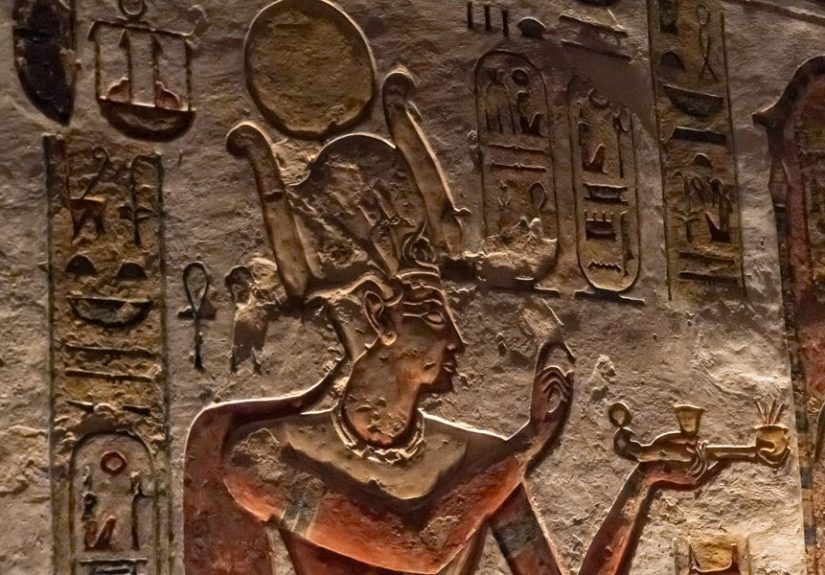
In many examples from museums in the United States, the false door is shown with a central niche, flanking jambs, lintels, and an image of the deceased seated before an offering table. The form imitates a real doorway, but the purpose is spiritual. That is the key distinction. The ancient builders were not pretending a stone slab would open physically. They were creating an interface between the living and the dead. “Fake door” is modern shorthand. “Ritual threshold” is closer to the truth.
Why pink granite makes the discovery even more remarkable
Material matters in archaeology, and here it matters a lot. False doors were commonly made of limestone, which was abundant and more practical for much of Egyptian construction. Pink granite, by contrast, was expensive, prestigious, and transported from Aswan far to the south. That alone signals wealth and importance.
So when archaeologists describe this false door as extraordinary in both size and material, they are not just admiring the color palette. They are pointing to social rank. Granite was effort. Granite was cost. Granite was status turned into stone. A giant pink granite false door for a prince was a statement, and not a subtle one.
It basically said: this is a man whose afterlife is expected to arrive in style.
Who Was Prince Waser-If-Re?
One of the most intriguing parts of the discovery is that Prince Waser-If-Re was not previously well known. Some scholars quoted in coverage of the find noted that, before this tomb came to light, his existence was not clearly established in the historical record available to them. That makes the inscriptions especially important. Titles in ancient Egyptian tombs are not filler. They are social evidence.
The prince’s listed roles suggest someone with authority in court, administration, religion, and regional governance. He was not merely royal by birth. He appears to have held real offices. His connection to Userkaf also matters because Userkaf was the founder of the Fifth Dynasty, a period associated with important shifts in royal ideology, especially the growing prominence of the sun god Re. Even the prince’s name reflects that religious atmosphere.
This helps place the tomb in a larger historical transition. The Fourth Dynasty is famous for the mega-project energy of Giza and its colossal royal monuments. The Fifth Dynasty still valued kingship and monumentality, but elite power networks became more visibly distributed among high-ranking officials and royal family members. A prince with many titles, buried in a richly equipped tomb at Saqqara, fits that broader pattern of elite prominence.
Why Saqqara Never Stops Surprising People
Saqqara is one of those places where every new excavation seems to answer one question and immediately create seven more. It served as the necropolis of ancient Memphis and remained important across multiple dynasties. That long use is exactly why discoveries there can feel so layered. A single tomb may preserve an Old Kingdom identity, later modifications, ritual traces, reused sculpture, and material from entirely different periods.
That is also why the Djoser connection in this tomb is so compelling. Djoser lived earlier than the prince, yet statues associated with him and his family were apparently placed in the tomb much later still. The result is a kind of archaeological time stack: Third Dynasty associations, a Fifth Dynasty prince, and reuse during the 26th Dynasty. It is less like opening a sealed time capsule and more like opening a historical filing cabinet that several civilizations kept reorganizing.
Saqqara keeps producing major finds because it was never just a cemetery. It was a sacred landscape, a political landscape, and a prestige landscape. To be buried there mattered. To reuse monuments there mattered. To build in stone there mattered. Saqqara was memory made geographic.
What the Tomb Reveals About Ancient Egyptian Beliefs
The false door is the headline magnet, but the broader context is just as revealing. Ancient Egyptian tombs were not merely storage spaces for bodies and grave goods. They were engineered environments for eternal maintenance. Food offerings, inscriptions, images of idealized bodies, ritual furniture, and spatial design all worked together to support the dead in the afterlife.
That is why offering tables are so important. That is why names and titles are carved with care. That is why family figures appear in these compositions. In many preserved false doors now held in museums, the owner sits before food offerings while inscriptions call for bread, beer, meat, incense, and other necessities. The visual message is simple: the dead should continue to receive status, nourishment, and remembrance.
Seen in that light, the giant pink granite door in Prince Waser-If-Re’s tomb is not weird decoration. It is a ritual machine. It organizes offerings, identity, and sacred passage in one commanding object. The fact that it was made in such valuable material only reinforces how seriously these beliefs were taken.
And frankly, there is something deeply human in that. People have always tried to keep loved ones present after death. Some leave flowers. Some light candles. Some build memorial websites. Some carve a ceremonial doorway in stone and make sure the afterlife has proper granite. The emotional logic is different in form, but not entirely foreign in spirit.
The Real Mystery Is Not the Door
For all the attention on the “door to nowhere,” the deeper mystery may be how much of the tomb remains undiscovered. Reports indicate that excavators have only uncovered part of the monument and that the burial chamber itself has not yet been found. That leaves open major questions. Where exactly was the prince buried? What additional inscriptions or objects survive? What can the unfinished excavation tell us about the tomb’s architecture, original use, and later adaptation?
There is also the puzzle of the seated figures and reused statuary. Were the 13 granite figures all members of the prince’s household? Why were some damaged? How did the later statue group end up in this tomb? Was the reuse practical, symbolic, devotional, or political? Ancient Egypt loved a clear inscription, but it also left modern archaeology plenty of unfinished sentences.
That uncertainty is part of what makes this discovery so compelling. The false door grabs attention, but the tomb’s broader story is still unfolding. Archaeology, at its best, is not a magic trick where one dramatic reveal explains everything. It is a patient argument with the past, and the past rarely hands over all its answers in the first round.
Experiences Related to the Topic: Why Discoveries Like This Hit People So Hard
There is a reason stories like this travel so quickly. Even people who do not follow archaeology closely understand the emotional jolt of a tomb, a threshold, and a space designed for someone who expected to remain important after death. A false door is especially powerful because it feels familiar and uncanny at the same time. You recognize it instantly as a door. Then you realize it is not a door for you. That gap between recognition and exclusion creates the chill.
For visitors who encounter ancient Egyptian material in museums, false doors often create a surprisingly intimate reaction. They are not giant pyramids towering at a distance. They are closer to human scale. You can see the niche, the carved jambs, the image of the deceased seated before offerings, the rows of hieroglyphs listing titles and requests. It feels less like looking at a ruined monument and more like standing in front of someone’s carefully prepared introduction to eternity. The stone is old, but the social instinct behind it is immediately readable: remember me, feed me, name me correctly, keep me in the world.
At a site like Saqqara, that feeling intensifies. The desert edge, the light, the silence, and the density of burials combine into something that is hard to reduce to a postcard summary. Saqqara can feel both exposed and hidden at once. The horizon is wide open, but the real stories are underground, sealed behind walls, shafts, and chambers. A discovery like Prince Waser-If-Re’s tomb sharpens that tension. It reminds people that beneath terrain that can seem still and empty, entire networks of ritual life and royal ambition remain buried.
There is also an experience of scale that changes how modern people respond. The false door in this tomb is huge. When readers picture a “fake door,” they may imagine a decorative panel the size of a closet. A nearly 15-foot granite monument is a different thing entirely. It has physical authority. It is not whispering symbolism. It is announcing it. Standing near something like that would likely feel less like admiring decoration and more like confronting a ceremonial statement that was designed to dominate the room and organize behavior around it.
And then there is the emotional paradox. Ancient Egyptian funerary art can feel serene, orderly, and controlled, yet it is driven by one of humanity’s oldest anxieties: how not to disappear. The experience of seeing a false door, whether in person or even through photographs, often comes from sensing that struggle beneath the polish. Every inscription, offering list, and idealized family scene says the same thing in slightly different language: this life mattered, and it should continue to matter.
That is why the phrase “door to nowhere” is catchy but incomplete. To modern observers, the doorway leads nowhere in physical space. To the people who made it, it led exactly where it needed to go. The emotional experience of that realization is what stays with readers, travelers, museumgoers, and probably anyone who has ever paused in front of an old object and suddenly felt that the ancient world was not distant at all. It was simply speaking in symbols instead of sentences.
Conclusion
The discovery of Prince Waser-If-Re’s tomb at Saqqara is memorable because it combines drama, symbolism, and real historical value in one elegant package. Yes, the giant false door is irresistible as a headline. But the real importance lies in what it reveals: the prince’s status, the expense of pink granite, the ritual role of offerings, the continued prestige of Saqqara, and the sophisticated spiritual logic behind ancient Egyptian tomb design.
In the end, the “fake door to nowhere” is not a story about ancient confusion. It is a story about ancient intention. The door was built to open onto belief, memory, and afterlife. That may not satisfy someone looking for a secret chamber full of booby traps and cinematic treasure. But for archaeology, it is better. It gives us something more durable than spectacle: a sharper understanding of how a civilization imagined death, prestige, and permanence.
And honestly, if you are going to build a doorway for eternity, making it giant, pink, and unforgettable feels like a pretty strong design choice.