Table of Contents >> Show >> Hide
- Before You Start: The 10-Second “Clutter Scan”
- Mistake #1: Decorating With Dozens of Small Objects Instead of a Few Anchors
- Mistake #2: Letting Your Nightstand Become a Museum of Daily Life
- Mistake #3: Overstyling the Bed With a Pillow Pileup
- Mistake #4: Treating Your Dresser Top Like a Catch-All Counter
- Mistake #5: Using Open Storage in the Wrong Places
- Mistake #6: Ignoring Scale (Too Much Furniture, or the Wrong-Sized Pieces)
- Mistake #7: Mixing Too Many Patterns (and Calling It “Cozy”)
- Mistake #8: Exposing Cord Chaos and Tech Clutter
- A Simple “Make It Look Less Cluttered” Reset (10 Minutes)
- Experience-Based Stories: What Usually Makes Bedrooms Look Cluttered (Even When People Try Hard)
- Conclusion: Calm Is a Styling Choice (and You Can Choose It)
You can clean your bedroom and still have it look like a “before” photo. Rude, but true.
That’s because clutter isn’t only about how much stuff you ownit’s also about what your eye can see at a glance.
If your room feels busy, chaotic, or oddly stressful (even after you’ve put the laundry away), you’re probably dealing with
visual clutter: too many objects, too many competing shapes, and not enough calm, open space.
The good news: you don’t need to become a minimalist monk or throw away your entire personality.
You just need to stop making a few common styling choices that quietly scream, “I live in a storage unit.”
Before You Start: The 10-Second “Clutter Scan”
Stand in your doorway and look around for 10 seconds. Don’t analyzejust notice what grabs your attention first.
If your eyes bounce from surface to surface like a pinball, you’ve got styling clutter (even if everything is technically “put away”).
- Too many tiny items scattered everywhere?
- Surfaces covered with “useful” piles?
- Too many patterns competing for attention?
- Cords, chargers, and tech showing like they pay rent?
Mistake #1: Decorating With Dozens of Small Objects Instead of a Few Anchors
Trinkets are cute. Twenty-seven trinkets are a yard sale you forgot to advertise.
When every surface has mini frames, candles, figurines, tiny plants, little bowls, and “just one more thing,”
your brain reads it as messeven if it’s arranged neatly.
Why it looks cluttered
Small items create lots of visual “edges.” More edges = more mental noise.
Your bedroom should be a soft landing, not a scavenger hunt.
Do this instead
- Swap a cluster of small decor for one larger statement piece (a bold lamp, a bigger vase, one framed print).
- Group small items on a tray so they read as one intentional “zone,” not a scattered crowd.
- Keep your decor to two or three finishes (for example: wood + brass + white ceramic).
Mistake #2: Letting Your Nightstand Become a Museum of Daily Life
The nightstand is the #1 clutter magnet because it’s where routines land: phone, water glass, lotion, meds, books,
receipts, earbuds, mystery key, and the emotional weight of three unfinished tasks.
Why it looks cluttered
Your bed is the visual centerpiece. If the area beside it is chaotic, the whole room feels chaoticno matter how pretty your bedding is.
Do this instead
- Limit the top to 3–5 items: lamp, book, small catch-all dish, water, and maybe one personal touch.
- Choose a nightstand with drawers or doors so the “real life” stuff disappears.
- Add a small tray for tiny items (lip balm, rings, earbuds) so they don’t roam freely.
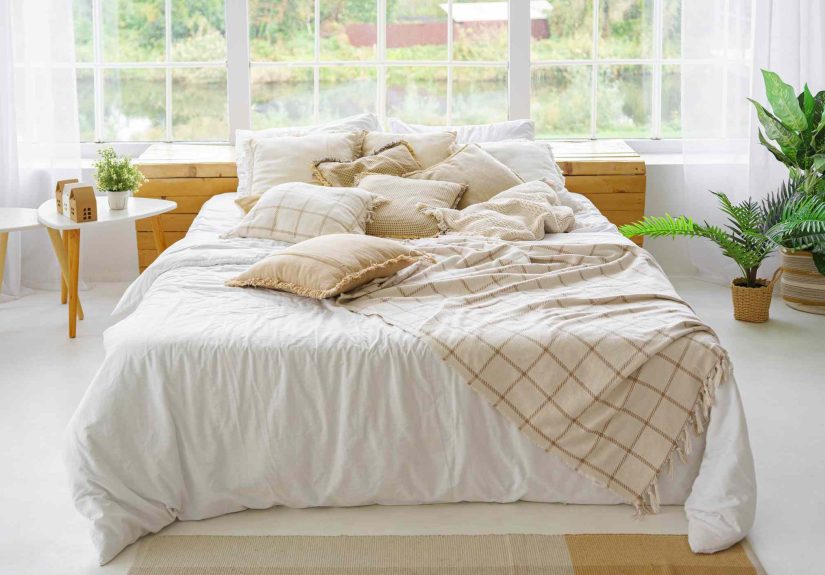
Mistake #3: Overstyling the Bed With a Pillow Pileup
Decorative pillows are like sprinkles: delightful in moderation, alarming in bulk.
If you need a separate warm-up routine to remove pillows before bedtime, your bed is wearing too much “accessory jewelry.”
Why it looks cluttered
Too many pillows create a lumpy silhouette and constant displacement (aka: pillows on the floor, chair, and treadmill you don’t use).
Do this instead
- Try a simple formula: sleeping pillows + 1–3 decorative pillows (or one lumbar pillow).
- Choose covers that relate (similar color family or texture) instead of fighting for attention.
- If you love the “styled” look, store extras in a bench with hidden storage or a bedroom basket.
Mistake #4: Treating Your Dresser Top Like a Catch-All Counter
Dressers are meant to store things. Somehow, their tops become a second job: jewelry pile, fragrance lineup,
hair tools, random mail, and a stray sock that wandered in from another dimension.
Why it looks cluttered
A busy dresser top is visual staticespecially if it’s in your direct line of sight from the bed.
Do this instead
- Keep one “pretty zone”: a lamp + one art piece + a small bowl or tray.
- Move daily-use items into drawer organizers so they stay accessible but hidden.
- If you must keep items out, group them into one container (a sleek box or tray), not five little piles.
Mistake #5: Using Open Storage in the Wrong Places
Open shelving can look amazing in photos. In real life, it often becomes “I swear this is organized” storage
especially above the bed, near the doorway, or in your main sightlines.
Why it looks cluttered
Open storage puts every item on display. Even tidy stacks can look busy when the room is small or the items are mismatched.
Do this instead
- Use closed storage for everyday necessities (drawers, baskets with lids, cabinets).
- If you keep open shelves, make them intentional: fewer items, more negative space, and repeat colors.
- Reserve open shelving for display-worthy items only (not your emergency charger collection).
Mistake #6: Ignoring Scale (Too Much Furniture, or the Wrong-Sized Pieces)
A bedroom can feel cluttered simply because the furniture is the wrong scaleeither too bulky for the room,
or too small so you keep adding more “helpers” (extra tables, extra chairs, extra “temporary” storage).
Why it looks cluttered
When circulation paths are tight, your room reads as cramped. And cramped reads as cluttereven if it’s clean.
Do this instead
- Keep a clear walkway around the bed so you’re not side-shuffling like a crab.
- Choose pieces with a lighter profile (legs, slimmer frames) to create visual breathing room.
- Use multi-functional furniture: storage bed, storage bench, or nightstands with drawers.
Mistake #7: Mixing Too Many Patterns (and Calling It “Cozy”)
Pattern is not the enemy. Pattern overload is.
If you’ve got a bold comforter, patterned rug, patterned curtains, patterned pillows, and patterned wallpaper,
your bedroom may be less “relaxing retreat” and more “visual karaoke night.”
Why it looks cluttered
Competing patterns create constant eye movement. That movement reads as busynessespecially in a small bedroom.
Do this instead
- Pick a “star” pattern and let others be supporting actors.
- Balance pattern with solid colors and texture (linen, knits, wood grain).
- Stick to a tight palette: 2–3 main colors plus one accent.
Mistake #8: Exposing Cord Chaos and Tech Clutter
Nothing shatters a calm bedroom vibe faster than a glowing charger snake pit.
Visible cords, power strips, and multiple devices on display create instant “office energy”and your bedroom should not feel like a waiting room.
Why it looks cluttered
Cords add harsh lines and messy tangles that draw the eye downward (exactly where you want calm).
Do this instead
- Use a charging station (or a small box) to hide devices and cords.
- Mount a power strip behind the nightstand or inside a drawer if possible.
- Use cord clips to route cables neatly and keep them from pooling on the floor.
A Simple “Make It Look Less Cluttered” Reset (10 Minutes)
- Clear the nightstand top down to essentials.
- Reset the dresser top into one styled zone + one functional tray.
- Remove one extra decor item from each flat surface.
- Hide cords or bundle them into one contained spot.
- Make the bed with fewer pillows (your future self will thank you nightly).
Experience-Based Stories: What Usually Makes Bedrooms Look Cluttered (Even When People Try Hard)
Let’s talk about what happens in real bedroomsthe kind where humans live, not the kind staged for a catalog.
Most cluttered-looking bedrooms aren’t caused by “too much stuff” alone. They’re caused by a handful of repeat patterns
that show up in house after house. If you recognize yourself below, congratulations: you’re normal.
First, there’s the Nightstand Drift. It starts innocently: you put a book down, then a glass of water,
then a charger, then your hand cream because winter is disrespectful. Add in a couple of hair ties and one mystery receipt,
and suddenly the nightstand has become a tiny airport baggage claim. People often think the solution is “better styling,”
but it’s usually “better hiding.” A nightstand with drawers (or even a lidded box) is basically a magic trick: the same items,
but invisible, which is the whole point of visual calm.
Then there’s the Chair That Becomes a Closet. Many bedrooms have one chair that was bought for reading,
but it quickly gets promoted to “semi-clean clothing storage.” Jeans you’ll wear again. A hoodie that’s not dirty.
A sweater that’s technically fine. The chair becomes a fabric mountain, and the room looks messy even when the floor is spotless.
The fix isn’t shameit’s a system. A simple hook rail, a valet stand, or a storage bench gives “in-between clothes” a defined home,
so they don’t colonize your furniture.
Another classic: the Pillow Phase. People want that plush, layered bed look, so pillows multiply.
Two become four. Four become seven. Seven become “where do these go at night?” The answer is usually: the floor, which instantly makes the room feel cluttered.
In most lived-in bedrooms, the sweet spot is a bed that looks styled and is easy to reset.
That often means limiting decorative pillows and using texture (like a quilted coverlet or a chunky throw) to keep the bed interesting without the pile.
Small bedrooms also fall into the Furniture Overcompensation Trap. When storage is limited,
people add another small dresser, then a shelf, then a slim cart, then a little table. Each piece is “useful,”
but collectively they create visual crowding. A single larger storage solution (like a dresser with enough capacity,
or a bed with drawers) usually looks calmer than several small helpers scattered around the room.
It’s not about having less; it’s about making your storage feel intentional.
Finally, there’s the Decor Scatter effect. People spread sentimental items everywhere because they love them:
framed photos on every surface, souvenirs on every shelf, candles on every ledge. The room ends up feeling busy, not personal.
A better approach is to curate: pick one zone for meaningful display (a single shelf, a dresser vignette, a gallery wall),
and let other areas breathe. Ironically, concentrating your favorite items often makes them stand out moreand makes the room feel calmer.
If you take one lesson from all these real-life scenarios, let it be this:
cluttered-looking bedrooms usually need boundaries, not perfection.
Give your daily-life items a hidden home, give your in-between clothes a system, and give your eye some open space to rest.
You’ll still live like a human. Your bedroom will just stop looking like it’s in the middle of moving day.
Conclusion: Calm Is a Styling Choice (and You Can Choose It)
A bedroom that looks uncluttered isn’t necessarily emptyit’s edited.
By simplifying surfaces, controlling pattern and scale, hiding everyday “real life” items, and reducing visual noise,
you create a space that feels restful the moment you walk in. Start with one area (nightstand or dresser),
fix one mistake at a time, and you’ll be shocked how quickly your bedroom goes from “busy” to “breathe.”