Table of Contents >> Show >> Hide
- 1) Mail, Paperwork, and the Random Stuff That “Just Needs a Second”
- 2) Too Many Small Appliances (AKA the Countertop Traffic Jam)
- 3) The Coffee (or Beverage) Station That’s Slowly Becoming a Convenience Store
- 4) Oils, Spices, and “Pretty Food” That’s Actually Aging Faster on Display
- 5) Cleaning Supplies, Dirty Dishes, and the “I’ll Deal With It Later” Cluster
- A 10-Minute Nightly Reset That Keeps Counters Clear
- Conclusion: Clear Counters, Clearer Cooking
- Experience-Based Add-On: What Countertop Clutter Looks Like in Real Life
Your kitchen countertops have two jobs: (1) give you space to cook, and (2) quietly make you feel like a capable adult.
When they’re cluttered, they fail at bothsuddenly chopping an onion feels like a competitive sport, and you’re one
misplaced spatula away from ordering takeout “for efficiency.”
The good news: most countertop clutter comes from a few repeat offenders. The better news: you don’t have to become a
minimalist who owns one plate and a single morally superior wooden spoon. You just need a smarter “what lives on the
counter” policyone that matches how you actually cook, snack, and exist.
Below are five things that are commonly cluttering kitchen countertops, why they pile up, and what to do insteadwithout
turning your home into a showroom where nobody is allowed to touch anything.
1) Mail, Paperwork, and the Random Stuff That “Just Needs a Second”
If your countertop has become a mail sorting facility, you’re not alone. The kitchen is bright, central, and visited a
thousand times a day. It’s basically the perfect trap for paper clutter: envelopes, school forms, receipts, coupons,
takeout menus (from 2019), and a mysterious rubber band that has lived a full life.
Why it clutters your counters
- Decision avoidance: paper requires choices (file, pay, shred, respond), and choices take energy.
- No “landing zone”: when paper doesn’t have a home, it becomes the countertop’s problem.
- It spreads fast: one envelope turns into a pile, which turns into “I’ll deal with it Saturday,” which turns into archeology.
What to do instead (simple, not heroic)
- Create a paper quarantine: place a single tray, basket, or folder near (not on) the main prep area.
The counter stays clear; paper still has a home. - Use the “one-touch” rule for the easy stuff: junk mail goes straight to recycling; receipts either
get photographed or tossed; invitations go on a calendar immediately. - Give paper a tiny daily appointment: two minutes after dinner, sort the tray: pay, file, respond, or toss.
You’re not “organizing,” you’re preventing countertop inflation.
Countertop rule: If it can’t be chopped, mixed, brewed, or safely staged for cooking, it doesn’t belong
on the main work surface.
2) Too Many Small Appliances (AKA the Countertop Traffic Jam)
Small appliances are wonderfuluntil they form a parade across your counters. The toaster, air fryer, blender, stand
mixer, espresso machine, slow cooker, rice cooker, and “I swear I use this” juicer can crowd out the space you need for
the actual cooking you’re doing on a random Tuesday.
Why it clutters your counters
- Convenience bias: we keep things out “just in case,” even if “case” happens twice a year.
- Cord chaos: cords sprawl, tangle, and make wiping counters feel like defusing something.
- Visual noise: multiple bulky items create a constant sense of mess, even when everything is “technically put away.”
Appliance audit: keep what you truly use
Do a quick inventory and sort into three categories:
- Daily or near-daily: keep on the counter (but corral it neatly).
- Weekly: store in an easy-access cabinet, pantry shelf, or appliance garage if you have one.
- Seasonal/rare: store higher up, deeper back, or donate if you’ve emotionally moved on.
Make the “keepers” look intentional
- Create zones: place breakfast appliances together, baking tools together, etc. One “appliance strip”
looks purposeful; scattered gadgets look accidental. - Use a tray to contain: a tray under a toaster + butter dish + jam keeps crumbs and clutter from
migrating. - Set a counter limit: pick a number that fits your kitchenlike “no more than three appliances visible.”
A rule beats willpower.
Countertop rule: If you have to move an appliance to cook, that appliance is living on borrowed real estate.
3) The Coffee (or Beverage) Station That’s Slowly Becoming a Convenience Store
Coffee stations start with good intentions: a cozy corner where mornings run smoothly. Then the corner expands. Suddenly
you have three syrups, two sweeteners, a stack of mugs, spare filters, pods, a milk frother, a bag clip collection, and a
spoon jar that could double as modern art.
Why it clutters your counters
- Micro-items multiply: stirrers, pods, packets, and lids don’t “feel” biguntil there are fifty.
- It’s a daily routine: daily routines attract clutter because you’re always using (and leaving) stuff.
- Open storage shows everything: if your coffee supplies are visible, they must be curatedor they’ll look chaotic.
Turn it into a neat, functional zone
- Contain the chaos: use one organizer, caddy, or lidded canister set. If it doesn’t fit, it doesn’t
live on the counter. - Go “front-of-house” vs. “backstock”: keep one week’s worth of pods/filters/sachets out; store the rest
in a cabinet like a responsible shopkeeper. - Limit mugs: keep 4–6 everyday mugs accessible and store the “cute but heavy” novelty mugs elsewhere.
Your counter is not a mug museum.
Countertop rule: Every station needs a boundary. If your coffee area has expanded into “beverage district,” it’s time for zoning laws.
4) Oils, Spices, and “Pretty Food” That’s Actually Aging Faster on Display
A line of olive oil bottles and spice jars looks charminguntil you realize the countertop is a harsh environment:
light, heat, steam, and splatter. Some foods and ingredients degrade faster when they’re warm or exposed to light and air.
Others invite pests, get sticky, or just become that grimy film you pretend not to see.
Why it clutters your counters
- It feels convenient: grabbing oil or seasoning without opening a cabinet is satisfying.
- It looks “chef-y”: we copy pro-kitchen vibes without pro-kitchen storage and cleaning staff.
- Containers attract mess: oil drips, spice dust, and sugar residue create a constant clean-up loop.
Keep what you use, protect what you love
- Store most oils and spices away from heat and sunlight: a cool cabinet or drawer keeps flavors fresher
and reduces sticky bottle buildup. - Use a small “active cooking” set: keep only the top 2–3 most-used items near the stove, ideally on a
wipeable tray, and refill from your main stash. - Be picky with countertop produce: if fruit ripens too quickly or draws fruit flies, move some to the
fridge or a cooler pantry shelf.
Countertop rule: The prettier the ingredient display, the more disciplined the maintenance must be. If you’re not maintaining it, it’s clutterjust fashionable clutter.
5) Cleaning Supplies, Dirty Dishes, and the “I’ll Deal With It Later” Cluster
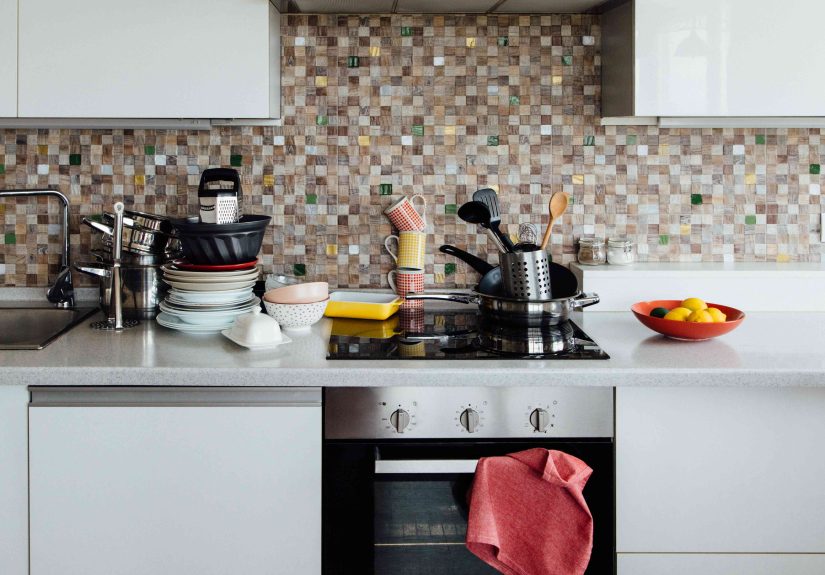
This is the clutter that doesn’t just look messyit can be genuinely gross. Sponges, dish rags, soap bottles, scrubbers,
a drying rack that never empties, and yesterday’s dishes create a countertop ecosystem that thrives on moisture and
procrastination.
Why it clutters your counters
- It’s mid-task storage: cleaning tools live where you use them, which is logical… until they never leave.
- Wet items don’t “put away” well: nobody wants to shove a damp sponge into a drawer (and you shouldn’t).
- Dishes expand to fill available space: one cup becomes five, and suddenly the counter is a dish staging area.
Make “cleaning stuff” disappear (without pretending you don’t clean)
- Create an under-sink cleaning zone: keep sprays, extra sponges, dishwasher pods, and brushes stored
below, not on display. - Upgrade your sponge routine: give sponges/rags a way to dry fully (a caddy, hook, or holder) and swap
them out regularly so your counter isn’t hosting a science fair. - Set a “sink is not storage” standard: dishes either go into the dishwasher, get washed, or get rinsed
and stacked neatly in one contained spotnever sprawled across the main prep zone. - Make the drying rack optional: if it lives out permanently, pick a compact one and commit to emptying
it daily. Otherwise, store it and bring it out only when needed.
Countertop rule: Cleaning tools should be accessible, not decorative. Your soap bottle doesn’t need a permanent penthouse suite.
A 10-Minute Nightly Reset That Keeps Counters Clear
If you do only one thing, do this. A nightly reset prevents “countertop creep,” where clutter slowly migrates back until
you’re once again slicing lemons on a two-inch strip of laminate.
- Clear the landing clutter: move mail/keys/random items to their designated drop zone.
- Deal with food: refrigerate perishables, seal snacks, and wipe obvious spills before they fossilize.
- Dish sweep: dishes into dishwasher or wash, then wipe the sink edges and counter around it.
- Reset the stations: coffee corner back to “one organizer,” cooking area back to “only essentials.”
- Wipe the main prep zone: because tomorrow-you deserves a clean slate.
The goal isn’t perfection. The goal is waking up to counters that say, “You’ve got this,” not “Good luck finding the cutting board.”
Conclusion: Clear Counters, Clearer Cooking
Decluttering your kitchen countertops isn’t about owning lessit’s about using space better. When you remove the five
biggest clutter culprits (paper piles, appliance crowds, overflowing drink stations, vulnerable ingredients, and cleaning
sprawl), your kitchen becomes easier to cook in, easier to clean, and oddly… calmer.
Start small: pick one category and fix it this week. Once the counter feels spacious again, you’ll protect that space like
it’s a reserved parking spot you fought for in court.
Experience-Based Add-On: What Countertop Clutter Looks Like in Real Life
Let’s talk about the kind of countertop clutter you don’t notice until you do. Not the dramatic, “we hosted a party and
now everything is chaos” mess. I mean the slow, sneaky buildup that happens when life is normal. Here are a few common,
painfully relatable scenariosplus what usually fixes them.
Scenario 1: The “I’ll file it later” paper stack. It starts with one envelope you don’t open because you’re
hungry. Then a receipt lands next to it. Then a school form arrives and you set it down “so you don’t forget.” Two weeks
later, you’re standing over a pile of paper like it’s a tiny stressful monument. The fix is almost comically simple:
a single tray (one!) and a two-minute daily sort. The tray doesn’t solve your paperworkyour routine doesbut it stops your
counter from becoming a filing cabinet without drawers.
Scenario 2: The small-appliance swap meet. Many kitchens reach a point where cooking requires moving
appliances around like puzzle pieces. The blender lives where the cutting board should go, and the air fryer is parked
like a vehicle you can’t find a garage for. The best “aha” moment usually comes from an honest appliance audit: if you
haven’t used it in a month (and it’s not seasonal), it probably doesn’t deserve daily visibility. Once you reclaim that
space, cooking feels faster because you’re not rearranging your countertop before you can even start.
Scenario 3: The coffee station that became a condiment aisle. Coffee corners are magnets for tiny items:
pods, sugar packets, cinnamon, syrups, stirrers, extra filters, and the occasional mystery key (how?). The station feels
“busy,” even when it’s clean, because nothing is contained. When people switch to a single organizer and keep only a week’s
worth of supplies out, the area suddenly looks intentional. Bonus: you stop buying duplicates, because you can actually see
what you have.
Scenario 4: The pretty oils-and-spices display that turns sticky. This one is heartbreaking because it starts
as a Pinterest dream. But between stove heat, steam, splatters, and sunlight, the bottles get grimy, the spices clump, and
you wipe around them instead of moving them. A realistic compromise is keeping a small “active” set on a tray (a couple of
essentials you truly use) and storing backups in a cabinet or drawer. The tray makes cleanup fast, and your ingredients
generally stay fresher and less gross.
Scenario 5: The dish-and-sponge cluster that multiplies overnight. You wash a pan, set it on the counter to
dry, and think, “I’ll put it away later.” Then a cutting board joins it. Then a mug. Then the sponge stays wet. And suddenly
your counters look messy even though you technically cleaned. The practical fix is to make “drying” a contained, temporary
activity: a compact rack you empty daily, a place for the sponge to dry, and a rule that dishes don’t camp out on the main
prep area. When the counter is clear, it’s easier to keep it cleanbecause wiping it takes 15 seconds instead of a
relocation project.
The common thread in all these stories is that countertop clutter usually isn’t lazinessit’s a system problem. Once the
system is easier than the mess, the mess stops winning.