Table of Contents >> Show >> Hide
- Why Fake Trees Often Look Sparse in the First Place
- 12 Easy Ways to Make a Fake Tree Look Fuller
- 1. Fluff every single branch, not just the obvious ones
- 2. Start at the trunk and work outward
- 3. Bend tips in different directions for a natural look
- 4. Lift the outermost branches slightly upward
- 5. Add extra faux stems, picks, or sprays where the holes are
- 6. Use ribbon to disguise bare spots
- 7. Layer your lights deep inside the tree, not only on the outside
- 8. Hang ornaments in layers and clusters
- 9. Mix textures to create the feeling of density
- 10. Fill the lower half generously, because that is where thin spots show most
- 11. Camouflage the trunk and base
- 12. Step back, rotate, and edit the tree from across the room
- Small Details That Make a Big Difference
- Conclusion
- Real-World Experiences: What Actually Helps a Fake Tree Look Fuller
If your fake tree currently looks less “winter wonderland” and more “sad broom with ambitions,” do not panic. Most artificial trees look a little underwhelming right out of storage. They get compressed in boxes, flattened in attics, and squished into submission year after year. The good news is that a fuller-looking tree usually has less to do with buying a brand-new one and more to do with shaping, layering, and styling the one you already own.
That is why decorators, home editors, and artificial-tree brands keep coming back to the same advice: fluff first, decorate with intention, and use a few smart fillers to disguise thin spots. A sparse tree can look dramatically better with a little branch work, better lighting, and a few well-placed accents. In other words, you do not need magic. You need ten fingers, a little patience, and maybe a ribbon spool that did not come from the bargain bin’s darkest corner.
Below, you will find 12 easy ways to make a fake tree look fuller, plus practical examples, styling ideas, and real-world observations to help you create a tree that looks lush, balanced, and far more expensive than it was.
Why Fake Trees Often Look Sparse in the First Place
Artificial trees usually look thin for three simple reasons: compressed branches, poor shaping, and not enough visual layering. Even a good-quality tree can seem skimpy if the branch tips are still lying flat after storage. Some models also have fewer branch tips than others. As a rough rule, fuller 7-foot trees tend to have noticeably higher tip counts than budget versions, so styling matters even more when you are working with a slimmer silhouette.
The fix is part structure and part illusion. First, shape the tree so the branches create depth. Then use lights, ribbon, picks, ornaments, and base styling to fill gaps and distract the eye from the inner framework. Think of it like decorating a room: empty corners feel empty until you add height, texture, and a little strategic drama.
12 Easy Ways to Make a Fake Tree Look Fuller
1. Fluff every single branch, not just the obvious ones
The number-one trick is also the most boring and the most effective: fluff the branches thoroughly. Not “give it a gentle pep talk” fluffing. Real fluffing. Separate each branch tip, fan them apart, and pull them away from the flat, packed shape they had in storage. Wear gloves if the needles are scratchy, and do not rush it. The fuller look comes from opening up hundreds of small tips, not from adjusting only the outside layer. Skip this step, and no amount of ornaments will save you.
2. Start at the trunk and work outward
Many people only style the outer edge of the tree because that is what they can see first. That is a classic fake-tree mistake. Start from the inside near the trunk, then move outward toward the tips. When inner branches are lifted and spread, they push the outer branches into a fuller shape and create depth instead of a flat shell. Work section by section from the bottom up so you can track what you have already done. It feels slower, but it prevents patchy shaping and mysterious bald zones.
3. Bend tips in different directions for a natural look
Real trees are gloriously imperfect. Their branches do not all point in identical directions like they were installed by a tiny engineer with a ruler. To make a fake tree look fuller, angle branch tips left, right, upward, and slightly forward. Variation creates movement, and movement creates visual density. When every tip points straight out, the tree looks stiff and oddly thin. When tips are staggered and layered, the eye reads them as lush. Aim for natural chaos, not showroom symmetry.
4. Lift the outermost branches slightly upward
If the outer branches droop too much, your tree can look tired instead of full. Gently lifting the ends of the outer branches creates the illusion of volume and gives ornaments better support. This is especially helpful on older artificial trees whose branches have started to sag a little. You are not trying to make the tree look rigid or overly sculpted. You are just giving the silhouette some bounce. Think “healthy evergreen” and not “umbrella caught in a wind tunnel.”
5. Add extra faux stems, picks, or sprays where the holes are
One of the easiest designer tricks is to tuck in extra faux greenery, berry stems, pinecone picks, or decorative sprays anywhere the tree looks sparse. These fillers instantly bulk up open areas and add texture at the same time. If your tree has a few stubborn gaps that still show the center pole, this trick works wonders. Choose pieces that match your tree style: pine stems for a classic look, frosted picks for a snowy effect, or metallic sprays for a more glamorous tree. Fuller and prettier is a solid combination.
6. Use ribbon to disguise bare spots
Ribbon is not just decorative. It is camouflage with excellent manners. Wide wired ribbon, mesh ribbon, or soft cascading ribbon can visually fill empty spaces faster than almost anything else. You can weave it horizontally, let it fall in vertical strands, or create loose loops that sit inside the branches. The key is to tuck it into gaps instead of just wrapping it around the outside like a gift that fought back. Wider ribbon works especially well on skinnier trees because it adds volume without making the tree feel overcrowded.
7. Layer your lights deep inside the tree, not only on the outside
Lights can make a fake tree look fuller because they add glow, depth, and visual softness. If all the lights sit only on the outside edge, the tree can still look flat. Try placing some lights deeper into the branches and some near the tips. That layered lighting creates dimension, especially at night. On a pre-lit tree, you can still add a supplemental strand in sparse areas. Warm white lights create a classic rich look, while clear twinkle lights can blur thin spots and make the whole tree appear more lush.
8. Hang ornaments in layers and clusters
Do not place every ornament at the branch tips like the tree is attending a very formal jewelry appointment. Put larger ornaments deeper inside the tree, medium ornaments in the middle, and smaller ornaments near the outer tips. This layered method gives the illusion of depth and fills visual gaps. Clustering ornaments in twos or threes can also create a fuller effect than spacing them evenly one by one. A tree feels richer when decorations have rhythm and weight instead of looking like they were distributed by a spreadsheet.
9. Mix textures to create the feeling of density
A tree can technically have plenty of decorations and still look oddly empty if everything is the same size, finish, and material. Mix matte ornaments with shiny ones. Add velvet bows, woven ribbon, pinecones, bead garlands, or faux florals. Texture gives the eye more to notice, which makes the tree feel fuller and more layered. This is especially helpful for monochromatic or neutral trees that risk looking too flat. Volume is not just about how much stuff you add. It is also about giving the arrangement visual depth.
10. Fill the lower half generously, because that is where thin spots show most
The bottom and middle sections of a fake tree usually get the most visual scrutiny. That is where open spaces stand out, especially in daylight. Give the lower half extra attention when fluffing and decorating. Use larger ornaments, fuller ribbon loops, or a few additional picks in these sections. If your tree is placed in a corner, focus on the front-facing lower branches first. A fuller base makes the entire tree feel more substantial, even if the top remains a little airier. It is the decorative equivalent of building a good foundation.
11. Camouflage the trunk and base
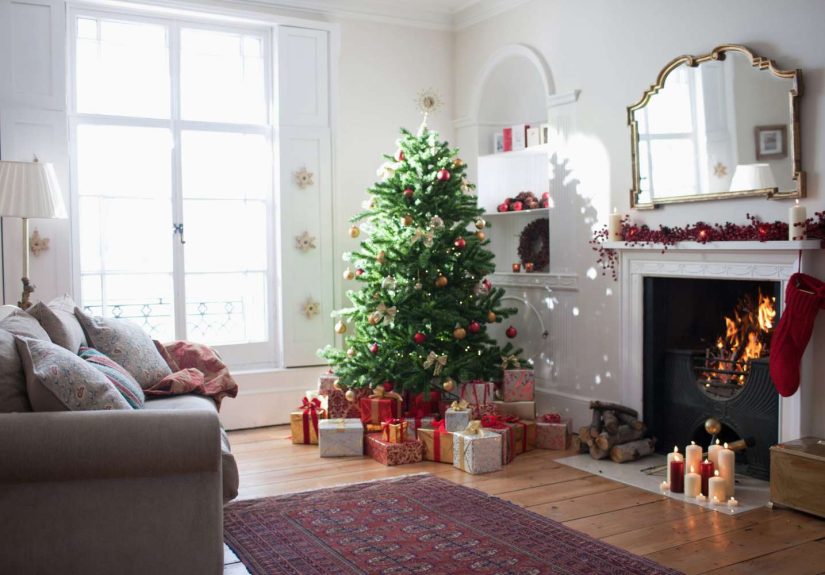
Sometimes a tree looks thin not because the branches are terrible, but because the center pole, stand, or open base area is too visible. A well-chosen tree collar, basket, skirt, or wrapped base helps hide that problem immediately. You can also tuck greenery, wrapped gift boxes, lanterns, or faux presents around the bottom to make the whole display feel abundant. If the trunk still shows through the middle, try deeper ornaments, extra picks, or ribbon loops near the center. Visual fullness is not cheating. It is decorating with purpose.
12. Step back, rotate, and edit the tree from across the room
Here is the trick many people forget: stop fussing from six inches away and look at the tree from where humans actually view it. Step across the room. Take a photo. Rotate the tree slightly if one side is fuller than the other. Fix any obvious gaps, uneven ornament spacing, or droopy ribbon. A tree can look fine up close and weirdly lopsided from the sofa. Editing from a distance helps you spot thin areas fast. It is the final polish that turns “good enough” into “wow, did you secretly hire a holiday stylist?”
Small Details That Make a Big Difference
If you want your tree to look even more convincing, add a few subtle realism boosters. Tuck in natural-looking faux branches with pinecones or berries. Use a simple scent strategy near the base, such as a seasonal candle or a pine-inspired diffuser nearby, so the room feels as good as the tree looks. Keep the tree away from heavy traffic areas where branches get bumped flat. And when the season ends, store it in a proper tree bag instead of forcing it back into its original box like you are wrestling an alligator made of PVC.
The best-looking fake trees rarely depend on one giant trick. They look full because several small smart decisions work together: better shaping, layered lighting, fuller ribbon treatment, thoughtful ornament placement, and a base that looks intentional instead of forgotten.
Conclusion
Making a fake tree look fuller is less about buying more stuff and more about using better technique. Start with branch shaping, build depth from the inside out, and then fill visual gaps with lights, ribbon, layered ornaments, and a few extra textured accents. Whether your tree is brand new, several seasons old, pre-lit, unlit, slim, flocked, or gloriously average, these easy fixes can make it look richer, softer, and much more realistic.
And perhaps that is the best part: a fuller fake tree does not have to be perfect. It just has to feel warm, balanced, and festive in your space. If it makes your room glow and earns at least one “Wait, is that new?” from a guest, you have done your job beautifully.
Real-World Experiences: What Actually Helps a Fake Tree Look Fuller
In real homes, the biggest transformation usually happens before the ornaments even come out. People often expect the magic to happen when they add decorations, but the most dramatic improvement nearly always comes from slow, patient fluffing. A tree that looks flat and disappointing at 5:00 p.m. can look surprisingly lush by 5:45, simply because someone took the time to separate the inner branches instead of tugging only at the tips. That is the moment many people realize their tree was not necessarily “bad.” It was just badly staged.
Another common experience is that sparse trees look far worse in daylight than at night. During the day, gaps, poles, and flattened spots are much easier to see. At night, layered lights soften everything and make the tree look richer. That is why so many decorators like to add extra light strands even to pre-lit trees. The glow hides imperfections and adds depth in a way ornaments alone cannot. A tree with modest decorations but excellent lighting often looks more expensive than a heavily decorated tree with harsh, uneven illumination.
People also tend to underestimate how helpful ribbon can be until they try it. On slimmer trees, a few wide loops or vertical cascades can completely change the silhouette. The tree suddenly looks intentional instead of skimpy. This is especially true in apartments, entryways, or smaller rooms where pencil trees are popular. A narrow tree does not need to pretend to be giant. It just needs enough softness and texture to look styled rather than sparse.
There is also a practical lesson many longtime artificial-tree owners learn the hard way: storage matters. Trees shoved into damaged boxes often come out flatter every year, which means more work every season. Trees stored in roomy zip bags or upright containers tend to keep more of their shape. That does not sound glamorous, but it can save a lot of time and frustration later. Future you deserves fewer branch battles.
Another real-world observation is that the lower half of the tree does most of the visual heavy lifting. When the base looks full, the entire tree feels full. When the bottom is patchy, the whole tree looks off, even if the top half is beautifully decorated. That is why extra picks, larger ornaments, or fuller ribbon treatment near the bottom can have such a dramatic effect. It is one of those small changes that delivers a disproportionate reward.
Finally, the best results usually come from a little restraint. People often respond to a sparse tree by adding everything they own. More garland, more ornaments, more bows, more glitter, more drama, more chaos. Sometimes that works, but often it just makes the tree feel crowded while the structural thinness remains obvious. The better approach is targeted fullness: fluff carefully, hide the holes, layer thoughtfully, and stop when the tree feels balanced. A fuller fake tree should look richer, not overwhelmed. There is a difference between “designer finished” and “holiday craft store exploded,” and your living room deserves the first one.