Table of Contents >> Show >> Hide
- What’s Inside
- Why this hurts so much (and why that’s normal)
- Expert Tips for Coping With Pet Loss (Without Pretending You’re Fine)
- 1) Give your grief a nameand a little room to breathe
- 2) If guilt is hanging around, treat it like a visitornot a judge
- 3) Use words when your brain can’t find the “off” switch
- 4) Build a support plan (because “be strong” is not a plan)
- 5) Decide what to do with belongings in “phases,” not all at once
- 6) Help your home adjust to the missing routine
- 7) If you have other pets, keep routines steady (they may grieve too)
- 8) Create a memorial that matches your dog’s actual vibe
- 110 Messages for My Dog Who Passed Away
- Short & Simple (1–10)
- Thank-You Notes (11–20)
- Funny-But-Loving (21–30)
- Apologies & Forgiveness (31–40)
- Rainbow Bridge & Spiritual Comfort (41–50)
- When You’re Having a Brutal Day (51–60)
- For Anniversaries & Special Dates (61–70)
- For Social Captions (71–80)
- For Letters & Journals (81–90)
- Messages Kids Can Say (91–100)
- Promises to Honor Them (101–110)
- Memorial Ideas That Feel Personal (Not Performative)
- What to Say (and Not Say) When Someone’s Dog Dies
- Helping Kids and Other Pets Through the Loss
- When to Seek Extra Support
- 500+ Words of Real-World Experiences After a Dog Dies (and What Helps)
- Conclusion
Losing a dog can feel like someone quietly unplugged the sun. One minute you’re stepping over a squeaky toy, the next minute you’re staring at a leash like it’s a museum artifact titled “The Walk That Never Happened.” If you’re here because you want the right wordswords you can text into the universe, write in a journal, or whisper into a dog tag you can’t quite put awaythis is for you.
Below you’ll find 110 message ideas you can copy, tweak, or turn into a letter to your best friend, plus practical, expert-backed tips for coping with pet grief, supporting kids (and other pets), and building a memorial that actually feels like themnot like something you did because the internet told you to.
Why this hurts so much (and why that’s normal)
Dog grief is weirdly specific. Your dog wasn’t just a pet; they were a routine, a soundtrack (hello, collar jingle), a built-in reason to go outside, andlet’s be honestyour most loyal audience for snacks and questionable life choices. When that’s gone, the loss shows up everywhere: empty corners of the house, silent mornings, and the sudden realization that nobody’s judging your vacuuming technique anymore.
A lot of people feel “I shouldn’t be this devastated.” But pet bereavement can be intense precisely because the bond is uncomplicated: affection, trust, and years of tiny daily moments. Grief doesn’t always move in neat stages, either. It can swing between “I’m okay” and “I just saw a golden retriever on a billboard and now I’m crying in a parking lot.” Both can be true in the same hour.
One more thing: pet loss is sometimes a disenfranchised griefmeaning the world doesn’t always treat it like a “real” loss. If someone says, “Just get another dog,” you have permission to imagine them stepping barefoot on a LEGO. (You don’t have to say it out loud. But you may.)
Expert Tips for Coping With Pet Loss (Without Pretending You’re Fine)
1) Give your grief a nameand a little room to breathe
Grief is not a malfunction. It’s a normal response to losing someone you loved. Try a simple sentence: “This hurts because I loved my dog deeply.” That’s not drama; that’s math.
- Micro-ritual: Set a daily two-minute window to look at one photo, light a candle, or say goodnight.
- Body check: Eat something, drink water, take a short walk. Grief can hijack basic maintenance.
2) If guilt is hanging around, treat it like a visitornot a judge
Guilt is incredibly common, especially after euthanasia or sudden loss. It often sounds like: “Did I wait too long?” “Did I do it too soon?” “Should I have noticed sooner?” Here’s a kinder reframing: you made the best decision you could with the information you had, while loving your dog.
If you keep replaying the last day, try balancing it with a “greatest hits” memory on purpose: a favorite hike, the ridiculous zoomies, the time they stole an entire sandwich and looked proud of their work.
3) Use words when your brain can’t find the “off” switch
Writing is a pressure-release valve. Try one of these prompts:
- “The things I miss most are…”
- “The funniest thing you ever did was…”
- “I forgive you for…” (Yes, even the trash can incident.)
- “Thank you for teaching me…”
4) Build a support plan (because “be strong” is not a plan)
Support can be a friend who gets it, a pet loss support group, a counselor, or a pet grief hotline. If you feel isolated, that’s a sign to add another human to the process. You don’t have to grieve alone.
If you want a concrete step: write one text to a safe person“I’m not okay today. Can you sit with me for a bit?” It’s simple, and it works.
5) Decide what to do with belongings in “phases,” not all at once
There is no rule that says you must immediately wash the blanket, donate the bowls, and erase every hair from your car before the next sunrise. Consider a three-bin approach:
- Keep now: items you’re not ready to move (collar, favorite toy).
- Keep later: items you might store in a memory box.
- Pass on: items you’re ready to donate when the time feels right.
6) Help your home adjust to the missing routine
Dogs create structure. Without them, the day can feel oddly shapeless. Replace the routine gently: take the walk anyway, even if it’s shorter; make a morning coffee ritual; volunteer when you’re ready. You’re not “moving on.” You’re learning how to carry love in a new shape.
7) If you have other pets, keep routines steady (they may grieve too)
Some pets show changes after a lossclinginess, reduced appetite, searching behaviors. Keeping feeding and walking routines steady can help them feel safe while the household shifts.
8) Create a memorial that matches your dog’s actual vibe
A serious memorial is lovelyunless your dog was a certified goofball who once barked at a garden gnome for three weeks straight. Your memorial can be sweet, funny, or both. (Honestly, that’s the most accurate kind.)
110 Messages for My Dog Who Passed Away
Swap in your dog’s name (use [Name] below), adjust the tone, and steal these shamelessly. These are meant to be dog loss messages you can write in a journal, post as a caption, add to a memorial card, or say out loud when the house feels too quiet.
Short & Simple (1–10)
- Goodbye, [Name]. I love you. Always.
- Thank you for being my best day, every day.
- I miss you in every room.
- You were home.
- My heart is bigger because of youand broken because you’re gone.
- Love doesn’t end. Neither do we.
- Run free, sweet friend.
- I’ll carry you with me.
- You were the best hello and the hardest goodbye.
- Forever wouldn’t have been long enough.
Thank-You Notes (11–20)
- Thank you for loving me on my worst days like they were still worth something.
- Thank you for every tail wag that turned a bad day around.
- Thank you for choosing me, even when I didn’t choose the “right” socks to wear.
- Thank you for guarding the house from delivery drivers and suspicious leaves.
- Thank you for teaching me what loyalty looks like in real life.
- Thank you for making ordinary days feel like adventures.
- Thank you for being my walking buddy, my couch buddy, and my emotional support comedian.
- Thank you for the way you trusted me completely.
- Thank you for reminding me to notice sunshine, snacks, and naps.
- Thank you for the love that asked for nothing but a place beside me.
Funny-But-Loving (21–30)
- I hope heaven has unlimited treats and zero baths.
- If there’s a squeaky toy shortage up there, I’ll be filing a complaint on your behalf.
- I forgive you for the time you ate the thing you definitely weren’t supposed to eat. (Mostly.)
- Thank you for protecting me from the vacuum. It was clearly dangerous.
- I miss your dramatic sighs when I stopped petting you for 0.3 seconds.
- I hope you’re currently stealing socks in the great beyond.
- You were the CEO of Side-Eye and the chairman of Cuddles.
- My heart hurts, but I can still hear your “I’m innocent” face.
- Wherever you are, I hope you finally caught that squirrel.
- Love you forever. Even if you did roll in that one thing. You know the one.
Apologies & Forgiveness (31–40)
- I’m sorry for every time I rushed a walk. I’d give anything for one more slow one.
- I’m sorry I couldn’t explain everything. I hope you only felt my love.
- Forgive me for the moments I was distracted. You deserved my full heart every time.
- I forgive myself for not being perfectbecause you never asked me to be.
- I’m sorry for the vet visits you hated. I was trying to keep you safe.
- I’m sorry I couldn’t keep you here longer.
- Thank you for forgiving me daily, without ever making a speech about it.
- I’m letting go of the “what ifs.” I’m holding onto the “we loved.”
- If love could have saved you, you would have lived forever.
- I hope you knew you were my whole heart in a furry body.
Rainbow Bridge & Spiritual Comfort (41–50)
- If there’s a rainbow bridge, I’ll find you at the end of it.
- I picture you running like you’re brand new again.
- I hope you’re surrounded by peace, warmth, and the best kind of quiet.
- May you rest in love as surely as you lived in love.
- Some bonds don’t break. They change shape.
- I’m sending love wherever you are.
- If heaven has a front porch, I hope you’re waiting there, tail wagging.
- You were my guardian angel on earth. Now be my angel from wherever you are.
- I’ll talk to you like you can still hear mebecause honestly, it helps.
- Love like yours doesn’t disappear. It echoes.
When You’re Having a Brutal Day (51–60)
- Today I miss you so much it feels like weather.
- I made it through this hour. I’ll try the next one too.
- I’m angry you’re gone, and I’m grateful you were here. Both are true.
- I still reach for you without thinking. My hands haven’t caught up yet.
- The house is too quiet. I wish I could borrow your paws for five minutes.
- I’m learning to breathe around the ache.
- I saw a dog that looked like you and my heart did a backflip.
- I miss the way you made everything feel safer.
- Grief is love with nowhere to go. So I’m sending it to you anyway.
- Hold on, heart. We loved a dog worth missing.
For Anniversaries & Special Dates (61–70)
- Happy birthday in heaven, [Name]. I’m celebrating you today.
- It’s been [time] and I still love you like it’s day one.
- Today I’m remembering your best momentsand laughing through tears.
- One year later and you’re still the first thought in my quiet moments.
- I’m lighting a candle for you today, because love likes a spotlight.
- I visited your favorite spot and felt you everywhere.
- I’m doing your favorite thing today, just to keep you close.
- Time passes. Love stays.
- I’m honoring you today with gratitude, not only sadness.
- I’m still your person. That doesn’t expire.
For Social Captions (71–80)
- Thank you for a lifetime of love, [Name]. I’ll miss you forever.
- My best friend crossed the rainbow bridge. My heart will never be the same.
- Gone from my arms, forever in my story.
- You gave me years I’ll spend the rest of my life remembering.
- Rest easy, my sweet dog. You did a good job being loved.
- Every paw print you left on my life is permanent.
- I’ll miss you, but I’ll never stop being grateful I got you.
- Thank you for the laughs, the comfort, and the unconditional love.
- Dogs don’t live long enough, but they love big enough to last.
- Sleep well, [Name]. You were my favorite hello.
For Letters & Journals (81–90)
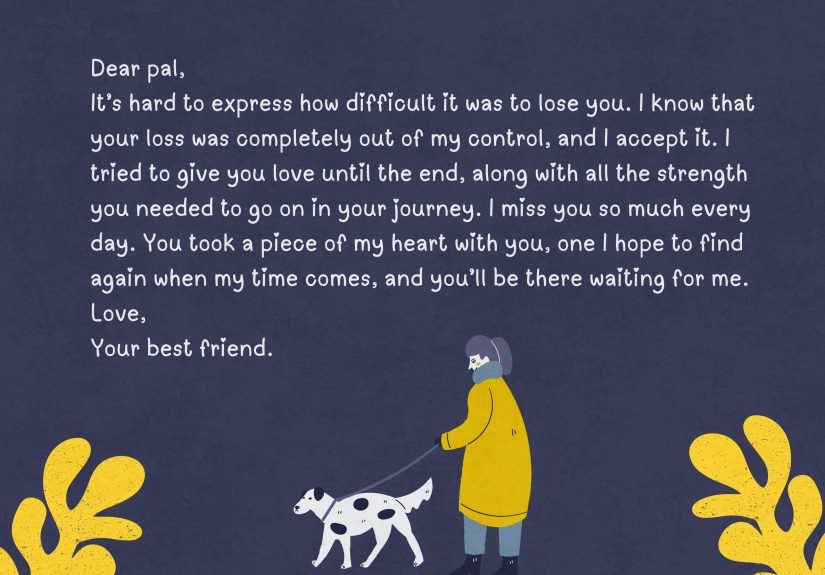
- Dear [Name], the world feels different without you. I’m learning, slowly, how to live with that.
- I keep thinking I hear you. Maybe that’s love refusing to be quiet.
- You were there for my messy days. I’ll try to be gentle with myself now, like you would be.
- I’m going to tell your stories until people feel like they knew you.
- I hope I gave you a life that felt safe, warm, and full of love.
- You made me a better human without ever asking me to changehow is that even fair?
- I’m saving a piece of you in every small routine you gave me.
- I miss your head on my knee. I miss being needed in that simple way.
- If I could, I’d trade every inconvenience for one more ordinary day with you.
- I love you past words, so I’ll keep trying anyway.
Messages Kids Can Say (91–100)
- Goodbye, [Name]. Thank you for being my friend.
- I’m sad you died, but I’m happy we had you.
- I’ll remember how soft you were.
- I’ll miss playing with you. I love you.
- Thank you for making me laugh.
- I hope you’re not in pain anymore.
- I’m going to draw you a picture so I can keep you close.
- Even though you’re gone, I still love you.
- You were a good dog. The best dog.
- I’ll tell you goodnight anyway.
Promises to Honor Them (101–110)
- I promise to keep your memory alive in the way I livekindly and fully.
- I promise to speak your name with a smile when I can.
- I promise to keep loving dogs, because you taught me how.
- I promise to take the walk, even when it’s hard, and think of you.
- I promise to help another animal somedaywhen my heart is ready.
- I promise to let myself heal without feeling guilty about it.
- I promise to remember you as you were: loved, safe, and cherished.
- I promise to forgive myself for being human.
- I promise to keep your stories loud, even if the house is quiet.
- I promise: you mattered. You still matter. You always will.
Memorial Ideas That Feel Personal (Not Performative)
A dog memorial doesn’t have to be expensive or Pinterest-perfect. The best ones feel like a continuation of the bond. Here are options that work for different personalities (yours and theirs).
Simple, meaningful memorials
- Memory box: collar, tag, a photo, a favorite toy, a note you write today.
- Photo project: a small album, a printed collage, or a rotating digital frame.
- Plant something: a tree, flowers, or a small garden marker with their name.
- Donation: give to a shelter or rescue in your dog’s honor.
“That is SO my dog” memorials
- Cook their “last meal” memory: make a safe version of their favorite treat (and tell the story).
- Playlist: songs that match your walks, your car rides, your ridiculous dance parties.
- Annual tradition: a hike, a beach visit, a donation day, or a “tell one story about [Name]” dinner.
What about getting another dog?
There’s no universal timeline. A new dog is not a replacement; it’s a new relationship. Some people feel ready sooner, others need a long stretch of “just us and our memories.” Let readiness be the guidenot pressure, not guilt, and definitely not your neighbor who says, “You’ll be fine once you get a puppy,” like puppies are a prescription medication.
What to Say (and Not Say) When Someone’s Dog Dies
What helps
- “I’m so sorry. [Name] was clearly loved.”
- “Tell me your favorite story about them.”
- “I’m here. Do you want a call, a meal, or a distraction?”
- “Your grief makes sense.”
What usually stings (even if you mean well)
- “At least they lived a long life.” (True, but still painful.)
- “Just get another dog.” (Nope. Not how love works.)
- “It was only a pet.” (Double nope. That’s how you get haunted by karma.)
A quick sympathy card formula (that doesn’t feel robotic)
Acknowledge the loss + name the dog + mention one specific trait + offer support. Example: “I’m so sorry about [Name]. I’ll never forget how they greeted everyone like a celebrity. I’m here if you want to talk.”
Helping Kids and Other Pets Through the Loss
Talking to kids about a dog’s death
Kids often need clear, gentle language. Many experts recommend avoiding confusing phrases like “went to sleep,” which can make bedtime scary. Try: “Their body stopped working, and they died. They aren’t in pain anymore.” Then invite questions and feelingskids may grieve in waves, not in one long cry.
- Let them “do” something: draw a picture, write a note, choose a memorial item.
- Model feelings: it’s okay for them to see you sad; it teaches grief is safe to express.
- Keep routines: structure helps kids feel secure when emotions feel big.
Supporting other pets
If you have another dog (or a cat who secretly ran the household), they may react to the absence. Some pets eat less, seem restless, or look for their friend. You can help by keeping daily routines steady and offering extra calm attention. If appetite or behavior changes persist or worsen, check in with your veterinarian.
When to Seek Extra Support
Pet grief is normaland still, sometimes it becomes heavy enough that you need more support than friends can provide. Consider reaching out to a mental health professional or a pet loss counselor if you’re:
- unable to function at work or home for a prolonged period,
- not sleeping for many nights in a row,
- using alcohol or substances to numb the pain,
- stuck in intense guilt or intrusive replaying that won’t ease,
- feeling hopeless, or having thoughts of self-harm.
Support options can include pet loss support groups, veterinary school helplines, or grief counseling. If you ever feel in immediate danger, contact local emergency services right away.
Pet loss support resources (no judgment, just humans)
- Veterinary school helplines: many vet schools run staffed phone lines and support groups.
- Community support: local humane societies and shelters sometimes host grief groups.
- Online chat/support: moderated pet loss communities can help you feel less alone.
Mini-FAQ
- Is it normal to grieve a dog like a family member?
- Yes. Dogs are woven into daily life, which makes their absence feel constant and personal.
- How long does pet grief last?
- There’s no set timeline. Many people notice grief changes over timeless sharp, more bittersweetwithout fully “going away.”
- Should I keep my dog’s things?
- If it helps, yes. You can decide in stages. There’s no deadline for what love should look like.
- Will getting another dog help?
- It can, when you’re ready. But it’s not a replacement; it’s a new chapter. Readiness matters.
500+ Words of Real-World Experiences After a Dog Dies (and What Helps)
People often expect grief to be mostly sadness. But dog loss grief can be surprisingly physical, oddly practical, and occasionally… comedic in the way only life can be when it’s trying to keep you humble.
One common experience: the phantom sounds. You swear you heard toenails tap-tap-tap across the floor. You pause mid-step, waiting for the familiar “I’m here” energy to appear. When it doesn’t, your stomach drops. This isn’t you “losing it.” It’s your brain reaching for a pattern that existed for years. What helps: pick one gentle replacement cuesoft music in the evening, a white-noise machine at night, or a new “end of day” ritual like tea on the couch where your dog used to sleep.
Another experience: the leash moment. You grab the leash automaticallybecause you always didand then you remember. Some people put the leash away immediately; others keep it in place for a while. Both are normal. What helps: choose one day to do a “memory walk.” Bring a friend if you can. Walk the old route and let the sadness show up. Some people talk to their dog during that walkout loud or in their headbecause love doesn’t suddenly become silent just because the body isn’t there.
Many people also face the belongings dilemma: bowls, beds, toys, medication, leftover treats. It can feel like every object is asking a question you don’t want to answer. “Are you letting go of me?” What helps: decide in phases. Keep a small “close items” basket (collar, tag, one toy) and move the rest into a box labeled Not Today. Give yourself permission to revisit later. Grief responds well to compassion and poorly to deadlines.
There’s also the experience of social mismatch. You may feel devastated while the world keeps moving: meetings still happen, errands still exist, and someone will inevitably ask, “How was your weekend?” like you didn’t spend Saturday crying over a photo where your dog looked like a tiny, fuzzy philosopher. What helps: prepare one simple line you can repeat without explaining everything. For example: “It’s been a hard weekwe lost our dog. I’m getting through it, one day at a time.” You’re allowed to be brief. You’re also allowed to be honest.
Sometimes grief brings unexpected moments of laughter. You might remember your dog’s dramatic hatred of the mailman, their Olympic-level begging face, or the time they barked at their own reflection and then acted like it was your fault. That laugh can come with guiltlike you’re betraying the sadness. You’re not. Laughter is proof the relationship was alive. What helps: start a “best-of” note on your phone. Add one memory whenever it pops up. Over time, it becomes a living memorial that’s actually true to who your dog was: not just a loss, but a whole personality.
Finally, many people experience a turning point that doesn’t feel dramaticjust quietly different. You still miss your dog, but you can breathe again. You can say their name without collapsing. You can feel grateful and heartbroken in the same sentence. That’s not forgetting. That’s healing. If you want a gentle goal, try this: aim for “I can carry this,” not “I’m over this.” Love like this doesn’t end. It just learns how to live alongside you.