Table of Contents >> Show >> Hide
Animal migration is one of nature’s most impressive flexes. While humans complain about layovers, baggage fees, and the suspiciously tiny bag of airplane pretzels, animals routinely cross oceans, continents, deserts, rivers, and mountain ranges with no GPS, no packed snacks, and absolutely no travel influencer content. They simply go because survival says, “Move.”
Some migrate to find food. Others head for safer places to breed, warmer waters, richer feeding grounds, or better weather. And some species do all of that in journeys so long they sound made up until scientists track them and say, “Nope, that bird really did fly that far.”
Before we begin, one important note: migration distance is measured in different ways. Some numbers are annual totals, some are round trips, and some refer to a single nonstop leg. So this isn’t a perfectly apples-to-apples ranking. It’s more like apples, whales, butterflies, and one extremely determined shorebird. Still, these 11 animals absolutely belong in the hall of fame for epic travel.
Why Animal Migrations Get So Long
Long migrations happen because the best places to eat are often not the best places to breed. Arctic waters may offer summer feasts, but they are terrible nurseries in winter. Tropical waters can be safer for calves, but not especially rich for feeding. Grasslands change with the rains. Insects follow temperature. Fish return to the rivers where they were born. Over time, evolution turned these repeated seasonal trips into some of the most extraordinary movements on Earth.
The result is a world where tiny birds cross entire oceans, insects complete relay-style migrations over multiple generations, and marine giants travel thousands of miles on routes older than human maps. Here are 11 of the most amazing examples.
11 Amazingly Long Animal Migrations
1. Arctic Tern
If the animal kingdom handed out elite travel status, the Arctic tern would be permanently upgraded. This elegant seabird is famous for having the longest migration known in the natural world. Recorded journeys have approached 60,000 miles in a year, and even more typical routes are astonishingly long.
Arctic terns breed in the far north, then head toward Antarctica for the southern summer. That means they effectively live in near-constant daylight, enjoying more sunlight each year than almost any other creature. They also take looping, wind-assisted routes rather than flying in one straight line, which helps them conserve energy while turning the globe into their commute.
2. Sooty Shearwater
The sooty shearwater does not get as much celebrity attention as the Arctic tern, but it absolutely deserves it. GPS tracking has shown that some individuals travel more than 40,000 miles within a single year, tracing giant figure-eight patterns across the Pacific.
These seabirds breed in the Southern Hemisphere and then head north to feed in highly productive northern waters. Their migration is a reminder that the open ocean is not empty space. It is a network of feeding zones, wind systems, and seasonal opportunities, and the sooty shearwater has learned to use them all like a seasoned long-haul pilot.
3. Rufa Red Knot
The rufa red knot is a medium-sized shorebird with a migration that feels wildly oversized for its body. Some travel up to 19,000 miles annually, making this one of the longest distance migrations in the animal kingdom.
Red knots are famous for their stopover in Delaware Bay, where they refuel on horseshoe crab eggs before continuing north toward Arctic breeding grounds. That stop is not just helpful; it is crucial. Miss the buffet, and the bird may not finish the trip. The red knot is a perfect example of how migration is not only about distance, but about timing, habitat, and ecological chain reactions.
4. Bar-tailed Godwit
The bar-tailed godwit is the overachiever that makes other birds look like they took the scenic route. This shorebird is known for record-setting nonstop flights, with tracked individuals flying more than 8,100 miles from Alaska to Australia without landing.
No rest stops. No snack breaks. No casual little perch on a tree branch. Just days of continuous wingbeats over the Pacific. The godwit pulls this off by bulking up before departure, shrinking some organs during flight, and relying on extraordinary physiology. It is one of the most jaw-dropping feats in bird migration, and frankly, it sounds like something an engineer would reject as unrealistic in a screenplay.
5. Leatherback Sea Turtle
Leatherback sea turtles are the largest turtles on Earth, and they back up that size with serious mileage. Some swim more than 10,000 miles a year between nesting beaches and feeding grounds.
Unlike hard-shelled sea turtles, leatherbacks have a flexible, leathery carapace and a body built for the open ocean. They can dive deep, travel far, and chase jellyfish across enormous marine distances. Their migration links tropical nesting areas with temperate and even cold-water feeding zones, making them some of the most wide-ranging reptiles alive today.
6. Gray Whale
Gray whales are among the best-known long-distance migrants in North America, and for good reason. Their annual journey is usually around 10,000 miles round trip and can exceed 14,000 miles in some cases.
These whales travel between rich Arctic feeding grounds and the warmer lagoons of Baja California, where they breed and give birth. It is one of the classic migrations in the natural world: a giant marine mammal moving along a predictable coastal route that humans can actually witness from shore. The scale is enormous, but the logic is simpleeat in the north, raise babies in the south, repeat.
7. Humpback Whale
Humpback whales are also marathon travelers. Some populations swim roughly 5,000 miles from tropical breeding grounds to colder feeding grounds, then make the trip back again when the season turns.
What makes humpbacks especially fascinating is the contrast between where they feed and where they mate. They gorge in productive northern or southern waters, then head to warmer breeding grounds where food is scarcer but conditions are better for calves. Add in their haunting songs, dramatic breaches, and huge body size, and you get an animal whose migration feels both scientifically elegant and outrageously cinematic.
8. Atlantic Salmon
Atlantic salmon begin life in freshwater, migrate to the ocean to mature, and then somehow return to their natal rivers to spawn. For salmon from Maine, that journey can total about 5,000 miles, reaching feeding areas near Greenland before the fish head home again.
This migration is physically punishing and biologically remarkable. Salmon transition between freshwater and saltwater, navigate shifting marine conditions, and then locate their home river with stunning precision. Their return runs are more than a wildlife spectacle; they are a powerful symbol of ecological memory. A fish born in a river can disappear into the Atlantic and still come back like it kept the address the entire time.
9. Monarch Butterfly
Monarch butterflies make one of the most famous insect migrations on the planet. East of the Rocky Mountains, monarchs can travel up to 3,000 miles from their summer breeding grounds to overwintering sites in central Mexico.
What makes monarch migration even more incredible is that no single butterfly completes the full annual cycle in both directions. It is a multigenerational journey. Several generations move north, breed, and die, while the fall “super generation” travels south and lives much longer. In other words, monarch migration is part marathon, part relay race, and entirely amazing.
10. Common Green Darner Dragonfly
Monarchs are not the only insects with a dramatic travel schedule. The common green darner dragonfly completes a migration that spans more than 1,500 miles over the course of three generations.
Scientists found that one generation moves north in spring, another heads south in fall, and a third remains in the southern part of the range over winter. It is a beautifully complex cycle tied to temperature and seasonality. The green darner shows that even insects many people barely notice are participating in continental-scale movements that are every bit as sophisticated as those of birds and mammals.
11. Wildebeest
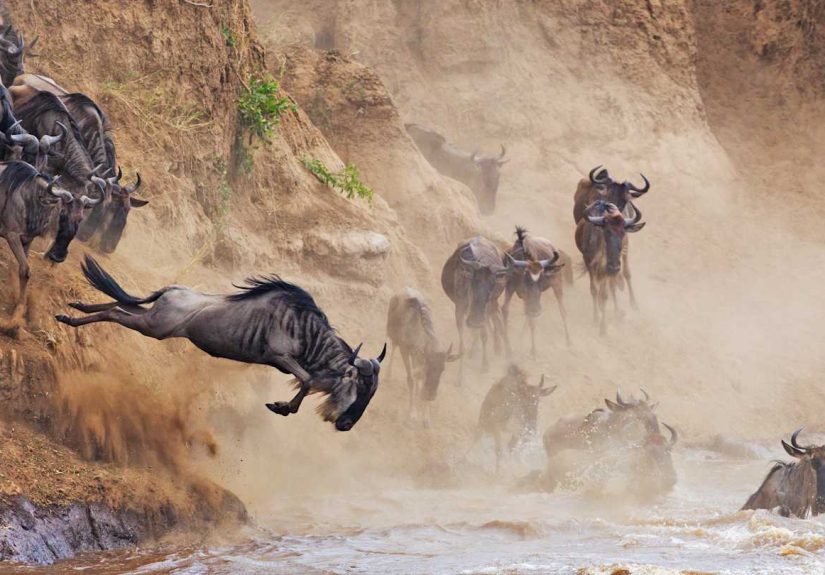
The great wildebeest migration in East Africa is not the longest migration on this list, but it may be the most visually overwhelming. More than a million wildebeest move through the Serengeti-Mara ecosystem on a circuit of roughly 1,250 miles, following rain and fresh grass across Tanzania and Kenya.
This migration is famous for river crossings, predator encounters, and sheer scale. Lions, crocodiles, hyenas, and other hunters take advantage of the moving feast, while the wildebeest keep pressing forward because standing still is not an option. It is one of the last great intact mammal migrations on Earth, and it proves that “amazing” is not just about mileage. Sometimes it is also about thunder, dust, risk, and a horizon that appears to be moving.
What These Epic Journeys Really Tell Us
These migrations are not random acts of animal wanderlust. They are survival strategies refined over thousands, and in some cases millions, of years. Each route depends on timing, habitat quality, weather, food, and safe passage. Remove one piecean estuary, a nesting beach, a stopover full of eggs, a river connection, a climate patternand the whole system starts to wobble.
That is why migration stories are also conservation stories. Red knots need healthy stopovers. Monarchs need milkweed and overwintering habitat. Salmon need connected rivers. Whales need safer corridors. Wildebeest need open landscapes. The farther an animal migrates, the more places it depends on, and the more chances there are for humans to help or make things worse.
Experiences That Make Long Animal Migrations Feel Even More Incredible
Reading about long animal migrations is impressive, but experiencing even a small piece of one can completely change how you think about wildlife. Numbers alone are huge3,000 miles, 10,000 miles, 40,000 milesbut those numbers become real when a migration stops being abstract and turns into sound, motion, weather, and timing.
Take monarch butterflies. On paper, their migration is a science story about navigation, generation turnover, and habitat loss. In person, it can feel surprisingly intimate. A monarch drifting over a roadside field or clustering in trees on a cool morning does not look like an endurance athlete. It looks delicate, almost decorative. That contrast is part of the magic. You see something that appears fragile, and then you remember it is engaged in one of the most extraordinary journeys in North America. Suddenly, a patch of milkweed or a strip of late-season wildflowers feels less like landscaping and more like essential infrastructure.
Bird migrations create a different kind of experience. A flock of shorebirds lifting off together has a kind of choreography that feels too precise to be accidental. Watching them wheel in unison makes migration look less like travel and more like a language. With species such as red knots or godwits, the wonder comes from imagining what happened before the sighting and what comes after. The bird in front of you may have just crossed an ocean or may be about to. It turns even a brief glimpse into a much larger story.
Whale migrations are even more dramatic because of scale. Seeing a whale surface during migration changes your sense of distance. The blow appears, then a back, maybe a fluke, and then the ocean closes again as if nothing happened. Yet that animal may be moving between tropical breeding areas and Arctic or sub-Arctic feeding grounds on a schedule older than modern coastlines as we know them. A single sighting can make the ocean feel connected in a way maps rarely capture.
The wildebeest migration is almost the opposite experience: not fleeting, but overwhelming. Accounts from the Serengeti often describe the sound before the sight. Hooves, grunts, dust, river spray, and the sheer density of moving bodies create a sensory overload that makes the landscape feel alive. It is not just that animals are passing through; it feels like the land itself has started moving. That kind of spectacle explains why migration inspires awe across cultures. It is survival performed at full volume.
Even fish migrations can become emotional once you understand them. Watching salmon push upstream, battered but determined, turns a river into a story of memory and return. These fish are not just swimming; they are completing a cycle that links ocean, river, forest, and future generations. You start by admiring stamina and end by appreciating ecological connection.
That may be the most lasting experience migration offers: perspective. These journeys remind us that animals do not live in isolated scenic snapshots. They live in connected systems across huge distances. A beach, a bay, a wetland, a grassland corridor, a cold current, or a mountain pass may all be pieces of the same journey. Once you understand that, wildlife becomes harder to see as separate from landscape, season, and climate. Migration does not just show where animals go. It shows how the living world fits together.
Conclusion
The longest animal migrations are some of the greatest stories on Earth because they combine endurance, instinct, timing, and geography on an almost absurd scale. From Arctic terns skimming across hemispheres to monarch butterflies fluttering toward Mexico, these journeys prove that movement is one of nature’s most powerful survival tools.
They are also reminders that the natural world runs on connections. Protect the route, the stopover, the feeding ground, and the breeding site, and migration can continue. Break those links, and even the planet’s toughest travelers start to struggle. The animals on this list may be built for distance, but they still need a world that lets them pass through it.