Table of Contents >> Show >> Hide
- What Actually Makes a Product “Silly”?
- The 10 Silliest Products of All Time
- 1. Colgate Kitchen Entrees: Toothpaste for Dinner
- 2. Dumbbell Eating Utensils: Because Forks Need Gains
- 3. The Egg Cuber: Turning Breakfast Into Geometry
- 4. Wonder Sauna Hot Pants: Inflatable Sweat Shorts
- 5. The Pet Rock: A Rock That Outsold Real Products
- 6. USB Pet Rock: The Sequel Nobody Asked For
- 7. The Hula Chair: Exercise by Sitting Badly
- 8. Baby Mop Onesie: Cleaning While Crawling
- 9. The Selfie Toaster: Your Face, But Crispier
- 10. Cat Wigs and Pet Fashion Overload
- Why Do Silly Products Go Viral?
- Lessons from the Silliest Products (Yes, There Are Some)
- Real-Life Experiences with Ridiculous Products
- Final Thoughts: In Praise of the Pointless
Some products change the world. Others change… absolutely nothing, except maybe your bank balance and
your friends’ opinion of your judgment. Today we’re celebrating that second category: the silliest
products of all time. These are the weird, ridiculous, “who approved this?” ideas that somehow made it
from a whiteboard brainstorm all the way to store shelves.
From toothpaste-branded frozen dinners to square eggs and rocks with better packaging than most luxury
gadgets, these bizarre consumer products prove one thing: humans will buy almost anything if the story
is good enough. Many of them flopped spectacularly. A few quietly made millions. All of them make us
laugh.
Grab your imaginary credit card, resist the urge to “add to cart,” and let’s walk through ten of the
silliest products of all timeplus what they can teach us about marketing, psychology, and the
never-ending search for the next big (or gloriously pointless) thing.
What Actually Makes a Product “Silly”?
“Silly” doesn’t always mean useless. Some famously strange inventions have real functions: they just
solve non-problems, solve them in the weirdest way possible, or come wrapped in branding so confusing
that nobody knows who they’re for.
Typically, the silliest products share a few features:
- Brand whiplash: The product doesn’t fit the brand at all (hello, toothpaste lasagna).
- Problem inflation: The product solves a “problem” nobody was actually having.
- Gimmick overload: It leans so hard on a joke or gimmick that practicality never stood a chance.
- Short viral fame: It sells for a season, shows up in late-night monologues, then vanishes into trivia.
With that in mind, here are ten of the silliest products ever unleashed on unsuspecting shoppers.
The 10 Silliest Products of All Time
1. Colgate Kitchen Entrees: Toothpaste for Dinner
Imagine walking down the frozen food aisle and seeing a logo you associate with minty-fresh breath
slapped on boxes of lasagna, beef entrées, and frozen meals. That actually happened. Colgate, the
toothpaste giant, once tried to launch a line of frozen “Kitchen Entrees.”
The logic (on paper) wasn’t totally insane: people eat dinner, and then they brush their teeth, so why
not own both moments? The problem was emotional. Consumers already associated Colgate with foam,
fluoride, and that “just brushed” feeling. Translating that mental image into “mmm… spaghetti” simply
did not compute.
The result? Confused shoppers, poor sales, and even reports that the mere existence of the dinners
hurt Colgate’s core toothpaste business. As a masterclass in brand mismatch, Colgate Kitchen Entrees
deserves a permanent seat on the “what were they thinking?” shelf.
2. Dumbbell Eating Utensils: Because Forks Need Gains
Next up is a product that asks the question, “What if dinner were also arm day?” Dumbbell eating
utensilsmarketed under names like “Eat Fit”are exactly what they sound like: stainless steel knives,
forks, and spoons attached to mini dumbbells so you “work out” while you eat.
The idea was pitched as a novelty gift for fitness fanatics, dieters, or people who want to brag that
even their cutlery hits the gym. In reality, they’re heavy, awkward, and make cutting a steak feel
like you’re participating in a poorly designed CrossFit challenge.
As a gag gift, they’re funny once. As a serious lifestyle tool, they’re utterly ridiculous. If your
workout plan relies on you curling your spoon between bites of mashed potatoes, we need to talk.
3. The Egg Cuber: Turning Breakfast Into Geometry
Somewhere, in a product design meeting, someone said, “Eggs are too round,” and nobody laughed. That’s
how we got the Egg Cuber: a device that squeezes a warm, hard-boiled egg into a cube so you can enjoy
perfectly square slices of… confusion.
To be fair, it does what it promises. You put a peeled egg in the little plastic chamber, twist down
the top, chill, and boomsquare egg. But why? It doesn’t taste different. It doesn’t store
meaningfully better. It just looks like breakfast escaped from a low-budget sci-fi lab.
The Egg Cuber sits at that beautiful intersection of “harmlessly silly” and “suspiciously unnecessary.”
Nobody needed it, but we’re sort of glad it existsif only to remind us that human creativity has no
off switch.
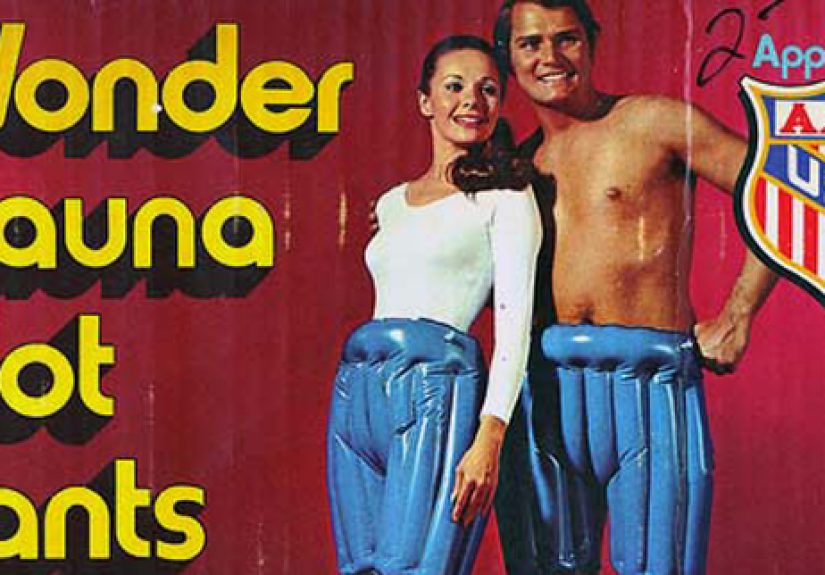
4. Wonder Sauna Hot Pants: Inflatable Sweat Shorts
In the 1970s, “sweat it off” was almost a religion, which birthed all kinds of questionable slimming
gear. Enter Wonder Sauna Hot Pants: inflatable plastic shorts you wore to “melt away” fat by turning
your lower body into a portable sauna.
You pulled on these puffy, squeaky pants, pumped in air, and waited while your thighs and hips steamed
like dumplings. The promise was faster weight loss. The reality was more “personal sauna” than
“fitness breakthrough,” with all the comfort of wearing a hot pool toy under your jeans.
These inflatable sweat shorts might be one of the most visually absurd products ever marketed as
health equipment. If you’ve ever felt embarrassed walking to the gym in leggings, just remember: it
could be worse. You could be swishing around in Wonder Sauna Hot Pants.
5. The Pet Rock: A Rock That Outsold Real Products
The Pet Rock is perhaps the most legendary silly product of all time. In 1975, advertising copywriter
Gary Dahl started selling smooth rocks in cardboard “pet carrier” boxes, complete with ventilation
holes and a tongue-in-cheek training manual. That’s it. No batteries. No moving parts. Just a rock
with good branding.
The joke landed perfectly. People bought them in droves as gag gifts, conversation starters, and
novelty items. Within months, Dahl had sold around a million and a half Pet Rocks and made millions of
dollars from what was essentially stylish gravel.
The Pet Rock proves that silliness doesn’t always equal failure. If the story is strong enough and the
price is low enough, a completely pointless product can become a cultural phenomenonat least until
everyone realizes they paid cash for a paperweight.
6. USB Pet Rock: The Sequel Nobody Asked For
Fast-forward to the digital era and, naturally, the Pet Rock had to get a “tech upgrade.” Enter the USB
Pet Rock: a rock with a USB cable attached that… does absolutely nothing. It doesn’t light up, store
files, or charge your phone. It’s just a rock hogging a port on your laptop.
The product leaned hard into its own uselessness as a kind of anti-tech joke. In a world obsessed with
productivity apps, smart devices, and “optimization,” the USB Pet Rock is proudly, aggressively
pointless. That self-aware silliness is the entire sales pitch.
It’s the perfect desk accessory for anyone who works in IT, hates meetings, or wants to subtly signal
“I’ve given up” during Zoom calls. As an actual piece of technology, it’s absurd. As satire in product
form, it’s kind of brilliant.
7. The Hula Chair: Exercise by Sitting Badly
The Hula Chairsometimes marketed as the Hawaii Chairlooks like a normal office chair, except the seat
rotates in a constant hula motion while you sit. The idea: you get a “core workout” while typing,
answering emails, or pretending you’re not dizzy.
In reality, the Hula Chair mostly gives you the elegance of a washing machine on spin cycle. Try using
a keyboard while your hips are swaying in a big circle and you’ll quickly discover that “hands-free
workout” really means “hands-can’t-hit-the-right-keys workout.”
As a low-impact exercise device, it’s debatable. As pure visual comedy, it’s unbeatable. Few products
look sillier than a serious businessperson trying to maintain eye contact on a video call while their
chair is doing interpretive dance.
8. Baby Mop Onesie: Cleaning While Crawling
If you’ve ever watched a crawling baby and thought, “That’s a lot of wasted floor coverage,” this next
invention is for you. The baby mop onesie is a regular baby outfit with mop-like fringe sewn onto the
arms and legs so that, in theory, your child helps clean the floor as they scoot around.
It’s usually sold as a joke, but the marketing copy sometimes tries to play it straight: “Teach your
baby the value of hard work!” Let’s be clearyour baby is not concerned about your tile grout. They
are concerned about putting absolutely everything in their mouth.
The baby mop onesie is undeniably funny on camera, but as a real cleaning solution it’s pure fantasy.
If anything, you’ve just invented a tiny, fuzzy dust magnet that licks the furniture.
9. The Selfie Toaster: Your Face, But Crispier
The selfie toaster takes personalized breakfast to ridiculous extremes. You send in a photo of your
face, the company creates a custom metal plate, and the toaster burns your likeness into every slice of
bread. It’s edible vanity, carb-loaded and lightly browned.
Is it technically impressive? Sure. Is it silly? Absolutely. The first time you pop up a slice of toast
staring back at you, you’ll either burst out laughing or question every life choice that led to this
moment.
The selfie toaster is the kind of purchase that makes sense at midnight on an online shopping spree,
then feels deeply unexplainable when a guest sees it in your kitchen. As a gift, it’s unforgettable.
As a kitchen staple, not so much.
10. Cat Wigs and Pet Fashion Overload
Finally, we have cat wigsyes, actual colorful wigs designed specifically for cats. These fluffy
headpieces transform your indifferent feline into a pink-bobbed pop star, a blue-haired punk rocker, or
a tiny, furious lion lookalike.
Pet fashion is a booming industry, but wigs for cats (and similarly outlandish pet accessories) sit at
the far edge of practicality. Most cats barely tolerate collars, let alone a neon wig. The result is
usually a five-second photoshoot followed by thirty minutes of your cat plotting revenge.
Still, the images are undeniably hilarious, and in the age of Instagram and TikTok, that’s all a
product really needs to semi-justify its existence.
Why Do Silly Products Go Viral?
It’s easy to dismiss these bizarre consumer products as flukes, but they reveal a lot about how we shop
and what makes something memorable:
- They’re instant conversation starters. A Pet Rock or selfie toaster doesn’t need a sales pitch. The story sells itself.
- They tap into humor. People love buying funny gag gifts for coworkers, white-elephant parties, and secret Santa exchanges.
- They ride media waves. Once a ridiculous invention hits TV, social media, or a list article, curiosity alone can drive sales.
- They feel low-risk. Many silly products are relatively cheap. Even if they’re useless, the buyer got a laugh.
Some start as jokes and accidentally make millions. Others vanish after a small, confused run. In both
cases, they live on as legends in the hall of fame of pointless genius.
Lessons from the Silliest Products (Yes, There Are Some)
Beneath the absurdity, these inventions offer real lessons for entrepreneurs, marketers, and anyone who
has ever scribbled a “crazy idea” in the notes app.
1. Branding Matters More Than Logic
Colgate frozen dinners show how powerful brand associations are. Once consumers trust you for one
thinglike toothpasteit’s hard to drag that trust into a completely unrelated category, especially
food. If your brand screams “mint and cavities,” people won’t think “lasagna night.”
2. Humor Is a Legitimate Business Strategy
The Pet Rock, USB Pet Rock, and cat wigs all prove that humor can be a business model. Nobody is buying
these items for their functionality. They’re buying the joke, the story, and the shared laughter. When
done intentionally, silliness can be strategic, not accidental.
3. Solving Fake Problems Can Still Make Real Money
Many silly gadgets solve problems we didn’t actually have: “How do I make eggs square?” “How do I
exercise while chewing?” “How can my baby contribute to household chores?” The problems are fakebut
the emotional payoff (novelty, fun, social media content) is real enough to drive sales.
4. Virality Has a Short Shelf Life
Silly products often burn bright and fast. A meme-worthy gadget might explode in popularity for a
season, then disappear. Relying solely on viral novelty is risky. The smartest creators either treat it
as a one-time jackpot or build a larger brand around the humor, launching new weird products over time.
Real-Life Experiences with Ridiculous Products
If you’ve ever impulse-bought a ridiculous product, you’re in good company. Silly products thrive
because they hit us in very human moments: boredom, stress, late-night scrolling, or pre-holiday panic.
They often show up when you’re thinking, “I need a gift, I’m out of ideas, and I want something that
will get a reaction.”
Picture this: it’s office secret Santa season. The spending limit is low, the pressure for originality
is high, and you’ve drawn the coworker you barely know. You could play it safe with a mug or a candle.
Instead, you end up on a product page for dumbbell forks or a USB Pet Rock, and suddenly you know:
this is the one. It’s not practical, but it guarantees a laugh in a room full of awkward small talk.
Or maybe you’ve been on the other side, opening a gift and trying to keep a straight face as you unwrap
a baby mop onesie at a baby shower or cat wigs at a pet-lover’s birthday. The best part isn’t the
product itself; it’s the shared moment when everyone realizes how absurd it is. Photos are taken.
Stories are told. The product’s true value is social, not functional.
Many people also meet silly products through late-night TV and social media. Infomercials and viral
videos are perfect vehicles for ridiculous inventions because they can demonstrate the product in all
its over-the-top glory. Watching someone sit in a gyrating Hula Chair while trying to drink coffee is
way more entertaining than reading about its “core-strengthening benefits.” That entertainment factor
is often what pushes people from “that’s ridiculous” to “I kind of want one.”
Then there’s the “found in the wild” experiencestumbling across bizarre items in clearance aisles or
discount bins. That’s where many of these inventions go once their fifteen minutes are up. You’ll see a
lone box of sauna pants or a gadget for slicing bananas into identical pieces and think, “Who made
this, and how many did they think they’d sell?” It’s like walking through a museum of strange business
decisions.
For creators and entrepreneurs, silly products can be surprisingly inspiring. They remind us that:
- Not every idea has to be world-changing to be worth trying.
- Sometimes “too weird” is exactly what cuts through the noise.
- A strong concept, clear joke, and memorable story can outshine advanced tech or complex features.
In a way, experimenting with playful, pointless products can be a low-stakes way to learn about
manufacturing, marketing, and customer behavior. You might not build a billion-dollar company around
square eggsbut you might learn enough from that experiment to create your next, genuinely useful hit.
And even for the rest of usthe non-inventorsthere’s something charming about these oddities. They
represent the gleeful, slightly unhinged side of human creativity. We don’t just make tools to survive;
we make laser-engraved toasters that burn our faces into breakfast. Is it practical? Not really. Is it
a very human thing to do? Absolutely.
Final Thoughts: In Praise of the Pointless
The silliest products of all time are easy to mock, but they’re also impossible to forget. They sit at
the crossroads of comedy, commerce, and curiosity. Some crashed and burned. Some made surprising
amounts of money. All of them remind us that the line between “ridiculous failure” and “weird viral
success” is thinner than we think.
So the next time you see a bizarre gadget or an unnecessary invention in your feed, remember: behind
that silly product is someone who dared to ask, “What if?” Sometimes that question leads to smartphones
and space travel. Other times it leads to inflatable sauna pants and USB rocks. Either way, the world
would be a lot more boring without them.