Table of Contents >> Show >> Hide
- The Short Answer: Best Sectional Size for a 12×12 Room
- Why a 12×12 Room Changes the Rules
- What Usually Fits Comfortably
- How to Know if the Sectional Is Too Big
- The Best Layout Ideas for a 12×12 Room
- How Much Space Should You Leave Around It?
- Features to Look For in a Sectional for a 12×12 Room
- When a Sectional Is Not the Best Choice
- How to Measure Before You Buy
- Realistic Example Sizes That Usually Work
- Final Verdict
- Extra Experiences: What It Actually Feels Like to Live With a Sectional in a 12×12 Room
A 12×12 room is the interior design version of a group chat with strong opinions: it looks manageable at first, and then suddenly everyone is talking at once. On paper, 144 square feet sounds decent. In real life, once you add a doorway, a coffee table, a TV stand, a lamp, a rug, and that one plant you swear you’re keeping alive this time, the room gets very small very fast.
That is why choosing the right sectional size matters so much. Go too small, and the room feels under-furnished and awkward. Go too big, and your living room turns into a padded obstacle course. The sweet spot is not about buying the biggest sectional that technically fits. It is about choosing the sectional that leaves enough room to live like a human being instead of a Roomba trapped behind a chaise.
The Short Answer: Best Sectional Size for a 12×12 Room
For most 12×12 rooms, the best sectional is an apartment-size or small-space sectional with a main width of about 78 to 90 inches. A chaise or return section around 60 to 65 inches usually works well, and a depth of about 35 to 40 inches tends to feel comfortable without swallowing the room whole.
If you want the safest recommendation, aim for a sectional around 82 to 86 inches wide with a compact chaise. That size usually gives you enough seating for everyday lounging while still leaving space for circulation, a coffee table, and at least one side table or floor lamp.
If your room has multiple doors, large windows that reach low, a fireplace, or a walkway cutting through it, go smaller. If the room opens into another area and the sectional can “borrow” visual space, you can sometimes push closer to 88 or 90 inches. But in a true closed-off 12×12 room, once you start shopping for 100-inch-plus sectionals, you are flirting with layout regret.
Why a 12×12 Room Changes the Rules
A 12×12 room is not tiny, but it is square, and square rooms can be sneaky. They give the illusion that almost anything can fit because both walls are the same length. Then you bring in an L-shaped sectional and realize one side of it is now bossing around the entire room.
The challenge is not just wall length. It is also the space needed around the sectional. You need room to walk, room to reach a coffee table, room to sit without bumping your knees, and room for the layout to look intentional instead of accidental.
A regular sofa is easier to place because it is basically one clean line. A sectional adds a second dimension. That extra chaise or return is great for stretching out on movie night, but it also eats floor space in a way that can make a small square room feel crowded faster than expected.
What Usually Fits Comfortably
Best overall size
If you want a sectional that looks proportional in a 12×12 room, start with a model in the 82- to 86-inch range. This size often feels “just right” because it gives you full sofa comfort without dominating every inch of the room. Pair it with a compact round or oval coffee table and the room will breathe much more easily.
Best size for maximum seating
If the room is your main TV lounge and you want the sectional to do most of the seating work, you can go a bit bigger, around 88 to 90 inches. At that point, keep other furniture very light: think one slim side table, one floor lamp, and maybe a pouf that can move around as needed. The sectional becomes the star, and everything else should act like a respectful supporting cast.
Best size if you still want extra furniture
If you want a chair, a larger media console, or more open floor area, stay closer to 72 to 82 inches. Yes, that can still count as a sectional if it includes a compact chaise or a small bumper. This is often the smartest choice in rooms that do not just serve as a lounge, but also as a passageway, a reading nook, or the place where the dog has somehow claimed half the rug.
Best shape
In a 12×12 room, the easiest sectional shape is usually a two-piece L-shape with a chaise. It gives you the comfort of a sectional without the sheer bulk of a large multi-piece configuration. A reversible chaise is even better because it gives you flexibility if the room layout changes, or if you discover after three days that the chaise is blocking the one outlet you actually use.
How to Know if the Sectional Is Too Big
Here is the practical test: if the sectional leaves you with only a narrow squeeze-path around the room, it is too big. If the chaise cuts directly into the main traffic route, it is too big. If you need a coffee table the size of a dinner tray just to avoid bruising your shins, it is too big.
A good sectional should feel substantial, not suffocating. In a well-planned 12×12 room, you should still be able to move through the space naturally. You should not have to turn sideways like a crab every time you head toward the window.
Another red flag is visual weight. Even if a sectional technically fits, a design with thick rolled arms, oversized cushions, or a very deep profile can make the room feel smaller than the measurements suggest. In compact rooms, slim arms, visible legs, and lower backs are often your best friends.
The Best Layout Ideas for a 12×12 Room
1. Sectional in the corner
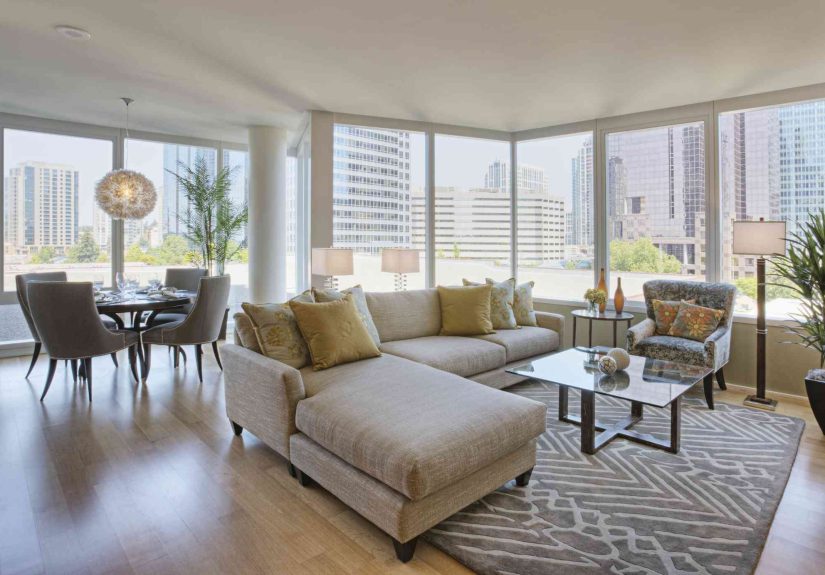
This is usually the winning move. Place the sectional in one corner so the long side runs along one wall and the chaise or return follows the adjacent wall. This keeps the middle of the room more open and makes the layout feel organized. It is the classic small-room strategy for a reason: it works.
2. Sectional facing the TV wall
If the room is primarily for watching TV, place the main run of the sectional opposite the TV and let the chaise extend toward the least-used side of the room. This layout makes lounging easy and usually preserves better sightlines than floating a sectional in the center.
3. Sectional plus round coffee table
In a small square room, a round coffee table is often smarter than a rectangular one. It softens the boxy shape of the room, improves flow, and reduces sharp corners. In other words, it is good for both the layout and your kneecaps.
4. Sectional with nesting tables instead of a big coffee table
If the room feels tight, skip the oversized coffee table and use nesting tables or a compact ottoman. This gives you flexibility without sacrificing function. Small rooms love furniture that knows how to multitask.
How Much Space Should You Leave Around It?
This is where the real decision happens. A sectional is not just about its own measurements. It is about the clearances around it.
- Walkways: Try to preserve about 30 to 36 inches for the main traffic path whenever possible.
- Coffee table spacing: Leave roughly 14 to 18 inches between the sectional and the coffee table so you can actually reach your drink without performing a yoga lunge.
- Extra breathing room: If possible, leave some open space around the chaise or outer edge so the room does not look packed to the brim.
That spacing is why a 78- to 90-inch sectional usually works better than a giant showroom model. Big sectionals are wonderful in catalogs because catalogs do not include your radiator, your floor vent, or your need to walk from the hallway to the sofa while holding a laundry basket.
Features to Look For in a Sectional for a 12×12 Room
Slim arms
Bulky arms steal precious inches without adding much usable seat space. Slim track arms are a smarter use of square footage.
Visible legs
A sectional with legs that lift the body slightly off the floor can make the room feel lighter and more open. It lets more floor show, and that visual trick matters in a compact room.
Reversible chaise
This gives you layout flexibility, which is gold in a small room. If you move the TV, shift the rug, or change apartments later, a reversible chaise can save the day.
Shallower depth
Deep sectionals are dreamy, but in a 12×12 room they can get bossy. A slightly shallower depth helps preserve floor area while still feeling comfortable.
Low profile
A lower back can make the room feel more spacious, especially if the sectional sits near a window. Tall, overstuffed backs can visually crowd a room even when the measurements seem fine.
When a Sectional Is Not the Best Choice
Sometimes the right answer is: do not force it. If your 12×12 room has two or three doorways, awkward architectural features, or needs to serve multiple purposes, a sofa plus one or two chairs may work better than a sectional.
A sectional is ideal when you want one main seating piece to anchor the room. But if the room also needs a desk, extra storage, or flexible seating for different activities, a standard sofa can give you more layout freedom. Not every room needs an L-shape. Sometimes a well-scaled sofa is the mature decision. Boring? Maybe. Correct? Often, yes.
How to Measure Before You Buy
Before you buy anything, map it out on the floor with painter’s tape. This is one of the easiest ways to avoid expensive “looked smaller online” heartbreak.
- Measure the full room dimensions.
- Mark doors, vents, windows, radiators, and outlets.
- Tape out the exact footprint of the sectional, including the chaise.
- Tape the coffee table too, not just the sofa.
- Walk through the room as if you actually live there.
If the taped outline already feels crowded, the real sectional will not magically feel better once it arrives. Furniture is many things, but merciful is rarely one of them.
Also remember to measure the delivery path. The perfect sectional for your room is not so perfect if it cannot make it through the front door, around the stair landing, and into the space without becoming an expensive hallway sculpture.
Realistic Example Sizes That Usually Work
Here is a practical way to think about it:
- Compact fit: around 72 to 79 inches wide with a small chaise or bumper. Great for tight layouts or multi-use rooms.
- Balanced fit: around 80 to 86 inches wide. Best choice for most 12×12 rooms.
- Upper limit: around 88 to 90 inches wide, only if the rest of the room stays minimal.
- Usually too large: 100 inches or more in a fully enclosed 12×12 room, unless you are skipping most other furniture.
That balanced middle zone is where function and comfort tend to shake hands. It gives you enough lounge space without asking the entire room to make sacrifices.
Final Verdict
So, what size sectional should you use in a 12×12 room? In most cases, a small-space sectional between 78 and 90 inches wide is the smart choice, with 82 to 86 inches being the safest sweet spot for comfort and flow. Choose a compact chaise, keep the arms slim, preserve room for walkways, and do not forget that a sectional has to fit your lifestyle, not just your wall.
If you remember only one thing, remember this: the best sectional for a 12×12 room is not the one that fills the room. It is the one that lets the room still function after it arrives.
Extra Experiences: What It Actually Feels Like to Live With a Sectional in a 12×12 Room
Here is the part furniture showrooms never tell you: living with a sectional in a 12×12 room is less about raw measurements and more about daily behavior. People often imagine the sectional as one magical piece that will solve everything. More seats, more comfort, more style, more movie-night glory. And sometimes it does. But the real experience depends on whether the sectional makes your routine easier or quietly more annoying.
One of the most common experiences in a 12×12 room is the “it fit, but it changed the room” moment. The sectional arrives, the delivery team leaves, and suddenly you realize the room now has a personality. It is no longer a flexible little space. It is now a sectional room. That can be wonderful if lounging is your main goal. It can be less wonderful if the room used to handle reading, gaming, working, and hosting without complaint.
Homeowners and renters with compact living rooms often say the chaise becomes both the best part and the most opinionated part of the furniture. On good days, it is the perfect nap spot. On bad days, it is the thing blocking the floor lamp, the path to the curtains, or the only place where a side table made sense. That is why compact chaises and reversible chaises are so valuable in smaller rooms. Flexibility is not a bonus in a 12×12 room; it is survival.
Another very real experience is discovering that one large seating piece can actually make a room feel calmer. This surprises people. They assume a sectional will automatically feel heavier than a sofa and two chairs. Sometimes the opposite is true. A well-scaled sectional can simplify the room by reducing visual clutter. Instead of several separate pieces competing for space, you get one clean anchor. The room looks more settled, more intentional, and frankly more grown-up.
But there is also a cautionary tale that repeats itself in small rooms: buying for fantasy instead of habit. People buy the huge sectional because they imagine hosting ten friends every weekend, only to realize the room is mostly used by two people, one dog, and a throw blanket that keeps sliding to the floor. In real life, the best furniture choices come from honest routines. If you mostly watch TV, read, and occasionally host one or two guests, a compact sectional is usually plenty. Your room does not need to prepare for a party that exists only in your imagination.
The happiest small-room sectional owners tend to have one thing in common: they edit the rest of the room ruthlessly. They choose a lighter coffee table, a slimmer media console, fewer side pieces, and better scale overall. They understand that once a sectional moves in, every other object needs to earn its keep. That mindset is what makes a 12×12 room feel cozy instead of cramped.
In the end, the experience of using a sectional in a 12×12 room is usually positive when the size is modest, the layout is intentional, and expectations are realistic. Get the scale right, and the room feels inviting. Get it wrong, and your living room becomes a very expensive lesson in why a tape measure deserves more respect.