Table of Contents >> Show >> Hide
- So, what exactly makes a ceiling a “tray” ceiling?
- Why homeowners love tray ceilings (besides the obvious “ooh” factor)
- Where tray ceilings work best
- Tray ceiling design ideas that don’t feel stuck in 2003
- Pros and cons of tray ceilings
- Tray ceiling vs. coffered ceiling vs. vaulted ceiling
- How much does a tray ceiling cost?
- DIY or hire a pro?
- Design rules of thumb (that save you from ceiling regret)
- Should you add a tray ceiling?
- Real-world experiences: what tray ceilings are like to live with (the extra )
- Experience #1: The “why does this room feel calmer?” moment
- Experience #2: Lighting becomes a conversation (in a good way)
- Experience #3: The paint decision spiral is real
- Experience #4: Dust finds the ledge (because dust is persistent)
- Experience #5: It can improve resale “feel,” even if buyers can’t name it
A tray ceiling is what happens when a “normal” ceiling decides it wants a glow-up. Instead of being one flat plane, it steps up in the middlelike an upside-down serving traycreating a recessed border around the perimeter and a higher center section. The result: a room that feels a little taller, a little fancier, and a lot more “someone cared about this place.”
But tray ceilings aren’t just about looking expensive. They can help define spaces in open floor plans, create natural zones for lighting, and add architectural interest without the full commitment (and cost) of more complex ceiling treatments. If you’ve ever walked into a bedroom and thought, “Why does this feel calmer and more finished?” there’s a decent chance the ceiling was quietly doing the work.
So, what exactly makes a ceiling a “tray” ceiling?
Picture a room with a ceiling that drops down around the edges (often a few inches) while the center remains higher. That recessed step creates the “tray” effect. Some tray ceilings are simple: one step up, clean lines, minimal trim. Others are layered or multi-tiered, stepping up two or three times for more depth (and more drama).
Common names you might hear
- Recessed ceiling (most common alternate name)
- Inverted ceiling (because it looks like an upside-down tray)
- Tiered ceiling (often used for multi-step versions)
Most tray ceilings follow the shape of the roomrectangles and squares are typicalbut custom shapes (ovals, octagons, curves) are also possible, especially in entryways and dining rooms where people are already inclined to look up.
Why homeowners love tray ceilings (besides the obvious “ooh” factor)
A tray ceiling adds depth. And depth is basically the interior design version of seasoning: it makes everything taste better. Here are the practical reasons tray ceilings keep showing up in new builds, remodels, and “we just want it to feel nicer” renovations.
1) They make a room feel taller (even when it’s not)
Because the center plane is higher than the perimeter, your eyes read the space as having more volume. It’s a subtle optical tricklike vertical stripes, but for architecture.
2) They create a natural focal point
If the walls are the stage, a tray ceiling is the spotlight. It draws attention upward and gives the room a finished, custom feelespecially when paired with a statement light fixture or layered lighting.
3) They can help “zone” open layouts
In open concept spaces, you don’t always want walls, but you do want visual separation. A tray ceiling can define the dining area or seating zone without building anything that blocks sightlines (or airflow, or the dog’s preferred running route).
Where tray ceilings work best
Tray ceilings can go almost anywhere, but they shine in rooms where a little elegance goes a long wayor where lighting and mood matter.
Bedrooms
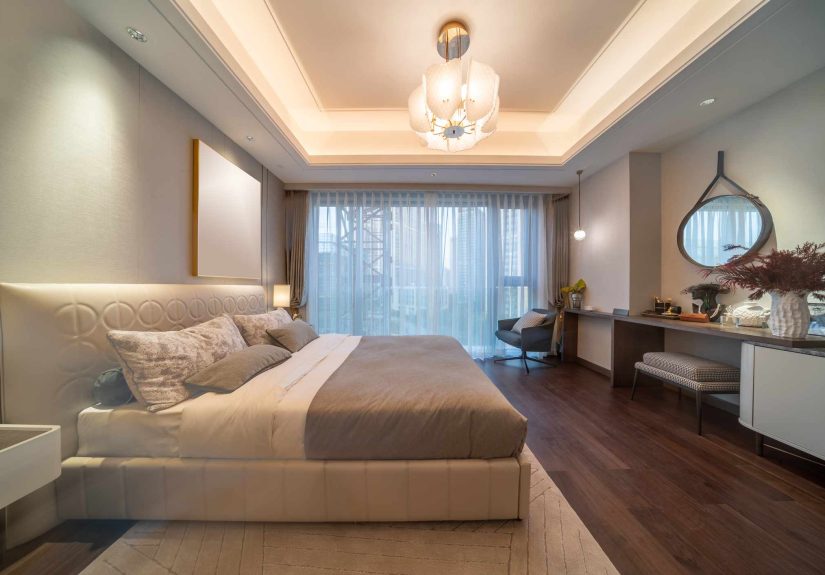
Bedrooms benefit from soft, indirect lighting. A tray ceiling is practically begging for cove lighting or hidden LED strips that create a gentle perimeter glow. It can also visually center the bed wall and make the room feel more intentional.
Dining rooms
Dining rooms are natural candidates for tray ceilings because a centered chandelier or pendant feels “right” there. The tray adds architectural framing to the light fixturelike a picture frame for your lighting budget.
Living rooms and great rooms
In larger spaces, tray ceilings help break up “big flat ceiling syndrome.” If your living room feels like a hotel lobby (but not in a fun way), a tray ceiling can add definition and a more residential scale.
Entryways and foyers
Entry spaces often aim for impact. A tray ceiling is an elegant way to say, “Welcome in, we have opinions about trim.”
Tray ceiling design ideas that don’t feel stuck in 2003
Tray ceilings got very popular in the late 1990s and early 2000s. Some of those versions were… enthusiastic. The good news: today’s tray ceilings can look clean, modern, and intentional without leaning into heavy trim and shiny gold fixtures.
Paint: the easiest way to make a tray ceiling look custom
Paint can emphasize depth by creating contrast between the tray (the higher center) and the drop-down border. You can go bold (deep color inside the tray), subtle (one shade lighter or darker), or seamless (matching the walls for a cocoon effect). If you’re nervous, start with a low-contrast approachyour ceiling doesn’t need to shout to be effective.
Molding and trim: polish without overdoing it
Crown molding along the step can sharpen the transition and add character. Modern styles often use simpler profilesclean lines rather than ornate curvesso the ceiling feels elevated, not busy. You can also add trim to highlight the inside edge of the tray for a crisp, tailored look.
Lighting: where tray ceilings become the main character
Lighting is one of the biggest perks of a tray ceiling, because you naturally get edges and ledges that can hide fixtures and create layers. Popular options include:
- Cove lighting (hidden lighting that washes the ceiling with a soft glow)
- LED strip lighting tucked along the perimeter for modern ambience
- Recessed lights placed strategically in the border (use sparinglymore isn’t always better)
- Chandelier or pendant centered in the tray for a strong focal point
Pro tip: The best tray ceiling lighting plans usually combine at least two layersambient perimeter light plus a central fixture, or perimeter plus a few recessed lights for task-friendly brightness.
Wallpaper, wood, beams, or paneling: texture that adds depth
If paint feels too basic, the tray’s center area is a perfect “feature zone.” Wood planks, beadboard, subtle wallpaper, or decorative paneling can add texture without overwhelming the room. Keep scale in mind: a small room can get visually crowded fast, while a larger space can handle bolder materials.
Pros and cons of tray ceilings
Pros
- More visual height and perceived spaciousness
- Architectural interest without rebuilding the entire roofline
- Great lighting opportunities (especially indirect, mood-friendly lighting)
- Design flexibilityworks with traditional, transitional, and modern styles
Cons
- Costmore framing, drywall, finishing, and often electrical work
- Ceiling height requirementsa deep tray in a low room can feel cramped
- Extra maintenanceledges can collect dust (yes, your ceiling can get dusty)
- Complexity in retrofitsadding one to an existing room can involve structural and permitting considerations
Tray ceiling vs. coffered ceiling vs. vaulted ceiling
These get mixed up a lot, mostly because people (understandably) don’t spend their free time categorizing ceiling geometry. Here’s the practical difference:
Tray ceiling
One large recessed (or stepped) area in the center, with a drop-down border around the edges. Clean and versatile.
Coffered ceiling
Multiple recessed panels (often a grid), usually created with beams or a beam-like framework. Coffered ceilings are more detailed and traditionally read as “luxury,” but they’re typically more labor-intensive and costlier.
Vaulted or cathedral ceiling
Instead of stepping up flat-to-flat, vaulted ceilings slope upward, following the roofline (fully or partially). They can make spaces feel dramatic and airy, but often involve structural design choices that are easiest in new construction.
How much does a tray ceiling cost?
Cost depends on whether you’re building new, remodeling, or retrofitting; how complex the tray is; and whether you’re adding specialty finishes or lighting. A simple, single-step tray ceiling added during a remodel is typically far less expensive than modifying framing or trusses to create a higher center plane.
Typical price ranges (realistic, not fantasy)
- Basic tray ceiling build: often quoted per square foot and commonly falls in a mid-range that reflects framing + drywall + finishing.
- Lighting add-ons: recessed lights, cove lighting, and chandeliers add electrical labor and materials.
- High-end finishes: custom millwork, layered steps, wood treatments, and integrated lighting can push costs up quickly.
A useful way to think about it: the “tray” itself is framing and drywall, but the look is paint, trim, and lightingand those last three are where budgets can quietly sprint.
Also: retrofitting a tray ceiling into an existing room can be more complicated than it sounds. If your contractor has to adjust framing, deal with mechanicals (HVAC), or secure permits, the scope and price can jump.
DIY or hire a pro?
A shallow tray (sometimes even a “faux tray” using trim and paint tricks) can be within reach for skilled DIYersespecially if you’re comfortable with layout, miter cuts, and patching drywall without turning your home into a dust museum.
DIY might be realistic if:
- The tray is shallow and decorative (not structural)
- You’re not moving electrical or HVAC components
- You can finish drywall cleanly (be honest with yourself)
Hire a pro if:
- You’re modifying framing, trusses, or joists
- You want integrated lighting (electricians exist for a reason)
- The ceiling is tall, complex, or multi-tiered
- You’re aiming for a seamless, high-end finish
Design rules of thumb (that save you from ceiling regret)
Keep the proportions friendly
In rooms with modest ceiling height, a shallow tray usually looks better than a deep drop. Too deep can make the perimeter feel lower, which is the opposite of the vibe you’re going for.
Let the room decide the level of drama
A dining room can handle a more dramatic tray ceiling because the furniture is lower and the focal point is centered. A small bedroom? Consider a simpler design with soft lighting and minimal trim.
Choose lighting that matches the ceiling’s job
If the tray ceiling is meant to be mood lighting, prioritize indirect or cove lighting. If the room needs real brightness (kitchen-adjacent spaces, work zones), mix in practical fixturesbut don’t turn the ceiling into an airport runway.
Finish the edges thoughtfully
Crisp lines and clean transitions are what make tray ceilings look intentional. If your trim feels bulky or your paint lines are messy, the ceiling can quickly shift from “custom” to “unfinished project you’re avoiding.”
Should you add a tray ceiling?
If you want to elevate a room’s style, create a focal point, and open up lighting options, a tray ceiling is a smart architectural upgrade. It’s especially worth considering in primary bedrooms, dining rooms, and living rooms where atmosphere matters. But if your ceiling is already low, or if your budget is tight, consider alternatives like a painted ceiling, subtle molding, or a well-chosen central fixturebecause sometimes the best ceiling upgrade is simply not pretending every room needs a cathedral moment.
Real-world experiences: what tray ceilings are like to live with (the extra )
The funny thing about tray ceilings is that you don’t notice them every dayuntil you do. Homeowners often describe the experience as “quietly upscale.” It’s not a flashy feature like a waterfall island or a two-story chandelier. It’s more like a good blazer: it makes everything look more put-together without demanding applause.
Experience #1: The “why does this room feel calmer?” moment
People commonly report that a bedroom with a tray ceiling feels more relaxing, even before they decorate. That’s usually because the ceiling adds depth and visual softnessespecially when paired with warm perimeter lighting. A simple LED strip tucked into the tray can make nighttime lighting feel less harsh than a bright overhead fixture, which is basically the difference between “spa vibe” and “interrogation room.”
Experience #2: Lighting becomes a conversation (in a good way)
Once a tray ceiling is in place, many homeowners start thinking in layers: ambient glow, focused task light, and a decorative centerpiece. The ceiling almost gives permission to be intentional. A centered chandelier feels more “anchored,” and the tray perimeter offers a natural hiding place for indirect lighting. The result is often a room that looks good in the afternoon and still looks good at nighttwo very different lighting challenges.
Experience #3: The paint decision spiral is real
A tray ceiling invites color choices, and that can be both fun and mildly unhinged. Homeowners often go through phases: “Let’s keep it white.” → “What if we did a soft tint?” → “What if the tray was deep navy?” → “What if we wallpapered it?” The practical takeaway is that subtle contrast tends to age well, while bold choices can look amazing when the rest of the room supports it. If the room has simple furnishings, a dramatic tray ceiling can carry the design. If the room is already busy, quieter ceiling choices usually feel more timeless.
Experience #4: Dust finds the ledge (because dust is persistent)
Tray ceilings often have small horizontal surfaces that collect dust over timeespecially if there’s crown molding or layered trim. Homeowners frequently mention that they didn’t think about cleaning until the first time sunlight hit the ledge at the perfect angle and revealed the “museum exhibit” of dust. The fix isn’t hard, but it does mean you’ll occasionally be the person holding an extendable duster like it’s a medieval spear.
Experience #5: It can improve resale “feel,” even if buyers can’t name it
In many markets, architectural details help a home photograph better and show better. Buyers may not walk in and announce, “Ah yes, a recessed ceiling detail with a stepped perimeter.” But they do notice when a room feels finished and intentional. Tray ceilings often contribute to that impressionespecially in primary suites and dining roomsbecause they suggest customization and care, two things buyers love almost as much as walk-in closets.
Bottom line: living with a tray ceiling is mostly about enjoying better atmosphere and a more polished room. The “experience” isn’t that it changes your lifeit’s that it makes your everyday spaces feel like someone designed them on purpose. And honestly, that’s kind of the dream.