Table of Contents >> Show >> Hide
- Net Dollar Retention (NDR) definition
- Why NDR matters (a lot) in SaaS
- How to calculate NDR (with a simple formula)
- NDR vs. GRR vs. logo retention (don’t mix these up)
- What’s a “good” NDR rate in SaaS?
- What actually drives NDR up or down?
- How to improve NDR in SaaS (a practical playbook)
- 1) Fix churn at the source: onboarding and time-to-value
- 2) Create customer health scoring (so risk doesn’t surprise you)
- 3) Reduce contraction with packaging that matches value
- 4) Build an expansion engine (without being “that” salesperson)
- 5) Make renewals boring (in the best way)
- 6) Use pricing as a lever (carefully, like handling hot coffee)
- 7) Partner Customer Success and Sales (so customers don’t get whiplash)
- 8) Segment your NDR (because averages lie)
- A 90-day plan to improve NDR (simple, not easy)
- Common mistakes that make NDR look better (but the business worse)
- Conclusion
- Experience Notes: Real-World Patterns
- Experience #1: The “We Have Great NDR!” trap (until churn catches up)
- Experience #2: Onboarding wasn’t broken… it was just not specific enough
- Experience #3: Expansion got easier when upgrades were framed as outcomes
- Experience #4: Pricing and packaging changes improved NDRbut only after trust was earned
- Experience #5: The “boring renewals” goal changed everything
Net Dollar Retention (NDR) is one of those SaaS metrics that sounds like it was invented by an accountant who never felt joy… until you realize it’s basically the scoreboard for whether your existing customers are growing with youor quietly ghosting you.
In plain English: NDR tells you how much recurring revenue you kept (and expanded) from the same group of customers over a time period, after accounting for upgrades, downgrades, and churn. If your NDR is over 100%, your current customers are, on average, paying you more than they did at the start of the period. If it’s under 100%, your customer base is shrinking in dollarseven if you’re winning new logos.
Net Dollar Retention (NDR) definition
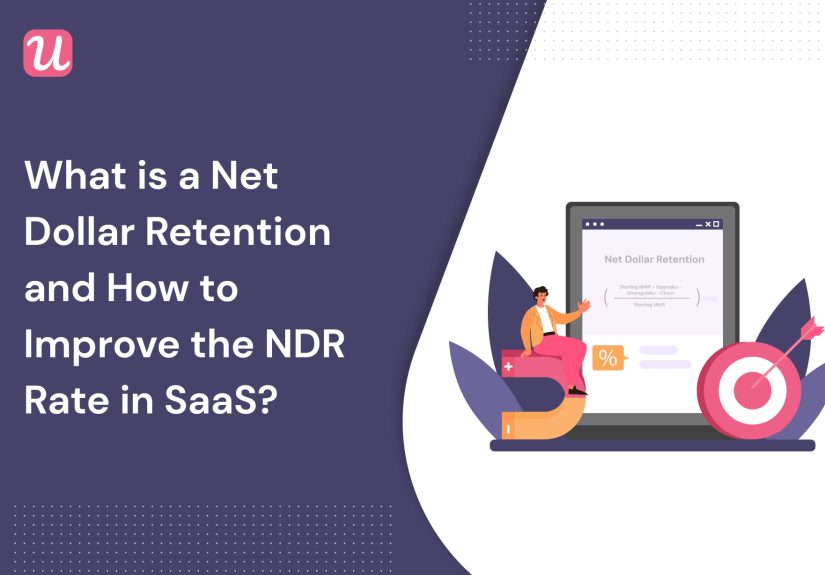
Net Dollar Retention measures the percentage of recurring revenue retained from existing customers over a period including expansion (upsells, cross-sells, seat growth, add-ons), and subtracting revenue lost from churn and contraction (downgrades).
You’ll also see it called:
- Net Revenue Retention (NRR)
- Net Dollar Retention (NDR)
- Net Retention (less specific, but usually the same idea)
Different companies use slightly different labels, but the spirit is the same: how well you keep and grow revenue from the customers you already have.
Why NDR matters (a lot) in SaaS
SaaS growth is often framed as “acquire more customers.” That’s trueuntil your churn starts acting like a hole in your boat. NDR matters because it answers a brutally practical question:
“If we stopped acquiring new customers for a while, would our revenue from existing customers still grow?”
NDR is a favorite among operators, boards, and investors because it connects directly to:
- Efficient growth: Higher NDR means more growth comes from customers you already paid to acquire.
- Product-market fit: If customers expand over time, they’re finding ongoing value.
- Forecast confidence: Stable retention makes planning less like reading tea leaves.
- Valuation and durability: Businesses that retain and expand revenue tend to be more resilient.
How to calculate NDR (with a simple formula)
NDR is usually calculated using MRR (Monthly Recurring Revenue) or ARR (Annual Recurring Revenue). Pick one and be consistent.
The standard NDR formula
Where:
- Starting Recurring Revenue: MRR/ARR from the same customer cohort at the beginning of the period
- Expansion: upgrades, add-ons, more seats, higher usage tier, cross-sells (from that same cohort)
- Contraction: downgrades, seat reductions, plan reductions (from that cohort)
- Churn: recurring revenue lost from customers who cancel (from that cohort)
Important: NDR uses a fixed cohort
NDR is calculated on the same group of customers you started with. That means:
- Do not include new customers acquired during the period.
- Be clear about rules for reactivations (customers who churn and come back). Many teams track reactivations separately to avoid “make-up churn.”
A quick NDR example (numbers you can sanity-check)
Imagine you start the quarter with $100,000 in ARR from a cohort of customers.
- Expansion ARR: +$20,000
- Contraction ARR: -$5,000
- Churned ARR: -$10,000
Interpretation: Even after churn and downgrades, your existing customers grew revenue by 5%. That’s the kind of math that makes SaaS leaders sleep better.
NDR vs. GRR vs. logo retention (don’t mix these up)
NDR is powerful, but it’s not the only retention metric worth tracking. Here’s how the common ones relate:
Gross Revenue Retention (GRR)
GRR measures how much revenue you keep without counting expansion. It’s basically retention on “hard mode.”
Why it matters: GRR reveals whether you’re losing dollars even if expansion is masking it.
Logo retention (customer retention)
Logo retention tracks the percentage of customers retained, regardless of spend. Losing one tiny customer and one massive customer both count as “one,” which is why it’s usefulbut incomplete.
So which one should you prioritize?
- NDR tells you whether customers expand faster than they churn.
- GRR tells you whether your core product value is sticky and durable.
- Logo retention tells you whether customers are staying at all.
Healthy SaaS businesses watch all threebecause you can “buy” NDR with expansion tactics, but you can’t fake long-term customer happiness.
What’s a “good” NDR rate in SaaS?
Benchmarks vary by customer segment, price point, and product type. A few rules of thumb commonly used in B2B SaaS:
- Below 100%: You’re shrinking within your existing base (not always fatal, but it’s a red flag).
- 100%–110%: Solid for many SMB/mid-market motions, especially early-stage.
- 110%–120%: Strongoften seen in healthy growth-stage B2B SaaS.
- 120%+: Excellentmore common in enterprise-focused products with expansion levers.
- 130%+: Best-in-class territory, usually with strong expansion mechanics and low churn.
Context matters: Higher ACVs (annual contract values) and enterprise accounts tend to produce higher NDR because expansion is easier through seats, departments, add-ons, and multi-year growth. Lower-priced SMB products can still be very successful with lower NDRespecially if acquisition is efficient and product-led adoption is strong.
What actually drives NDR up or down?
NDR is the net result of four forces in your customer base:
- Renewals: Do customers stay?
- Churn: Who cancelsand why?
- Contraction: Who stays but pays less?
- Expansion: Who pays more over time?
If you want to improve NDR, you don’t “optimize NDR.” You optimize the behaviors and systems behind those forces.
How to improve NDR in SaaS (a practical playbook)
Improving NDR is usually a mix of reducing churn, reducing contraction, and increasing expansion. Here’s the operator-friendly way to tackle it.
1) Fix churn at the source: onboarding and time-to-value
Most churn isn’t dramatic. It’s quiet. Customers don’t churn because your competitor had a nicer logo. They churn because they never reached a moment where your product became “obviously worth it.”
Practical improvements:
- Define time-to-value (TTV): What’s the first measurable outcome customers should achieve in the first 7–30 days?
- Build an onboarding path by persona: Admins, end-users, and executives don’t need the same journey.
- Instrument activation: Track the actions that correlate with retention (not vanity metrics).
- Make help unavoidable (in a nice way): In-app checklists, contextual tips, and nudges for key features.
2) Create customer health scoring (so risk doesn’t surprise you)
If you only discover churn risk when the cancellation email arrives, you’re playing defense with your eyes closed.
Build a simple customer health model using signals like:
- Product usage and feature adoption
- Seat utilization (paid vs. active users)
- Support tickets (volume and sentiment)
- Billing signals (failed payments, downgrades, pauses)
- Stakeholder engagement (QBR attendance, champion activity)
Then route actions: high-risk accounts get proactive outreach, training, or executive alignment before the renewal cliff appears.
3) Reduce contraction with packaging that matches value
Contraction is sneaky because customers “stay,” so it can look like a win. But contraction is often a symptom of misalignment: customers don’t see enough value in what they’re paying for.
Tactics that work:
- Right-size plans: Offer plans that fit real usage patterns (especially for seasonal or project-based customers).
- Improve seat utilization: If 50 seats are paid but 12 are active, the downgrade is coming. Fix adoption.
- Stop bundling everything: Bundle core value; sell specialized value as add-ons. Customers hate paying for what they don’t use.
- Introduce value metrics: Price around a metric customers associate with outcomes (seats, usage, volume, workflows, locations, etc.).
4) Build an expansion engine (without being “that” salesperson)
Expansion should feel like the customer’s idea. The trick is to tie growth to outcomes, not to awkward “Heyyyy so have you considered our Premium Deluxe Ultra?” emails.
Strong expansion programs usually include:
- Expansion triggers: usage thresholds, feature requests, growth milestones, team additions
- Lifecycle moments: 30/60/90-day check-ins, adoption reviews, business reviews
- Product-qualified leads (PQLs): identify accounts where usage suggests readiness to upgrade
- Land-and-expand packaging: low-friction entry plan, clear upgrade path, and measurable value at each tier
5) Make renewals boring (in the best way)
The goal is not to “win renewals.” It’s to make renewal a non-event because customers already got value.
Operational moves that improve retention outcomes:
- Start renewal conversations early: 90–120 days ahead for mid-market/enterprise
- Document success: capture outcomes, ROI anecdotes, and usage wins throughout the term
- Align stakeholders: don’t rely on one champion; build multi-threaded relationships
- Remove friction: smooth invoicing, clear terms, and minimal contract confusion
6) Use pricing as a lever (carefully, like handling hot coffee)
Pricing changes can improve NDR, but only if customers perceive added value. Random price hikes without clear justification are a speedrun to churn.
Smarter approaches:
- Value-based packaging: charge more for higher outcomes, not just more features.
- Grandfather selectively: protect strategic customers while modernizing pricing over time.
- Attach services thoughtfully: implementation, training, and premium support can increase success and expansion.
- Offer annual commitments: annual prepay or annual contracts reduce churn volatility and support planning.
7) Partner Customer Success and Sales (so customers don’t get whiplash)
NDR improves when customers feel supportednot shuffled between teams like a library book.
Practical alignment ideas:
- Define ownership: onboarding, adoption, renewals, expansion
- Use shared account plans and shared success metrics
- Align incentives so expansion doesn’t punish retention behaviors
- Create a clear handoff model (e.g., CS identifies value moments; sales executes commercial steps)
8) Segment your NDR (because averages lie)
Overall NDR can hide problems. You want to know:
- NDR by customer size (SMB vs. mid-market vs. enterprise)
- NDR by industry or use case
- NDR by acquisition channel
- NDR by product tier
- NDR by cohort month/quarter (so you can see whether improvements are sticking)
Segmentation turns NDR from a vanity metric into a diagnostic tool.
A 90-day plan to improve NDR (simple, not easy)
Days 1–30: Diagnose
- Calculate NDR, GRR, churn, contraction, expansion for the last 4–8 quarters
- Segment results by ACV, tier, industry, and tenure
- Interview churned and downgraded customers (patterns > opinions)
- Identify your activation and adoption drivers
Days 31–60: Stabilize retention
- Improve onboarding steps tied to time-to-value
- Launch a basic health scoring model and risk playbooks
- Fix top “paper cuts” that block adoption (UX friction, missing integrations, confusing setup)
- Standardize renewal timelines and customer success cadences
Days 61–90: Build expansion motion
- Define expansion triggers and lifecycle touchpoints
- Create upgrade paths that feel natural (packaging + in-product prompts)
- Train CS/AM teams on outcome-based expansion conversations
- Instrument reporting so you can see expansion drivers weekly, not “sometime next quarter”
Common mistakes that make NDR look better (but the business worse)
- Celebrating NDR while GRR is weak: expansion can mask a leaky bucket.
- Over-discounting renewals: you keep logos but lose dollarsand teach customers to wait you out.
- Letting customers overbuy seats: short-term ARR gains can turn into next-quarter contractions.
- Ignoring product adoption: expansion comes from value; value comes from usage.
- Using inconsistent cohort rules: if the definition changes every month, the metric becomes a mood.
Conclusion
Net Dollar Retention is more than a metricit’s a reflection of whether your SaaS is becoming more valuable over time to the people who already trust you. To improve NDR, focus on:
- Retention fundamentals: faster time-to-value, stronger onboarding, proactive risk management
- Contraction control: better adoption, better packaging, better alignment to value
- Expansion strategy: clear upgrade paths, lifecycle triggers, and outcome-based growth conversations
- Operational discipline: predictable renewals, clean billing, and segmentation that reveals the truth
Get those right, and your NDR becomes less like a scary report card and more like a growth engine that hums quietly in the backgroundlike a refrigerator that actually works.
Experience Notes: Real-World Patterns
Note: The “experiences” below are composite field patterns commonly reported by SaaS operators, customer success leaders, and revenue teams. They’re written as practical stories so you can borrow the lessons without needing the battle scars.
Experience #1: The “We Have Great NDR!” trap (until churn catches up)
A common pattern shows up in fast-growing SaaS companies: leadership celebrates an NDR above 110%, but when you look closer, GRR is slipping. What’s happening? Expansion is doing heroic work covering up churn and contraction. In the short term, the business still grows. In the long term, the company becomes dependent on a small portion of customers expanding aggressivelywhich is risky if budgets tighten or a competitor enters.
Teams that fix this typically do two things: (1) they make churn prevention an operating rhythm (health scoring, adoption programs, renewal timelines) and (2) they stop measuring success only in “new ARR won.” Once retention fundamentals improve, NDR becomes healthier because it’s built on stability, not on expansion “bailing out” losses.
Experience #2: Onboarding wasn’t broken… it was just not specific enough
Many teams think onboarding means “a welcome email, a kickoff call, and a few help docs.” Then they wonder why customers downgrade after month two. The breakthrough comes when onboarding is redesigned around one job-to-be-done per persona. For example, an admin’s success might be “integrations configured and permissions set,” while an end-user’s success might be “completed first workflow in under 10 minutes.”
Operators often report that tightening onboarding around measurable time-to-value increases early adoption, which reduces both churn and contraction. That alone can lift NDR even before an official expansion program existsbecause fewer accounts leak revenue early.
Experience #3: Expansion got easier when upgrades were framed as outcomes
One repeatable lesson: upsells feel gross when they’re presented as “more features,” but they feel natural when presented as “the next outcome.” For instance, customers who are hitting a usage threshold might be offered improved analytics, governance controls, or automationpositioned as the tools that unlock the next stage of results. In practice, teams create expansion triggers (usage spikes, team growth, new department interest, repeated feature requests) and connect those triggers to upgrade conversations with specific ROI narratives.
When this is done well, expansion becomes part of customer success rather than a surprise sales ambush. That tends to increase NDR because upgrades are rooted in real usage and perceived value (higher willingness to pay, lower churn risk).
Experience #4: Pricing and packaging changes improved NDRbut only after trust was earned
Pricing changes can increase NDR, but teams often learn the hard way that you can’t “math” customers into happiness. The best outcomes usually happen when packaging changes remove mismatch: customers stop paying for what they don’t use, and start paying for the value they actually get. One pattern is shifting from overly broad bundles to a clear core plan + outcome-based add-ons. Another is introducing a value metric customers already track internally (like active seats, workflows processed, or locations managed).
In these experience patterns, the companies that win communicate early, provide clear reasoning, and often pair pricing changes with product improvements or added services. The result is higher expansion revenue with fewer downgrade conversationsimproving NDR without damaging relationships.
Experience #5: The “boring renewals” goal changed everything
Finally, many SaaS teams report that NDR improves when renewals become operationally predictable. That typically means: renewal timelines start 90+ days ahead for larger accounts, success metrics are documented throughout the term, and champions are supported with internal ROI stories they can take to budget owners. The surprising effect is that smoother renewals also enable more expansionbecause customers aren’t in “defensive mode” about whether they should even stay.
Bottom line: The most consistent “experience” across successful SaaS teams is that NDR is a downstream result. When customers adopt, achieve outcomes, and trust your product’s value, expansion becomes easyand churn becomes rare.