Table of Contents >> Show >> Hide
- The Sign That Lit the Fuse
- When the Internet Smells Discrimination, It Brings Receipts (and Jokes)
- The Legal Reality Check
- Why This Was a Terrible Business Strategy (Even Before the Internet Got Involved)
- What a Smarter, More Human Business Would Do Instead
- So… Why Do People Still Do This?
- Extra Experiences & Lessons: When Exclusion Meets the Real World
There are bold marketing moveslike offering free coffee, launching a loyalty program, or finally admitting your store’s “mystery jar” is just loose screws.
And then there are the other bold marketing moveslike putting up a handwritten sign that basically says, “Hello, I would like fewer customers, please.”
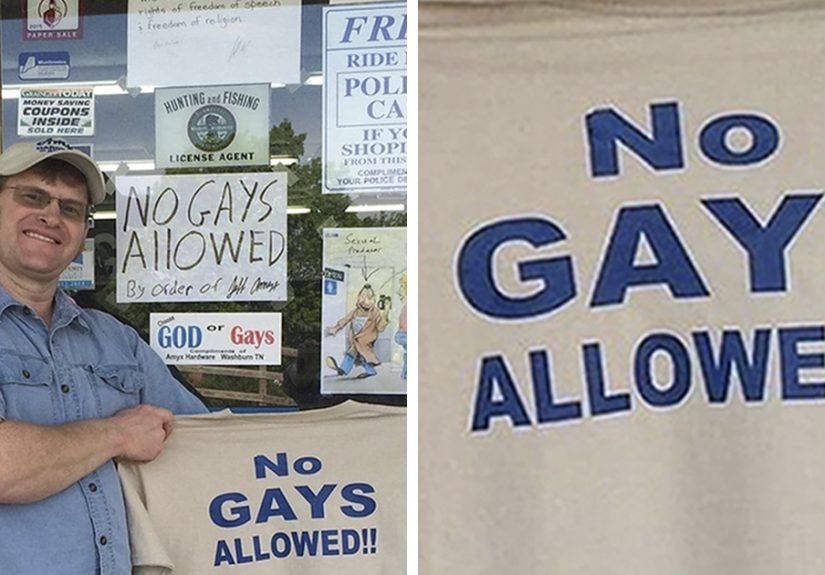
That second category is where this story lives. In a small Tennessee town, a hardware store owner decided to “take a stand” after major national court rulings related to same-sex marriage and LGBTQ rights.
Instead of, say, writing a strongly worded diary entry or venting to a perfectly innocent ceiling fan, he did what every PR professional advises you not to do:
he posted a sign implying gay people weren’t welcome.
And because we live in the age of screenshots, search results, and public reviews, the sign didn’t just hang there quietly.
It hit the internet like a cymbal crash in a libraryloud, attention-grabbing, and immediately followed by a lot of people saying, “Wait, why would you do that?”
The Sign That Lit the Fuse
The incident most commonly cited in coverage centers on a hardware store in eastern Tennessee whose owner, Jeff Amyx, posted a “No Gays Allowed” message around the time the U.S. Supreme Court’s
Obergefell v. Hodges decision (June 26, 2015) legalized same-sex marriage nationwide. In multiple reports, Amyx described the sign as a religious statement and said he didn’t agree with LGBTQ people’s “lifestyle.”
Timing matters (and not in a good way)
The “why now?” isn’t just triviait’s the whole engine of the story.
Obergefell was a watershed moment in American civil rights law. For millions of people, it meant dignity and legal security.
For a smaller subset of people, it apparently meant, “Time to buy a marker and a sheet of printer paper.”
In the earliest wave of coverage, the store owner reportedly swapped the blunt “No Gays Allowed” wording for a second sign that leaned on familiar phrases like “freedom of speech” and “freedom of religion,”
essentially reframing the message as: “We reserve the right to refuse service…” (which, notably, is still not the same thing as an all-purpose legal forcefield).
The “nicer” version that wasn’t actually nicer
If you’re wondering how you “soften” a sign banning a whole group of people, the answer (in this case) was:
add more words and sprinkle in constitutional vocabulary like it’s garlic powder.
Some write-ups described the update as making the message “nicer,” but the practical effect was basically:
“We’re not saying that… we’re saying this other thing that still lands the same way when you’re the person being targeted.”
Even commentators pointed out the obvious question: how would the store owner even know who is gay?
When the Internet Smells Discrimination, It Brings Receipts (and Jokes)
In 2015, the backlash was immediate: phone calls, national coverage, and public criticism.
But the part that made the story live forever in internet folklore came laterwhen the controversy re-surfaced and people responded the most modern way possible:
through search listings and reviews.
“Congratulations, you played yourself” the review era
By 2018, the sign story circulated again in the wake of the Supreme Court’s Masterpiece Cakeshop decision (June 4, 2018),
which many people misunderstood as “Businesses can refuse service to LGBTQ customers whenever they want.”
That’s not what the Court held; the opinion is far narrower and emphasizes case-specific issues about how the state process was handled, plus a broader expectation of respectful treatment of religious claims.
But nuance doesn’t trend as well as outrage.
As coverage spread, people began leaving negative reviews and mocking comments online.
The reaction included a mix of anger, sarcasm, and the uniquely 21st-century form of protest known as “I will now weaponize the star-rating system.”
Some posts referenced how the business was trolled through platforms like Yelp, and at one point it was even described as being miscategorized online (for example, briefly labeled something it definitely wasn’t),
because the internet will always choose petty comedy when handed a microphone.
To be clear: online mobs can be messy, and harassment is never admirable.
But this story became a case study in something businesses often forget:
if you publicly announce discrimination, the public will respond publicly.
Not quietly. Not politely. And definitely not in private.
Why “it backfired” is the understatement of the decade
The backfire wasn’t just “some people got mad.”
It was reputational gravity: once the story was searchable, it became part of the store’s identity.
Every time someone looked it upwhether to buy bolts, rent equipment, or find the nearest place that sells paint
the controversy could show up right alongside the phone number.
And that’s the real punchline: the sign was intended to draw a boundary around who “belongs.”
Instead, it drew a boundary around the store’s future. Because the internet doesn’t forget.
It screenshots.
The Legal Reality Check
Whenever a business owner says “freedom of religion” or “freedom of speech,” it’s worth pausing for a basic legal distinction:
the Constitution protects you from government action in many contextsbut it doesn’t automatically turn every private business decision into a protected right.
Public accommodations law is a patchwork
In the U.S., protections against discrimination in public accommodations (places like stores, restaurants, hotels) vary widely by state and locality.
Federal law clearly bans discrimination in public accommodations on certain grounds (like race), but explicit nationwide protections for sexual orientation and gender identity have historically depended on a mix of state laws,
local ordinances, and evolving interpretationscreating gaps that leave many LGBTQ people legally vulnerable depending on where they live.
That’s why these stories keep happening: not because discrimination is new, but because the rules aren’t uniform.
In some places, a discriminatory policy can trigger enforcement quickly.
In others, the bigger “penalty” is social and economic blowback.
What Masterpiece Cakeshop did (and didn’t) say
The Masterpiece Cakeshop decision is frequently invoked as a permission slip for discrimination.
But if you read the opinion, it’s more like a reminder that the government must apply laws in a way that is neutral toward religioneven while recognizing that LGBTQ customers should not be subjected to indignities in the marketplace.
Translation: it didn’t create a universal “No Gays Allowed” coupon that can be redeemed at any cash register in America.
It was fact-specific, and the Court explicitly signaled that future disputes would need further legal development.
Which is a very Supreme Court way of saying, “Stop trying to turn this into a bumper sticker.”
Why This Was a Terrible Business Strategy (Even Before the Internet Got Involved)
Let’s take the moral issue as settled: excluding LGBTQ people is wrong and harmful.
But even if you focus purely on business outcomes, the decision was still baffling.
A hardware store is not exactly a “boutique niche” industry.
Your customer base is basically: people who live near you and need stuff to fix things.
That’s everybody.
Small towns have long memories
In a small community, word travels fast. In the internet era, it travels faster and carries screenshots.
A sign like that doesn’t just alienate LGBTQ customers; it alienates:
- Friends and family of LGBTQ customers
- Allies who don’t want to spend money in a hostile space
- People who simply don’t want drama while buying a hinge
- Anyone who thinks “discrimination” is a weird brand identity
The Streisand effect, but with a price tag
This is a classic example of the Streisand effect: attempting to publicly assert control (over speech, behavior, or identity) ends up amplifying the very thing you’re trying to suppress.
The sign wasn’t just a local statementit became national content.
And once it’s national content, it becomes a permanent digital footprint. Long after the paper comes down, the screenshots keep circulating.
The “backfire” is that the store becomes searchable for the controversy first, and for the products second.
What a Smarter, More Human Business Would Do Instead
If you own a business, you don’t have to become a full-time activist.
But you do need to understand a basic reality: your store is part of the public life of your community.
People come in with different backgrounds, families, identities, and beliefs.
A business that wants to last doesn’t try to police who counts as “acceptable.”
A practical inclusion checklist (no corporate buzzwords required)
- Write a clear, welcoming service policy. One that protects staff safety without targeting identity groups.
- Train your team on de-escalation. Most conflicts are about behavior, not identity. Address behavior.
- Keep politics off the door. If you must make a statement, consider donating privately or supporting causes without turning your storefront into a battleground.
- Remember that “rights” are not a marketing plan. Legal arguments don’t replace empathy, and they don’t guarantee customer loyalty.
- Assume screenshots are forever. Because they are.
So… Why Do People Still Do This?
Because some people confuse “being allowed to say something” with “being insulated from consequences.”
In a free society, you can express unpopular views.
In a market economy, customers can decide they don’t want to fund those views.
The “hilarious backfire” part of this story isn’t that discrimination is funnyit’s not.
It’s that the attempt to gatekeep a basic public space (a hardware store!) was so self-defeating that the internet responded with the only tool it always has:
collective judgment delivered through the world’s pettiest megaphone.
Extra Experiences & Lessons: When Exclusion Meets the Real World
Stories like this hit a nerve because they rhyme with experiences a lot of LGBTQ peopleand their friends, families, and alliesrecognize instantly.
Maybe it wasn’t a literal “No Gays Allowed” sign. Maybe it was a bartender who suddenly “couldn’t find” a table for a same-sex couple.
Maybe it was a cashier who got weirdly quiet when two women paid together and said “wife.”
Or maybe it was the constant micro-math of deciding: Is this place safe? Will this be annoying? Should we just go somewhere else?
In other words, what looks like “one guy being edgy” is often experienced as part of a broader pattern: the feeling that ordinary errands can become identity tests.
And that’s exactly why the backlash can be so intense.
People aren’t just reacting to one sign; they’re reacting to the exhausting idea that a business gets to rank customers by whether the owner approves of their existence.
There’s also a second, less discussed side of the “internet backlash” coin: not every LGBTQ-related business controversy involves a discriminatory owner.
Sometimes, the target is an inclusive business that hosts a Pride event, supports drag artists, or simply puts up a rainbow decal that says, “You’re welcome here.”
Those businesses can get hit with misinformation, harassment, or coordinated outrageproof that the culture war doesn’t only punish exclusion; it also tries to punish inclusion.
In practice, that means many owners learn the same lesson from opposite directions: whatever you do, the internet can make it louder than you intended.
So what do communities do when a place openly signals exclusion?
Usually, three things happensometimes all at once:
- Customers vote with their feet. People quietly stop going. The business doesn’t always notice immediately, but revenue does.
This is the least dramatic response and often the most effective. It’s also the most realistic for people who don’t have time to argue with strangers while buying drywall anchors. - People warn each other. Group chats light up. Local Facebook pages circulate screenshots. Someone posts, “Heads upavoid this place.”
This isn’t “cancel culture” in a spooky abstract sense; it’s consumer self-defense. People want to know where they’ll be treated with basic decency. - Someone turns it into comedy. This is the part that looks “hilarious” from the outside.
Humor becomes a coping mechanism and a pressure valve: a way to say, “This is absurd” without writing an essay every time discrimination shows up.
Jokes and sarcasm are also a way to reclaim power in a situation designed to make someone feel small.
For business owners watching from the sidelines, the takeaway isn’t “be afraid of the internet.”
It’s: be clear about what kind of place you’re running.
If your brand is “anyone can come in and buy what they need,” then act like it.
If your brand is “I am going to publicly reject an entire group of people,” then understand you’re not just making a statementyou’re setting off a chain reaction you don’t control.
The most durable businesses tend to be the ones that keep the door simple: open, welcoming, and focused on serving customers.
Because at the end of the day, it’s a store. People are there for nails, paint, and a ladder they promise they’ll return.
Turning that into a referendum on human rights is a fast way to become famous for all the wrong reasons.