Table of Contents >> Show >> Hide
- The F-117’s Retirement Was Real, But Not Exactly Final
- What We Actually Know About the Nighthawk’s Desert Encore
- The Most Likely Jobs the Retired F-117A Is Doing
- Why Not Just Use the F-22 or F-35?
- Why the Desert Keeps Showing Up in This Story
- So, What Is the Retired F-117A Nighthawk Doing in the Desert?
- What It Feels Like When the Nighthawk Shows Up: The Desert Experience
- Conclusion
The F-117A Nighthawk was supposed to be enjoying a quiet retirement by now. You know, maybe a dignified museum life. A velvet rope. A few respectful dads whispering, “That thing changed air warfare.” Instead, the most famous angular jet in American aviation keeps popping up in the desert like a conspiracy theory with excellent maintenance support.
It is retired. Officially. It also keeps flying. Also officially. And that contradiction is exactly why the F-117 remains one of the most fascinating aircraft in the U.S. inventory, even though the Air Force stopped calling it an active combat platform years ago.
For aviation watchers, the mystery has become part of the appeal. Photographers catch Nighthawks slipping through California canyons, cruising near Nevada test ranges, or appearing in exercises where a supposedly retired aircraft has no business looking this operational. The photos are gorgeous. The details are sparse. The clues, however, are enough to build a smart, grounded theory about what this stealth legend is doing in the desert.
The short version: the retired F-117A Nighthawk is almost certainly serving as a low-observable test tool, a training asset, an aggressor stand-in, and a stealthy surrogate for targets that are hard to replicate with ordinary jets. In other words, the Nighthawk may no longer be leading combat raids, but it is still extremely useful for helping America prepare for the next war. Not bad for an airplane many people assumed had already taken its final bow.
The F-117’s Retirement Was Real, But Not Exactly Final
The F-117 entered service as the world’s first operational stealth aircraft, though calling it a “fighter” was always a little generous. This jet was built to sneak into heavily defended airspace, drop precision munitions on high-value targets, and leave before enemy radars fully understood what had just happened. It was a specialist, not a dogfighter. A ninja with bomb bays.
Its reputation was forged in secrecy and then polished in combat. The Nighthawk was publicly acknowledged in 1988 after years in the shadows, made its combat debut during Operation Just Cause in Panama, and became a household name during Operation Desert Storm. There, the aircraft’s stealth and precision helped it strike a huge share of the war’s most heavily defended strategic targets while flying a tiny slice of the total sorties. That performance gave the aircraft an aura that has never really faded.
Still, military aviation moves fast. By 2008, the Air Force retired the F-117 from combat service as newer stealth platforms matured and the mission set evolved. The aircraft were sent to Tonopah Test Range in Nevada, a location so well suited to mystery that it practically comes with its own soundtrack. Many assumed the remaining airframes would quietly disappear into history.
That is not what happened.
Instead of vanishing, the Nighthawk entered a peculiar second life. Some aircraft were demilitarized for museum display. Others, however, remained in flyable condition. Over time, sightings piled up. Then those sightings became more frequent, more open, and harder to dismiss as one-off anomalies. Eventually, official reporting and defense coverage made the situation clearer: the Air Force had not preserved the F-117 just for nostalgia. It had kept it because it still solved problems.
What We Actually Know About the Nighthawk’s Desert Encore
Plenty of internet chatter around the F-117 floats off into UFO-adjacent nonsense. The more grounded picture is much more interesting. Recent reporting indicates the Air Force expects to continue flying at least part of the F-117 fleet through at least 2034. That alone tells you this is not a casual heritage program. Nobody maintains a rare stealth aircraft for another decade just to make plane spotters happy.
We also know the Nighthawk has shown up in training environments well beyond the old secretive Nevada orbit. The aircraft has been observed in large-force exercises, including Northern Edge in Alaska. It has also been seen flying low-level routes in the California desert, sometimes in pairs, sometimes with unusual coatings or paint treatments, and sometimes alongside other aircraft or support assets that hint at specialized test work.
The Air Force and defense outlets have further tied the aircraft to research and development, test and evaluation, and training missions. That wording matters. It means the Nighthawk is no museum bird getting occasional stretch-the-wings privileges. It is a working asset used where its unique combination of stealth shaping, mature logistics, and relative expendability makes sense.
And that last point is key. Using an F-117 for certain experiments can be smarter than pulling high-demand F-22s, F-35s, or B-2-related assets into every exercise or developmental event. The Nighthawk offers a real low-observable aircraft without burning precious hours on frontline fleets that are more expensive, more limited, or more operationally tasked.
The Most Likely Jobs the Retired F-117A Is Doing
1. Playing the Bad Guy in Advanced Training
One of the strongest explanations is that the F-117 is being used as an aggressor or dissimilar stealth aircraft. In simple terms, it helps American pilots train against something that behaves more like a stealthy enemy platform than a normal fourth-generation fighter does.
That matters because modern air combat is increasingly defined by sensor management, signature control, low-observable tactics, and kill chains built around who sees whom first. A regular aggressor F-16 can teach many useful lessons. But it cannot truly mimic the detection challenges posed by a stealthier target. The F-117 can.
For this role, the Nighthawk does not need cutting-edge avionics. It needs the right kind of wrongness. It needs to be hard to detect, odd to track, and realistic enough to stress friendly radar operators, fighter pilots, and battle managers. That makes it perfect for exposing weaknesses in American tactics before an adversary does it for real.
2. Acting as a Surrogate for Low-Signature Cruise Missiles
This is one of the most compelling explanations for why the F-117 keeps appearing in training and test environments. Defense reporting has repeatedly connected the aircraft to work as a surrogate for stealthy cruise missiles or similarly low-signature airborne threats.
That role makes a lot of sense. A conventional fighter flying low and fast is not a great stand-in for a difficult-to-detect cruise missile. Its radar signature is too large, its behavior is too different, and the training value can quickly become unrealistic. In military terms, that is called negative training. In plain English, it means your drill is teaching the wrong lesson.
The F-117 helps fix that. It offers a platform with low observable characteristics that can simulate the challenge of finding and tracking something sneaky, especially at low altitude and in cluttered environments. If your air defense network can spot, classify, and engage an F-117-like problem, it is probably learning more than it would by swatting at a conventional jet pretending to be a cruise missile.
And in an era when long-range strike weapons, low-flying cruise missiles, and one-way attack systems are central to modern conflict, that training value is enormous.
3. Supporting Sensor, Radar, and Infrared Testing
The desert is not just beautiful in a rugged, “please bring extra water” way. It is also ideal for testing. Large restricted airspace, predictable weather, long sightlines, and established infrastructure make places around Nevada and California perfect for developmental work.
That is why the F-117’s desert flights are so suggestive. The aircraft has been seen with unusual paint schemes and even mirror-like coatings that sparked speculation about infrared signature reduction, sensor evaluation, or advanced tracking experiments. While the exact purpose of those finishes is not publicly confirmed mission by mission, the broader logic is sound: if you want to test how a radar, infrared search-and-track system, or other sensor handles a stealthy target, the F-117 is a very handy lab rat.
That may sound disrespectful to an iconic jet, but in defense circles, being a useful experimental platform is a compliment. The Nighthawk’s shape, age, and availability make it valuable for evaluating detection systems, refining tactics, and comparing how different sensors perform against low-observable aircraft under real conditions.
4. Helping With Tactics Development for Future Conflicts
The Air Force is preparing for a world where air defenses are denser, kill webs are faster, and targets are harder to hide from only if you are not being looked for by twelve different sensors at once. In that environment, stealth is still hugely important, but so is understanding how stealth works against real defenders, not just PowerPoint confidence.
The F-117 gives planners and tacticians a way to keep sharpening those lessons. It can support tests involving fighters, tankers, command-and-control networks, and surface-based sensors. It can appear in scenarios where friendly forces must find, track, and counter low-observable threats. It can also help build more realistic concepts for protecting air bases, ships, and ground formations against the sort of weapons and aircraft that define modern peer conflict.
Basically, the Nighthawk may be old, but it is still teaching very modern lessons.
Why Not Just Use the F-22 or F-35?
This is the obvious question. The United States has newer stealth aircraft. Better ones, in fact. So why keep an angular relic airborne?
Because the best tool is not always the newest tool.
Using frontline stealth fighters for every test event can be expensive, operationally disruptive, and sometimes unnecessary. The F-22 and F-35 are high-demand combat assets with training pipelines, readiness requirements, and finite service life considerations. The F-117, by contrast, is no longer a front-line combat jet. That makes it easier to use in specialized roles where a real stealth signature is valuable but the mission does not require the newest sensors or weapons.
Think of it like this: if you need to test how a goalie reacts to a wicked curveball, you do not need the world’s most expensive baseball launcher if the older machine still throws exactly the kind of nasty pitch you want.
The Nighthawk remains uniquely qualified for that kind of niche work. It is stealthy enough to matter, mature enough to understand, and rare enough to be useful without being irreplaceable in the same way as current operational fleets.
Why the Desert Keeps Showing Up in This Story
The desert is not just scenery. It is part of the plot.
Tonopah Test Range, Nevada training routes, and nearby restricted airspace have long been tied to the F-117 story. The aircraft grew up in secrecy there, and its afterlife has unfolded in the same broad region. That continuity is not accidental. The area offers security, infrastructure, and giant chunks of airspace where highly unusual aircraft activity can happen with relatively little public interference.
It also offers another benefit: mythology. The desert makes every F-117 sighting feel like a dispatch from another timeline. One second you are looking at rocky emptiness, and the next an aircraft shaped like weaponized geometry slices through the sky. No wonder photographers keep chasing it. The Nighthawk does not just fly through the desert; it fits the desert. It looks like something the landscape dreamed up after watching too many classified briefings.
But the romance should not distract from the practical truth. The desert is where the United States does some of its most important aviation experimentation. When the F-117 shows up there, the smart assumption is not “alien technology confirmed.” It is “the Air Force is working on something it considers worth protecting.”
So, What Is the Retired F-117A Nighthawk Doing in the Desert?
The most honest answer is still: not everything is public. The Air Force has revealed enough to confirm the aircraft’s active second life, but not enough to map every sortie or explain every odd coating, route, or pairing.
Still, the mystery is narrower than it used to be. The strongest evidence points to a bundle of missions rather than one single secret job. The retired F-117A Nighthawk is likely helping the Air Force and joint force train against stealthy threats, test detection and tracking systems, act as a surrogate for low-signature cruise missiles or aircraft, and support tactics development for future conflicts.
That may sound less cinematic than “black project superplane returns to battle,” but it is actually more meaningful. The Nighthawk is not hanging around because the Air Force is sentimental. It is hanging around because the airplane still creates value in problems where stealth, realism, and controlled experimentation matter.
In a way, that is the perfect ending for the F-117. Or perhaps the perfect non-ending. This jet was born in secrecy, matured in controversy, proved itself in war, and then refused to disappear on schedule. Even in retirement, it remains what it has always been: a specialist built for the edges of what the public is allowed to know.
What It Feels Like When the Nighthawk Shows Up: The Desert Experience
There is also an emotional side to this story, and it helps explain why every fresh F-117 sighting generates so much buzz. For people who follow military aviation, seeing a Nighthawk in the desert is not like seeing a random fighter overhead. It feels more like catching a ghost on a lunch break.
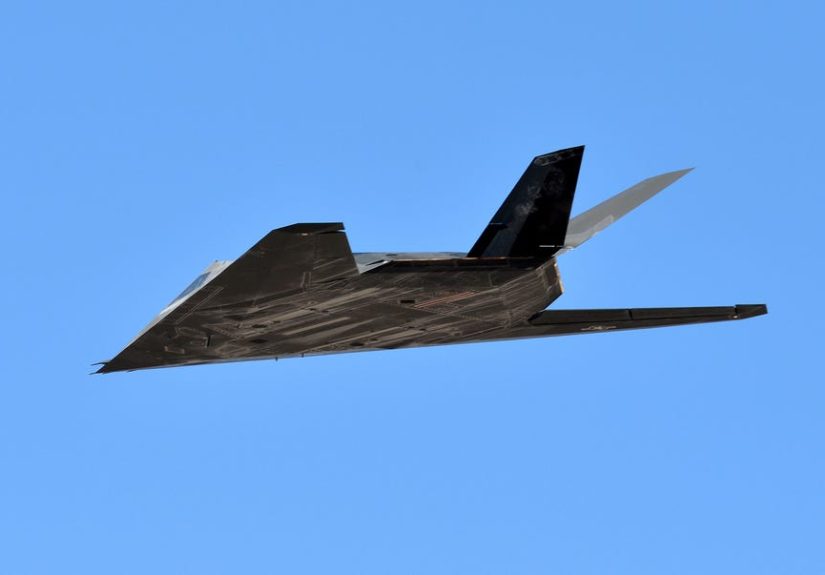
The experience starts with the setting. Desert air has a way of making everything look both crystal clear and slightly unreal. The mountains sit in layers. Heat shimmer bends the distance. Sound travels strangely. Then a dark shape appears where your brain expects a hawk, a cloud shadow, maybe a trick of the light. But the silhouette sharpens, and there it is: all sharp angles, split tail, and unapologetic weirdness.
Unlike many modern fighters, the F-117 does not look fast in the usual sense. It looks secret. That is different. Sleek aircraft advertise speed. The Nighthawk advertises intent. It seems less designed by aesthetics than by a committee of mathematicians who distrusted curves and probably had very good reasons. When it passes low over desert terrain, the effect is unforgettable. The aircraft feels out of time, as if a classified 1980s future escaped its filing cabinet and kept flying into the 2020s out of sheer stubbornness.
For spotters, the thrill is not only visual. It is interpretive. Every appearance becomes a puzzle. Why here? Why now? Why in that configuration? Why with that escort, that tanker, that route, that finish? The aircraft turns ordinary observation into detective work. A photo is never just a photo. It is a clue with jet exhaust.
There is also a deeper reason the Nighthawk still hits people so hard. It belongs to a phase of American airpower that felt almost mythic: hidden development, sudden revelation, and battlefield performance that seemed to confirm years of rumor. The jet became famous not simply because it was stealthy, but because it changed what “stealthy” meant in the public imagination. It looked like tomorrow before most people had even finished understanding yesterday.
That emotional residue lingers. So when a retired F-117 appears over canyon walls or desert ridgelines, it does not merely trigger nostalgia. It bridges eras. You are seeing Cold War ingenuity, Gulf War legend, post-retirement adaptation, and future-oriented testing all at once. Very few aircraft can do that.
Maybe that is why the F-117’s afterlife feels so appropriate. A normal retirement would have dulled the mythology. This half-visible, half-explained desert existence preserves it. The Nighthawk remains useful, yes, but it also remains itself: elusive, angular, and just secret enough to keep people looking up a little longer than usual. For an airplane built to avoid being seen, that is a pretty funny legacy.
Conclusion
The retired F-117A Nighthawk is doing something in the desert, all right. Probably several somethings. The evidence suggests an aircraft that has traded headline-grabbing strike missions for a quieter but still crucial role in training, testing, and preparing the U.S. military for low-observable threats. It is no longer the star of opening-night bombing campaigns, but it may still be helping write the playbook for how America detects, tracks, and defeats stealthy threats in the future.
That is a remarkable second act. Most aircraft retire into memory. The Nighthawk retired into relevance.