Table of Contents >> Show >> Hide
- Why the Mona Lisa Is the Ultimate Remix Material
- The Original Mona Lisa: A Quick Look at What Artists Keep “Borrowing”
- How a Portrait Became a Global Celebrity (and a Magnet for Parody)
- Meet the Reimaginers: What “Nearly 300 Artists” Really Reveals
- The 7 Most Common “Innovation Lanes” in Mona Lisa Reinterpretations
- 1) The Dada/Parody Lane: “Respectfully… no”
- 2) The Pop Art Lane: celebrity meets consumer culture
- 3) The Street Art Lane: the museum escapes to the wall
- 4) The Identity Lane: “What if she looked like me?”
- 5) The Surreal Lane: the smile becomes a portal
- 6) The Tech Lane: pixels, AR, AI, and the modern “copy machine”
- 7) The Activism Lane: iconic image, loud message
- What a “300-Artist Mona Lisa” Exhibit Would Feel Like
- How to Create Your Own Mona Lisa Reimagining (Without Copy-Pasting Your Way Into Boredom)
- The Bigger Meaning: Why We Keep Reimagining the Same Smile
- Experiences: What It’s Like to Live in a World Full of Mona Lisas (500+ Words)
- Conclusion
The Mona Lisa has a superpower. Not the “laser eyes” kindmore like the “I can walk into any room, any century, any Wi-Fi signal, and still be the main character” kind. She’s a 16th-century portrait painted on a wood panel, yet she’s also a pop icon, a meme template, a protest backdrop, a fashion print, a street mural, and an endless excuse for artists to say, “Okay, but what if she had… a mustache? Neon skin? A galaxy for hair? A barcode?”
This is the story of how one painting became the world’s favorite canvas for reinventionand what it looks like when nearly 300 innovative artists take turns remixing the same mysterious smile. We’ll dig into what makes the original portrait so “remixable,” trace the cultural moments that turned it into a global celebrity, and explore the creative categories that show up again and again when artists reinterpret it. Along the way, you’ll get concrete examples, curatorial ideas, and practical tips if you want to try a Mona Lisa reimagining yourselfwithout turning your studio into a museum security incident.
Why the Mona Lisa Is the Ultimate Remix Material
1) The face is simple enough to recognize… and complex enough to argue about
The Mona Lisa’s features are instantly identifiable: the half-smile, the calm gaze, the soft edges, the dark clothing, the hands folded like they’re politely waiting for your next hot take. But that simplicity is deceptive. People debate her mood, her identity, and even what’s happening in the background landscape. When an image contains mystery, artists smell opportunity.
2) It sits at the intersection of “high art” and mass reproduction
The Mona Lisa is museum royalty, but she’s also been reproduced for centuriesfirst through prints and postcards, then through magazines, advertising, television, and now the internet’s infinite scroll. When an artwork becomes widely reproduced, it becomes a shared language. And shared language gets remixed.
3) It’s old enough to be “public domain famous,” but modern enough to be “culture famous”
Leonardo da Vinci’s painting is centuries old, which means it lives in the cultural commons of human imagination. Yet its celebrity is profoundly modernshaped by media coverage, museum tourism, and pop culture moments. That blend makes it feel both sacred and available. Artists love that tension: reverent one minute, rebellious the next.
The Original Mona Lisa: A Quick Look at What Artists Keep “Borrowing”
Before we talk reinvention, it helps to know what gets reinvented. Most Mona Lisa reinterpretations “sample” a few core elements:
- The smile: subtle, ambiguous, and strangely personallike she knows your browser history but isn’t judging… out loud.
- The eyes: direct enough to feel like a conversation, calm enough to feel like a riddle.
- The soft transitions (sfumato): edges and shadows that melt rather than stop, giving the face a lifelike haze.
- The hands and posture: a quiet composure that artists can either honor or completely disrupt.
- The background: a dreamlike landscape that invites reinterpretation, relocation, and occasional alien invasion.
Even if an artist changes everything elseskin tone, style, era, mediumthese “anchors” often remain. They’re the visual shorthand that tells viewers: “Yes, this is still her.”
How a Portrait Became a Global Celebrity (and a Magnet for Parody)
Plenty of masterpieces exist. Very few become celebrities. The Mona Lisa’s fame didn’t come from technique alone; it came from events that shoved the painting into public conversation at scale. One of the biggest turning points was the early 20th century, when the painting became a headline and a spectacle rather than “just” a revered artwork.
From there, the feedback loop kicked in: when people talk about the Mona Lisa, more people want to see it; when more people want to see it, more people reproduce it; when it’s reproduced everywhere, more artists feel free to play with it; and every clever parody makes the original even more famous. It’s the rare cultural phenomenon that gets stronger every time it gets copied.
Meet the Reimaginers: What “Nearly 300 Artists” Really Reveals
The phrase “The Mona Lisa Reimagined by nearly 300 artists” isn’t just a dramatic headlineit’s also a clue: when you collect hundreds of reinterpretations in one place, patterns emerge. A large compilation of Mona Lisa-inspired artworks (spanning both established and emerging creators across many countries and styles) highlights one big truth: artists don’t remix the Mona Lisa because they ran out of ideas; they remix it because the Mona Lisa can hold almost any idea.
When a single subject can survive that much stylistic pressurecubism, graffiti, pixel art, collage, surrealism, minimalism, hyperrealism, parody, political commentaryit’s not just famous. It’s structurally flexible. The Mona Lisa is like the jazz standard of visual culture: the melody is recognizable, but the solos can go anywhere.
The 7 Most Common “Innovation Lanes” in Mona Lisa Reinterpretations
If 300 artists reimagine the Mona Lisa, you don’t just get 300 random results. You get clustersrecurring creative strategies. Here are the lanes that show up repeatedly in Mona Lisa-inspired art, with specific examples of how artists tend to approach each one.
1) The Dada/Parody Lane: “Respectfully… no”
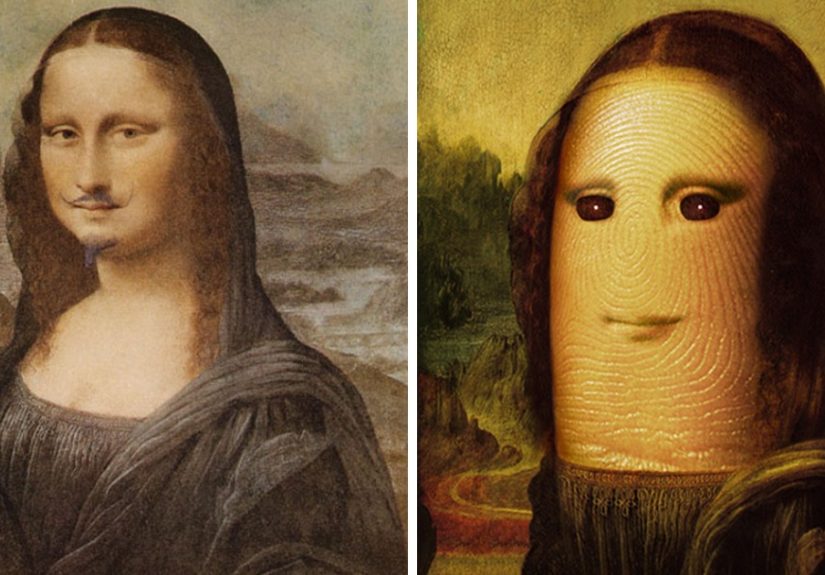
One of the most famous Mona Lisa interventions in modern art history is the prankish, pointed kind: take a revered icon and disrupt it. The logic is simple: if society treats an image like a relic, the artist tests what happens when you poke the relic. The result can be funny, uncomfortable, or bothoften on purpose.
2) The Pop Art Lane: celebrity meets consumer culture
Pop artists saw the Mona Lisa not just as “art history,” but as a brandan image recognized the way movie stars are recognized. That recognition is the raw material. Pop-inspired reimaginings often use repetition, bold color shifts, and commercial aesthetics to ask: When does a portrait become a logo?
3) The Street Art Lane: the museum escapes to the wall
Street and mural artists love the Mona Lisa for one reason: she’s instantly legible from across the block. In public spaces, speed matters; viewers don’t have time to decode a subtle reference. A street-style Mona Lisa often mixes classic composition with spray-paint textures, stencils, and urban symbolsturning “museum quiet” into “city loud.”
4) The Identity Lane: “What if she looked like me?”
Many creators reimagine the Mona Lisa to explore identityrace, gender expression, disability, age, or cultural heritage. The point isn’t just representation; it’s critique. If the world treats one face as the default “most famous,” then reimagining that face becomes a way to challenge who gets centered in cultural memory.
5) The Surreal Lane: the smile becomes a portal
Surreal interpretations often treat the Mona Lisa as a doorway to the subconscious. The background turns into a dream landscape; the figure dissolves into symbols; the smile becomes something cosmic, uncanny, or deliberately impossible. These works lean into the painting’s inherent ambiguity: if we can’t fully pin down what she’s thinking, she can be made to think anything.
6) The Tech Lane: pixels, AR, AI, and the modern “copy machine”
Today’s most innovative Mona Lisa reimaginings often happen through technology: digital collage, glitch aesthetics, animation, augmented reality filters, generative tools, and interactive installations. The fascinating twist is that this mirrors the Mona Lisa’s historical path to fame: mechanical reproduction helped make her a mass icon, and now digital reproduction keeps reinventing her for the next audience.
7) The Activism Lane: iconic image, loud message
Because the Mona Lisa is globally recognizable, it has also been pulled into activism and protest culturesometimes symbolically, sometimes literally as a target of attention. The image functions like a cultural megaphone: attach a message to it, and the world looks. Many artists translate that dynamic into works that comment on climate, food systems, politics, surveillance, or consumerismwithout needing viewers to recognize a niche reference.
What a “300-Artist Mona Lisa” Exhibit Would Feel Like
Imagine walking into a gallery where every wall is a different Mona Lisa: one is hand-stitched textile; one is a neon sign; one is a minimalist line drawing; one is made of recycled plastic; one looks like a comic panel; one is a hyperreal painting that feels like it’s breathing; one is a glitchy animated loop; one is a mural-sized reinterpretation that turns her into a neighborhood guardian.
The experience wouldn’t just be visualit would be psychological. You’d notice how quickly your brain recognizes “Mona Lisa-ness,” even when the medium changes. You’d also notice how your emotions change depending on the style: a pop version might make you smile; an identity-focused version might make you reflect; an activism version might make you uncomfortable in the useful way.
A show like this also proves a curatorial point: the Mona Lisa isn’t one image in culture anymore. She’s an ecosystem of imageseach reinterpretation adding a new branch to the tree.
How to Create Your Own Mona Lisa Reimagining (Without Copy-Pasting Your Way Into Boredom)
Want to make a Mona Lisa-inspired piece that feels fresh? Don’t start by asking, “How do I draw her?” Start by asking, “What question do I want her to carry?”
Pick one constraint that forces originality
- Medium constraint: only paper cutouts, only found objects, only embroidery, only chalk, only 8-bit pixels.
- Time constraint: a 30-minute sketch sprint that prioritizes bold decisions over perfection.
- Theme constraint: translate “mystery” into a modern contextprivacy, identity, AI, fame, mental health, climate.
- Palette constraint: use only two colors, or invert the lighting scheme, or move the portrait into neon night.
Decide what stays recognizable
Keep one “anchor” (smile, hands, gaze, silhouette) and radically transform everything else. This creates a strong link to the original without trapping you in imitation.
Say something about fame itself
The Mona Lisa isn’t just a portrait; it’s a celebrity portrait with no publicist. Consider building your piece around modern fame: crowds, cameras, selfies, brand culture, algorithmic attention, or the strange pressure to “see the famous thing” rather than actually look at it.
The Bigger Meaning: Why We Keep Reimagining the Same Smile
The Mona Lisa reimagined isn’t merely an art trendit’s a cultural habit. Reinterpretations reveal how each era talks to the past: sometimes with reverence, sometimes with satire, sometimes with activism, sometimes with pure play.
And maybe that’s the secret. The Mona Lisa survives every remix because the original already contains a kind of openness. Her expression isn’t a single emotion; it’s a spectrum. That gives artists permission to project, question, joke, remix, and rebuild. In a world that changes fast, returning to a familiar icon can be groundingand changing it can be liberating.
Experiences: What It’s Like to Live in a World Full of Mona Lisas (500+ Words)
Spend a day paying attention to how the Mona Lisa shows up in modern life, and you’ll start to feel like you’re in a friendly (and slightly unhinged) multiverse. It might begin innocently: you see a tote bag with her face on it, or a social post that uses the Mona Lisa as a punchline for “me pretending I’m fine.” Then you notice the deeper layersthe way people use her image to signal “culture,” “mystery,” “wealth,” “taste,” or simply “I have seen the internet.”
In museums, the Mona Lisa experience is often described less like quiet contemplation and more like witnessing a celebrity in public. People line up, phones rise like a field of metallic flowers, and the painting becomes both the destination and the backdrop. Even when viewers only catch a brief glimpse, they often walk away with a story: “I saw her.” That story is part of her power. It’s not just about the artwork; it’s about participating in a global ritual of recognition.
Now imagine stepping out of that crowd and into a room filled with reinterpretationsdozens, then hundreds. The feeling changes immediately. Instead of “I must see the original,” it becomes “I get to see what people do with the original.” You start spotting creative decisions like a game: Which artist kept the smile but changed the eyes? Who preserved the hands but turned the figure into a robot? Who moved the portrait into a modern city and swapped the background for skyscrapers, freeways, or a subway map? With enough versions, you realize the Mona Lisa can act like a mirror: each remake reflects the artist’s world more than Leonardo’s.
For creators, making a Mona Lisa-inspired work can be surprisingly personal. The first draft often feels like a joke“What if she wore sunglasses?”but the longer you sit with it, the more it becomes a conversation with your own taste and values. Many artists describe a turning point where the piece stops being “a reference” and becomes “a statement.” A collage version made from receipts and packaging suddenly turns into commentary on consumer culture. A Mona Lisa built from recycled materials turns into a quiet protest. A portrait that reimagines her as an older woman becomes a meditation on aging and visibility. The icon is the entry point, but the meaning is yours.
Even if you’re not an artist, you can try a low-stakes Mona Lisa experience at home: pick one everyday materialsticky notes, magazine scraps, embroidery thread, grocery bags, digital stickersand build a simple reinterpretation in under an hour. The goal isn’t to “improve” the Mona Lisa (good luck arguing with 500 years of hype); it’s to understand why she’s so adaptable. When you finish, you’ll likely feel two things at once: (1) you made something recognizable, and (2) you made something that couldn’t have existed without your specific moment in time. That’s the entire point of reimagining.
The strangestand bestpart is how quickly the exercise trains your eyes. After you’ve seen enough remixes, you’ll start noticing design choices everywhere: the curve of a smile in an ad, the three-quarter pose in a fashion photo, the soft shadow transitions in a movie close-up. The Mona Lisa isn’t just a painting you look at; it’s a visual vocabulary that helps you read the world. And once you realize that, the “300 artists” idea stops sounding like a gimmick and starts sounding inevitable. Of course hundreds of people would reinterpret her. She’s the most famous invitation in art history: “Here’s a face. Tell me what it meansnow, in your language.”
Conclusion
“The Mona Lisa Reimagined By 300 Most Innovative Artists” is more than a catchy conceptit’s proof that cultural icons don’t stay still. They evolve through repetition, parody, admiration, critique, and play. The original portrait remains a technical marvel and a historical artifact, but its modern life is something bigger: a shared canvas that lets each generation test what it values, fears, laughs at, and dreams about.