Table of Contents >> Show >> Hide
- How a rights battle created Bond’s strangest detour
- The unmade version that almost went full supervillain circus
- Why Never Say Never Again still feels like an alternate-universe Bond
- Why the Austin Powers comparison actually fits
- The bigger irony: Austin Powers helped save Bond
- Was the world robbed of a glorious disaster?
- Conclusion
- The Viewing Experience: Why This Story Still Feels So Much Fun to Revisit
- SEO Tags
James Bond has survived supervillains, sharks, lasers, bad puns, worse disguises, and enough tailored tuxedos to bankrupt a small nation. But one of the strangest threats to 007 did not come from Blofeld, Goldfinger, or a man with a third nipple. It came from his own reflection in the funhouse mirror. Long before Austin Powers turned Bond-style excess into an international punchline, one James Bond project was already flirting with the kind of wild, campy spectacle that would later make Mike Myers look almost restrained.
That movie was Never Say Never Again, or more accurately, the even crazier version of it that almost happened before cooler heads, legal limits, and probably at least one horrified studio executive stepped in. The finished 1983 film is already one of the oddest entries in Bond history: unofficial but still unmistakably Bond, familiar yet off-brand, and powered by Sean Connery’s return so thoroughly that it sometimes feels like the movie exists because his eyebrows alone refused to retire. But the abandoned concept behind it was something else entirely. Think Bond, but with a fever dream. Think Bond, but with the volume knob snapped off. Think Bond, but one bad decision away from becoming self-parody years before self-parody became profitable.
How a rights battle created Bond’s strangest detour
To understand why Never Say Never Again feels like a parallel-universe 007 adventure, you have to start with the messy history of Thunderball. Producer Kevin McClory had long-standing rights tied to the story, which opened the door for a separate Bond adaptation outside the official Eon series. That legal wrinkle is why Sean Connery could return as Bond in 1983 even while Roger Moore was still the official 007 in Eon’s Octopussy. For Bond fans, it was like watching two parallel timelines collide in a tuxedo store.
On paper, that alone was irresistible. Connery was back. The original Bond, the man whose mixture of menace, wit, and cool had defined the cinematic template, was stepping into the role again after more than a decade away. The title itself was a wink at his old promise that he would “never again” play the part. Very cute. Very sly. Very Bond. But behind that playful title was a production story with enough complications to fill its own mini-series.
The key problem was simple: if this off-brand Bond project was going to exist, it had to remain close enough to Thunderball to stay within the legal boundaries of what could actually be made. That matters because some early ideas went charging far beyond “updated remake” and straight into “who gave this script espresso and fireworks?” territory.
The unmade version that almost went full supervillain circus
This is where the legend gets deliciously weird. Before Never Say Never Again settled into the movie audiences eventually saw, there was an earlier development phase often associated with the title Warhead. That version has become catnip for Bond historians because the descriptions make it sound less like a traditional 007 thriller and more like an over-caffeinated brainstorm session held inside a volcano lair.
Among the details that have circulated for years are mechanical sharks carrying bombs, outlandish large-scale action, and a climactic helicopter battle involving the Statue of Liberty. That is not a typo. It is also the kind of imagery that makes you understand, instantly and involuntarily, why people later described the project as “more Austin Powers than Austin Powers.” If you are picturing Dr. Evil nodding in approval while muttering, “Finally, someone gets me,” you are not alone.
And that is the joke at the center of this whole saga: the version of Bond that Austin Powers would later mock so brilliantly was already hiding inside Bond itself. The parody did not invent those tendencies. It only put brighter lights on them. A giant villain plan, killer sea creatures, an absurdly oversized finale, and a total refusal to believe the word “enough” applies to spy cinema? That is not anti-Bond. That is Bond with the safety rails removed.
Thankfully or tragically, depending on your appetite for glorious nonsense, those wilder ideas did not make it intact to the screen. Legal concerns and practical realities pushed the production toward something closer to a revamped Thunderball. So the world never got the fully unleashed version. We got the compromise. But even the compromise was still plenty strange.
Why Never Say Never Again still feels like an alternate-universe Bond
The finished film is not an all-out spoof. In fact, one reason it remains surprisingly watchable is that it often tries to play things straighter than its reputation suggests. Connery is older, but he is not a joke. The movie actually leans into his age, which gives Bond a slightly more seasoned, more tired, and occasionally more human edge. That was unusual for the franchise at the time and, in some ways, ahead of its moment.
But the movie also cannot escape its own oddness. It has different versions of familiar Bond fixtures. It has the energy of a franchise cover band that somehow hired the original lead singer. It has moments of cleverness right next to choices that make you blink twice and check whether you accidentally changed channels. The famous video game duel between Bond and Largo is a perfect example. It is ambitious, memorable, and deeply, wonderfully weird. It feels like Bond wandered into an expensive arcade and decided espionage could wait five minutes.
Then there is Barbara Carrera’s Fatima Blush, who storms through the movie like she has personally declared war on subtlety. She is flamboyant, theatrical, dangerous, and so perfectly pitched for a heightened Bond adventure that she almost feels like a character from the spoof of a Bond movie that had not been made yet. In another timeline, Austin Powers absolutely steals her homework.
That tension is what makes Never Say Never Again so fascinating. It is not a disaster in the fun, train-wreck way some bad franchise entries are. Nor is it a lost masterpiece. It is something more interesting: a Bond movie that keeps revealing how unstable the franchise formula can become when separated from its usual machinery. Connery gives it gravity. The surrounding movie keeps trying to float away like a rogue weather balloon.
Why the Austin Powers comparison actually fits
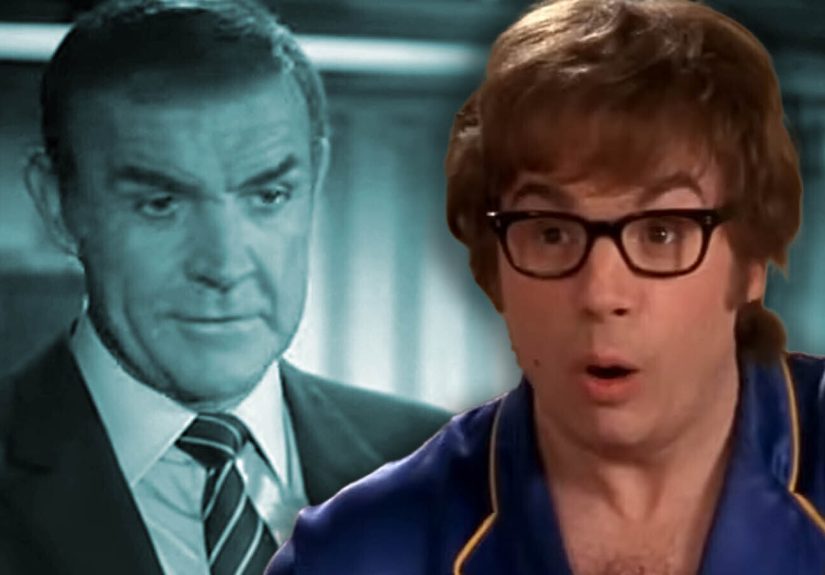
At first glance, comparing a 1983 Sean Connery thriller to Austin Powers sounds like a cheap joke. Austin is a broad comedy character with bad teeth, impossible confidence, and the fashion judgment of a lava lamp. Bond is Bond. But once you look past the tone, the comparison makes perfect sense.
The Austin Powers films worked because they did not create Bond absurdity out of thin air. They extracted it. They studied the old spy-movie grammar, found the most exaggerated pieces, and turned them up until audiences could no longer pretend they were not ridiculous. Villain monologues. Phallic rockets. gadget worship. impossible seduction. secret bases designed by people who clearly hated practicality. That material was already sitting there in the Bond canon wearing a tux and asking for a martini.
Never Say Never Again, and especially the abandoned wilder version behind it, shows just how narrow the border is between “classic Bond fun” and “this should end with a disco sting.” The line is not as firm as nostalgia likes to claim. One more mechanical shark. One more indulgent set piece. One more villain flourish. Suddenly Bond is one shagadelic catchphrase away from becoming his own parody.
That is why the phrase “more Austin Powers than Austin Powers” lands so well. It is funny, yes, but it is also diagnostic. It captures a real truth about Bond’s DNA: the franchise has always balanced danger and silliness, cool and camp, elegance and excess. When that balance goes off, the movies can become unintentionally hilarious. Never Say Never Again was perilously close to tumbling down that staircase in extremely expensive shoes.
The bigger irony: Austin Powers helped save Bond
Here is where the story gets even better. Austin Powers did not just lampoon Bond. In a weird, indirect, deeply cinematic act of tough love, it forced Bond to evolve. By the time the Pierce Brosnan era reached Die Another Day, the franchise had drifted toward flashy gadgetry, exaggerated villains, and enough tonal excess to make even longtime fans raise an eyebrow. Then along came the hard reset.
When Daniel Craig took over in Casino Royale, the franchise deliberately pulled away from the old playbook. The gadgets were scaled back. The tone was grounded. The bruises looked like they actually hurt. Craig himself famously said there was an “Austin Powers alarm” on set, which is one of those quotes so perfect it should come with its own brass plaque. The producers also spoke about the need to bring Bond “back to Earth,” which was studio-speak for “perhaps invisible cars were a sign that we should sit down for a moment.”
So the strangest twist in this whole saga is that Bond’s near-slip into self-parody, and Austin Powers’ gleeful exposure of the franchise’s campy underbelly, helped create the conditions for one of the greatest Bond reinventions ever. In that sense, Austin Powers did not kill Bond. It scared Bond into cardio, better tailoring, and emotional realism.
Was the world robbed of a glorious disaster?
Possibly. There is a strong argument that the unmade, ultra-bonkers version of this project would have been terrible. There is an equally strong argument that it would have been unforgettable. Not “good” in the polished, prestige-franchise sense. More like the kind of movie people force their friends to watch at midnight while shouting, “No, wait, you have to see the shark part.”
And maybe that is the real reason this story still has so much charm. It represents the road not taken, the Bond movie that would have exposed the franchise’s excesses from inside the house instead of waiting for Mike Myers to show up with a grin and a velvet suit. It would have been ridiculous. It might also have been weirdly prophetic. Because once you know what Bond eventually had to do to survive, the idea of a pre-Austin Powers Bond project accidentally becoming the ultimate Austin Powers setup feels less like trivia and more like destiny with a raised eyebrow.
Conclusion
Never Say Never Again remains one of the most curious corners of James Bond history: unofficial but significant, uneven but never boring, and permanently haunted by the even wilder movie it almost became. The abandoned Warhead-style ideas reveal just how close Bond came to tipping into self-caricature under his own power. That is what makes the “more Austin Powers than Austin Powers” label so satisfying. It is not just a joke about excess. It is a reminder that parody often works best when the original is already halfway there.
In the end, this almost-Bond oddity did not break the franchise. It exposed it. It showed how fragile the line between suave escapism and absurd spectacle really is. And years later, when Austin Powers kicked that line wide open, Bond had no choice but to reinvent himself. Strange as it sounds, one of the weirdest detours in 007 history helped explain why the future of Bond had to get tougher, leaner, and a lot less interested in frickin’ sharks with frickin’ anything attached to their heads.
The Viewing Experience: Why This Story Still Feels So Much Fun to Revisit
One reason this topic keeps pulling people back in is that it offers two pleasures at once. First, there is the history lesson. Fans get to peek behind the velvet curtain and see that the Bond machine was never as smooth and inevitable as it looked from the audience. There were rights disputes, rival productions, abandoned scripts, creative grudges, and giant “what if?” moments. That alone makes the story entertaining. It turns Bond history into something almost as suspenseful as Bond fiction.
Second, there is the pure viewing experience of imagining what this nearly-made version would have felt like on screen. Even people who have never seen Never Say Never Again can understand the delight of hearing about robot sharks, oversized finales, and a Bond concept that sounds one costume fitting away from becoming a luxury camp opera. It is the kind of material that makes movie lovers lean forward. You start with curiosity and end with a grin. Not because it sounds classy, but because it sounds gloriously, unapologetically excessive.
For longtime Bond viewers, the experience is even richer. Watching the official series often means learning to love its contradictions. Bond is cool, but he is also ridiculous. He is elegant, but sometimes the movies are one-liners stitched to explosions. He is a fantasy of control in stories that can go completely off the rails. Revisiting a project like this puts those contradictions right on the table. It lets fans enjoy the franchise with both affection and perspective. You can admire the mythology and laugh at it in the same breath, which is honestly the healthiest possible relationship to a long-running movie series.
There is also something oddly satisfying about seeing how close major franchises come to wild mistakes. Modern blockbusters often feel over-managed, over-tested, and polished within an inch of their lives. But older franchise history is full of near-misses, strange bets, and giant ideas that sound impossible until someone in a boardroom says, “Well, maybe.” That gives this Bond story a kind of rough, human texture. It reminds us that iconic movie brands are not built by destiny. They are built by people making questionable decisions in expensive offices.
And then, of course, there is the Austin Powers effect. Once you know how heavily that parody drew from Bond, every bizarre detail starts feeling twice as funny. You are no longer just hearing about an abandoned Bond concept. You are hearing about an alternate reality in which the source material got to the joke before the parody did. That flips the whole story from interesting to irresistible. It becomes a cinematic chicken-and-egg puzzle: was Bond becoming self-aware, or was he just one outrageous set piece away from accidentally inventing his own spoof?
That is why the experience of revisiting this subject feels so rewarding. It is not just about deciding whether Never Say Never Again was good, bad, underrated, or deeply odd. It is about seeing the franchise from a new angle. It is about recognizing that Bond’s greatness has always depended on balance. Too serious, and the films lose their sparkle. Too silly, and they drift into costume-party territory. This nearly “more Austin Powers than Austin Powers” chapter is fascinating because it shows Bond wobbling right on that line, martini in hand, trying not to spill.
For movie fans, that kind of story never gets old. It has history, ego, camp, reinvention, legal chaos, and just enough almost-happened madness to make the whole thing unforgettable. In other words, it has everything a Bond story should have, except perhaps a better shark safety policy.