Table of Contents >> Show >> Hide
- Why Bullock Movies Reward Detail-Hunting
- Action & Thrillers: Tiny Choices That Crank the Tension
- Rom-Coms & Comedy: Details That Sell Chemistry
- Sets, Style & World-Building: The “Place” Details You Feel
- A Quick Checklist for Spotting Small Details in Bullock Movies
- Experience Section: Watching “Small Details From Sandra Bullock Movies” Like a Pro (About )
- Conclusion
Sandra Bullock movies are comfort food with a side of adrenaline. Even when the plot is sprinting in high heels
(sometimes literally), the best moments often come from the tiniest choices: a prop that quietly explains a
character, a throwaway line that becomes a running gag, a location that does half the emotional work, or a
filmmaking trick so clever you don’t notice it until your second (or seventh) rewatch.
This is the secret sauce of Bullock’s filmography: big energy, grounded by small details. Whether she’s driving
a city bus like her life depends on it, surviving the most stressful “team-building exercise” in outer space,
or walking into a room with the confidence of a woman who already knows where the exits are, the best “Bullock
moments” tend to be built from specificsnot speeches.
Why Bullock Movies Reward Detail-Hunting
She plays competence under pressure (and the details prove it)
Bullock’s most memorable characters aren’t just “strong.” They’re specific. They’re the kind of people who
solve problems while muttering, panicking, joking, and still getting the job done. That’s why production details
matter so much in her movies: the wardrobe has to move, the props have to be usable, and the spaces have to feel
lived-inbecause her characters behave like they actually live there.
Her best scenes are physical (even in dialogue-heavy movies)
Watch how often a Bullock scene involves motion: she’s leaning, scrambling, adjusting, driving, running,
re-centering. Physical choices make comedy sharper and tension more believable. The “small detail” is rarely a
random Easter egg. It’s usually something that supports movement and timing.
Action & Thrillers: Tiny Choices That Crank the Tension
Speed: The Bus That’s Secretly Counting for You
The premise of Speed is already a stopwatch disguised as a movie: the bus can’t drop below 50 mph, or it
explodes. But a blink-and-you-miss-it detail turns the whole vehicle into a visual reminder of the rule:
it’s Bus #2525. That number reads like a little math joke25-25quietly echoing the movie’s obsession
with speed thresholds and ticking consequences.
Another small-but-important realism boost is how much the film asks Bullock’s character, Annie, to actually
drive. The camera doesn’t treat her like a passenger who accidentally grabbed the wheel; it treats her like
someone learning fast under stress. That feeling is helped by behind-the-scenes reality: Bullock has talked about
the unusual, low-tech vibe of her audition setup (a chair and a paper-plate “steering wheel”), and she later
obtained a real bus driver’s license for the rolean extra step that pays off in the film’s grounded driving beats.
Rewatch tip: look at Annie’s hands. Action heroes get close-ups of guns; Annie gets close-ups of steering and
braking decisions. It’s a tiny storytelling shift that makes her feel like a co-hero rather than “the love interest
who survived the plot.”
The Net: A 1995 Peek at the Future… Hidden in Plain Sight
The Net is often remembered as “that early internet thriller,” but the small details are what make it eerie
today. The film uses mundane tech behaviorslogins, menus, pop-ups, usernamesas suspense devices. The most famous
micro-detail is the fictional online pizza service: it’s presented as a casual convenience, not a sci-fi gimmick.
That’s exactly why it lands. The scene isn’t yelling “LOOK, THE FUTURE!” It’s whispering, “This will be normal
soon,” and then immediately shows how “normal” can be exploited.
Rewatch tip: pay attention to how often Angela is alone when she’s online. The movie frames connectivity as
isolationan idea that feels even more modern now. The details (interfaces, notifications, casual clicks) aren’t
decoration; they’re the horror soundtrack.
Gravity: The “Small Detail” Is the Whole Universe
Gravity is a masterclass in invisible effort. One of its most famous flexes is the long opening sequence
that feels like a continuous, floating take. What makes that work isn’t just the ambitionit’s the micro-precision:
tiny body movements, tiny camera adjustments, tiny lighting shifts that mimic the harsh, unfiltered feel of space.
Behind the curtain, the production built an LED “light box” environment and used robotics and pre-programmed
camera motion so the camera could move like it’s weightless. When you know that, a rewatch becomes even cooler:
you can see how the movie choreographs breath, panic, and orientation. Bullock’s performance is doing emotional
work while the tech is doing physics homework.
Rewatch tip: listen for how the movie handles sound. Space is silent, but Gravity still gives you impact
through vibrations, muffled thuds, and internal perspective. It’s not just realismit’s empathy. The sound design
keeps you locked inside the character’s experience, which is scarier than any loud explosion.
Bird Box: The Blindfolds Were the Point (and the Details Prove It)
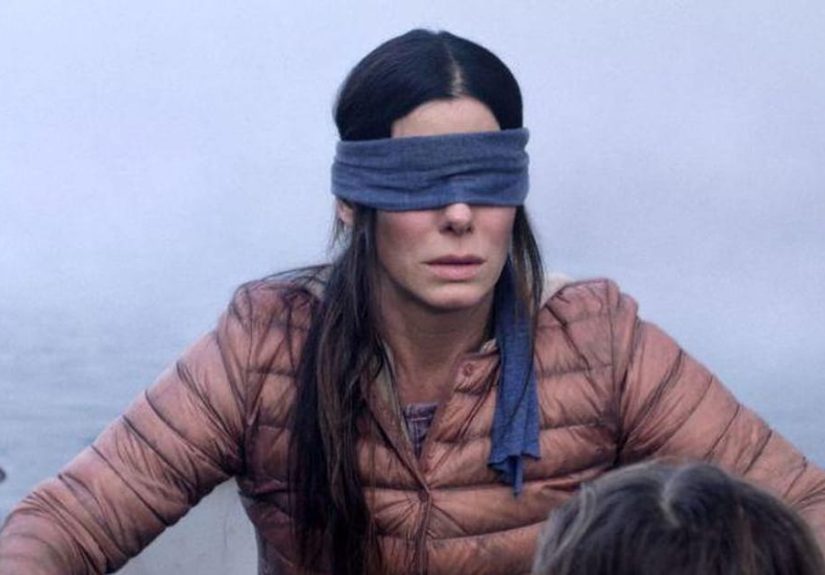
Bird Box doesn’t just use blindfolds as a visual gimmick; it uses them as a performance constraint. One
detail that reshapes how you watch the film: the blindfolds were treated as real limitations. The production could
have made “cheat” holes. The point was not to.
That decision changes everything: movement becomes cautious, hands become “eyes,” and trust becomes part of the
blocking. Bullock has described how the blindfolded work forced reliance on scene partners and made control feel
slipperyexactly the emotion the story wants. The micro-detail (no peeking) becomes the macro-feeling (constant
uncertainty).
Rewatch tip: look at how characters communicate without lookingtiny head turns, pauses, and the way hands hover
just ahead of the body. It’s physical acting as survival strategy.
Rom-Coms & Comedy: Details That Sell Chemistry
While You Were Sleeping: Chicago Isn’t a BackdropIt’s the Mood
The coziest detail in While You Were Sleeping is how specific it is about place. Lucy isn’t just “a transit
worker”; she’s tied to recognizable Chicago transit spaces, including stations that fans can still identify.
The setting does more than provide sceneryit supplies texture: winter breath, crowded platforms, the rhythm of
commuting, the loneliness of watching the same strangers every day.
Modern revisits of the film often point out how certain locations became part of local nostalgia. That’s a small
detail with big emotional payoff: the movie feels warmer because the world feels real. Even little city-accuracy
quirks (like the occasional “Hollywood Chicago” slip) become part of the charmproof that the film is anchored in
a specific city, not a generic rom-com universe.
Rewatch tip: notice how often Lucy is framed through windowsbooth windows, train windows, apartment windows.
The film keeps showing her separated from the life she wants, until the story gradually brings her into the frame
with other people.
Miss Congeniality: The Perfect-Date Joke That Became a Mini Holiday
Some movie details age out. The “perfect date” line in Miss Congeniality aged up.
The specific pickApril 25became a recurring fan celebration, partly because it’s so oddly specific.
It’s not “springtime.” It’s not “a Saturday.” It’s a calendar square you can point to.
What makes this detail even funnier is the behind-the-scenes context: the film’s tone was shaped to treat the
pageant world as real rather than purely a parody. That choice lets the pageant’s sincerity and weirdness generate
the comedy naturally. In other words, the movie doesn’t wink so hard that it breaks its own joke.
Rewatch tip: track how Gracie’s transformation is communicated through behavior more than looks. Yes, there’s
styling. But the lasting detail is posturehow she carries herself when she stops fighting the room and starts
owning it.
The Heat: When the Script Basically Says, “Chaos Here”
Buddy comedies live and die by rhythm. One famous detail from The Heat is that a key bar sequence leaned
heavily on improvisationless “perfectly scripted banter,” more “two performers finding the moment.”
That matters because Bullock’s character is tightly controlled while Melissa McCarthy’s is delightfully unruly.
Improv isn’t just funny here; it’s character design.
Rewatch tip: watch Bullock’s micro-reactionsthose half-beat pauses where she’s choosing between staying proper
and admitting she’s having fun. The comedy isn’t only the big punchline; it’s the small surrender.
The Proposal: The Power of Precise Physical Comedy
The Proposal works because it treats awkwardness like choreography. Romantic comedies often rely on
“accidents” that feel fake. This film makes its big physical-comedy beats feel planned in a way that still reads
spontaneous. Behind the scenes, Bullock has talked about how the director wanted certain moments staged carefully
so the joke landed without turning into chaos.
Rewatch tip: notice how often the humor comes from timing, not dialoguewho moves first, who freezes, who
tries to recover dignity and fails. The small details are basically a dance routine disguised as panic.
Sets, Style & World-Building: The “Place” Details You Feel
Practical Magic: The House That Functions Like a Character
If you’ve ever watched Practical Magic and thought, “I want to live in that house,” congratulations:
the production designers did their job and also might have accidentally launched a thousand Halloween Pinterest
boards.
The key detail is that the Owens house wasn’t just a pretty façade. It was built to communicate warmth, ritual,
and family history. Reports on the production describe how the exterior was constructed in Washington state for
filming, while interior scenes were built on soundstagesallowing the kitchen, conservatory, and cozy nooks to be
designed with story purpose. The house was temporary, but the feeling wasn’t. That’s world-building through
architecture.
Rewatch tip: look at how the camera lingers in the kitchen. In many movies, kitchens are “where exposition happens.”
In Practical Magic, the kitchen is where belonging happens.
Ocean’s 8: Cameos That Make the Glamour Feel Real
Ocean’s 8 is a heist movie that understands an important truth: a con only works if the world feels
authentic. One small detail that sells the Met Gala sequence is the flood of real-world fashion and celebrity
cameos. When you recognize a familiar face walking the red carpet as themselves, the movie’s version of the event
becomes more believableand the heist becomes more deliciously bold.
Another grounding detail: the production secured time to film inside the real Metropolitan Museum of Art overnight.
That matters because museums have a particular “after-hours” feelingquiet, echoing, slightly unreal. The film
uses that atmosphere as a tension engine. Glamour on the surface; stealth in the shadows.
Rewatch tip: watch Debbie Ocean like she’s conducting an orchestra. In heist movies, the leader’s real superpower
is calm. Bullock plays Debbie with tiny, controlled reactionslike someone who already rehearsed the panic and
decided not to wear it.
The Blind Side: Costume as Character (Without Needing a Speech)
In The Blind Side, Leigh Anne Tuohy’s style isn’t just wardrobe; it’s communication. She dresses with the
certainty of someone used to being listened to. That’s a small detail with major story function: it establishes
authority before she even speaks. The film also uses clothing as a narrative tool in scenes where she helps Michael
step into a world that’s been closed off to himmoments that read as practical care but also as identity-building.
Rewatch tip: notice how the movie contrasts softness and structurecomfortable family spaces versus more formal,
public spaces. Bullock’s costuming often mirrors that shift, subtly signaling whether Leigh Anne is in “home mode”
or “I will absolutely talk to the manager of injustice” mode.
A Quick Checklist for Spotting Small Details in Bullock Movies
- Hands and posture: Bullock often acts through movementwatch what her body says before her mouth does.
- Props that do real work: steering wheels, phones, blindfolds, handbagsobjects often drive the scene’s logic.
- Locations as emotion: Chicago platforms, museum halls, cozy kitchens, sterile tech spaceswhere a scene happens is part of the point.
- Sound as storytelling: tension isn’t always loud; sometimes it’s a careful absence or a muffled impact.
- Comedy timing: the funniest moments often live in a half-second pause, not the punchline.
Experience Section: Watching “Small Details From Sandra Bullock Movies” Like a Pro (About )
The most fun “experience” with Sandra Bullock movies isn’t just watching themit’s re-watching them with a
new mission. The first viewing is for the plot. The second is for the craft. The third is for the ridiculous joy
of realizing the movie has been quietly showing you the answer the whole time, and you were too busy yelling,
“DON’T SLOW DOWN!” or “WHY ARE YOU OPENING THAT DOOR?” to notice.
One easy way to turn a Bullock marathon into a detail-hunting event is to assign everyone a “department” like a
friendly film-nerd game night. One person watches for costume and hair changes (especially in transformation arcs
like Miss Congeniality). Another watches the environment (how While You Were Sleeping uses winter and
public spaces to show loneliness). Someone else tracks “objects with power” (the bus wheel in Speed, the
computer interface in The Net, the blindfolds in Bird Box). Suddenly the room is alive with
tiny discoveriesand nobody has to pretend they’re above pausing to rewind a scene by ten seconds like it’s a sport.
Another great experience trick is the “Bullock Reaction Countdown.” Pick one scene where chaos peaksan argument,
a chase, an awkward meetingand focus only on Bullock’s micro-reactions. Not her lines. Not the other actor.
Just her face and posture as she processes what’s happening. Bullock is particularly good at playing someone who’s
calculating three solutions at once while also trying to keep their dignity from evaporating. It’s a masterclass
in controlled comedy: you’ll see her choose the exact moment to break, the exact moment to recover, and the exact
moment to pretend she never broke at all.
If you want a more chill, solo experience, try the “sound-and-space” rewatch. Turn subtitles on and keep the
volume slightly lower than normal. This sounds backwards, but it forces attention to how scenes are built:
footsteps, silence, room tone, the way a camera lingers. Movies like Gravity become even more impressive
because you notice how sound cues guide emotion when the visuals are already doing so much heavy lifting.
Thrillers like Bird Box feel different toomore tense, less “jump scare,” because you can track how the
film uses uncertainty as a rhythm.
Finally, the most rewarding experience is noticing the common thread across wildly different genres:
Bullock’s characters often start on the outside of a systeman office, a pageant, a family, a missionand slowly
learn how to operate inside it without losing themselves. The small details (a uniform, a rule, a ritual, a space)
represent the system. Watching her push against those detailsand then repurpose themcan make even familiar movies
feel new. It’s like discovering the hidden blueprint beneath the jokes and adrenaline. And once you see it,
you’ll start catching those details everywhere… which is both a gift and a curse, because now you’re the person
who pauses a rom-com to say, “Wait, look at the way the camera framed that doorway.” Welcome. Snacks are on the left.
Conclusion
The “small details” in Sandra Bullock movies aren’t random triviathey’re the stitches holding the experience
together. A bus number that echoes a rule. A blindfold that refuses to cheat. A city location that adds instant
warmth. A house set that feels like family history. A scene that’s funnier because the actors found it in the
moment. These choices make her movies rewatchable in the best way: every time you return, there’s a new layer to
noticeand a new reason to say, “Okay, one more. Just one more.”