Table of Contents >> Show >> Hide
- The $40,000 Family Drama: What Actually Happened?
- Why the $40k “Mistake” Isn’t Just a Simple Oops
- Should You Ever Rehire a Family Member After a Major Screw-Up?
- But She’s Sick Doesn’t That Change Everything?
- Financial Boundaries With Siblings: When Helping Becomes Enabling
- What the Internet Had to Say
- Practical Takeaways If You’re in a Similar Situation
- Real-Life Experiences and Lessons Inspired by This Drama
- Final Thoughts: You’re Not a Monster for Protecting Your Livelihood
Nothing tests “family first” quite like a missing $40,000 and a sibling who suddenly wants their old job back.
That’s the core of a viral Bored Panda story about two sisters, a long-running family medical practice, and one
very expensive mistake that has Reddit and the internet firmly picking sides.
On paper, it sounds simple: one sister, a doctor, runs the practice; the other sister handles billing and
insurance. Then the money disappears, the truth unravels, and things get very messy very fast. Add in serious
illness, disability leave, and parents who refuse to see their “golden child” as the problem, and you’ve got a
case study in why people say never mix family and business.
Let’s walk through what happened, why people online are so passionately defending the doctor, and what this
kind of drama can teach anyone juggling loyalty, money, and family guilt trips.
The $40,000 Family Drama: What Actually Happened?
The story starts in a family medical practice that’s been around for decades. The dad, a physician, ran it for
over 50 years before his daughter stepped in to take over. She’s the new doctor-owner, trying to modernize the
business, keep patients happy, and, minor detail, actually get paid for her work.
Enter her sister. She works in the practice too, handling insurance credentialing, billing, and patient
balances the kind of behind-the-scenes work that determines whether a clinic survives or sinks. According to
the doctor’s account, the sister’s job was to keep the financial gears turning: submit claims, follow up with
Medicare, chase down unpaid balances, and keep the cash flowing.
Instead, the doctor eventually discovers something alarming:
- Medicare credentialing for one of the doctors was mishandled or delayed.
- Claims weren’t processed correctly or followed up on.
- Balances were allegedly being written off without proper justification.
- The practice lost about $40,000 in revenue.
To make matters worse, the doctor says her sister lied repeatedly about having taken care of the paperwork and
ignored emails and reminders. By the time the truth came out, the appeal window on some claims had closed and
the money was simply gone. For a small-to-medium medical practice, $40,000 isn’t a rounding error; it’s payroll,
rent, and “are we still open next year?” money.
Around the same time, the sister becomes seriously ill and goes on disability. The doctor steps in to clean up
the financial mess while juggling patient care and solo-parent responsibilities. Eventually, the sister’s health
stabilizes and she wants to return to work specifically, back into the same role that she previously mishandled.
The doctor says no. Her parents say, “How dare you.”
Why the $40k “Mistake” Isn’t Just a Simple Oops
Negligence vs. honest error
Everyone messes up at work sometimes. But this isn’t “forgot to send a fax.” It’s tens of thousands of dollars
in lost revenue, missed deadlines, and unsigned forms, combined with a paper trail of ignored messages and
“Yep, I did it!” when she very much did not.
In a medical practice, billing and credentialing aren’t optional background tasks. They’re legally and
financially critical. When those pieces are mishandled, you’re not just losing money; you’re risking audits,
patient care delays, and the survival of the business.
Betrayal of trust in a family business
Family businesses run heavily on trust. You hire your sibling because you assume they’ll have your back. When
that trust is broken especially with lying, cover-ups, or repeated negligence the damage is emotional as
much as financial.
Experts who advise family businesses point out that mixing kinship and employment often leads to blurred lines:
job expectations aren’t clearly defined, and bad performance gets excused because “that’s just how they are.” But
when the stakes are high, like in healthcare or law, those blurred lines can be dangerous for everyone involved.
Patients and staff pay the price
The doctor in the story isn’t just worried about her bank account. She’s responsible for:
- Pays for nurses, receptionists, and support staff who rely on consistent paychecks.
- Keeping the lights on and the doors open for patients who may have been seeing the practice for years.
- Maintaining compliance with insurers and government programs like Medicare.
Rehiring someone who already proved they can’t (or won’t) handle that responsibility isn’t just a “be nice, she’s
your sister” issue. It’s a potential risk to every employee and patient connected to that practice.
Should You Ever Rehire a Family Member After a Major Screw-Up?
Career and leadership coaches who work with family companies tend to say the same thing: family members are not,
and should not be, “fireproof.” If someone’s performance would get a non-relative fired, it’s usually a sign
that hard conversations are overdue not that you rearrange the entire business around them forever.
What business experts suggest
People who advise on firing (or rehiring) family members often recommend a reality check before making a
decision:
- Is the role mission-critical? If errors in this position can sink the business, you need
someone rock-solid there relative or not. - Is there a clear pattern? One mistake can be coached. A pattern of lying, avoidance, and
blaming others is much harder to fix. - Has accountability ever actually happened? If the only “consequence” was an awkward dinner,
rehiring just reinforces that nothing serious was wrong. - Can you supervise objectively? If every conversation risks a full family meltdown, you may
not be able to manage that person effectively.
In this story, the sister isn’t asking to come back in a totally different, lower-risk role with tight oversight.
She wants the same high-responsibility job that ended in a massive loss. From a business perspective, that’s a
hard no.
The guilt trap: “But we’re family!”
Parents in these stories often frame the issue as a lack of compassion: “She’s sick. She’s had such a hard time.
How can you do this to your own sister?” The problem is that compassion doesn’t magically erase consequences.
You can care about someone’s health, bring them soup, drive them to appointments, and still admit that they
shouldn’t be responsible for the financial survival of your business. Love does not equal “you get your old job
back no questions asked.”
But She’s Sick Doesn’t That Change Everything?
The sister in the story reportedly developed a serious illness and went on disability, which is awful and
absolutely deserves empathy. Illness can affect energy, concentration, reaction time, and stress tolerance all
things that matter a lot in a high-pressure, detail-heavy job like medical billing.
But there are two separate questions here:
- How should the family support her as a person?
- Is she still a safe and reliable fit for a specific, critical role in the business?
Those are not the same question, and the doctor is allowed to answer them differently.
Reasonable accommodations in employment are about giving qualified employees fair support so they can do their
jobs not ignoring the job requirements altogether. If someone has already shown that they mishandled key
responsibilities, putting them back into the exact same position “because they’re sick now” can actually be
unfair to everyone: the employee, coworkers, and the people the business serves.
Financial Boundaries With Siblings: When Helping Becomes Enabling
This story isn’t just about a job. It’s also about money, and the unspoken rule in many families that the “stable”
sibling is supposed to quietly absorb everyone else’s chaos.
Experts who talk about financial boundaries with relatives point out a few classic red flags:
- You’re constantly asked to “help out just this once.”
- There’s very little transparency about where the money went or what went wrong.
- You feel afraid to say no because it will “tear the family apart.”
- People minimize the impact of their mistakes because they assume you’ll fix it.
The doctor in this case isn’t just saying no to rehiring her sister she’s saying no to being the endless safety
net. No to covering up consequences. No to pretending $40,000 is a “lesson learned” instead of a catastrophe.
That may be painful in the short term, but in the long term it’s often the only way for relationships to become
healthier and more honest.
What the Internet Had to Say
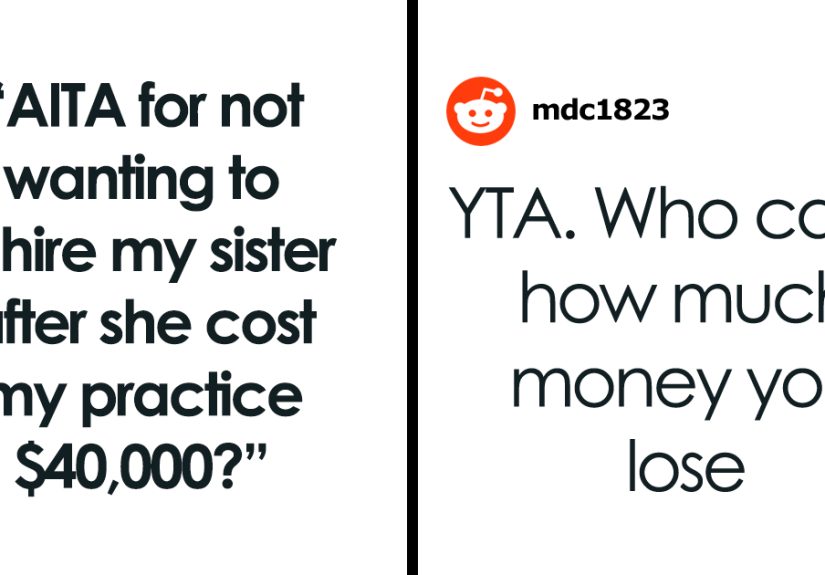
Predictably, online commenters did not hold back. On Reddit and Bored Panda, the overwhelming majority of people
sided with the doctor. Many pointed out that:
- If any non-family employee had cost the practice $40,000 and lied about it, they would have been fired on the
spot and never rehired. - The parents seem more focused on keeping the peace than on acknowledging the seriousness of the mistake.
- The sister’s illness is tragic, but it doesn’t retroactively fix the damage she caused.
- The doctor has a duty to protect her staff and patients first, then her sister’s feelings.
A few people suggested possible compromises like offering the sister a lower-responsibility role, or helping her
find training for a different line of work but most agreed that putting her back in charge of billing and
credentialing would be like handing the car keys back to someone who just totaled your last three vehicles.
Practical Takeaways If You’re in a Similar Situation
You might not own a medical practice or be out $40,000, but the dynamics in this story are painfully familiar to a
lot of people. If you’re dealing with financially irresponsible or boundary-pushing family members, here are some
grounded lessons:
1. Separate the person from the role
You can love your sibling and still admit they are a terrible fit for a specific job or responsibility. Your
feelings do not magically change the skill set required to run a business well.
2. Put responsibilities in writing
If you do employ family, treat it like a real job:
- Use job descriptions, written expectations, and clear metrics.
- Document training, performance issues, and corrections.
- Don’t rely on “We talked about it over dinner last week.”
This doesn’t make you cold; it makes you fair to them and to everyone else on the team.
3. Don’t ignore huge red flags
If someone lies about work tasks being done, ignores repeated reminders, or consistently causes financial damage,
those are not “quirks.” That’s a pattern that will repeat itself unless it’s addressed directly, with real
consequences.
4. Offer support that doesn’t endanger your future
Supporting a sick or struggling relative doesn’t have to mean rehiring them. It might look like:
- Helping with rides to appointments.
- Assisting with disability paperwork.
- Sending meals, checking in, and staying emotionally present.
- Connecting them with social workers, career counselors, or financial advisors.
What it doesn’t have to mean is “risking your entire livelihood to prove you care.”
5. Remember that saying “no” is still an act of care
Boundaries feel harsh in the moment, especially when other family members pile on the guilt. But a calm, firm no
is often more loving than a resentful yes that leads to burnout, debt, and resentment so deep you can’t share a
holiday table anymore.
Real-Life Experiences and Lessons Inspired by This Drama
Stories like “She Lied About Everything” go viral because they echo real situations people quietly live through
every day. The details are unique, but the emotional pattern trust, betrayal, guilt, and boundary-setting
pops up in countless families. Here are some composite experiences and lessons that mirror the themes in this
Bored Panda story.
Case 1: “The Loan That Never Came Back”
One woman lent her brother tens of thousands of dollars to “get back on his feet” after a business flop. There
were promises, vague repayment plans, and plenty of “I’ll make it up to you when things turn around.” Years
later, nothing had turned around but he was still posting vacation photos and buying new gadgets.
When she finally stopped giving him money and asked for a partial repayment, he accused her of “choosing money
over family.” It hurt, but she realized that continuing to bail him out had turned her into his permanent
safety net. Once she stopped paying, he finally met with a financial counselor, downsized his lifestyle, and
started chipping away at his debts. The relationship is still tense, but at least it’s honest.
The lesson: sometimes, the first step toward someone else’s financial maturity is your decision to close your
wallet.
Case 2: The “Helpful” Cousin in the Family Shop
In another family, a cousin worked in a small retail business owned by relatives. He was charming with
customers, fun at staff parties, and absolutely hopeless with inventory and cash handling. Missing stock,
unrecorded returns, and cash drawer “adjustments” became a regular thing.
When the owners tried to tighten up procedures counting tills more often, adding inventory checks, assigning
tasks in writing the cousin took it as a personal attack. Eventually they let him go. The family dinners got
chilly, but the business slowly stabilized. Years later, the cousin even admitted he hadn’t been taking it
seriously and that losing the job was the wake-up call he needed.
The lesson: keeping an underperforming relative in a critical role doesn’t just hurt the business; it lets them
coast instead of grow.
Case 3: Illness, Empathy, and Different Kinds of Help
In another situation, a sister developed a chronic illness and could no longer handle her high-pressure job in
the family restaurant. Long shifts, late nights, and physical labor sent her symptoms spiraling. At first, the
family tried to adjust her schedule, lighten her workload, and give her the “easy” tasks. It still wasn’t
enough.
Eventually, they had a brutally honest conversation: the restaurant environment just wasn’t safe for her health
anymore. Instead of keeping her in a role that was slowly breaking her down, the family helped her apply for
disability benefits, find part-time remote work, and start a small online side business she could manage on
her own terms.
The relationship stayed intact because they were honest about both her limitations and the needs of the
business. She wasn’t fired “for being sick”; she was supported in transitioning to a life that fit her new
reality better.
The lesson: compassion doesn’t always mean “keep doing the same job.” Sometimes it means helping someone build
a different life that actually works for them.
Case 4: Choosing Your Own Future Over Family Expectations
Many people who relate to the Bored Panda story talk about being “the responsible one” the sibling who gets
good grades, pays bills on time, and quietly rescues the family from financial fires. At some point, that role
becomes crushing. They’re expected to hire the struggling sibling, co-sign the risky loan, and pick up the
pieces when it all goes wrong. Again.
Some of them finally draw a line: they refuse to bring a chaotic sibling into their business, won’t co-sign
loans, and decline to let relatives move in “just until things calm down.” The backlash from parents and other
family can be intense. They’re called selfish, cold, ungrateful. But over time, many report feeling lighter,
more secure, and less resentful because they’re no longer sacrificing their mental health and future to keep
everyone else comfortable.
The lesson: you’re allowed to build a life that isn’t constantly on fire, even if that means other people
accuse you of being the villain.
Final Thoughts: You’re Not a Monster for Protecting Your Livelihood
“She Lied About Everything” isn’t just a catchy headline it’s a painful summary of how badly things can go
when family, money, illness, and denial collide. The doctor at the center of the story isn’t choosing money
over her sister; she’s choosing stability, safety, and honesty over a repeat of a disaster that almost sank
her practice.
You can feel sympathy for a sick sibling and still refuse to hand them back the keys to the business they
nearly drove off a cliff. You can love your family and still insist on boundaries. You can be generous without
being a doormat.
If you take anything away from this drama, let it be this: protecting your livelihood and mental health is not
cruelty it’s survival. And sometimes, the most loving thing you can say to family is a firm, steady, “No.”