Table of Contents >> Show >> Hide
- The “Rejected” Working Pup Who Still Had a Job to Do
- When a Bull Breaks Loose, It’s Not “Just a Big Cow”
- How Ziya Turned a Disaster Into an Escape Window
- The Hambone Award Twist: When Heroism Becomes an “Unusual Claim”
- Practical Safety Lessons: What to Do If You Encounter Cattle (Or a Loose Bull)
- What Ziya’s Story Says About Dogs, Families, and Second Chances
- How to Encourage Calm Protection Instead of Risky Reactivity
- Conclusion: A Hero Story With a Practical Message
- Extra: of Real-World Experiences and Lessons Related to This Story
Some dogs become heroes because they’ve been trained to do it. Others become heroes because the universe rolls up,
tosses a runaway bull into their morning walk, and says, “Surprise quiz!”
That’s basically what happened to Ziya, a Belgian Malinois who once “flunked out” of working-dog trainingonly to
prove, in the most dramatic way possible, that a dog doesn’t need a shiny job title to show up like a professional.
When an agitated bull broke loose on the family’s property and started posturing like it owned the place, Ziya did
what many dogs do when the people they love are in danger: he stepped in front, took the attention, and created the
seconds his family needed to get away.
The headline version is thrilling. The real lesson is even better: “rejected” doesn’t mean “useless,” and “pet” can
still mean “protector.” Let’s unpack what happened, why it makes sense (yes, even the bull part), and what you can
learn from itwhether you live on acreage, hike near cattle, or just want to understand why your dog insists on
escorting you to the bathroom like a tiny, fuzzy security guard.
The “Rejected” Working Pup Who Still Had a Job to Do
When people hear “working dog,” they often picture a canine who wakes up at 5 a.m., drinks black coffee, and
completes a mission briefing before breakfast. In reality, working-dog programs look for very specific traits:
intense drive, steady nerves, the ability to focus under pressure, and the kind of motivation that says,
“Yes, I’d like to chase that moving object for the next eight hours.”
Dogs who don’t match that exact profile aren’t “bad dogs.” They’re just not the right fit for that particular role.
Sometimes they’re too social. Sometimes they’d rather cuddle than conquer. Sometimes they’re brilliant but not
interested in the whole “high-stakes tasks with strangers” lifestyle. In Ziya’s case, he was training to be a
working dog, but his personality was better suited for companionshipso he needed a home that wanted a loyal family
dog, not a full-time employee with a badge.
Why “Washout” Isn’t a Bad Word
In dog-training circles, “washout” can sound harsh, but it often just means the program made a decision based on
safety and suitability. A dog can be healthy, smart, stable, and lovingand still not be ideal for a demanding job
that requires extreme consistency under pressure.
Think of it like this: someone can be an excellent driver and still not belong in Formula 1. Ziya didn’t fail at
being a dog. He simply changed career paths… into something arguably more important: family protector.
When a Bull Breaks Loose, It’s Not “Just a Big Cow”
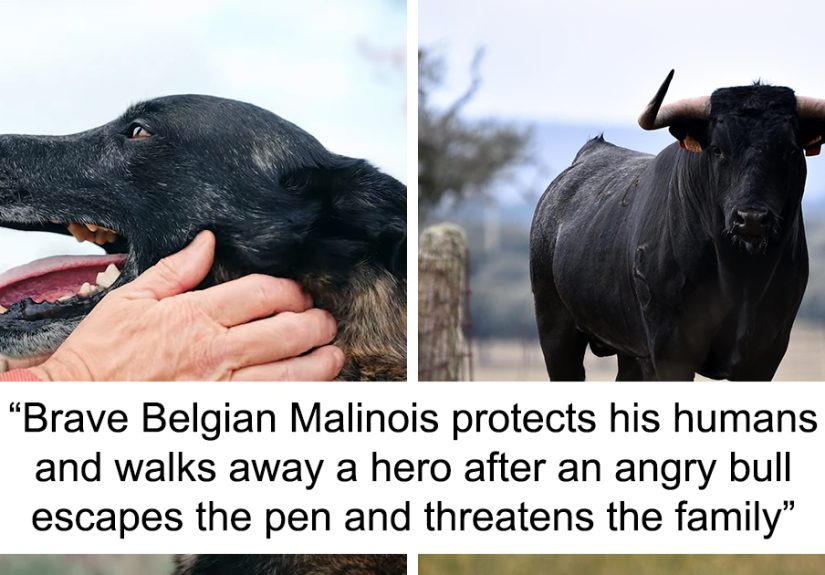
The encounter happened on the family’s propertyan 80-acre space that was partially rented to cattle farmers. On a
foggy morning walk, Ziya and his humans encountered an aggressive bull that had breached a nearby fence. The bull
didn’t stroll up politely like it was asking for directions. It signaled agitationsnorting, stomping, and acting
like a heavyweight champ warming up for a round.
Bulls are powerful animals, and their body language matters. Safety experts often warn that bulls can be dangerous
even without a history of aggression. They’re large, fast, and strong enough to cause serious harm. And because
cattle are prey animals, fear and stress can flip the switch quickly. In other words: a bull doesn’t have to be
“evil” to be dangerous; it just has to be a bull having a bull moment.
Common Signs a Bull Is Not in a Friendly Mood
- Stomping or pawing the ground (a classic “back up” signal)
- Snorting and head tossing
- Turning broadside to look bigger
- Quick, direct movement toward you or your dog
- Fixated staring like it’s choosing a target
If you’ve ever watched a movie where someone ignores the “ominous music,” that’s what it looks like when humans
downplay bull behavior. The safest assumption is that an unfamiliar, loose bull is a problem you do not want to
solve up close.
How Ziya Turned a Disaster Into an Escape Window
When the bull escalated, Ziya moved instinctively into the space between the animal and his family. That’s a
protective behavior many dogs display: “I’ll be the barrier.” It can happen in subtle waysstanding in front of a
stroller when a stranger approaches, leaning into a doorway, or placing a body between a child and a loud object.
In this case, the stakes were higher and the opponent had horns.
Ziya’s move did two things at once:
- He redirected attention. The bull focused on the dog instead of the humans, buying seconds that
matter in any close encounter. - He prompted motion. His family could retreat toward safety while the bull’s energy was aimed at
a moving, engaged target.
In the process, Ziya was kicked in the jaw and lost a tooth. The injury required emergency veterinary care, but he
recovered fullywhile his family walked away unharmed.
Why Dogs Do This (Even When It Seems Unreal)
Most family dogs aren’t thinking in movie dialogue like, “I shall protect thee, humans.” Protective actions are
usually a blend of:
- Bonding: dogs are social animals, wired to stay close to their group
- Pattern recognition: they notice tension, posture changes, and “something’s off” energy
- Breed tendencies: some dogs are naturally more watchful, alert, and quick to respond
- Reinforcement history: even casual household routines can “teach” a dog to stand guard
Belgian Malinois are known for their intelligence, athleticism, and strong work drive. Many are used in police and
military rolesbut they can also be devoted family dogs in the right environment. A Malinois may not always fit a
formal working program, yet still carry a built-in readiness to respond to a perceived threat. For Ziya, that
readiness showed up exactly when it mattered.
The Hambone Award Twist: When Heroism Becomes an “Unusual Claim”
Here’s the part that feels like reality pulling a comedic U-turn: Ziya’s story didn’t just become a family legend.
It also became part of a pet insurance award series that highlights unusual claimsthe Nationwide Hambone Award.
Ziya’s encounter helped land him national recognition, and he ultimately won the 2025 Hambone Award.
The award exists because pet injuries and emergencies can be weirdly specific. One dog might eat something that
definitely shouldn’t fit in any mammal. Another might get themselves into a scenario that sounds like a deleted
scene from a sitcom. Ziya’s claim was unusual for a better reason: he got injured protecting his people from a
runaway bull.
This is also a reminder that “farm-adjacent life” can bring unexpected hazards. Even if you’re not a rancher, being
near livestock means you should treat the environment with respectbecause fences fail, gates get left open, and
animals don’t read your plans for a relaxing morning walk.
Practical Safety Lessons: What to Do If You Encounter Cattle (Or a Loose Bull)
Let’s be clear: the goal isn’t to make people afraid of cattle. It’s to replace casual assumptions with smart
habits. Most cattle are calm. But a bull that’s loose, stressed, or acting territorial is not a petting-zoo moment.
If you find yourself in cattle countryon acreage, near rented pasture, or on trails that cross grazing landkeep
these safety principles in mind.
1) Create Distance First, Not Drama
Your best move is usually to put space and a barrier between you and the animal. Back away slowly, look for a gate,
fence, vehicle, sturdy tree, or anything that separates you. Avoid sudden movements that could trigger chasing.
2) Keep Your Dog Close and Under Control
A loose dog can escalate a livestock encounter fast. Even a friendly dog can look like a predator to cattle, and a
charging bull does not stop to ask whether your dog “means well.” On trails and around grazing areas, keep your dog
leashed and close to you.
3) Pay Attention to Body Language
If a bull is pawing, snorting, presenting broadside, or fixating, treat it as a warning. Don’t test whether it’s a
bluff. You don’t win points for staying calm if you stayed calm in the wrong place.
4) Don’t Turn Your Back
Livestock safety guidance often repeats this for a reason: keep eyes on the animal while you retreat. Turning your
back reduces your ability to react if the animal advances.
5) Have an “Escape Plan” Mindset
Even when nothing looks wrong, assume you may need a quick route out. That can mean knowing where the nearest gate
is, not walking between an animal and its herd, and avoiding narrow areas where you could be cornered.
If you’re on property where cattle are kept, the highest-safety move is also the simplest: alert the responsible
adults (property owner, rancher, or land manager) and keep kids and pets away until the animal is contained.
What Ziya’s Story Says About Dogs, Families, and Second Chances
The most powerful part of this story isn’t the bull. It’s the label “rejected.” That word sticks to animalsand
peoplelike gum on a shoe. Yet Ziya’s life shows how misleading it can be.
A dog can be “not right” for one environment and perfect for another. He can be too soft for a high-pressure
working pipeline and still be brave. He can be too social for one job and still be deeply bonded to his family. He
can fail a test and still pass the only test that truly matters: what happens when your people need you.
Reframing “Failure” in Training
Training outcomes are not moral judgments. They’re compatibility notes. That’s why adoption stories matter:
sometimes the dog who didn’t fit a program ends up fitting a lifeyour lifebetter than you ever imagined.
And if you’ve ever adopted a dog with a confusing past (“returned twice,” “too energetic,” “too timid,” “doesn’t do
well in shelters”), Ziya’s story is a loud, tail-wagging reminder: context is everything.
How to Encourage Calm Protection Instead of Risky Reactivity
Ziya’s protective action helped his family, but not every protective behavior is automatically safe. In everyday
life, dogs that become overly protective can also become reactivebarking, lunging, or escalating when they think
they must handle every situation.
The goal is not to “turn off” your dog’s devotion. The goal is to shape it into calm, controllable behaviorso your
dog looks to you for direction instead of making the call alone.
Helpful training foundations for safety
- Reliable recall: “Come” should work even when your dog is excited or worried.
- Loose-leash walking: keeps your dog close and prevents sudden rushing.
- Place/settle cues: teaches your dog to relax and hold position when things feel tense.
- Neutral exposure: gradual, controlled exposure to new environments builds confidence.
- Professional help when needed: if your dog shows aggression or fear that seems unsafe, talk to a veterinarian or qualified trainer.
In other words: let your dog be brave, but let you be the decision-maker. Courage is even better with a leash,
a plan, and a human who’s paying attention.
Conclusion: A Hero Story With a Practical Message
Ziya didn’t become a hero because he had a perfect résumé. He became a hero because he had the one trait that
matters most in a crisis: commitment. When a bull broke loose and turned a foggy morning walk into a dangerous
encounter, he stepped forward, took the risk, and created an exit for his family.
The takeaway isn’t “dogs should fight bulls.” The takeaway is:
prepare for the unexpected, respect livestock, train for control, and never underestimate the heart of a dog
who finally found his place.
“Rejected” was never the end of the story. It was the plot twist that made the hero arc possible.
Extra: of Real-World Experiences and Lessons Related to This Story
Stories like Ziya’s hit people in the chest because they feel both rare and strangely familiar. Rare, because most
of us don’t routinely encounter loose bulls on a morning stroll. Familiar, because many dog owners have seen a
smaller version of the same protective instinctjust with lower stakes and fewer hooves.
One common “experience pattern” shows up whenever families move from city life to even a little bit of rural space:
the environment changes faster than the mindset. A new homeowner walks the perimeter like it’s a suburban sidewalk,
but the land operates like farmlandfences are functional, gates get used, and animals don’t care that you’re
listening to a podcast about productivity. People who live near livestock often learn quickly to scan the landscape
before they commit to a path. They notice where the cattle are. They notice whether the herd is calm. They notice
the “big one” that stands alone and watches. That habitobserving first, walking secondprevents most bad
encounters before they start.
Another experience that comes up a lot: dogs can become “brave” in ways their owners didn’t expect. Plenty of
families adopt a dog because it’s sweet, goofy, and (allegedly) afraid of the vacuum. Then something genuinely
stressful happensan unfamiliar animal rushes the fence line, a loud crash happens near a child, or a stranger
appears where strangers don’t usually appearand the same dog who panics at a plastic bag suddenly positions
itself between the family and the unknown. It’s not always aggression. Often it’s simply, “I’m staying with my
people, and I’m not moving.” That kind of steady presence is protection, too.
Families who hike or walk in cattle areas also learn a practical truth: your dog’s behavior can change the entire
situation. A calm, leashed dog at your side is one scenario. A dog that lunges, barks, or tries to chase is a
completely different scenariobecause livestock may interpret that as predatory pressure. Many experienced walkers
carry a simple routine: shorten the leash, keep moving calmly, give cattle wide space, and avoid cutting between
animals (especially cows and calves). The goal is to look boring, not bold.
And then there’s the “fence reality” lesson. People who rent land, share boundaries, or live near working farms
eventually accept that containment is an ongoing process, not a one-time setup. Weather shifts posts. Animals lean
on wire. Gates get left unlatched. The most prepared property owners don’t just trust the fencethey build a
lifestyle that assumes something could go wrong. They keep phone numbers handy. They teach kids to report animals
immediately. They avoid “let’s go look closer” curiosity. They practice what livestock safety experts repeat over
and over: have an escape route, stay aware, and don’t assume an animal will behave the way you want it to behave.
Ziya’s story is extreme, but the experiences around it are everyday: pay attention, plan your walk, train your dog,
and respect the power of animals that outweigh you by several hundred pounds. If you do that, most days will be
peacefuland your dog can spend his hero energy on something safer, like bravely defending you from the mailman.