Table of Contents >> Show >> Hide
- What Happened When Parker Solar Probe Entered the Sun’s Atmosphere?
- Why This Mission Was a Big Deal Long Before the Milestone
- How Parker Solar Probe Survives the Sun Without Instantly Becoming Expensive Vapor
- What Parker Solar Probe Found Inside the Corona
- Why Earth Should Care About a Spacecraft Roasting Near the Sun
- The Record-Breaking Encore in December 2024
- Experience: What Following Parker Solar Probe Feels Like
- Conclusion
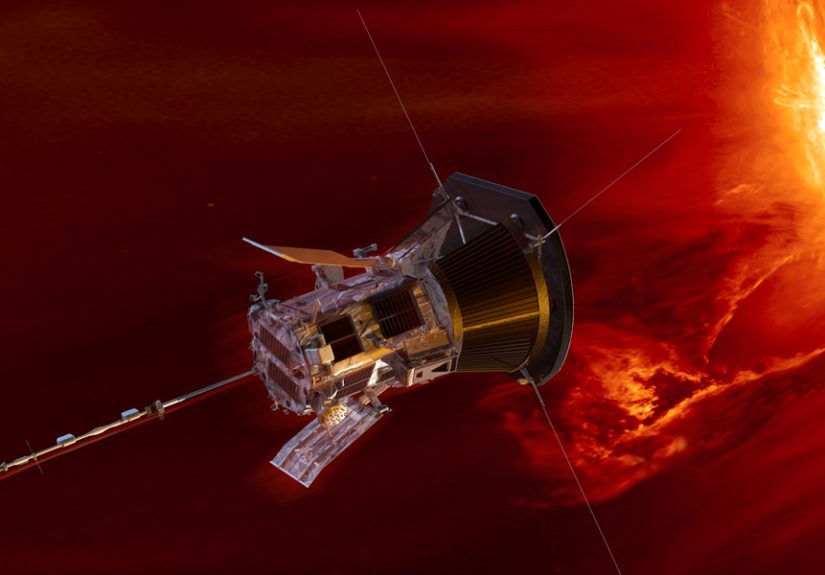
For decades, scientists had a slightly inconvenient problem: the Sun is the most important star in our neighborhood, yet it has been outrageously difficult to study up close. You can build telescopes, launch satellites, and write extremely serious papers with impressive Greek letters, but eventually you hit the same wall: you are still observing the action from far away. NASA’s Parker Solar Probe changed that. It did not just look at the Sun from a respectful distance. It went right into the Sun’s outer atmosphere, the corona, and turned a long-standing scientific dream into real data.
That milestone is why the phrase “Parker Solar Probe enters Sun atmosphere” made such a splash. It sounds like sci-fi, and honestly, it kind of reads like sci-fi too. But this was very real. Parker Solar Probe became the first spacecraft to fly through the corona, sampling particles, magnetic fields, and plasma conditions in a region that had only been modeled, debated, and admired during solar eclipses. Suddenly, solar physics stopped being a mostly remote exercise and became a direct-contact sport.
And the timing could not be better. The Sun drives space weather that can affect satellites, radio communications, navigation systems, astronauts, and even power infrastructure on Earth. So this mission is not just about getting bragging rights for “closest spacecraft to the Sun.” It is about learning how our star works, why the corona is so hot, how the solar wind gets accelerated, and how violent solar events can ripple across the solar system. In other words, Parker Solar Probe is not just flirting with the Sun. It is interrogating it.
What Happened When Parker Solar Probe Entered the Sun’s Atmosphere?
The headline-making moment traces back to April 28, 2021, during Parker Solar Probe’s eighth close flyby of the Sun. That was when the spacecraft crossed a key boundary called the Alfvén critical surface and entered the corona, the Sun’s outer atmosphere. NASA announced the achievement later, after researchers had enough time to receive, analyze, and confirm the data. So the spacecraft had already done the historic part while the rest of us were still going about our business, blissfully unaware that humanity had basically high-fived a star.
It is important to understand what “touching the Sun” actually means. Parker Solar Probe did not plunge into a solid surface because, thankfully for both science and common sense, the Sun does not have one. Instead, it flew through the corona, which is made of superheated plasma. The spacecraft crossed in and out of this region multiple times, spending hours inside it during that pass. Those repeated crossings were a huge clue: the boundary was not smooth and neatly spherical. It was wrinkled, uneven, and surprisingly dynamic.
That discovery matters because the corona is where some of solar physics’ most stubborn mysteries live. The Sun’s visible surface is incredibly hot, but the corona above it is even hotter, reaching temperatures in the millions of degrees. That makes about as much intuitive sense as standing near a campfire and finding the air ten feet above it hotter than the flames themselves. Parker Solar Probe went into the very region where scientists believe the energy transfer and magnetic chaos behind this oddity happen.
Why This Mission Was a Big Deal Long Before the Milestone
Parker Solar Probe launched on August 12, 2018, aboard a Delta IV Heavy rocket from Cape Canaveral. It was built to do something no spacecraft had ever done: travel through the Sun’s atmosphere while surviving brutal heat, radiation, and dust. NASA designed the mission to come within roughly 4 million miles of the Sun’s surface, closer than any previous human-made object. That is still a long way in ordinary life, but in solar terms it is basically pulling up a lawn chair at the cosmic barbecue.
The spacecraft was named after solar physicist Eugene Parker, who helped explain the solar wind and became the first living researcher to have a NASA mission named after him. That detail is not just a nice historical footnote. It captures the mission’s scientific purpose. Parker predicted that the Sun continuously releases a stream of charged particles into space. Decades later, the spacecraft bearing his name went straight to the source to study how that flow begins and how it behaves near the star.
The mission set out to answer three major questions:
- How does energy and heat move through the corona?
- What accelerates the solar wind to such extreme speeds?
- How are energetic particles launched and boosted through the solar system?
Those are not niche questions only relevant to people who own three solar telescopes and a mug that says “plasma is my love language.” They are central to understanding the star that powers Earth’s environment. Better answers mean better forecasting of solar storms and a better grasp of how stars behave more broadly across the universe.
How Parker Solar Probe Survives the Sun Without Instantly Becoming Expensive Vapor
One of the most impressive parts of this story is the engineering. Parker Solar Probe survives close solar passes thanks to a carbon-composite thermal protection system about 4.5 inches thick. That shield is designed to withstand temperatures near 2,500 degrees Fahrenheit while keeping the spacecraft’s instruments near room temperature. Which is a wildly comforting detail, because “close to the Sun” and “near room temperature” are not phrases most people expect to see in the same sentence.
The spacecraft also uses an autonomous guidance system to keep the shield pointed at the Sun. If Parker wobbled too much and exposed sensitive hardware to direct sunlight, the mission could end very quickly and very dramatically. Its solar arrays are cleverly designed and partially retracted during the closest passes so they can still generate power without frying. This is not just a tough spacecraft. It is an exquisitely choreographed machine that survives by maintaining perfect attitude and timing under conditions that would ruin almost everything else humans have ever built.
Even the journey itself required unusual strategy. Parker Solar Probe did not simply launch toward the Sun in a straight line. That would actually be harder than it sounds because Earth is already moving around the Sun very fast. To fall inward, the spacecraft had to shed orbital energy. It used repeated gravity assists from Venus to tighten its orbit over time. Across seven Venus flybys and 24 planned solar orbits, Parker spiraled closer and closer to the Sun. Spaceflight, as usual, found a way to make the impossible look like orbital geometry homework with million-degree consequences.
What Parker Solar Probe Found Inside the Corona
A Boundary That Looks Wrinkled, Not Clean
Before Parker’s observations, many people pictured the boundary of the Sun’s atmosphere as a somewhat tidy shell. Instead, the spacecraft found a much messier structure. The Alfvén critical surface has spikes and valleys, not a smooth, uniform edge. That means the transition from solar atmosphere to solar wind is more complicated than a textbook diagram might suggest. In science, this is the sort of thing that makes theorists groan, observers grin, and graduate students quietly open another spreadsheet.
Magnetic Switchbacks That Bend the Rules
Parker Solar Probe also observed mysterious “switchbacks” in the solar wind, sudden reversals in the magnetic field that look like kinks or folds. These disturbances are not just weird for weirdness’ sake. They may help explain how the solar wind is heated and accelerated as it streams away from the Sun. Near the Sun, switchbacks appear to be more common and more energetically important, which suggests they are not random background noise. They are part of the main performance.
These observations helped scientists connect small-scale magnetic behavior to large-scale solar wind dynamics. In plain English, Parker showed that the solar wind is not a smooth breeze drifting outward. It is more like a fast, tangled, turbulent rush with magnetic hairpin turns and sudden bursts of structure.
Clues to the Fast Solar Wind
Later results also sharpened scientists’ understanding of the fast solar wind, especially the streams associated with coronal holes. Observations from Parker supported the idea that interchange reconnection, a process involving magnetic field lines snapping and reconnecting, plays a major role in producing fast solar wind. That sounds abstract until you think of it this way: the Sun’s magnetic field is constantly rearranging itself, and those rearrangements can fling plasma outward at extraordinary speeds.
This matters because the solar wind does not stay politely near the Sun. It fills the solar system, interacts with planetary magnetic fields, shapes auroras, and influences the radiation environment around spacecraft. Parker Solar Probe is helping scientists understand not just what the solar wind is, but how it is born in the first place.
Coronal Streamers, Explosions, and Dust Drama
The mission also captured close-up views of coronal structures, including streamers that are often visible during total solar eclipses. These features are not just visually dramatic. They reveal how plasma is organized and how magnetic fields shape the corona. Parker has also flown through powerful coronal mass ejections, giving scientists a front-row seat to giant solar eruptions instead of the usual distant after-the-fact interpretation.
In one especially fascinating result, Parker’s observations helped show how massive solar eruptions can vacuum up interplanetary dust as they race outward. That kind of finding expands the mission beyond one famous milestone. Parker Solar Probe did not enter the Sun’s atmosphere, take a selfie, and call it a career. It kept collecting the kind of data that turns broad ideas into testable physics.
Why Earth Should Care About a Spacecraft Roasting Near the Sun
It is tempting to treat the mission as pure wonder, and to be fair, wonder is absolutely part of the package. But Parker Solar Probe also has practical value. Solar activity drives space weather, and space weather can disrupt modern technology. Strong solar storms can affect satellites, GPS, radio communications, spacecraft electronics, and power systems. They also matter to astronauts, who face added radiation risk beyond Earth’s protective atmosphere.
By studying the corona and the solar wind at their source, Parker helps improve the physical models used in forecasting these events. Better models can eventually translate into better warnings and better preparation. That is especially important as humanity becomes more dependent on space-based infrastructure and increasingly interested in crewed missions beyond low Earth orbit. If the Sun is going to throw plasma tantrums, it would be nice to know when and why.
The mission also helps explain natural phenomena people already know and love, such as the aurora borealis and aurora australis. Those beautiful lights are not just pretty sky confetti. They are part of a chain of events that begins at the Sun and travels through space. Parker Solar Probe is helping scientists map that story much closer to its origin.
The Record-Breaking Encore in December 2024
If entering the corona in 2021 was the historic breakthrough, the later close passes were the victory laps with flamethrowers attached. On December 24, 2024, Parker Solar Probe made its closest-ever pass by the Sun, flying about 3.8 million miles above the solar surface and reaching roughly 430,000 miles per hour. That made it the fastest human-made object ever, which is the sort of achievement that sounds invented until NASA confirms it with a calm press release.
Mission teams received a beacon tone on December 26 confirming that the spacecraft had survived the encounter and was operating normally. The close approach was not just about setting records for distance and speed. It placed Parker deeper into the environment it was built to study, giving scientists an even better chance to collect data from uncharted territory. The spacecraft’s earlier entry into the Sun’s atmosphere was the door-opening moment. The 2024 pass pushed that exploration further.
Together, these milestones show that Parker Solar Probe is not a one-headline mission. It is an ongoing scientific campaign that keeps raising the bar for how close humans can study a star directly.
Experience: What Following Parker Solar Probe Feels Like
There is also a more human side to the Parker Solar Probe story, and it is worth talking about because this mission does something rare: it makes space science feel immediate. Most of us will never build a thermal protection system, plot a Venus gravity assist, or interpret magnetometer data over coffee. But when you follow this mission, you feel the tension of it anyway. You read that a spacecraft is heading toward the Sun at hundreds of thousands of miles per hour, then you wait for a tiny beacon signal to confirm it survived. It turns cutting-edge science into an emotional experience, not just an intellectual one.
For students, teachers, science fans, and even casual readers, Parker Solar Probe offers a kind of cosmic perspective shift. The Sun stops being a flat yellow doodle in the corner of a childhood drawing and becomes what it really is: a violent, dynamic, magnetic engine that shapes life on Earth in quiet and dramatic ways. Following Parker’s journey makes the solar system feel less like a static poster and more like a living, moving environment. You begin to understand that space weather is not a poetic phrase. It is weather, just on a scale that involves plasma, radiation, and stars acting like stars.
The mission also inspires a special kind of admiration for engineering. Space exploration often gets framed around astronauts and launch day spectacle, but Parker Solar Probe reminds people that robotic missions can be just as thrilling. There is something deeply satisfying about seeing a machine do exactly what it was designed to do under absurdly hostile conditions. The probe does not have a dramatic face, a movie soundtrack, or a heroic monologue. It just keeps flying, measuring, surviving, and sending back evidence from a place humans cannot reach. That quiet competence is its own kind of poetry.
And then there is the emotional contrast at the center of the mission. The Sun is familiar. It lights our days, warms the planet, grows our food, and shows up in weather apps without much ceremony. Yet Parker Solar Probe reminds us that this familiar object is still profoundly mysterious. Watching scientists celebrate a boundary crossing in the corona feels like witnessing a map being redrawn in real time. The mission gives the public a front-row seat to discovery, and that experience matters. It makes science feel alive, unfinished, and gloriously open-ended.
For many readers, the mission also taps into something older and more instinctive: awe. Humans have stared at the Sun for as long as humans have existed, usually with myths, fear, reverence, and very sensible warnings not to do it directly. Parker Solar Probe transforms that ancient fascination into measurable progress. It is not trying to conquer the Sun or “solve” it in one neat package. It is doing something better. It is helping us ask smarter questions. And there is a real thrill in watching knowledge expand that way, one close pass at a time.
So yes, the experience of Parker Solar Probe is scientific, technical, and practical. But it is also emotional. It is the experience of seeing curiosity turned into hardware, patience turned into data, and distance turned into contact. For a mission about plasma and magnetic fields, it ends up feeling surprisingly personal. Maybe that is because the Sun has always been personal. It is our star. Parker just finally gave us the nerve to get closer.
Conclusion
NASA’s Parker Solar Probe entered the Sun’s atmosphere and changed solar science forever. By flying through the corona, crossing the Alfvén critical surface, and returning direct measurements from the region where the solar wind is born, the mission moved key questions about the Sun from educated guessing toward hard evidence. It revealed a wrinkled atmospheric boundary, captured puzzling magnetic switchbacks, strengthened ideas about how fast solar wind forms, and provided rare observations of explosive solar events.
Just as important, the mission showed why this research matters beyond astronomy. Understanding the Sun means understanding the space environment around Earth, the risks faced by satellites and astronauts, and the forces behind space weather that can affect modern technology. Parker Solar Probe is a triumph of science, engineering, and patience. It did not merely get closer to the Sun. It gave humanity a direct look into the furnace that shapes our cosmic neighborhood. Not bad for a spacecraft whose job description can be summarized as: “please fly into the impossible and send notes.”