Table of Contents >> Show >> Hide
- From Fluffy Wool to a Tiny Wearable Garden
- What Exactly Is a Felted Flower Brooch?
- How I Turn Merino Wool into Flower Brooches
- Flowers I Love to Recreate in Wool
- How to Style Felted Flower Brooches
- How to Care for Felted Flower Brooches
- Why Handmade Felted Flowers Feel So Special
- Behind the Scenes: My Experiences Creating Felted Flower Brooches
- Conclusion: A Garden You Can Wear
From Fluffy Wool to a Tiny Wearable Garden
Give me a handful of soft merino wool, some warm soapy water, and a free afternoon, and I’ll give you a flower that never wilts. My felted flower brooches started as a “let’s-see-what-happens” experiment and quietly grew into a whole wearable garden: poppies, roses, calla lilies, hellebores, and a few fantasy blooms that don’t exist in nature (yet).
If you’ve ever seen felted flower brooches and wondered, “How on earth is that fluffy wool turning into a solid, sculpted bloom?” you’re in the right place. In this behind-the-scenes tour, I’ll walk you through what merino wool is, how wet felting works, how I build each petal, plus styling and care tips so your brooch stays bright and beautiful for years.
Think of this as a Bored Panda–style peek into my studio: fewer cat memes, more soap bubbles, lots of petals.
What Exactly Is a Felted Flower Brooch?
A felted flower brooch is a small, sculpted flower made from wool fibers that have been transformed into fabric through felting. Instead of cutting shapes out of store-bought felt sheets, I start with loose merino wool fibers and literally build the flower from wisps of fluff.
Once the flower itself is finished, I attach a brooch pin to the back, turning it into a wearable accessory you can pin on a coat, dress, scarf, hat, or bag. Each piece is completely handmade, so no two flowers are identical. Even when I try to make “twins,” they end up more like siblings with slightly different personalities.
Why I Use Merino Wool
Merino wool comes from merino sheep, known for their incredibly fine, soft fibers. For jewelry and brooches, that softness is a big deal: it lets me create delicate petals that feel smooth against your skin instead of scratchy. Fine merino fibers also blend beautifully, so I can create smooth color gradientsthink ombré calla lilies that shift from creamy white at the base to deep burgundy at the tips.
Merino is also naturally breathable, renewable, and biodegradable. So while you’re pinning a bright poppy to your jacket, you’re also wearing a tiny piece of slow, sustainable fashion instead of mass-produced plastic.
Wet Felting vs. Needle Felting
There are two main techniques people use to turn wool into solid felt: wet felting and needle felting.
- Wet felting uses hot water, soap, and friction. The combination of moisture, heat, and movement makes the wool fibers tangle and lock together, shrinking into a firm, unified fabric.
- Needle felting uses special barbed needles that you repeatedly poke into the wool. The tiny barbs catch fibers and tangle them as you sculpt.
For my flower brooches, I mostly use wet felting to form petals and leaves because it creates a smooth, flowing surface that feels almost like suede. I sometimes add a touch of needle felting to refine details in the flower center or to sharpen an edge when a petal needs extra drama.
How I Turn Merino Wool into Flower Brooches
Every brooch begins with a small pile of colored wool that looks like something you’d pull from a cloud. Here’s the basic process I useno industrial machines, just hands, patience, and a bit of controlled chaos.
1. Laying Out the Fibers
First, I pull off thin tufts of merino and lay them out in layers. For petals, I arrange the fibers in a circle or oval shape, criss-crossing layers so they’ll felt evenly. This step is like painting, but with fibers: I build up color from light to dark, add subtle shading at the edges, and sometimes blend two or three hues to mimic the way real petals shift in the light.
2. Adding Warm Water and Soap
Once I’m happy with the layout, I carefully wet the wool with warm, soapy water. A little gentle pressure helps the fibers start to cling together. In the beginning, I handle everything like it’s a tiny newborntoo much enthusiasm too soon, and the petals can distort beyond saving.
3. Felting with Friction
Next comes the magic: I rub, roll, and gently massage the wool. As I work, the fibers tighten and shrink, and the piece gets denser and stronger. I check constantly: is the petal sturdy enough? Are the edges smooth? If I need sharper lines or more structure, I adjust the direction of my rubbing or roll a little longer.
This is a slow process, and that’s one of the things I love about it. Felting doesn’t rush; it insists you slow down, feel the wool, and pay attention to small changes in texture.
4. Shaping the Petals
When the felt is firm but still flexible, I start sculpting. I pinch and curl the edges, stretch some parts and compress others, coaxing the flat piece into a three-dimensional petal. For calla lilies, I shape a single petal into a graceful funnel. For roses and poppies, I create multiple petals and layer them in a spiral.
Every flower is built petal by petal, just like in nature. Some blooms need only three large petals; others demand many smaller pieces that overlap and create depth.
5. Creating the Center and Backing
The center (or “heart”) of the flower is where I can add personality. I might felt a contrasting color ball for a poppy’s center, embroider tiny “stamens,” or needle felt dots of darker wool for extra realism. Once the flower is fully shaped and dry, I attach it to a felt backing and secure a brooch pin. The back isn’t the star of the show, but it needs to be sturdy enough to handle repeated use.
Flowers I Love to Recreate in Wool
Over time, a few flowers have become my “regulars,” requested again and again by customers and friends.
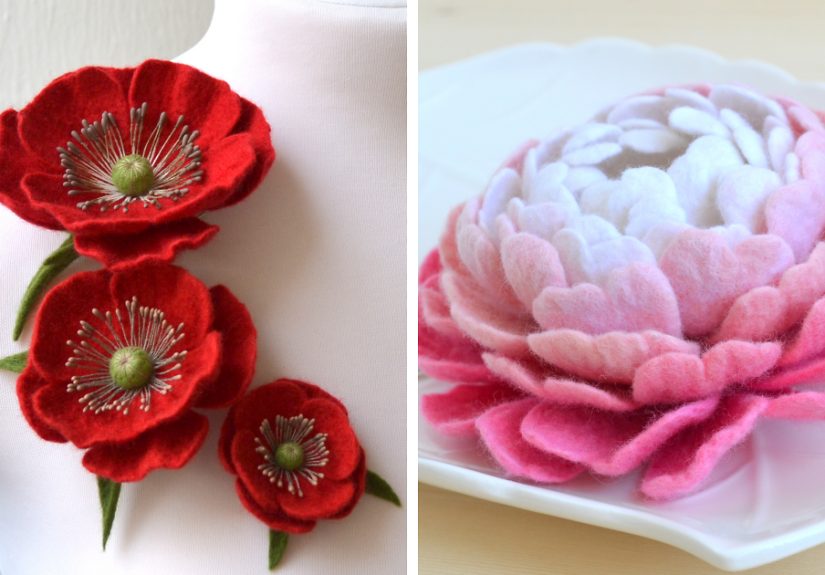
- Poppies: Their bold colors and dramatic centers make them perfect statement brooches. I love using deep reds, oranges, and even unexpected teal or plum.
- Roses: Soft layers, romantic curves, and endless color optionsfrom vintage blush pink to moody dark wine.
- Calla lilies: Elegant and sculptural, they’re ideal for more minimal outfits. I often blend white, cream, and subtle yellows, or go bold with burgundy and black.
- Hellebores and fantasy blooms: These let me play with unusual color combinations, like black petals with metallic threads or mossy green centers.
I keep a large palette of merino shades so I can mix and match: soft pastels for spring jackets, saturated jewel tones for winter coats, and vivid brights for bags and denim.
How to Style Felted Flower Brooches
A felted flower brooch is small, but it can change the whole mood of your outfit. Here are some of my favorite ways people wear them:
- On coats and jackets: Pin a single bold flower on the lapel of a trench coat, blazer, or denim jacket. It’s like wearing your own portable garden.
- On scarves and shawls: Use a brooch to secure a scarf in place and add a bit of color around your face.
- On hats and beanies: A small bloom on the side of a beret or wool hat adds instant personality.
- On bags: Clip a flower to the strap or pocket of a canvas tote or leather bag for a quick style upgrade.
- For weddings and events: Felted flowers can stand in for traditional corsages or boutonnieres, especially for fall and winter weddings where wool textures feel cozy and seasonal.
Because the brooches are light but sturdy, they work on everything from heavy wool coats to lighter cardigans and dresses.
How to Care for Felted Flower Brooches
Good news: merino wool is naturally resilient, and felted pieces can last for years with a bit of care. Here are some simple tips to keep your wearable garden blooming:
- Avoid soaking: Don’t machine wash or soak your brooch. If it gets a little dusty, gently pat it or use a soft brush to lift away surface dust.
- Spot clean only: For a small stain, use a damp cloth with a tiny amount of mild soap and dab gently. Don’t scrubyou don’t want to rough up the surface.
- Keep away from moth snacks: Store brooches in a box or on a covered display board in a dry, well-lit area. You can add cedar or lavender sachets to discourage moths.
- Avoid long-term direct sunlight: Just like real flowers, even wool colors can fade if left in strong sun for months.
- Shape them occasionally: If petals get slightly flattened in storage, you can gently reshape them with your fingers. A light steam from a distance can help, but keep the brooch backing dry.
Treat your brooch like a tiny piece of wearable art, and it will keep brightening outfits for seasons to come.
Why Handmade Felted Flowers Feel So Special
We live in a world of fast fashion where accessories often arrive in plastic packaging, identical by the thousands. A felted flower brooch is the opposite of that: slow, tactile, and full of small decisions made by human hands.
Every bloom carries the memory of the time it took to build itchoosing the fiber colors, blending shades, rolling and rubbing the petals, shaping each curve, and checking every stitch on the backing. When you wear one, you’re not just adding color to your outfit; you’re carrying a tiny story on your lapel.
Behind the Scenes: My Experiences Creating Felted Flower Brooches
Creating these felted flower brooches from merino wool has taken me on a journey that’s equal parts creative playground and wool-covered obstacle course. Since you made it this far, here’s the “extra footage” that doesn’t always make it into the tidy product descriptions.
My First “Flower” (If You Can Call It That)
My very first attempt at a felted flower was… not a flower. It was more like a slightly panicked pom-pom. I used too much soap, too much water, and approximately the patience of a toddler. The wool shrank into a lumpy ball with confused petals sticking out at odd angles. I pinned it to my coat anyway, partly out of pride and partly so I’d remember where I started.
That disaster taught me two important lessons: go lighter with the soap, and don’t rush the felting phase. Wool needs time to transform. If you’re just getting into wet felting, expect a few “abstract art” pieces before your flowers start looking like actual flowers.
Custom Orders and Favorite Stories
One of my favorite parts of making felted flower brooches is hearing why people want them. I’ve had customers ask for:
- A poppy brooch to honor a loved one who served in the military.
- A rose in a very specific shade to match a grandmother’s old scarf.
- A set of calla lilies as keepsake corsages for a small, intimate wedding.
These stories change the way I work. When I know a flower is connected to a memory, I spend extra time adjusting the color or reshaping a petal until it feels “right.” It turns the piece from “cute accessory” into something more personal and meaningful.
What the Studio Really Looks Like
On social media, you usually see the polished final shots: a neat row of brooches on a linen background, maybe a few leaves styled just so. The reality? My worktable is often covered in tiny bits of wool like colorful confetti. There’s a lineup of soap bars, jars of warm water, stacks of towels, and a rotating cast of half-finished flowers waiting for their centers.
There are days when I make only one brooch because it’s particularly detailed and layered. There are other days when I’m in the flow and an entire “bouquet” appears by evening. Either way, I end the day with pleasantly tired hands and a deep sense of calm that’s hard to find scrolling on a phone.
What I’ve Learned from Making Dozens of Flowers
After creating many, many felted flower brooches, a few truths keep repeating themselves:
- Perfect symmetry is overrated. Real flowers aren’t perfect, and the brooches look more alive when one petal sits slightly higher or folds differently than the rest.
- Color experiments are worth the risk. Some of my favorite pieces came from trying “wrong” color combinations that turned out unexpectedly gorgeous.
- People crave tactile things. At markets, people can’t resist reaching out to touch the brooches. The softness of merino wool surprises them every time.
Most importantly, I’ve learned that small, handmade objects can make a big emotional impact. A single flower pinned to a coat has sparked conversations between strangers, comforted someone on a tough day, or simply made the wearer smile whenever they catch a glimpse of it.
Why I Keep Coming Back to Merino Wool Flowers
I’ve tried other crafts, but I keep returning to merino wool and felted flowers because they sit at the sweet spot between art and utility. They’re beautiful, but they’re also wearable and practical. They’re delicate in appearance but surprisingly durable in daily life.
Every time I start a new brooch, I know it will end up somewhere far from my studioon a winter coat in a busy city, on a tote bag in a small town, or clipped to a scarf halfway across the world. That quiet connection is what keeps me buying more wool, mixing more colors, and creating new blooms, one petal at a time.
Conclusion: A Garden You Can Wear
My felted flower brooches from merino wool began as simple experiments and grew into a wearable bouquet of stories, colors, and textures. From laying out the first wisps of fiber to shaping the last petal and stitching on the backing, each piece is a slow, intentional act of making in a very fast world.
Whether you swap out brooches with the seasons or treasure a single favorite flower for years, I hope each one brings you a burst of color, a little joy, and a reminder that handmade things still matter. After all, a tiny garden on your lapel is the kind of small, delightful detail the world always needs more of.