Table of Contents >> Show >> Hide
- What Are Enchanted Books in Minecraft?
- What You Need Before You Can Use Enchanted Books
- How to Get Enchanted Books in Minecraft
- How to Use Enchanted Books in Minecraft (Step-by-Step)
- How to Combine Enchanted Books for Better Results
- Common Mistakes When Using Enchanted Books
- Best Enchanted Books to Prioritize
- Java vs. Bedrock Notes (Quick Reality Check)
- Advanced Tips for Smarter Enchanting
- Player Experiences: What I Wish More Players Knew About Enchanted Books (Extended Practical Notes)
- Conclusion
If Minecraft had a “make my gear ridiculous” button, it would be enchanted books. They’re one of the best ways to build custom tools, weapons, and armor without relying on pure luck from the enchanting table. Want Mending on your pickaxe? Want to stack strong effects on a sword? Want to stop burning XP on random enchantment rolls that feel like they were selected by a sleepy villager? Enchanted books are your answer.
In this guide, you’ll learn how to use enchanted books in Minecraft, where to get them, how to combine them, how to avoid expensive anvil mistakes, and which enchantments are worth saving for your “main character” gear. I’ll keep it practical, beginner-friendly, and just nerdy enough to make your next mining trip much less tragic.
What Are Enchanted Books in Minecraft?
Enchanted books are special items that store one or more enchantments. Instead of enchanting gear directly at an enchanting table, you can apply the enchantment later using an anvil. This gives you much more control over what goes onto your item.
Why players love them:
- Precision: Put the enchantment on the exact item you want.
- Flexibility: Save rare enchantments until you craft better gear.
- Efficiency: Applying a book can be cheaper than combining two already-enchanted items.
- Treasure enchantments: Some enchantments (like Mending) are commonly pursued via books and other loot/trading methods rather than table rolling.
What You Need Before You Can Use Enchanted Books
1) An Anvil
You cannot apply an enchanted book without an anvil. The crafting recipe is:
- 3 Iron Blocks
- 4 Iron Ingots
Yes, it’s a chunk of iron. Minecraft is basically saying, “If you want elite gear, pay the blacksmith tax.”
2) Experience Levels (XP)
Anvils require XP levels to apply enchantments. The cost depends on the enchantment, the item, and how many times that item has already been worked on in an anvil.
3) A Compatible Item
Not every enchantment can go on every item. For example, a bow enchantment won’t work on a sword. If the enchantment and item don’t match, the anvil won’t let you complete the combination.
How to Get Enchanted Books in Minecraft
Before you can use enchanted books, you need to collect them. Here are the most reliable ways:
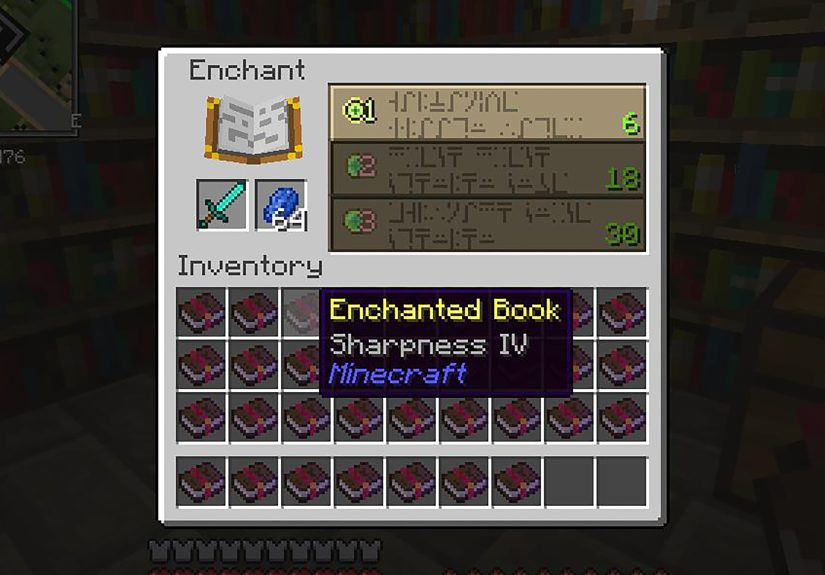
Enchant a Regular Book at an Enchanting Table
This is the most direct method early on. Place a normal book into an enchanting table with lapis lazuli and choose one of the available enchantments. It’s random, but it’s a great way to build a stockpile.
Pro tip: Set up 15 bookshelves around your enchanting table (with a one-block gap) to unlock stronger enchantment options up to level 30. That bookshelf ring is basically your magical home gym.
Loot Chests in Structures
Enchanted books can appear in structure loot chests across the world. This is a great source of rare or high-value enchants, especially when exploring mid-game and late-game areas.
Trade with Librarian Villagers
This is one of the best methods for hunting specific enchantments. Librarian villagers can sell enchanted books, and many players use villager trading setups to roll for favorites like Mending, Unbreaking, or Silk Touch.
Fishing (Treasure Loot)
Fishing can reward enchanted books as treasure. It’s not always the fastest method, but if you already enjoy fishing (or you’re roleplaying as the world’s most overqualified fisherman), it can pay off.
Special Sources for Certain Enchantments
Some enchantments are tied to particular activities or locations. For example, certain book enchants are associated with specific loot pools or systems (such as bartering or structure-exclusive loot), so if you’re chasing a very specific enchantment, it’s smart to look up the best source instead of spamming random table rolls.
How to Use Enchanted Books in Minecraft (Step-by-Step)
Here’s the core process for applying an enchanted book:
- Place the anvil and open it.
- Put the item you want to enchant in the first slot (left slot).
- Put the enchanted book in the second slot.
- Check the result preview to confirm the enchantment applies correctly.
- Pay the XP cost and take your upgraded item.
That’s it. No dramatic ritual. No moon phase requirement. Just iron, XP, and smart planning.
Example: Adding Mending to a Pickaxe
- Place your diamond or netherite pickaxe in slot one.
- Place a Mending enchanted book in slot two.
- Pay the anvil XP cost.
- Take your pickaxe and enjoy far fewer “well… time to craft another one” moments.
How to Combine Enchanted Books for Better Results
You can combine enchanted books with other enchanted books in an anvil. This is one of the best ways to build high-level gear while managing anvil costs.
How Combining Works
- If two books have the same enchantment and same level, they can combine into the next level (if a higher level exists).
- If books have different compatible enchantments, they can merge into a single multi-enchantment book.
- If an enchantment on the book is not compatible with the target item, it won’t transfer.
Example:
Sharpness III + Sharpness III = Sharpness IVUnbreaking III + Efficiency Vcan become one powerful utility book (if combined in the right order and used on a compatible tool)
Smart players often combine books first, then apply the final combo book to the target item. This can help reduce total costs compared with repeatedly modifying the item itself.
Common Mistakes When Using Enchanted Books
1) Applying Books to “Temporary” Gear
Don’t slap your best enchantments onto iron gear unless you absolutely need to. Save top books for diamond or netherite items when possible.
2) Ignoring Enchantment Compatibility
Some enchantments conflict. A classic example is damage enchantments like Sharpness, Smite, and Bane of Arthropods on the same weapon type. Plan your build before you spend XP.
3) Triggering “Too Expensive!” on the Anvil
The more times an item is worked on in an anvil, the more expensive future work becomes. If you repeatedly rename, repair, and add books one at a time, the item can eventually hit the dreaded “Too Expensive!” limit in Survival.
How to reduce the risk:
- Combine books together first.
- Apply multiple enchantments in fewer total anvil operations.
- Avoid unnecessary renames/repairs on your endgame gear.
- Plan your final enchant set before starting.
4) Forgetting the Grindstone Exists
If you’re experimenting and end up with a bad enchantment on an item, a grindstone can remove many enchantments (with some exceptions like curses). It’s a useful reset tool before you commit your rare books.
Best Enchanted Books to Prioritize
The “best” enchantments depend on your playstyle, but these are consistently excellent:
For Tools
- Efficiency – Faster mining/chopping/digging
- Unbreaking – More durability
- Mending – Repairs with XP
- Silk Touch or Fortune – Pick based on resource goals
For Weapons
- Sharpness (or Smite/Bane for specialized builds)
- Looting – Better mob drops
- Fire Aspect – Extra damage + accidental barbecue
- Unbreaking / Mending
For Armor
- Protection (general use)
- Feather Falling (boots; saves lives constantly)
- Respiration / Aqua Affinity (helmets for underwater play)
- Unbreaking / Mending
For Bows and Fishing Rods
- Power, Infinity (bow builds)
- Luck of the Sea and Lure (fishing efficiency)
Java vs. Bedrock Notes (Quick Reality Check)
The core method for using enchanted books is the same in both Java Edition and Bedrock Edition: use an anvil, combine the item with the book, pay XP, done. However, some enchantment availability, edge cases, and platform-specific behaviors can vary by edition and version.
If you’re following a build guide and something seems “wrong,” check whether that guide was written for Java or Bedrock. Minecraft loves consistency the way creepers love personal space.
Advanced Tips for Smarter Enchanting
Build an Enchantment Pipeline
Instead of enchanting only when you need something, keep a chest for:
- Good enchanted books
- “Maybe later” books
- Villager trade bargains
- Combined endgame books (ready to apply)
This saves time and prevents panic-enchanting when your pickaxe breaks in the middle of a giant mining project.
Use Books to Reroll Enchanting Table Options
If the enchanting table gives you terrible options, enchanting a book (or another cheap item) can refresh the table’s offerings. This is a handy strategy when hunting a specific enchantment path without wasting your best gear.
Plan Endgame Gear Before Touching the Anvil
Write down your target enchantments for each item. It sounds extra, but it works. Minecraft turns into spreadsheet simulator surprisingly fast once you care about perfect gear.
Player Experiences: What I Wish More Players Knew About Enchanted Books (Extended Practical Notes)
One of the most common experiences players have with enchanted books is the “I found a rare book too early” dilemma. You’re in early survival, wearing mixed armor, and suddenly you get a great book from fishing or a village trade. The instinct is to use it immediately because shiny things are exciting. But the smarter move is usually to stash it and wait until you have gear you’ll keep for a long time. Applying a top-tier book to a throwaway item feels great for about ten minutes, and then you upgrade that item and regret everything.
Another experience a lot of players share is learning anvil costs the hard way. At first, it seems harmless to keep improving the same tool little by little: one enchantment now, another later, maybe a rename because “Dragon Shovel” is objectively a great name. Then suddenly the anvil starts charging way more XP than expected, and eventually you run into cost limits. This is where planning pays off. Combining books first and doing fewer total operations on the final item makes a massive difference. It’s one of those Minecraft lessons that turns you from “surviving” into “running the place.”
Villager trading is also a huge turning point in player experience. The first time you build a simple librarian setup and realize you can target important books instead of gambling endlessly at the enchanting table, the game changes. You stop feeling stuck behind random rolls and start building gear intentionally. For many players, this is when Minecraft begins to feel less like luck and more like strategy.
There’s also the emotional arc of finally getting Mending. Before that, tools feel temporary. After that, your favorite pickaxe becomes a long-term companion. You start caring more about XP collection routes, mob farms, and how you manage repairs. A lot of players remember the exact moment they got their first Mending book because it changes how they approach mining, exploration, and gear progression.
And finally, experienced players often say the same thing: enchanted books are not just about powerthey’re about control. They let you build gear that matches your playstyle. Speed miner? Combat-focused adventurer? Careful builder who falls off roofs too often? (Feather Falling says hello.) Once you understand how to use books properly, Minecraft becomes less frustrating and far more creative. You spend less time wrestling with bad enchantment luck and more time actually building, exploring, fighting, and doing the fun stuff that made you open the game in the first place.
Conclusion
Learning how to use enchanted books in Minecraft is one of the biggest upgrades you can make to your gameplay. The process is simpleget an anvil, combine the right item with the right book, and pay the XP costbut the strategy behind it is what separates basic gear from legendary loadouts.
If you remember only three things, make it these: save rare books for permanent gear, combine books before applying them, and plan your enchantment order so the anvil doesn’t punish your ambition. Do that, and your tools, armor, and weapons will start feeling less like disposable equipment and more like a custom-built kit.