Table of Contents >> Show >> Hide
- Start Here: The 3 Questions That Decide the Whole Layout
- The 5 Best Two-Sofa Layouts (and When to Use Each)
- Spacing Rules That Make Two Sofas Feel “Right”
- Choose the Right Sofa Pairing: Matchy-Matchy or Mix It Up?
- Examples: Two-Sofa Layouts for Real Rooms
- Common Two-Sofa Mistakes (and the Fixes)
- Styling Tricks That Make Two Sofas Look Intentional
- of Real-World Experience: What It Actually Feels Like Living With Two Sofas
- Conclusion
Two sofas in one living room sounds like a luxury… until you realize you’ve basically adopted two large, opinionated
rectangles that both want the best seat in the house. The good news: arranging two sofas isn’t hard once you
stop thinking “Where do these go?” and start thinking “What do I want this room to do?”
Whether you’re hosting game nights, corralling kids, binge-watching shows, or just trying to keep your coffee from
living on the floor, this guide walks you through the most reliable two-sofa layouts, spacing rules that actually
make the room feel comfortable, and real-life fixes for awkward windows, doors, fireplaces, and TVs.
Start Here: The 3 Questions That Decide the Whole Layout
1) What’s the “main character” of the room?
Most living rooms have a natural focal point (fireplace, TV, big window, built-ins). Choose the one that matters
most to your life. If you watch TV daily, treat that as primary. If you entertain and talk more than you
stream, prioritize conversation. Your layout gets dramatically easier once you pick what “wins.”
2) Where does traffic naturally want to move?
Before you move anything, walk through the room the way you normally dofrom doorways, hallways, and open-plan
connections. You’re looking for “desire paths” (the routes people instinctively take). A great two-sofa arrangement
protects those routes so no one has to shuffle sideways like a crab holding a plate of snacks.
3) What is the room’s shape and problem area?
Rectangular rooms tend to prefer parallel or face-to-face seating. Square rooms love an L-shape. Open-concept
spaces often need a “floating” sofa to create a boundary. And problem areaslike an off-center fireplace, too many
doors, or a giant windowneed a layout that works with them instead of fighting them.
The 5 Best Two-Sofa Layouts (and When to Use Each)
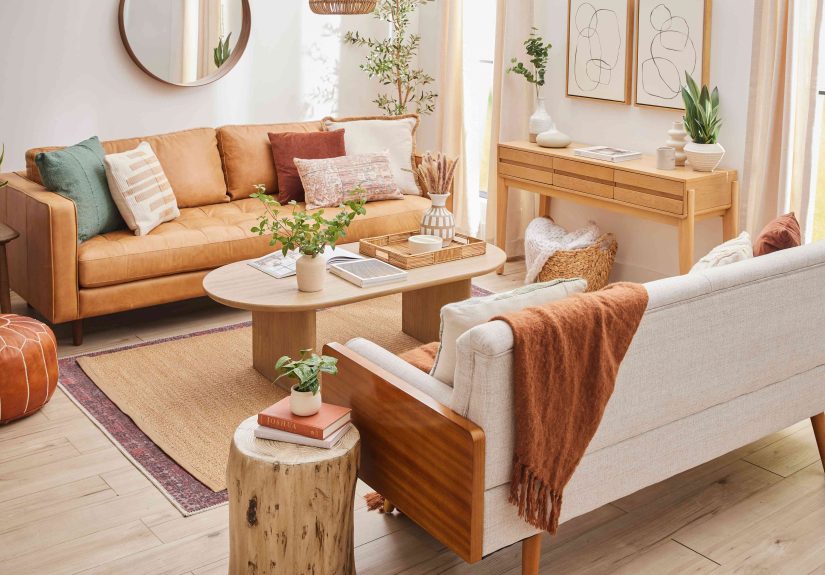
1) Face-to-Face (Parallel Sofas): The Conversation Classic
This is the “grown-up” layout people imagine in magazines: two sofas directly opposite each other with a coffee
table (or ottoman) in the middle. It’s excellent for conversation, entertaining, and making a living room feel
intentional instead of “we just put furniture where it fit.”
Best for: Rectangular rooms, formal living rooms, homes that host often, fireplace-centered spaces.
Watch out for: TV viewing (it can feel like you’re sitting in a polite debate club).
- Pro tip: If you still want TV access, angle one sofa slightly or use swivel chairs so some seats
can pivot toward the screen without wrecking the conversation zone. - Keep the center grounded: a rug big enough that at least the front legs of both sofas sit on it looks cohesive and
stops the space from feeling “floaty.”
2) L-Shape (Perpendicular Sofas): The Cozy, Flexible Crowd-Pleaser
Place one sofa along a wall or facing the focal point, then position the second sofa at a 90-degree angle to form an
L. This layout is less formal, makes it easy to chat and watch TV, and naturally creates a cozy corner without
needing a sectional.
Best for: Square rooms, family rooms, TV-friendly setups, smaller spaces.
Watch out for: Blocking pathways at the “inside corner” of the L.
- Put the coffee table/ottoman near the “elbow” of the L so both sofas can reach it comfortably.
- If the room feels tight, choose a round or oval coffee tablefewer bruised shins, more graceful traffic flow.
3) Floating + Wall Sofa: The Open-Plan Space Divider
In open-concept homes, one sofa can “float” with its back toward the dining area or kitchen, acting like an invisible
wall. The second sofa faces it (or sits perpendicular) to complete the living zone. This is how you make a large,
undefined space feel like it has rooms inside it.
Best for: Open floor plans, combined living/dining rooms, large spaces that feel echo-y.
Watch out for: Forgetting a landing spot behind the floating sofa (you’ll want at least a clear walkway).
- Add a sofa table or narrow console behind the floating sofa to make it look finished and to prevent the “back of
couch” vibe. - Anchor everything with a generously sized rug so the living zone reads as one coherent area.
4) Angled Sofas: The “My Room Is Weird” Solution
If your living room has odd angles, an off-center fireplace, or a tight door swing, angling one (or both) sofas can
unlock better flow. This reduces the “bowling alley” feeling long rooms sometimes get and makes the layout feel more
relaxed.
Best for: Awkward room geometry, diagonal fireplaces, tricky door placement.
Watch out for: Wasting too much space behind angled furniture (measure before committing).
- Use a round rug or round coffee table to make angled seating feel intentional instead of accidental.
- Keep angles subtlethink “slightly turned toward the focal point,” not “we live on a ship.”
5) Two Sofas + Extra Seat (U-Shape Vibe): The Entertaining Upgrade
If you have room, two sofas plus a pair of chairs (or one oversized chair) creates a U-shaped conversation area.
It’s welcoming, balanced, and makes guests feel included instead of lined up like they’re waiting for a bus.
Best for: Large living rooms, frequent hosting, families who want seating options.
Watch out for: Overcrowdingleave breathing room so the furniture doesn’t feel like it’s in a group hug.
Spacing Rules That Make Two Sofas Feel “Right”
You don’t need to memorize a textbook of measurementsbut a few rules of thumb can turn “clunky” into “designer
approved.”
Quick spacing cheat sheet
- Walkways: Aim for about 30–36 inches in main paths so people can move comfortably through the room.
In lower-traffic gaps, you can often get away with roughly 24 inches. - Coffee table to sofa: About 16–18 inches is a sweet spot for legroom and reach. (Close enough for
your drink, far enough for your knees to keep their dignity.) - Conversation distance: Keep seating close enough that people can chat without raising their voices.
As a practical guideline, try to keep the main seats within about 8–10 feet of each other. - Rug sizing: Bigger is usually better. Ideally, place at least the front legs of both sofas on the
rug so the seating area feels anchored.
Choose the Right Sofa Pairing: Matchy-Matchy or Mix It Up?
Option A: Two identical sofas (clean, classic, calm)
Matching sofas create instant symmetry and a polished lookespecially in face-to-face layouts. If you love a tidy,
balanced room, this is the easiest path to “I totally meant to do that.”
How to keep it from feeling sterile: vary throw pillows, add different side tables, or choose a coffee table with a contrasting shape (like an oval table between boxy sofas).
Option B: Two different sofas (layered, interesting, more forgiving)
Mixing sofas can look more collected and personal. The trick is giving them a shared “thread”similar seat height,
a related color family, matching leg style, or consistent texture (like two sofas in different neutrals).
- Easy mix: one sofa in a solid neutral, one in a subtle texture (bouclé, tweed, performance fabric).
- Bold mix: one sofa with clean lines, one with softer armsunited by matching pillows or a shared rug palette.
Examples: Two-Sofa Layouts for Real Rooms
Example 1: Small apartment living room (about 12′ x 14′)
Use an L-shape. Put your primary sofa facing the TV (or window), and a smaller sofa/loveseat perpendicular. Choose a
round coffee table to improve flow. Keep side tables slim. Add a rug that fits under the front legs of both sofas to
visually “merge” them into one zone.
Example 2: Long, narrow living room
Try face-to-face sofas if the width allows it, but keep the walkway clear at one end so the room doesn’t become a
furniture tunnel. If the room is too narrow for parallel sofas, place one sofa along the long wall and float the
second slightly opposite it (not flush to the wall) so the seating still feels connected.
Example 3: Open concept living + dining
Float one sofa with its back to the dining zone to define the living area. Place the second sofa facing it, or form
an L. Add a console behind the floating sofa and use a large rug to “draw the border” of the living room without
building a wall.
Example 4: Fireplace + TV both competing for attention
Decide which one is primary. If TV is primary, angle seating so at least most seats can see it comfortably. If the
fireplace is primary, use face-to-face sofas centered on it and place the TV off to the side (or use swivel chairs)
so TV viewing is possible without making the entire room revolve around the screen.
Common Two-Sofa Mistakes (and the Fixes)
Mistake: Pushing everything against the walls
It feels like you’re making the room biggerbut it often creates a dead zone in the center and makes conversation
awkward. Pull sofas in (even a few inches) so the seating area feels intentional and connected.
Mistake: A rug that’s too small
A tiny rug can make two big sofas look like they’re hovering over an island. Go bigger so the seating group feels
anchored. If you’re unsure, size upyour room will usually look more finished.
Mistake: No “landing spots” for drinks
Two sofas need a strong support team: a coffee table and/or side tables. Make sure every seat has easy access to a
surface. Otherwise, you’ll find cups on windowsills, and that’s how rings happen.
Mistake: Blocking doors or creating a pinch point
If you keep bumping into furniture, the layout isn’t “cozy”it’s “obstacle course.” Protect the main pathway first,
then build the seating zone around it.
Styling Tricks That Make Two Sofas Look Intentional
- Use symmetry… then soften it: Start balanced (matching lamps, similar side tables), then add a
slightly different accent chair, a textured throw, or a unique coffee table to keep the room from feeling too formal. - Vary shapes: Two rectangular sofas love an oval table, a round ottoman, or a curved chair to break up the boxiness.
- Layer lighting: Pair overhead lighting with floor lamps and table lamps so the seating area feels warm at night.
- Repeat a color on purpose: Echo one accent color in pillows, art, and a small decor piece so the room feels connected (not chaotic).
of Real-World Experience: What It Actually Feels Like Living With Two Sofas
Here’s the part no one tells you: arranging two sofas isn’t just a design puzzleit’s a lifestyle decision. Two sofas
will reveal exactly how you use your living room, because they’ll either support your habits or quietly roast you
every day.
For example, the face-to-face layout looks amazing in photos, but in real life it changes the “default behavior” of
the room. People talk more. Phones come out less. Snacks travel in a more civilized circle. But if your household is
TV-centered, you may notice everyone slowly migrating to the sofa with the best screen angle like it’s a sunflower
following the sun. The fix is rarely “ditch the layout”it’s adding one flexible seat (like a swivel chair) so TV
viewers can rotate without turning conversation into neck yoga.
The L-shape layout is the daily-driver of two-sofa living. It’s the one that survives real life: kids building pillow
forts, a friend stretching out for a nap, someone perching on the corner during a party. But the L-shape has one
sneaky downsideclutter collects in the “corner zone.” That inside corner becomes a magnet for remote controls,
throw blankets, and the mysterious hair tie that apparently pays rent. If that corner is always messy, it’s not a
personal failure; it’s a design cue. Add a small tray on an ottoman, a basket beside the sofa, or a side table at
the elbow so your stuff has a home.
In open-concept spaces, the floating-sofa layout feels weird for exactly one afternoonand then you’ll wonder how you
ever lived with everything shoved against the walls. Floating a sofa makes the living room feel like a defined place,
not a furniture spill. The “experience upgrade” comes from what happens behind the sofa: a console table for keys,
chargers, and mail; a lamp that makes evenings cozier; and a clear walkway that keeps traffic from cutting through
your conversation zone.
The biggest real-world lesson is that comfort is geometry. When the coffee table is too far, people lean forward and
never fully relax. When it’s too close, knees complain. When pathways are tight, everyone moves cautiously, like
they’re carrying a full cup of soup. A few inches can change the mood of the whole room. So if your two-sofa setup
feels “almost right,” don’t start shopping in a panic. First, nudge: slide the rug, pull the sofas in, swap a square
table for a round one, or rotate one sofa slightly. In most homes, the perfect layout isn’t discoveredit’s
dialed in.
Conclusion
The best way to arrange two sofas in a living room is the one that supports how you actually live: conversation,
lounging, TV time, hosting, or all of the above. Start with the focal point, protect your traffic flow, pick a layout
that matches the room’s shape, and use simple spacing rules to keep everything comfortable. Once the big pieces are
right, the room will feel less like “furniture storage” and more like a place people want to hang out.