Table of Contents >> Show >> Hide
- First: What Kind of “Laurel” Do You Have?
- When to Prune Laurel: The Practical Calendar
- Tools and Prep: Set Yourself Up for Clean Cuts
- How to Prune Laurel Bushes (Not Hedges): The Healthy Shrub Method
- How to Prune Laurel Hedges: Thick, Green, and Not Bald at the Bottom
- Renovating an Overgrown Laurel: Two Reliable Strategies
- Aftercare: Help Your Laurel Bounce Back Fast
- Common Laurel Pruning Mistakes (And How to Avoid Them)
- Quick FAQ
- Experience-Based Tips: What Gardeners Learn Pruning Laurels (The Fun Way… or the Hard Way)
- 1) The hedge always looks worse before it looks better
- 2) String lines are a confidence booster
- 3) Broad leaves + power trimmers = temporary “brown confetti”
- 4) The bottom goes bare because of shade, not because the plant “hates you”
- 5) Renovation pruning is emotionally dramatic but horticulturally normal
- 6) Timing mistakes usually show up as “Where did my flowers go?”
- 7) The “one big weekend chop” is temptingstaged pruning is kinder
- 8) Cleanup is part of pruning (and yes, it matters)
- Sources Consulted (No Links, Just Transparency)
Laurels are the overachievers of the shrub world: glossy leaves, fast growth, great privacy… and an occasional urge to
swallow your walkway like it’s an all-you-can-eat buffet. The good news? Most laurel bushes and laurel hedges respond
beautifully to smart pruning. The better news? “Smart pruning” does not require a gardening degreejust good timing,
sharp tools, and the ability to step back and say, “Yep, I did that on purpose.”
This guide covers the best time to prune laurel (by type), how to shape laurel hedges so they stay thick from top to
bottom (no sad, see-through legs), and what to do when your once-tidy screen has turned into a green wall of mystery.
I’ll also share experience-based tips gardeners commonly learn the hard wayso you don’t have to.
First: What Kind of “Laurel” Do You Have?
“Laurel” is a popular nickname, not a single plant. In U.S. landscapes, the shrubs people call laurel commonly include:
cherry laurels (Prunus species), bay laurel (the cooking herb), and mountain laurel (a native flowering shrub). Pruning
timing depends on whether the plant blooms on old wood (last year’s growth) or new wood (this year’s growth), and that
changes your “safe window” dramatically.
Cherry laurel / English laurel (Prunus laurocerasus) and Portuguese laurel (Prunus lusitanica)
These are classic evergreen hedge plants with broad, shiny leaves and spring flower spikes. They can be kept informal
(natural look) or trained into a hedge. They tolerate pruning well, but broad leaves can look ragged if you shear them
like a boxwood.
Carolina cherry laurel (Prunus caroliniana)
A North American native often grown as a dense screen or hedge with regular pruning. It’s vigorous and adaptable, but
it’s still a broadleaf evergreenso technique matters if you want a “clean” look without leaf browning.
Bay laurel (Laurus nobilis)
This is the culinary bay leaf plant, grown as a shrub, small tree, container topiary, or (in warm climates) a formal hedge.
It’s slower growing than cherry laurel, but it takes shaping very well.
Mountain laurel (Kalmia latifolia)
A spring-blooming evergreen shrub native to the eastern U.S. It’s prized for flowers, not for being a clipped hedge.
Prune it differently: you’ll usually prune lightly and right after flowering to avoid removing next year’s buds.
Quick ID tip: If your “laurel hedge” has long, glossy, oval leaves and grows fast, it’s probably a cherry laurel
(Prunus). If it smells like soup seasoning when you crush a leaf, it may be bay laurel. If it has showy spring clusters
of pink/white flowers and grows more slowly, it may be mountain laurel.
When to Prune Laurel: The Practical Calendar
There isn’t one perfect date for the entire U.S. because growing seasons vary, but there is a reliable strategy:
do your bigger, structural cuts when the plant can recover fast and you won’t trigger tender growth right before cold.
Then do small “haircuts” when new growth is active and the hedge can fill in.
Best windows (most laurels)
-
Late winter to early spring: Great for structural pruning, size control, removing older wood, and setting the basic shape
before the main flush of growth. -
After flowering (late spring to early summer): Best for spring-blooming laurels if you care about flowers.
You get shape control without sacrificing next year’s bloom display. - Mid-summer touch-ups: Light trimming is okay if needed, but keep it conservativeespecially in hot spells or drought.
Times to avoid (in most regions)
-
Late summer into fall (often August–October): Heavy pruning can push a fresh flush of growth that doesn’t harden off
before cold snaps in many climates. - During drought or extreme heat: You’ll stress the plant when it’s already struggling to balance water loss.
- When foliage is wet: Open cuts + wet leaves can increase the odds of disease moving around the plant.
A simple “when to prune laurel” chart
| Laurel type | Primary prune time | Optional light trim | Big caution |
|---|---|---|---|
| Cherry laurel / Portuguese laurel (Prunus) | Late winter–early spring OR just after flowering | Early to mid-summer | Avoid heavy pruning in fall; avoid shearing leaves into confetti |
| Carolina cherry laurel (Prunus caroliniana) | Late winter–early spring for structure | After spring flush, light shaping | Don’t remove too much at once; keep hedge wider at base |
| Bay laurel (Laurus nobilis) | Late winter–spring shaping | Summer tip-pruning for form | Container plants dry out fast after pruningwater management matters |
| Mountain laurel (Kalmia latifolia) | Immediately after flowering | Minimal; mostly dead/damaged wood | Pruning at the wrong time can remove next year’s buds |
Tools and Prep: Set Yourself Up for Clean Cuts
Pruning can be meditative… until your pruners crush a stem and leave a jagged tear that looks like your shrub lost a bar fight.
Clean cuts heal better. Use the right tool for the branch size:
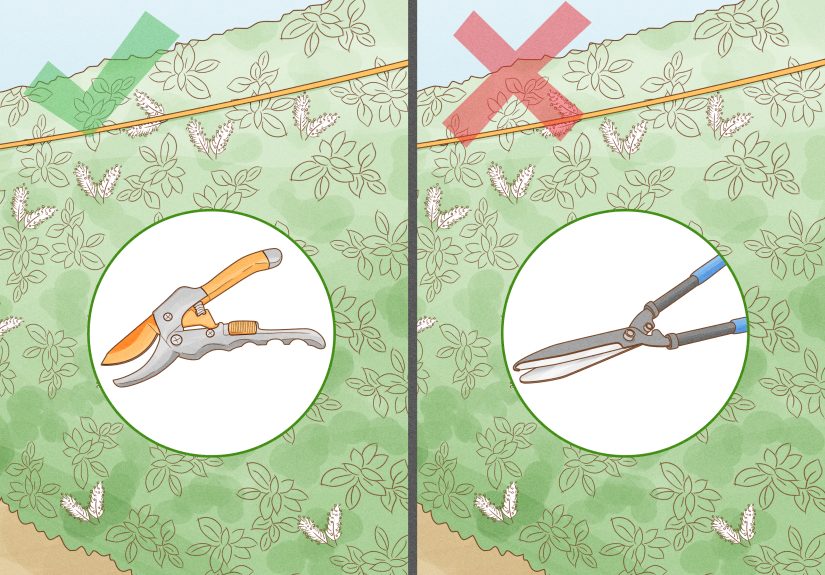
- Bypass hand pruners: Best for small stems; cleaner cuts than anvil-style for most shrubs.
- Loppers: For thicker stems that would make hand pruners cry.
- Pruning saw: For old, woody stems or big renovation cuts.
- Hedge shears or trimmer (use carefully): Fine for small-leaved hedges; can brown broad leaves on laurels.
Before you cut: Walk the hedge, look from multiple angles, and decide your goal:
privacy screen, formal “wall,” or a natural shrub line. Then mark the target height with stakes and string if you’re shaping a long hedge.
Your eyes are good, but string is better (and doesn’t get distracted by squirrels).
How to Prune Laurel Bushes (Not Hedges): The Healthy Shrub Method
For a laurel bush that’s meant to look natural, the goal is to keep it full, vigorous, and appropriately sized without turning it into a green brick.
That means using selective cutsnot constant shearing.
Step 1: Remove the “3 Ds” anytime
- Dead branches (brittle, leafless, clearly not coming back)
- Damaged branches (split, broken, rubbed raw)
- Diseased branches (discolored, oozing, unusually spotted leaves tied to that stem)
Cut dead or damaged stems back to a healthy side branch or to the basedon’t leave stubs. Stubs don’t “heal,” they just become tiny porch rentals for pests.
Step 2: Thin for light and airflow
Laurel shrubs can get dense on the outside and bare inside if you only “haircut” the surface. Instead, remove a few older stems
from near the base (or where they originate) to open the interior and encourage fresh growth.
A solid guideline: don’t remove more than about 25% of the live growth in one season unless you’re doing a planned renovation
(and the plant is known to tolerate it). If you’re not sure, prune less now and more later. Plants rarely complain about patience.
Step 3: Reduce size with smart cuts (not random chopping)
If a laurel is outgrowing its space, shorten long branches by cutting them back to a smaller side branch. This is called a
thinning cut (it removes a whole branch) or a reduction cut (it reduces length to a lateral branch). These cuts look
more natural than “heading cuts” that leave a lot of stubs and trigger a burst of awkward shoots.
How to Prune Laurel Hedges: Thick, Green, and Not Bald at the Bottom
Pruning a laurel hedge is part plant care, part geometry. If you do only one thing right, make it this:
keep the base wider than the top. This lets sunlight hit lower branches, so the hedge stays leafy all the way down.
A hedge that’s wider at the top becomes a shade umbrellaeventually the bottom thins out and looks like it’s wearing skinny jeans.
Hand pruners vs. shears: why laurels can “brown” after trimming
Many laurels have broad leaves. When you shear them, you often slice through leaves instead of stems. Those cut leaf edges can turn brown,
which makes the hedge look “crispy” for weeks. If you want the cleanest look, use hand pruners to selectively cut stems, especially on the
most visible parts of the hedge.
If you do use a hedge trimmer (and plenty of people do), treat it like a light shaping toolthen come back with hand pruners to fix
obvious leaf-slice zones and to thin the interior so it doesn’t become a leafy shell with a hollow center.
Step-by-step: shaping a laurel hedge (the “string line” method)
- Pick your timing: Late winter/early spring for structure, or just after flowering for spring bloomers.
- Set a guide: Use stakes and string to mark the top height. For long runs, do this in 8–12 foot sections so the line stays taut.
- Establish the profile: Aim for a slight taperwider at the bottom, narrower at the top. Even a small angle helps.
- Make the big cuts first: Remove thick stems that stick out, cross, or crowd the center. Use loppers or a saw.
-
Then refine: Use pruners or shears to bring the surface into line. Step back every few minutes and view from multiple angles.
(Your hedge looks different from the driveway than it does from two feet awaytrust me.) - Finish with “air holes”: Every few feet, thin small interior twigs so light can reach inside. This helps prevent a bare interior over time.
How often should you prune laurel hedges?
For most cherry laurel-type hedges, one to two prunes per year is typical:
- Once per year: Informal hedges or screens where you just want containment and health.
- Twice per year: Formal hedges where you want crisp lines (usually a main prune plus a light summer touch-up).
More frequent shearing can create a very dense outer layer while the interior declines. If your hedge is starting to look lush on the outside
but sparse inside, switch to selective thinning and reduce how often you shear.
Renovating an Overgrown Laurel: Two Reliable Strategies
When a laurel hedge gets too tall, too wide, or too woody, you basically have two options: renewal pruning (gradual)
or rejuvenation pruning (dramatic). Which one you choose depends on the plant’s tolerance and how patient you feel.
Option A: The 3-year renewal plan (safer, steadier)
Renewal pruning means removing a portion of the oldest stems close to the base each year. It keeps the hedge alive and functional while
gradually replacing old wood with new growth.
- Year 1: Remove about one-third of the oldest, thickest stems near the base. Lightly shape the remaining growth.
- Year 2: Remove another one-third of old stems. Tip-prune new shoots to encourage branching.
- Year 3: Finish removing remaining old stems as needed and refine the final shape.
This approach is excellent if you can’t stand the idea of a temporary “bare phase” or if the hedge is providing important privacy.
Option B: Rejuvenation pruning (the bold reset)
Rejuvenation pruning is the “cut it back hard and let it regrow” method. Many multi-stem shrubs can be cut back dramatically in early spring,
often to within several inches of the ground, to force vigorous new shoots. This is most appropriate when the plant is truly out of control,
leggy, or hollowand you’re okay with a recovery period.
Important: Not all evergreens tolerate severe pruning equally. Before you go full lumberjack, verify your plant type and consider a
staged renovation if you’re unsure. If you’re dealing with cherry laurel-type shrubs that are known to handle pruning, a hard reset can work well
but you’ll still want strong aftercare (water management, mulching, and patience).
Aftercare: Help Your Laurel Bounce Back Fast
Pruning is a stress. A manageable stresslike a workoutbut still a stress. Help the plant recover:
- Water deeply during dry spells, especially for the first season after major pruning.
- Mulch 2–3 inches deep (keep it off the stems) to moderate soil moisture and temperature.
- Skip heavy fertilizer unless a soil test shows a deficiency. Too much nitrogen can cause weak, floppy growth.
- Watch for pests and disease on stressed plants; address issues early rather than “hoping it gets over it.”
Common Laurel Pruning Mistakes (And How to Avoid Them)
Mistake #1: Making the hedge wider at the top
This is the fastest way to create a bare-bottom hedge. Fix it by gradually tapering the sides so the base is slightly wider than the top.
If the bottom is already thin, you may need gradual renewal pruning to stimulate new growth lower down.
Mistake #2: Shearing only the surface, forever
Constant surface trimming can create a dense “outer skin” that blocks light from the interior. Add thinning cuts: remove select stems inside the hedge
and occasionally remove older stems near the base.
Mistake #3: Pruning too late in the season
Late-season heavy pruning can push soft new growth at the wrong time in many climates. A safer rule: do most structural pruning in late winter/early spring,
then stop major trimming by late summer in regions with cold winters.
Mistake #4: Pruning mountain laurel at the wrong time
If you prune mountain laurel in fall or early spring, you may remove buds that were set earlier. If flowers matter, prune right after bloom and keep it light.
Quick FAQ
Can I prune laurel in winter?
In many areas, late winter to early spring is a prime time for structural pruning. If you’re in a region with harsh winters, avoid pruning during extreme cold snaps.
Wait until the worst weather has passed and spring growth is approaching.
How do I keep a laurel hedge from getting too tall?
Reduce height gradually and maintain it with a consistent pruning schedule. If it’s already too tall, consider a staged reduction over multiple seasons so you don’t
shock the hedge or create big bare zones that take forever to fill.
Why are my laurel leaves turning brown after trimming?
Often it’s leaf edges that were sliced by shears or a hedge trimmer. It’s mainly cosmetic. For a cleaner look next time, use hand pruners to cut stems rather than
slicing across leavesespecially on broadleaf types like cherry laurel.
Is laurel toxic?
Some plants commonly called “laurel” contain toxic compounds and should not be eaten by people or pets. Keep clippings away from kids and animals, and don’t assume
“laurel” means “edible bay leaves.”
Experience-Based Tips: What Gardeners Learn Pruning Laurels (The Fun Way… or the Hard Way)
The internet loves a perfect pruning diagram. Real life loves… rain, uneven ground, and that one neighbor who chooses the exact moment you start trimming to ask
whether you’ve “ever thought about growing avocados.” With that in mind, here are real-world lessons gardeners commonly share about pruning laurel bushes and hedges.
Think of these as the “been there, snipped that” section.
1) The hedge always looks worse before it looks better
This is normal, especially if you’ve been avoiding pruning for a couple seasons. The first pass removes the obvious chaoslong whips, leaning stems, and the “one
branch that has clearly been training for the Olympics.” The hedge can look thinner right after you open it up. Give it a few weeks of active growth and it will
usually fluff back out. The secret is that thinning cuts improve light penetration, so the plant can rebuild density from the insidenot just the outside.
2) String lines are a confidence booster
Plenty of people try the “I’ll just eyeball it” approach once. The second time, they use string. A taut line helps prevent the classic hedge problem:
it starts level, then slowly drifts upward until you’re trimming at shoulder height wondering how you got there. Use string for the top, and if you’re aiming for
a formal look, consider a second line for the side profile so your taper stays consistent.
3) Broad leaves + power trimmers = temporary “brown confetti”
If you shear cherry laurel hard with a hedge trimmer, you’ll likely slice through a lot of leaves, and the cut edges can brown. This doesn’t mean you “killed”
the hedge; it means you gave it a haircut with a blender. Some gardeners accept that trade-off for speed. Others compromise:
use the trimmer for rough shaping, then switch to hand pruners for the visible front edge and for selective thinning.
4) The bottom goes bare because of shade, not because the plant “hates you”
Bare-bottom hedges are usually a sunlight problem. When the top is wider than the base, the upper foliage blocks light. Over time, lower branches weaken and drop
leaves. The fix is geometry: taper the hedge so the base is wider. If you’re already dealing with leggy bottoms, the most successful recoveries usually combine
tapering with renewal pruning (removing some old stems to stimulate fresh lower growth). It’s not instant, but it works.
5) Renovation pruning is emotionally dramatic but horticulturally normal
Cutting big stems near the base feels intense, especially the first time. Many gardeners describe it as “I swear I heard the plant gasp.”
But for overgrown shrubs, selective removal of old wood is a standard technique used to restore vigor. If you’re nervous, start small: remove a couple of the
oldest stems, step back, and watch how the plant responds over the season. You’ll often gain confidence because the regrowth proves the point.
6) Timing mistakes usually show up as “Where did my flowers go?”
If you prune a spring-blooming laurel at the wrong time, you might remove flower buds and lose a season of blooms. Gardeners who love flowers tend to adopt a simple
mantra: prune spring bloomers right after they finish blooming. If you’re growing cherry laurel mainly for privacy, missing flowers may not bother you.
But if you’re growing mountain laurel for flowers, timing is everything.
7) The “one big weekend chop” is temptingstaged pruning is kinder
When a hedge is huge, it’s tempting to take it down to the “correct” size all at once. The problem is that severe reduction can expose interior branches that
haven’t seen sunlight in years. The result can be bare spots that take longer to fill. Many successful hedge makeovers happen in stages:
reduce width first (restore taper and light), then reduce height over one or two additional seasons while encouraging branching with light tip-pruning.
8) Cleanup is part of pruning (and yes, it matters)
Rake out clippings, especially if you saw disease issues. Don’t leave piles of wet leaves stuffed into the hedge base where they can trap moisture.
If you’re pruning for a crisp look, cleanup is the “final polish” that makes the whole hedge look intentional instead of “recently wrestled.”
Bottom line: pruning laurels is less about strict rules and more about understanding what the plant needslight, airflow, and time to regrowand then
choosing cuts that support those needs. Do that, and your laurel hedge will stay dense, green, and politely within its boundaries. Mostly.
Sources Consulted (No Links, Just Transparency)
- University of Maryland Extension (pruning cherry laurel; pruning shrubs & hedges)
- Clemson Home & Garden Information Center (laurel factsheet)
- NC State Extension Plant Toolbox (Prunus laurocerasus; Prunus caroliniana)
- University of Georgia Cooperative Extension (hedge shaping; pruning ornamentals)
- West Virginia University Extension (hedge pruning shape guidance)
- Virginia Cooperative Extension Gardener Handbook (tools; pruning limits)
- Purdue Extension (pruning ornamental trees & shrubs; timing principles)
- Rutgers NJAES (pruning flowering shrubs; rejuvenation concepts)
- UF/IFAS Extension (bay laurel; cherry laurel as screen/hedge)
- Texas A&M AgriLife Extension (seasonal pruning cautions)
- Better Homes & Gardens / Southern Living (general timing cautions; mountain laurel timing reminders)