Table of Contents >> Show >> Hide
- Why Cargo Ships Are Going Back to Wind (On Purpose This Time)
- How Giant Sails on Cargo Ships Actually Work
- Do Giant Sails Really Save Fuel? YesBut the Fine Print Matters
- Why This Helps the Planet (and the Shipping Company’s CFO)
- What Giant Sails Can’t Do (Because This Is a Blog, Not a Fairy Tale)
- Why Adoption Is Growing Now
- How Shipping Companies Should Evaluate Wind-Assist Sails
- The Big Picture: Wind-Assist Sails Are a Smart “Now” Solution
- Experience Section: What This Looks Like in Practice (500+ Words)
- Conclusion
If you told a 19th-century sailor that the future of cargo shipping would involve giant sails again, they’d probably nod smugly and say, “So… you’re welcome?” But this isn’t a nostalgic pirate reboot. Today’s “sails” are high-tech, sensor-driven, automated wind-assist systems mounted on massive commercial vessels that still run on engines. The goal is simple: burn less fuel, cut emissions, and keep global trade moving without acting like the climate is somebody else’s problem.
And yes, it’s working. From rigid wing sails to spinning rotor sails and suction-assisted wings, wind-assisted propulsion systems (WAPS) are helping cargo ships reduce fuel consumption in real-world conditions. They’re not magic. They won’t replace every engine tomorrow. But they are one of the most practical near-term tools shipping companies can deploy while the industry figures out cleaner fuels, tighter regulations, and the tiny detail of decarbonizing one of the world’s largest transport systems.
In this guide, we’ll break down how giant sails work on cargo ships, why they matter for fuel savings and emissions reductions, where they fit in shipping decarbonization, and what shipowners need to think about before bolting a wind-powered skyscraper onto a deck.
Why Cargo Ships Are Going Back to Wind (On Purpose This Time)
Modern shipping moves the vast majority of global trade by volume, which makes it essential to everyday lifeand a major climate challenge. The industry is under growing pressure to reduce greenhouse gas emissions, improve efficiency, and comply with increasingly strict rules around carbon intensity and fuel performance. Translation: the “we’ve always done it this way” era is getting expensive.
That’s where wind-assist technology shines. Unlike some future fuels that need new infrastructure, new bunkering systems, new safety protocols, and a lot of crossed fingers, wind-assist systems can often be added to existing ships as retrofit solutions. They reduce the amount of engine power needed, which lowers fuel burn right now. Not in 2040. Not after 17 pilot projects and a committee. Right now.
This matters because shipping decarbonization is not a one-lane highway. It’s a messy intersection of fuel switching, operational changes, energy efficiency upgrades, and vessel design improvements. Wind-assist sails fit neatly into that mix as a practical “use less fuel” strategy while the sector scales low- and zero-emission fuels.
How Giant Sails on Cargo Ships Actually Work
Modern cargo ship sails are not canvas sheets flapping dramatically while someone shouts from a crow’s nest. They’re engineered systems designed to generate thrust efficiently and safely on commercial routes. Most are automated, integrated with weather routing tools, and designed to fold, rotate, or adjust depending on wind conditions and port operations.
1) Rigid Wing Sails
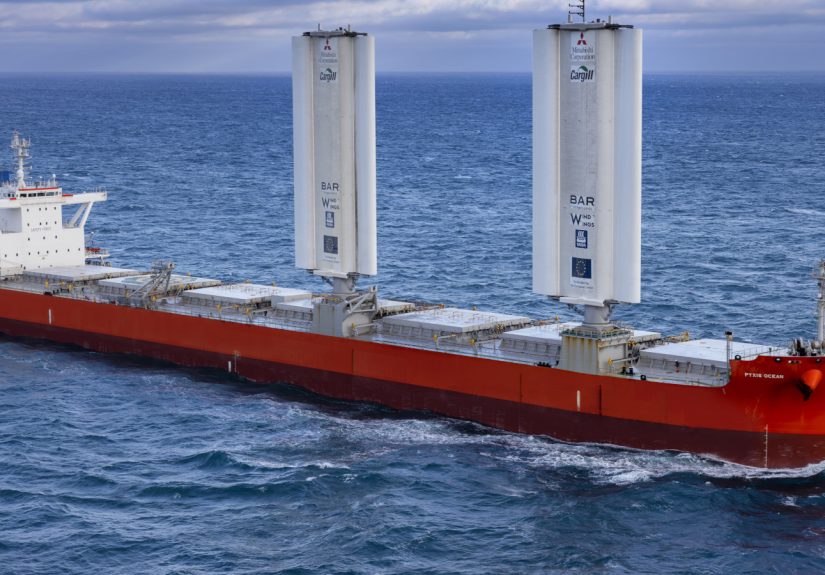
Think airplane wing meets skyscraper. Rigid wing sails use aerodynamic profiles to create lift, which translates into forward thrust. These systems can be very tall, fold for port access, and are optimized using route planning and weather data. They’re especially attractive because they can deliver meaningful fuel savings on suitable routes without changing the ship’s core propulsion system.
A well-known example is the WindWings concept used on large bulk carriers. Public reporting and company disclosures around early trials have shown that these wing sails can produce substantial savings, especially in favorable wind conditions. In plain English: when the wind cooperates, the fuel bill notices.
2) Rotor Sails (Flettner Rotors)
Rotor sails are tall spinning cylinders that look a little like minimalist smokestacks from a sci-fi movie. They generate thrust using the Magnus effect: spinning changes airflow around the cylinder, creating a force that helps push the ship forward.
Rotor sails have become one of the most visible wind-assist technologies because they’re relatively mature, increasingly proven, and suitable for a range of vessel types. They also play nicely with retrofits, which is a big deal in an industry where replacing fleets overnight is not exactly on the budget spreadsheet.
3) Suction Wings / eSails
Suction-assisted sails combine aerodynamic wing shapes with airflow control to boost lift and efficiency. These systems can be highly effective on the right route profile and are gaining attention for retrofits and new builds.
If rotor sails are the flashy spinning option, suction wings are the “quietly excellent” engineering solution that shipping nerds get very excited about. (And to be fair, they have good reason.)
4) Kites and Other Wind-Assist Systems
Some systems use large automated kites flown ahead of the vessel to provide supplemental pull. Others focus on aerodynamic optimization and hybrid wind-assist designs. The core principle is the same across all of them: let the wind do part of the work so engines do less.
Do Giant Sails Really Save Fuel? YesBut the Fine Print Matters
The short answer: yes, giant sails can absolutely save fuel on cargo ships. The more useful answer: savings vary based on route, ship type, weather, speed, vessel loading, sail configuration, and how well the system is integrated with voyage planning.
Recent industry reporting has cited real-world wind-assist fuel savings in the single digits to low double digits, with higher savings possible under favorable conditions. DNV-referenced figures reported by Reuters note that wind-assisted propulsion systems are already delivering fuel savings of up to 20%, with potential for more depending on vessel and technology type.
The Pyxis Ocean trial helped move this conversation from “interesting concept” to “show me the numbers.” Public coverage of the vessel’s WindWings trial described average fuel savings in moderate weather and significantly higher savings in optimal conditions, demonstrating exactly what operators need to see: measurable performance, not just pretty renderings.
In other words, giant sails don’t turn a cargo ship into a zero-emission clipper ship. They make an engine-powered vessel more efficient. That distinction matters, and it’s also why this technology is so useful: efficiency gains are bankable.
Why This Helps the Planet (and the Shipping Company’s CFO)
Lower Fuel Burn Means Lower CO2 Emissions
The environmental logic is refreshingly straightforward. Burn less fuel, emit less CO2. For shipping companies facing carbon pricing, emissions intensity rules, or corporate climate targets, every ton of fuel saved has operational and financial value.
Wind-assist systems are especially compelling because they can reduce emissions without waiting for full-scale alternative fuel supply chains to mature. That makes them a practical bridge strategyone that may remain valuable even after low-carbon fuels scale, because reducing energy demand is useful in every scenario.
Better Compliance Positioning
The regulatory environment is tightening. IMO strategy targets, fuel-intensity standards, and emissions pricing mechanisms are pushing shipowners to adopt both fuel and efficiency solutions. Wind-assist propulsion can help improve a vessel’s emissions profile and reduce exposure to future compliance costs.
Put differently: if your ship can reach the same destination while burning less fuel, you’re not just greeneryou’re less vulnerable to policy shocks and fuel-price mood swings.
Operational Resilience
Fuel markets are volatile. Anyone budgeting marine fuel costs knows they can behave like a cat on espresso. Wind is also variable, of course, but wind-assist systems are supplemental. They don’t require ship operators to “bet the ship” on weather. Instead, they provide optional thrust that lowers engine demand when conditions are favorable.
That creates a useful hedge: better efficiency when possible, no dramatic breakdown of operations when winds are weak.
What Giant Sails Can’t Do (Because This Is a Blog, Not a Fairy Tale)
Wind-assist cargo sails are promising, but they’re not a universal solution for every vessel and every trade lane.
They Depend on Route and Weather
A ship on a wind-friendly route with smart voyage planning may see excellent results. Another vessel on a different route may see smaller gains. That doesn’t mean the technology failed. It means shipping is a real-world system, not a lab simulation.
They Require Deck Space and Integration Planning
Giant sails take up space, affect deck layouts, and must be designed around loading operations, visibility, safety systems, and port constraints. Retrofitting a vessel is possible, but it isn’t the same as installing a phone app.
They Don’t Replace the Need for Cleaner Fuels
Even strong wind-assist performance does not eliminate the need for broader maritime decarbonization measures. The industry will still need cleaner fuels, better operational practices, improved port coordination, and continued vessel efficiency upgrades.
Think of giant sails as a force multiplier. They make other decarbonization pathways easier by cutting total energy demand.
Why Adoption Is Growing Now
Timing matters. Wind-assist propulsion has existed in various forms for years, but several factors are making this the moment when adoption looks much more serious:
- Regulatory pressure: emissions targets and carbon pricing are turning efficiency into a boardroom priority.
- Better data: shipowners now expect validated performance data, and more case studies are arriving.
- Maturing technology: automation, controls, materials, and integration tools have improved dramatically.
- Retrofit potential: operators don’t have to wait for an entirely new fleet cycle.
- Portfolio thinking: companies increasingly view decarbonization as a stack of solutions, not a single silver bullet.
Industry reporting has also highlighted a growing orderbook for wind-assisted systems, which is often the clearest signal that shipowners believe this is more than a headline trend. Once operators start ordering at scale, the conversation shifts from “Can it work?” to “How fast can we deploy it where it makes sense?”
How Shipping Companies Should Evaluate Wind-Assist Sails
If you’re a shipowner, operator, charterer, or fleet planner, the right question isn’t “Are sails good?” It’s “Are sails good for this vessel on this route under these constraints?”
Key Evaluation Questions
- Route wind profile: Is there enough favorable wind on the vessel’s typical voyages?
- Vessel type and deck geometry: Can the ship safely accommodate the system?
- Speed profile and charter requirements: Will operating patterns allow savings to materialize?
- Port and bridge constraints: Can the sails fold or clear height limitations?
- Fuel price and carbon cost exposure: How valuable is each percentage of fuel savings?
- Maintenance and training needs: What changes are required for crew and technical management?
- Data verification: Are projected savings backed by credible modeling and measured results?
The winners in this space likely won’t be the companies with the fanciest press release. They’ll be the ones that match the right wind technology to the right vessel and track performance honestly.
The Big Picture: Wind-Assist Sails Are a Smart “Now” Solution
Shipping decarbonization is often framed like a dramatic showdown between future fuelsammonia vs. methanol vs. hydrogen vs. biofuels vs. whatever your panel discussion sponsor is selling. But while that debate continues, energy efficiency remains the most immediate, least philosophical way to cut emissions.
Giant sails fit that reality perfectly. They don’t ask the industry to wait for perfect infrastructure. They reduce fuel use on ships that are sailing today. They complement route optimization, hull improvements, and cleaner fuels. And they bring a bit of common sense back into the conversation: if there’s free energy moving across the ocean, maybe use some of it.
So yes, giant sails actually help cargo ships save fueland the planet in turn. Not because they’re romantic. Because they’re practical.
Experience Section: What This Looks Like in Practice (500+ Words)
Below are realistic, composite experiences based on public reporting, industry case studies, and how commercial shipping teams typically evaluate and operate efficiency technologies. They’re written in a human, on-the-ground style because spreadsheets rarely capture what adoption feels like.
1) The Operations Manager Who Stopped Rolling His Eyes
“I’ll be honest,” says a fictionalized operations manager at a dry-bulk company, “when the engineering team first pitched giant sails, I thought we were one step away from parrots and treasure maps.” His job is route schedules, charter commitments, and minimizing delaysnot starring in a sustainability marketing video.
The attitude changed when the team started reviewing voyage data instead of renderings. They looked at route-specific weather patterns, engine load profiles, and fuel consumption on comparable voyages. The big shift wasn’t the maximum projected savings number; it was the consistency of incremental savings across multiple legs. “You stop thinking in terms of one dramatic headline and start thinking in terms of annual fuel budgets,” he says. “Then the math gets very interesting.”
He also noticed a subtle cultural change: once crews and shore teams saw that the system was automated and integrated into normal operations, resistance dropped. “The first question was, ‘Will this complicate our lives?’ The second question, after a few voyages, was, ‘Can we do this on more vessels?’ That’s when you know it’s becoming operational, not experimental.”
2) The Chief Engineer Who Loves Any Technology That Burns Less Fuel
A composite chief engineer describes wind-assist more pragmatically than poetically: “If the main engine can do less work for part of the trip, that’s useful. Full stop.” He’s less interested in branding terms and more interested in what happens in heavy weather, during maintenance cycles, and when the ship is on a tight schedule.
His experience is that the best results come when wind-assist is paired with disciplined operations: hull cleaning, smart speed management, and voyage planning. “Some people expect sails alone to transform everything. That’s not how ships work. But if you layer efficiencies, the total impact becomes significant.”
He also points out a very human factor: confidence. “Crews trust systems when they behave predictably and don’t create nonsense work. If controls are stable, support is responsive, and the performance data makes sense, crew buy-in grows quickly.” In his words, that’s worth almost as much as the hardware, because a technology that looks great on paper but irritates the crew tends to become expensive deck art.
3) The Chartering Team’s New Favorite Question
A chartering analyst at a composite shipping company says customers increasingly ask about emissions intensity, not just freight rates and availability. “A few years ago, decarbonization talk mostly lived in ESG reports. Now it shows up in commercial conversations.”
Wind-assist gave the team something concrete to discuss. Not a future promise. A current efficiency measure with voyage-level implications. “We’re still careful not to overpromise because wind varies,” the analyst says, “but customers respond well when you can explain the technology, the expected range, and how it fits into broader efficiency upgrades.”
The biggest surprise was internal: finance teams started treating wind-assist less like a branding expense and more like a performance asset. “Once carbon costs and compliance risk enter the picture, fuel savings have a second and third value stream.” In other words, the sails are helping sell not just greener shipping, but smarter shipping.
4) The Port Planner’s Perspective
A composite port and terminal planner notes that wind-assist systems force better coordination across the value chain. Questions about air draft, berth operations, loading windows, and maneuvering constraints must be addressed early. “That’s not a drawback,” she says. “That’s good planning.”
Her team found that projects moved faster when shipowners involved ports sooner and treated them as partners instead of late-stage signoff checkpoints. “The successful deployments were the ones where everyone talked through practical issues before installation. It turned a ‘cool technology’ discussion into an operational readiness discussion.”
Her summary is probably the best one-liner in this entire topic: “The sails matter, but the system around the sails matters more.” And that’s the real lesson from the early wave of wind-assisted cargo shippingtechnology wins when operations are ready to let it.
Conclusion
Giant sails on cargo ships are no longer a quirky idea for conference slides. They are a practical fuel-saving and emissions-cutting tool that can be deployed now, especially when matched carefully to route profiles and vessel design. As shipping faces tighter climate rules, higher efficiency expectations, and long timelines for fuel transitions, wind-assist propulsion gives operators something rare: a solution that is both old in principle and modern in performance.
The future of shipping won’t be powered by sails alonebut it will almost certainly include them.